Strategy Bitcoin treasury hits breakeven point as BTC price passes $77K

cointelegraphPublished on 2026-08-21Last updated on 2026-08-21

Abstract

Bitcoin surged above $77,000, marking its highest level since May and pushing Strategy's corporate treasury of 840,447 BTC back into profitability. The price move above Strategy's average cost basis of $75,385 has yielded an estimated $450 million year-to-date gain. Despite recent concerns after Strategy sold a small portion of its holdings for stock repurchases, analysts note the price recovery has alleviated fears about the company's investment strategy. On-chain data reveals a significant new support zone, with approximately 11% of Bitcoin's supply acquired between $58,000 and $67,000 over the past 11 weeks, creating a potential floor below current prices. The rally also saw BTC reclaim its 200-day moving average, a key technical milestone for ending the longer-term downtrend.


Bitcoin (BTC) hit $77,000 on Friday as business intelligence company Strategy’s corporate treasury returned to profit.


Key points:


  • Bitcoin reaches its highest level since May 26 as it revisits $77,000.
  • Price returns above the cost basis for Strategy’s BTC corporate treasury at $75,385.
  • Around 11% of the BTC supply constitutes a new band of support below $68,000.


Strategy out of the red with Bitcoin at highest since May


Data from TradingView showed new local highs above $77,400 prior to the week’s final Wall Street open.
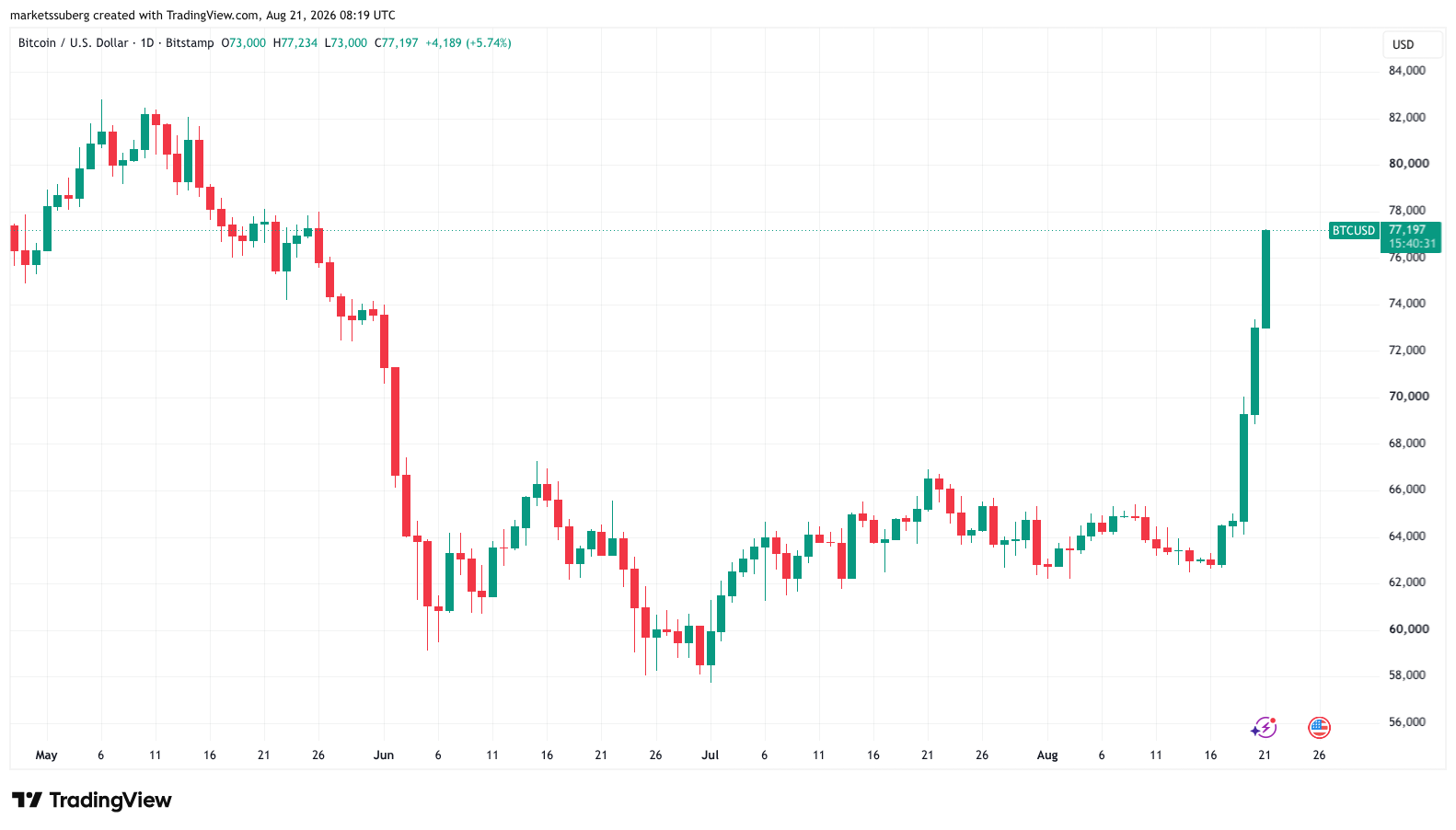

BTC/USD one-day chart. Source: Cointelegraph/TradingView


Now up around 20% in 48 hours, BTC/USD saw little by way of consolidation as it reclaimed a key level for Strategy, the world’s largest corporate Bitcoin treasury company. Data from monitoring resource BitcoinTreasuries puts the cost basis for Strategy’s holdings of 840,447 BTC at $75,385, currently with a year-to-date gain of approximately $450 million.
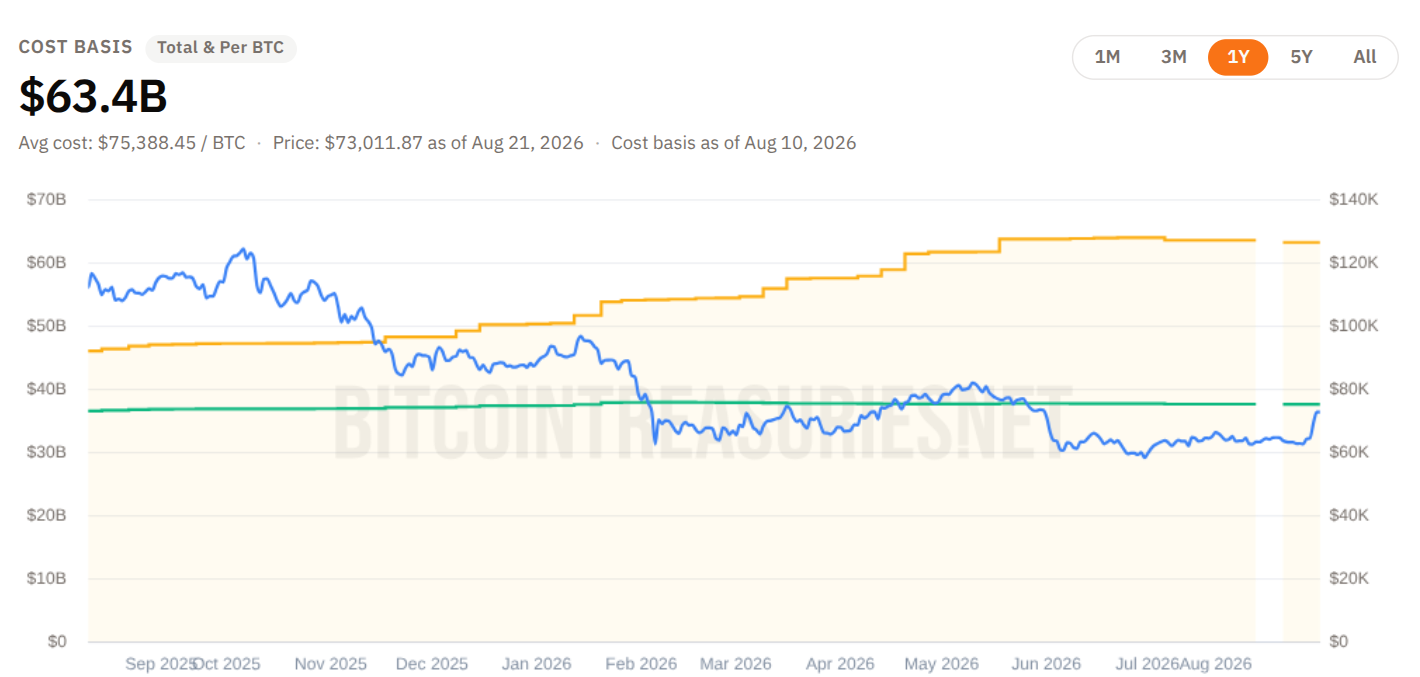

Strategy Bitcoin treasury cost basis data. Source: BitcoinTreasuries


As Cointelegraph reported, between Aug. 3 and Aug. 9, Strategy opted to sell a small portion of its treasury worth 1,690 BTC to repurchase 1.15 million shares of its STRC preferred stock for $108.6 million. The move represented the company’s fourth Bitcoin sale of 2026.


Concerns over the long-term viability of the company’s Bitcoin investment thesis accompanied the sales, something that the subsequent BTC price run-up should help alleviate, independent crypto analyst William Clemente suggested.


“Not only should Saylor/Strategy fears have been abated for a while once he showed that he was willing to sell BTC to rebuy STRC, but now after this price impulse they are even more over-collateralized by their BTC holdings,” he wrote on X, referring to former CEO Michael Saylor.


In an interview with Fox News earlier in August, current CEO Phong Le stated that Strategy would return to buying Bitcoin before the end of the year.


New BTC buy wall sits below $68,000


Amid misgivings over the durability of Bitcoin’s volatile upside move, analysis from onchain analytics platform Glassnode revealed a new safety net forming below $70,000.


Related: Bitcoin has ‘largely purged’ froth that preceded 50% drop from $126K: BlackRock


Some 3.44 million BTC now have an onchain cost basis, also known as realized price, between $58,000 and $67,000. Of this, 2.23 million BTC — equal to around 11% of the total supply — was added over the past 11 weeks.


“It’s the densest cost-basis cluster below spot — a key potential support zone on any retracement,” Glassnode cofounder Rafael Schultze-Kraft commented on X.
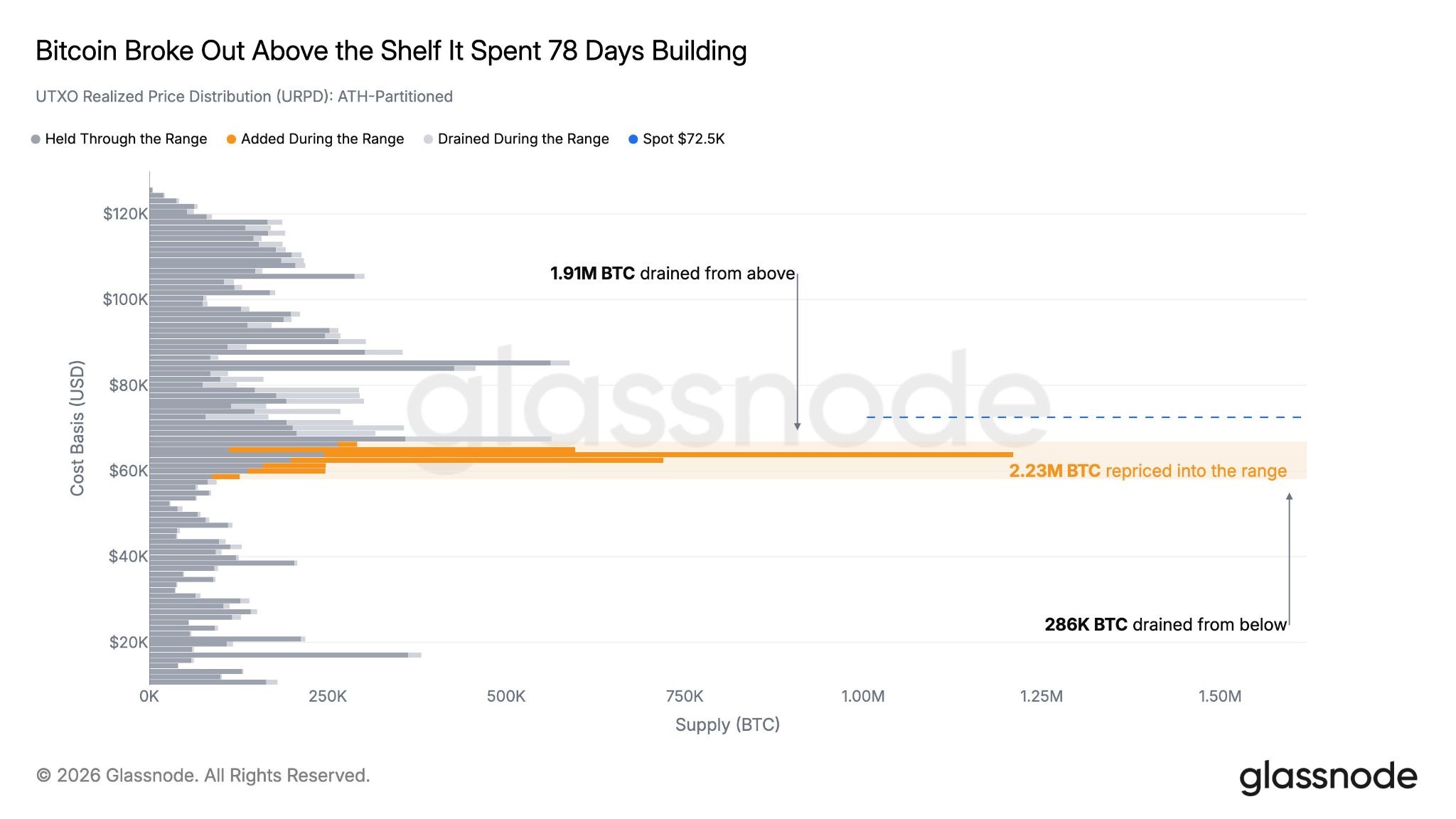

Bitcoin UTXO realized price distribution data. Source: Rafael Schultze-Kraft on X.com


BTC/USD broke through several key resistance levels this week, including its 200-day simple moving average (SMA) at $68,967, a key target to reclaim to end the long-term BTC price downtrend.



Trending Cryptos

Related Questions

QAt what price did Bitcoin hit that allowed Strategy's corporate treasury to return to profit?

ABitcoin hit $77,000, which is above Strategy's BTC treasury cost basis of $75,385, returning the company's holdings to profit.

QWhat was the key action Strategy took regarding its Bitcoin treasury between August 3rd and 9th, 2026?

ABetween August 3rd and 9th, 2026, Strategy sold 1,690 BTC to repurchase 1.15 million shares of its STRC preferred stock for $108.6 million.

QAccording to the article, what does the new 'buy wall' or support zone for Bitcoin consist of?

AA new support zone for Bitcoin is forming below $70,000, specifically a cluster of 3.44 million BTC with an onchain cost basis between $58,000 and $67,000. 2.23 million BTC, roughly 11% of the total supply, was added to this zone in the past 11 weeks.

QWhat significant technical price level did Bitcoin reclaim this week according to the article?

ABitcoin reclaimed its 200-day simple moving average (SMA) at $68,967 this week, which is seen as a key target for ending the long-term price downtrend.

QWhat did current Strategy CEO Phong Le state regarding the company's future Bitcoin purchases?

AIn an interview with Fox News in August, current Strategy CEO Phong Le stated that the company would return to buying Bitcoin before the end of the year.

Related Reads

Alexander Shokhin: Business Needs an Interest Rate Below 10% and the Dollar at 90-95 Rubles

Alexander Shokhin, head of the Russian Union of Industrialists and Entrepreneurs (RSPP), has advocated for potentially using "non-market" tools to keep the ruble within a target exchange rate corridor. This, he argues on August 21, would help avoid excessive volatility, though he called the topic a separate discussion. Shokhin had previously raised the idea of a currency corridor in late May, noting the ruble's current exchange rate is not fully market-driven due to a limited currency segment and reduced foreign currency demand. He stated that many business community colleagues propose fixing a corridor, even through non-market methods, to ensure predictability. The business community's key targets, as outlined by Shokhin in late December 2025, are a Central Bank key rate of 12%, inflation of 4–5%, and a US dollar exchange rate of 90–95 rubles by the end of 2026. A turning point for investment, he said, would be lowering the rate to 12% with 6% inflation, though truly comfortable business conditions would require a rate below 10%. He stressed the critical importance of currency predictability for corporate investment decisions. From a data analysis perspective, the idea of a ruble corridor is not new. A similar mechanism was used in Russia from 1995 to 1998, where the central bank held the dollar within fixed boundaries through regular interventions. This regime lasted three years before ending abruptly during the 1998 default, illustrating the fragility of rigid targets under external shocks. The macro-economic link is clear: stricter corridors require more reserves to defend against currency pressure. The key unresolved technical aspect is the specific sources and volume of such interventions given the current market's limited liquidity. Whether this discussion remains theoretical or leads to concrete corridor parameters will be seen in the coming months.

cryptonews.ru1h ago

Alexander Shokhin: Business Needs an Interest Rate Below 10% and the Dollar at 90-95 Rubles

cryptonews.ru1h ago

Trading

Spot

Hot Articles

What is $BITCOIN

DIGITAL GOLD ($BITCOIN): A Comprehensive Analysis Introduction to DIGITAL GOLD ($BITCOIN) DIGITAL GOLD ($BITCOIN) is a blockchain-based project operating on the Solana network, which aims to combine the characteristics of traditional precious metals with the innovation of decentralized technologies. While it shares a name with Bitcoin, often referred to as “digital gold” due to its perception as a store of value, DIGITAL GOLD is a separate token designed to create a unique ecosystem within the Web3 landscape. Its goal is to position itself as a viable alternative digital asset, although specifics regarding its applications and functionalities are still developing. What is DIGITAL GOLD ($BITCOIN)? DIGITAL GOLD ($BITCOIN) is a cryptocurrency token explicitly designed for use on the Solana blockchain. In contrast to Bitcoin, which provides a widely recognized value storage role, this token appears to focus on broader applications and characteristics. Notable aspects include: Blockchain Infrastructure: The token is built on the Solana blockchain, known for its capacity to handle high-speed and low-cost transactions. Supply Dynamics: DIGITAL GOLD has a maximum supply capped at 100 quadrillion tokens (100P $BITCOIN), although details regarding its circulating supply are currently undisclosed. Utility: While precise functionalities are not explicitly outlined, there are indications that the token could be utilized for various applications, potentially involving decentralized applications (dApps) or asset tokenization strategies. Who is the Creator of DIGITAL GOLD ($BITCOIN)? At present, the identity of the creators and development team behind DIGITAL GOLD ($BITCOIN) remains unknown. This situation is typical among many innovative projects within the blockchain space, particularly those aligning with decentralized finance and meme coin phenomena. While such anonymity may foster a community-driven culture, it intensifies concerns about governance and accountability. Who are the Investors of DIGITAL GOLD ($BITCOIN)? The available information indicates that DIGITAL GOLD ($BITCOIN) does not have any known institutional backers or prominent venture capital investments. The project seems to operate on a peer-to-peer model focused on community support and adoption rather than traditional funding routes. Its activity and liquidity are primarily situated on decentralized exchanges (DEXs), such as PumpSwap, rather than established centralized trading platforms, further highlighting its grassroots approach. How DIGITAL GOLD ($BITCOIN) Works The operational mechanics of DIGITAL GOLD ($BITCOIN) can be elaborated on based on its blockchain design and network attributes: Consensus Mechanism: By leveraging Solana’s unique proof-of-history (PoH) combined with a proof-of-stake (PoS) model, the project ensures efficient transaction validation contributing to the network's high performance. Tokenomics: While specific deflationary mechanisms have not been extensively detailed, the vast maximum token supply implies that it may cater to microtransactions or niche use cases that are still to be defined. Interoperability: There exists the potential for integration with Solana’s broader ecosystem, including various decentralized finance (DeFi) platforms. However, the details regarding specific integrations remain unspecified. Timeline of Key Events Here is a timeline that highlights significant milestones concerning DIGITAL GOLD ($BITCOIN): 2023: The initial deployment of the token occurs on the Solana blockchain, marked by its contract address. 2024: DIGITAL GOLD gains visibility as it becomes available for trading on decentralized exchanges like PumpSwap, allowing users to trade it against SOL. 2025: The project witnesses sporadic trading activity and potential interest in community-led engagements, although no noteworthy partnerships or technical advancements have been documented as of yet. Critical Analysis Strengths Scalability: The underlying Solana infrastructure supports high transaction volumes, which could enhance the utility of $BITCOIN in various transaction scenarios. Accessibility: The potential low trading price per token could attract retail investors, facilitating wider participation due to fractional ownership opportunities. Risks Lack of Transparency: The absence of publicly known backers, developers, or an audit process may yield skepticism regarding the project's sustainability and trustworthiness. Market Volatility: The trading activity is heavily reliant on speculative behavior, which can result in significant price volatility and uncertainty for investors. Conclusion DIGITAL GOLD ($BITCOIN) emerges as an intriguing yet ambiguous project within the rapidly evolving Solana ecosystem. While it attempts to leverage the “digital gold” narrative, its departure from Bitcoin's established role as a store of value underscores the need for a clearer differentiation of its intended utility and governance structure. Future acceptance and adoption will likely depend on addressing the current opacity and defining its operational and economic strategies more explicitly. Note: This report encompasses synthesised information available as of October 2023, and developments may have transpired beyond the research period.

2.0k Total ViewsPublished 2025.05.13Updated 2025.05.13

What is $BITCOIN

Discussions

Welcome to the HTX Community. Here, you can stay informed about the latest platform developments and gain access to professional market insights. Users' opinions on the price of BTC (BTC) are presented below.

活动图片