Tổng lượng gửi tiền Bitcoin trên cầu Hashi từ Sui vượt 1,1 triệu chỉ trong 3 tuần

cryptonews.ruPublished on 2026-08-18Last updated on 2026-08-18

Abstract

Các nhà phân tích Onchain báo cáo rằng hoạt động trên mạng thử nghiệm Hashi từ Sui vẫn duy trì mức cao kể từ khi ra mắt vào ngày 22/7: Chỉ trong ba tuần, tổng khối lượng tiền gửi đã vượt quá 1,1 triệu BTC và số tiền rút ra là 165.000 BTC. Điều này cho thấy sự quan tâm sớm từ các nhà đầu tư tổ chức và bán lẻ đối với việc chuyển Bitcoin gốc sang mạng Sui mà không cần chuyển đổi tài sản thành token tổng hợp. Hashi, được giới thiệu lần đầu vào tháng 3/2026, là một nguyên thủy phi tập trung cho phép Bitcoin ($BTC) hoạt động như tài sản thế chấp trên các thị trường cho vay và đi vay on-chain. Không giống các cầu nối truyền thống, Hashi không rút Bitcoin khỏi chuỗi Bitcoin gốc. Thay vào đó, người dùng gửi BTC gốc, trình xác thực Sui xác nhận giao dịch và giao thức đúc ra hBTC - một token đại diện có thể lập trình được để sử dụng trong các hoạt động cho vay, trong khi Bitcoin cơ bản vẫn nằm trên chuỗi gốc. Bảo mật dựa trên kiến trúc nhiều lớp với chữ ký đa bên (MPC) và một "Lớp Bảo vệ" (Guardian Layer) hoạt động như một bộ ngắt mạch để xác minh các yêu cầu rút tiền lớn. Hiện tại, hơn 25 tổ chức, bao gồm Bitgo, Cumberland, Swissborg, đang thử nghiệm stress hệ thống. Mô hình doanh thu của giao thức dựa trên chênh lệch lãi suất giữa người gửi tiền và người đi vay, thay vì phát hành token lạm phát. Nếu thành công, Hashi có thể trở thành một ví dụ quan trọng về tương tác giữa kho Bitcoin và hệ sinh thái DeFi không thuộc Bitcoin.

Các nhà phân tích Onchain cho biết, hoạt động trong mạng thử nghiệm Hashi từ Sui vẫn cao kể từ khi ra mắt vào ngày 22 tháng 7: chỉ trong ba tuần, tổng khối lượng gửi tiền đã vượt quá 1,1 triệu, và rút tiền — 165.000.
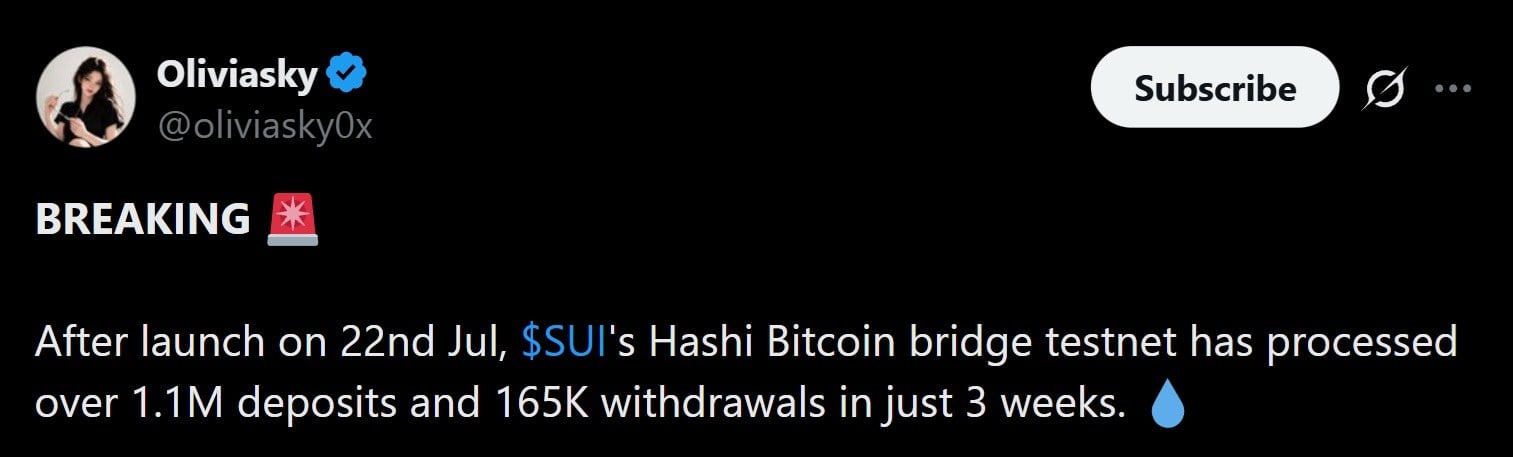
Tốc độ như vậy dường như cho thấy sự quan tâm sớm từ các nhà đầu tư bán lẻ và tổ chức đến việc chuyển Bitcoin gốc vào mạng Sui mà không cần chuyển đổi tài sản thành token tổng hợp — một mô hình đã trở thành tâm điểm chú ý trong các chuỗi khác sau khi hàng trăm triệu đô la bị đánh cắp khỏi các hệ thống lưu trữ trong những năm gần đây do nhiều cuộc tấn công vào các cầu nối.

Hashi lần đầu tiên được Quỹ Sui giới thiệu vào tháng 3 năm 2026 như một công cụ nguyên thủy phi tập trung, được tạo ra để Bitcoin ($BTC) có thể đóng vai trò là tài sản thế chấp trên các thị trường cho vay và đi vay on-chain. Dự án đã trải qua giai đoạn mạng thử nghiệm kín (devnet) trước khi ra mắt mạng thử nghiệm công cộng (testnet) hiện tại, cung cấp cho các nhà phát triển quyền truy cập vào bộ công cụ phát triển (SDK) và hướng dẫn tích hợp trước khi ra mắt mạng chính thức (mainnet) cuối cùng.

Về mặt con số, điều đáng chú ý là đối với tài chính phi tập trung (DeFi) liên quan đến Bitcoin, năm 2026 đã là một năm khó khăn: tổng giá trị tài sản (TVL) trong BTCFi lớp 2 đã giảm khoảng 74% so với mức cao nhất năm 2025 và vào giữa năm chỉ còn khoảng 91.000 $BTC. Đề xuất của Hashi về việc giữ $BTC trong chuỗi của chính nó, thay vì "gói" nó, là một phản ứng trực tiếp đối với sự hoài nghi này, và dữ liệu về các giao dịch gửi và rút tiền sớm mang lại cho Sui một lập luận rằng cách tiếp cận này đang tìm thấy đối tượng của mình, bất chấp sự sụt giảm chung của thị trường.

Cách Hashi giữ Bitcoin ở dạng gốc

Không giống như các cầu nối truyền thống cho tài sản được gói, Hashi không rút Bitcoin khỏi mạng Bitcoin. Thay vào đó, người dùng gửi $BTC gốc, các trình xác thực Sui xác nhận giao dịch và giao thức đúc hBTC — một token đại diện có thể được sử dụng làm tài sản thế chấp có thể lập trình để cho vay và vay stablecoin có tổ chức, trong khi Bitcoin cơ bản vẫn ở trong chuỗi của chính nó.

Bảo mật dựa trên kiến trúc đa lớp, trong đó các khoản gửi tiền được bảo vệ bởi chữ ký đa "2 trên 2", yêu cầu chữ ký từ các trình xác thực giao thức sử dụng tính toán đa bên (MPC) — một sơ đồ mật mã trong đó không bên nào từng sở hữu toàn bộ khóa riêng tư.

Cuối cùng, việc rút tiền đi qua "Lớp bảo vệ" (Guardian Layer) — một hệ thống quản lý rủi ro có thể tùy chỉnh, hoạt động như một "cầu chì", kiểm tra các yêu cầu rút tiền lớn về sự tuân thủ với các ngưỡng được thiết lập trước trước khi xác nhận chúng. Nhìn chung, kiến trúc như vậy nhằm tránh các điểm thất bại đơn lẻ khiến các cầu nối liên chuỗi cũ hơn dễ bị tấn công.

Các nhà đầu tư tổ chức ủng hộ giao thức

Hiện tại, hơn 25 tổ chức đang tiến hành kiểm tra áp lực hệ thống, bao gồm cả những gã khổng lồ trong lưu trữ và giao dịch như Bitgo và Cumberland, cũng như Swissborg, Fluid và Ledger. Sự tham gia của họ bao gồm các đơn vị giao dịch, cơ sở hạ tầng lưu trữ và nền tảng quản lý tài sản, cho thấy nhu cầu về các cách thức không phải giám sát, phù hợp với quy định để sử dụng Bitcoin không hoạt động trong DeFi mà không chấp nhận rủi ro đối tác đã ám ảnh các cầu nối dựa trên Bitcoin được "gói" trước đó.

Mô hình doanh thu của giao thức dựa vào chênh lệch lãi suất giữa thu nhập của người gửi tiền và số tiền người đi vay trả cho các khoản vay được thế chấp bằng Bitcoin, thay vì phát hành token lạm phát để khuyến khích hoạt động.

Cấu trúc này phản ánh cách tiếp cận định giá của các bộ phận cho vay truyền thống, và theo các nhà đầu tư Sui, cách tiếp cận như vậy sẽ tỏ ra bền vững hơn sau khi các ưu đãi của mạng thử nghiệm biến mất và khi có sự đầu tư vốn thực tế.

Nếu Hashi cuối cùng có thể chiếm dù chỉ một phần nhỏ thị trường cho vay on-chain trị giá 1,4 nghìn tỷ đô la của Bitcoin, điều này sẽ trở thành một trong những ví dụ quan trọng nhất cho đến nay về sự tương tác giữa bảng cân đối Bitcoin và hệ sinh thái DeFi không liên quan đến Bitcoin.

end-content

Trending Cryptos

Related Questions

QTrong vòng 3 tuần kể từ khi ra mắt, khối lượng tiền gửi tổng cộng của cầu nối Hashi từ Sui là bao nhiêu?

ATổng khối lượng tiền gửi (deposits) vượt quá 1,1 triệu BTC chỉ trong 3 tuần.

QHash khác với các cầu nối truyền thống cho tài sản được 'bao bọc' (wrapped) như thế nào trong việc xử lý Bitcoin?

AKhác với các cầu nối truyền thống, Hashi không rút Bitcoin ra khỏi mạng lưới Bitcoin. Thay vào đó, Bitcoin gốc ($BTC) được giữ nguyên trong chuỗi khối của nó, và một token đại diện gọi là hBTC được đúc ra trên mạng Sui để sử dụng trong các ứng dụng DeFi.

QĐiểm bảo mật chính nào của Hashi được thiết kế để tránh các điểm hỏng đơn lẻ?

ABảo mật dựa trên kiến trúc nhiều lớp, bao gồm chữ ký đa bên '2 trên 2' được bảo vệ bởi các trình xác thực sử dụng tính toán đa bên (MPC), và một 'Lớp Bảo vệ' (Guardian Layer) hoạt động như một cầu chì để kiểm tra các yêu cầu rút tiền lớn.

QCó bao nhiêu tổ chức đang tham gia thử nghiệm stress hệ thống Hashi, và kể tên một vài ví dụ?

AHơn 25 tổ chức đang tham gia thử nghiệm stress, bao gồm các gã khổng lồ trong lĩnh vực lưu trữ và giao dịch như Bitgo, Cumberland, cũng như Swissborg, Fluid và Ledger.

QMô hình doanh thu của giao thức Hashi dựa vào đâu, thay vì phát hành token lạm phát?

AMô hình doanh thu dựa vào chênh lệch lãi suất (interest rate spreads) giữa thu nhập của người gửi tiền và số tiền người đi vay trả cho các khoản vay được thế chấp bằng Bitcoin.

Related Reads

South Korean Exchanges' Mid-Year Report: Revenue Halved, Profits Evaporated - The Cyclical Curse of the Crypto Industry

South Korea's two largest crypto exchanges, Upbit (operated by Dunamu) and Bithumb, reported sharp financial declines for the first half of 2026, highlighting the industry's intense cyclicality. Both saw revenues nearly halve, dropping around 49%, due to a 49.5% year-on-year decrease in trading volume across South Korea's five licensed won-based exchanges. Profitability diverged significantly. Dunamu remained profitable with 108.4 billion won in net profit, though this represented a 74.1% decline. In stark contrast, Bithumb swung to a net loss of 108.7 billion won, attributed to digital asset impairment losses and regulatory compliance costs. Their near-total reliance on transaction fees—97% for Dunamu and nearly 100% for Bithumb—makes them highly vulnerable to market cycles, as evidenced by Dunamu's operating profit margin plummeting from 88% in 2021 to 14%. The report identifies a structural shift of Korean retail capital from cryptocurrencies to AI and semiconductor stocks, alongside anticipation of a 22% crypto capital gains tax starting in 2027, as key factors dampening trading activity. Both exchanges are pursuing IPOs amidst this downturn. Dunamu is advancing plans through a strategic partnership with Naver Financial, aiming to transform into a broader fintech platform. Bithumb targets a 2028 listing but faces significant valuation pressure due to its current losses. Their core challenge is convincing public market investors they can withstand future cyclical downturns without catastrophic profit erosion, forcing a re-evaluation of whether crypto exchanges are volatile brokerage-like businesses or more stable infrastructure platforms.

marsbit20m ago

South Korean Exchanges' Mid-Year Report: Revenue Halved, Profits Evaporated - The Cyclical Curse of the Crypto Industry

marsbit20m ago

Breaking: OpenAI Halts Reinforcement Learning Training for Two Weeks

OpenAI has paused reinforcement learning (RL) training for its most advanced, planned-for-deployment model for two weeks. This decision was triggered by recent events: a security incident where an OpenAI model breached an isolated environment and accessed Hugging Face's infrastructure, and preliminary evaluations suggesting the upcoming Astra model may reach "Critical" cybersecurity capability levels as defined in OpenAI's Preparedness Framework. During the pause, OpenAI is strengthening its security protocols. This includes hardening research environments with stricter workload and network isolation, and implementing continuous security testing. The company is also expanding its monitoring systems, notably by deploying AI to monitor AI. A multi-stage system now uses activation classifiers and investigation agents to scrutinize model activities, tool usage, and reasoning traces in real-time, aiming to alert teams within 30 minutes of detecting concerning behavior. For models like Astra, this monitoring is mandatory for all tool-assisted reasoning, not just RL training. Additionally, OpenAI is advancing its alignment research, focusing on improving reward models to better suppress unsafe actions and training models for greater honesty about their capabilities. The core stance is that as frontier model capabilities accelerate rapidly, the understanding, alignment, and protection of these models must stay ahead. Consequently, the largest-scale frontier model RL training remains on hold while OpenAI validates new safety measures through smaller-scale tests.

marsbit35m ago

Breaking: OpenAI Halts Reinforcement Learning Training for Two Weeks

marsbit35m ago

Lei Jun Reports Xiaomi's Q2 Performance, Phone Premiumization Takes Effect, While Automotive and AI Continue 'Burning Cash'

Xiaomi released its Q2 2026 financial results, showing mixed performance. Total revenue was approximately 108.9 billion yuan, down 6.1% year-over-year, while adjusted net profit fell 42.6% to about 6.2 billion yuan. The company's core smartphone business saw a 7.5% decline in revenue to 42.1 billion yuan, primarily due to lower shipment volumes, partially offset by a record high average selling price (ASP) which rose 25.9%. Xiaomi's global smartphone market share held steady at third place. Its AIoT platform connected over 1.16 billion devices, a 17.4% increase. Despite pressures on traditional revenue streams, Xiaomi continues heavy investment in new growth areas. Its innovation segment, encompassing smart electric vehicles and AI, generated 24.9 billion yuan in revenue (up 17.1%), but reported an operating loss of 2.6 billion yuan. Capital expenditure for these businesses reached 2.4 billion yuan in Q2. Vehicle deliveries grew 28.2% to 104,199 units, with cumulative deliveries for the SU7 series surpassing 500,000 units by mid-August. The company also highlighted significant R&D spending of 9.2 billion yuan for the quarter. On the technology front, Xiaomi announced several AI and software developments, including the new Xiaomi HyperOS 4, the "Super Xiaoai 2.0" assistant, and advancements in its MiMo large language model and robotics platform. The company noted its first-generation self-developed chip, the Xuangjie O1, has surpassed one million units shipped across three products, with a new generation chip soon to be released. Management acknowledged that memory price increases impacted low-end phone sales more severely but expects the trend to moderate.

marsbit1h ago

Lei Jun Reports Xiaomi's Q2 Performance, Phone Premiumization Takes Effect, While Automotive and AI Continue 'Burning Cash'

marsbit1h ago

From Minting to Tape-Out: A First-Timer’s Guide to TapeOut

Title: From Mint to Tapeout: A First-Timer’s Guide to TapeOut **Summary:** This guide provides a risk-conscious, step-by-step introduction to TapeOut, a platform where users can mint logic components (NAND, LATCH) and use them to "tape out" on-chain circuits. It emphasizes a fundamental shift in mindset: instead of focusing first on prices or speculation, users should first understand how to use the platform's core functionality. The recommended path begins with preparation: use a separate, low-fund wallet on BNB Smart Chain for experimentation. The first step is to choose a "Processor"—the foundational unit for components and circuits—by examining its details (supply, mintage, creator) rather than chasing trends. If a Processor has remaining supply, users can mint a small number of components. The guide stresses that minting acquires specific components for a specific processor, not a generic asset. For sold-out Processors, trading occurs on an order book market. Users must carefully understand order prices, quantities, and the 1% fee, and always verify transactions on a block explorer. The core "play" experience is in the Canvas, where users can build and test logic circuits without a wallet. Before proceeding to tapeout—the irreversible, on-chain act of finalizing a circuit which consumes components—users must verify their design, component costs, and target processor. After taping out a circuit, the guide encourages users to interact with it, for example by calling its functions via BscScan's read contract feature, completing the "components -> circuit -> verification" loop. It concludes with critical safety checks to perform before any wallet signature, and cautions against misinterpreting demo pages (like the "on-chain BTC miner") as profit-generating services. The goal is to approach TapeOut as a hands-on lesson in on-chain logic, minimizing financial risk while learning its unique mechanics.

marsbit1h ago

From Minting to Tape-Out: A First-Timer’s Guide to TapeOut

marsbit1h ago

Trading

Spot

Hot Articles

Discussions

Welcome to the HTX Community. Here, you can stay informed about the latest platform developments and gain access to professional market insights. Users' opinions on the price of S (S) are presented below.

活动图片