Glassnode: Consumer Confidence Falls as AI-Related Stocks Rise, Bitcoin Lags Behind

cryptonews.ruPublished on 2026-08-17Last updated on 2026-08-17

Abstract

According to Glassnode, consumer confidence remains at one of its lowest levels in a decade, despite two consecutive months of improvement. This has not stopped households from moving money out of cash, as they expect further cost-of-living increases and a broader economic slowdown. The key question is where this capital is flowing. US stocks hit a new all-time high in early August, primarily driven by trading in AI-related stocks rather than a broad market rally. Bitcoin, historically seen as a hedge against declining trust in traditional finance, has not participated in this movement. Spot Bitcoin ETFs saw outflows of $389.7 million in one week, coinciding with rising equity markets—a divergence that aligns with Glassnode's data on capital flows. Bitcoin is currently trading at roughly half its October 2025 peak, stuck in a narrow range. Meanwhile, AI-related trading continues to attract fresh capital from retail traders, hedge funds, and even crypto-native institutional investors, who are redirecting funds into AI stocks and tokens. The macroeconomic backdrop has not been hostile to Bitcoin, with core inflation at a moderate 2.5% in July. However, Bitcoin's muted response to favorable inflation data is seen as a concerning signal, given its supposed role as a hedge against currency debasement. Spot Bitcoin exchange trading volume has fallen to its lowest since 2019, and recent ETF inflows are only a "fraction of any prior accumulation wave," suggesting institutional buy...

According to Glassnode's assessment, the level of consumer confidence remains "among the lowest levels in the past decade," even after two consecutive months of improvement. This weakness has not stopped households from moving funds from cash into assets, as consumers still expect the cost of living to rise further and overall economic growth to slow. However, the intrigue still lies in where exactly this capital is flowing.
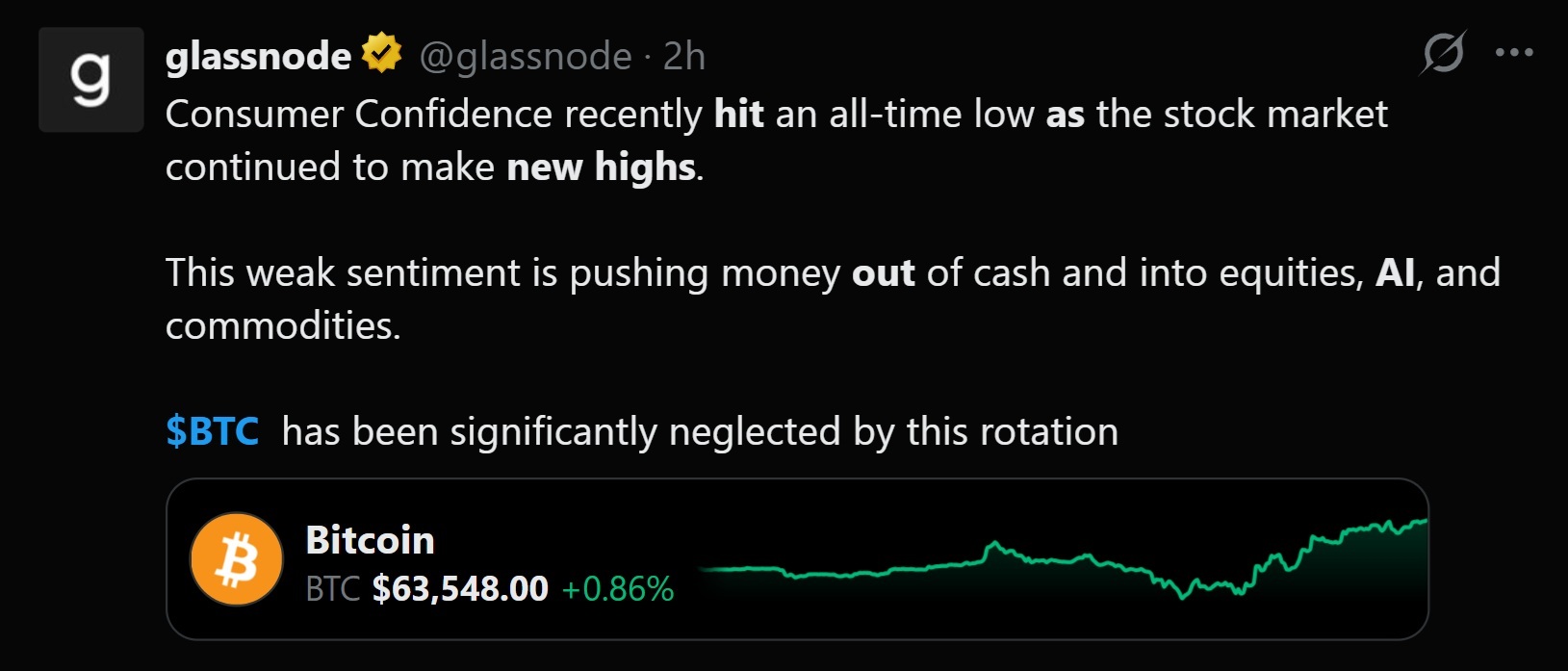
Image source: X

US stocks set a new all-time high on August 7th and have since held just below that level, with the gains almost entirely driven by trading in artificial intelligence (AI)-related company stocks, rather than a broad market rally.

Bitcoin, historically positioned as an asset that wins in situations where consumers lose confidence in the traditional financial system, has not been part of this move. As Bitcoin.com News reported last week, assets under management in spot Bitcoin ETFs shrank by $389.7 million in a single week, even as stock markets continued to rise—this divergence aligns with Glassnode's data on where capital is actually flowing this summer.

Where the Money is Actually Going

Bitcoin is currently trading at roughly half its October 2025 peak—a sharp drop that has left the asset stuck in a narrow range between its median realized price of around $63,000 and the cost basis for short-term holders of around $68,700.
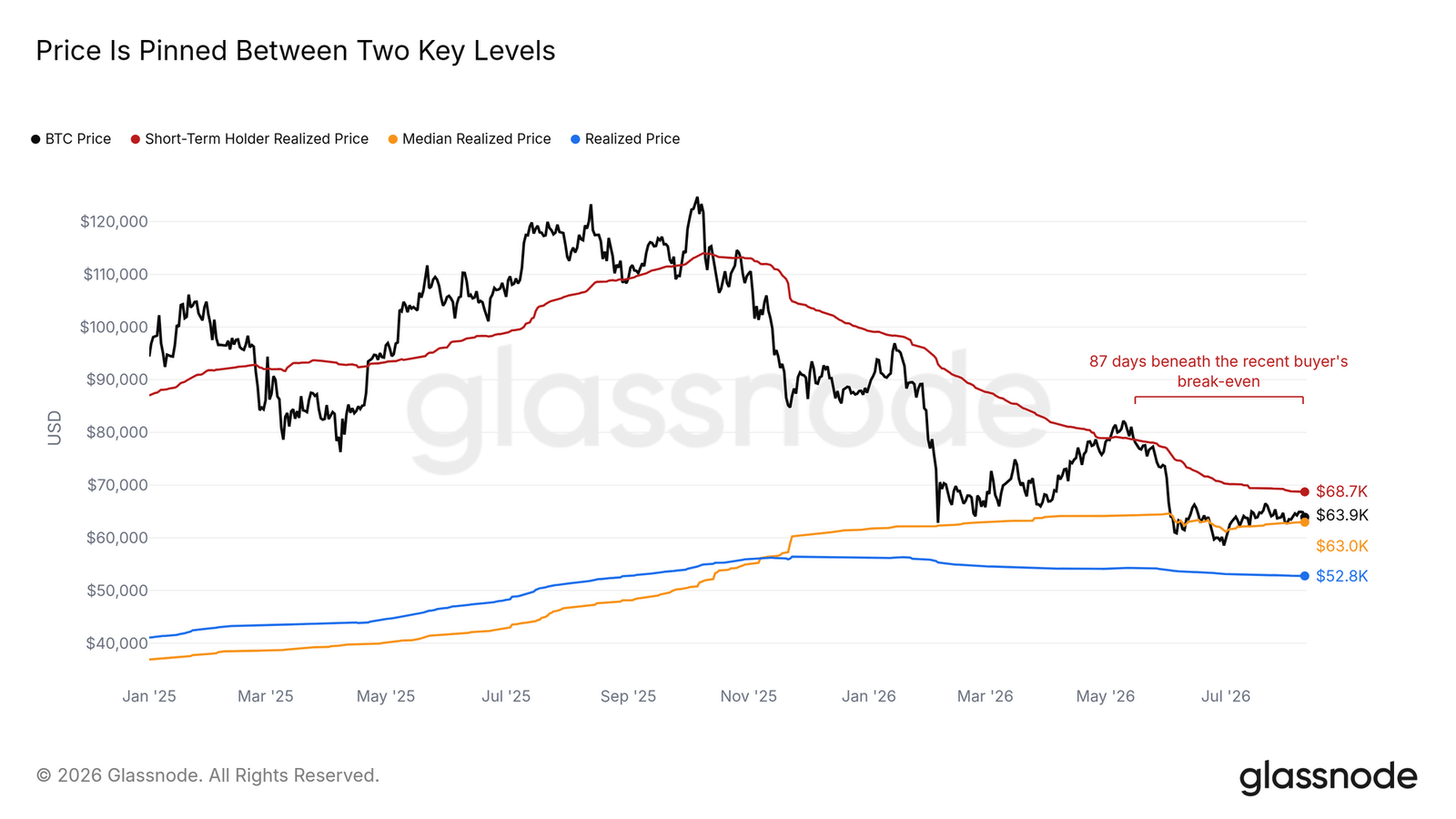
Meanwhile, AI-related trading continues to attract fresh capital, as retail traders, hedge funds, and even crypto-oriented institutional investors (who once championed Bitcoin as the preferred hedging tool) are instead redirecting their investments into AI-specializing company stocks and AI-related crypto tokens.

The macroeconomic backdrop has not been hostile to Bitcoin, at least on paper: core inflation was 2.5% in July—a relatively moderate level—and the stock market took it as good news, continuing its record run. Bitcoin's muted reaction to favorable inflation data is itself a red flag noted by researchers, given that this asset is supposed to thrive amidst currency devaluation fears and loose monetary policy.

Finally, Bitcoin spot exchange trading volume has fallen to its lowest level since 2019, with recent ETF inflows constituting only a "tiny fraction of any of the past accumulation waves." This may indicate that institutional buying (which was the driver of Bitcoin's rally in 2024 and 2025) has paused.

What This Means for Bitcoin

The trend described by Glassnode—namely, the reorientation of mining and tech companies towards AI instead of digital assets—is manifesting not only in trading flows. Some Bitcoin miners have already begun pivoting their power contracts and data center capacity towards AI workloads, following the same capital rotation that Glassnode is tracking in the stock markets.

From the outside, this movement looks like a structural shift that may continue to put pressure on the narrative of Bitcoin as the "default place" for capital leaving cash.

Nevertheless, none of this actually means the arguments for Bitcoin's devaluation hedging or scarcity have been disproven—it's simply not happening on the timeline crypto optimists expected this summer. Bitcoin.com News recently analyzed a parallel argument that the growing US national debt should structurally have a positive impact on Bitcoin—a thesis that, like the AI capital rotation story, has not yet been clearly reflected in the price.

end-content

Trending Cryptos

Related Questions

QAccording to the Glassnode analysis, where is capital flowing despite low consumer confidence levels?

AThe capital is flowing primarily into assets, specifically towards stocks of companies related to Artificial Intelligence (AI) and AI-related crypto tokens, rather than into Bitcoin or broad market equities.

QWhy is Bitcoin's recent price action considered concerning by researchers mentioned in the article?

ABitcoin's muted reaction to favorable July inflation data (2.5% core inflation) is a concerning signal because the asset is supposed to thrive in environments with currency devaluation concerns and loose monetary policy, yet it failed to rally.

QWhat does the record low spot Bitcoin exchange trading volume, coupled with weak ETF inflows, potentially indicate?

AIt potentially indicates that institutional buying, which was a driving force behind Bitcoin's rallies in 2024 and 2025, may have paused or stalled.

QHow are some Bitcoin miners adapting to the capital rotation trend described by Glassnode?

ASome Bitcoin miners are starting to repurpose their power contracts and data center capacity towards Artificial Intelligence (AI) workloads, following the same capital rotation from digital assets to AI seen in the stock markets.

QWhat does the article suggest about the structural narrative of Bitcoin as a default destination for capital leaving cash?

AThe article suggests that the current capital rotation into AI represents a structural shift that may continue to pressure the narrative of Bitcoin being the default destination for capital exiting cash, even though the long-term arguments for Bitcoin (scarcity, hedge against devaluation) are not disproven.

Related Reads

Arthur Hayes Discusses the Sudden Surge in Bitcoin and the Reasons for Bullish Outlook on Ethereum

In a podcast interview, BitMEX co-founder Arthur Hayes discusses the recent surge in Bitcoin and his optimism for Ethereum. He attributes Bitcoin's rise to mounting concerns over the US's $40 trillion debt, unsustainable interest payments, and recent Treasury actions, including doubling its long-term bond buyback program. Hayes argues these measures signal impending "yield curve control" and will inject significant liquidity into the market, benefiting scarce assets like Bitcoin. He sees this as a replay of the 2008 financial crisis dynamics that led to Bitcoin's creation. Hayes expresses particular bullishness on Ethereum (ETH), citing its underperformance relative to its previous all-time high and other major crypto assets. He highlights Ethereum's strengths: the largest and most innovative developer community, the "Lindy effect" from its longevity since 2015, and narratives like asset tokenization (e.g., Robinhood's involvement). He believes Ethereum is well-positioned to outperform in a liquidity-driven bull market and could significantly reduce Bitcoin's current market dominance. Regarding regulation, Hayes downplays the importance of the US "CLARITY Act" for crypto's core value proposition, stating Bitcoin's primary driver is macroeconomic liquidity, not legislation. He identifies war or catastrophic infrastructure failure as the biggest risk to crypto assets. For year-end predictions, Hayes forecasts Bitcoin reaching $126,000, breaking its previous record high. His advice to new traders emphasizes patience, dedication, and continuous learning.

marsbit3m ago

Arthur Hayes Discusses the Sudden Surge in Bitcoin and the Reasons for Bullish Outlook on Ethereum

marsbit3m ago

DeFi Sector Rebounds Most Strongly, Which High-Revenue Projects Can Be a Good Opportunity to 'Get On Board'?

**Title: DeFi Sector Leads Market Rebound: High-Revenue Projects to Watch** The recent surge in Bitcoin and Ethereum has revitalized the altcoin market, with DeFi emerging as one of the most active sectors. Beyond chasing price rallies, a key fundamental metric for evaluating DeFi projects is their protocol revenue—the actual income retained after paying liquidity providers. This indicates genuine user demand and sustainable business models. **Top Revenue-Generating DeFi Projects:** * **DEX (Decentralized Exchanges):** * **Uniswap (UNI):** Leads with $7.18M in 30-day revenue. It accrues income from protocol fees, which are now active on multiple chains and used to buy back and burn UNI. * **Solana Ecosystem:** Jupiter ($4.69M), Meteora ($1.67M), and Raydium ($1.13M) are top performers, with substantial revenues driven by Solana's vibrant trading activity. Jupiter and Raydium use a portion of fees for token buybacks, while Meteora has also executed significant buybacks. * **PancakeSwap (CAKE):** Generated $5.16M recently, maintaining a strong position on BNB Chain and other networks. Its token CAKE continues a net deflationary trend through buybacks and burns. * **Aerodrome (AERO):** On Base chain, it earned $4.11M. Its revenue is directly distributed to veAERO holders instead of funding buybacks. * **Lending:** * **World Liberty Financial (WLFI):** Topped the lending sector with $10.47M in 30-day revenue. A proposal to use fees from its proprietary market making for WLFI buybacks passed, but token holders' net income remains zero currently. * **Aave (AAVE):** Earned $4.12M. It had an active buyback program until it was paused in April 2026 following a security incident. * **ETH Staking:** * **ether.fi (ETHFI):** Generated $3.03M. Revenue from eETH withdrawals is fully used to buy back ETHFI, which is then distributed to sETHFI stakers. * **Lido (LDO):** Earned $2.31M. Its recently activated NEST mechanism automatically uses 50% of annual revenue above $40M to buy back LDO. In summary, during the market rebound, several DeFi protocols across DEXs, lending, and staking are demonstrating strong revenue generation. Key models include direct fee collection, token buyback/burn programs, and revenue distribution to governance token stakers, providing fundamental strength amidst market volatility.

Odaily星球日报4m ago

DeFi Sector Rebounds Most Strongly, Which High-Revenue Projects Can Be a Good Opportunity to 'Get On Board'?

Odaily星球日报4m ago

HBM at a Crossroads

At Hot Chips 2026, Samsung and SK Hynix outlined diverging strategies for High-Bandwidth Memory (HBM) evolution. The core battlegrounds are base die architecture and advanced packaging. Samsung unveiled a three-phase roadmap for its zHBM technology. The plan transforms the base die from a passive interposer into an active partner. Phase 1 moves the memory controller from the GPU to a logic-node base die, freeing up 5-10% of GPU area for compute and offering potential 10-20% performance gains. Later phases aim to add compute-in-memory capabilities (like attention calculations) and ultimately achieve true 3D integration by stacking DRAM directly on top of the compute die. Samsung claims zHBM could reduce DRAM power by 70% and more than double bandwidth versus HBM4E, with HBM5 targeting 6TB/s bandwidth. SK Hynix is focused on advancing conventional 3D stacking while managing thermal and warpage challenges. It confirmed a 12-layer HBM4 is in production and a 16-layer version is in customer validation. The path to 20+ layers is hybrid bonding, which allows for thicker dies and finer pitches. Its iHBM concept embeds dedicated thermal conduction paths within the stack's hottest areas. However, SK Hynix noted hybrid bonding may not arrive until HBM5, as current thickness limits and manufacturing challenges (like controlling warp in 50-micron thin dies) are being addressed by its Mass Reflow-Molded Underfill (MR-MUF) process. Micron emphasized the growing "memory wall," where AI accelerator compute performance is outpacing HBM bandwidth growth. It detailed HBM's role as a bridge between compute and memory but highlighted the rising complexity and silicon cost (approximately 3x more silicon for equivalent HBM3E capacity vs. DDR5). Key challenges include thermal management, reliability (chip-package interaction, ECC), and the continued push for faster I/O and larger, more advanced system-in-package (SiP) designs. In summary, the HBM market is at a crossroads: Samsung is pursuing a radical architectural shift with active base dies and vertical stacking, SK Hynix is pushing the limits of conventional stacking with advanced thermal solutions, and all players confront significant thermal, packaging, and cost hurdles as they scale bandwidth and capacity for next-generation AI workloads.

marsbit24m ago

HBM at a Crossroads

marsbit24m ago

The Eve of the Bull Market: Undervalued/Innovative Narratives Worth Watching

Author: Haotian With a bull market approaching and many unsure where to invest, which niche or innovative narratives that emerged during the bear market—though perhaps ahead of their time—are worth watching now? (Some are already gaining momentum.) **1) Hooks:** Uniswap V4 Hooks are externally customizable smart contracts that allow custom logic to be inserted at key points in an AMM pool's lifecycle, such as initialization, liquidity actions, swaps, donations, and fee handling. (Examples: uPEG, SATO, Slonks) **2) x402:** This initiative revives the long-reserved but rarely used HTTP 402 "Payment Required" status code, proposing it as a foundational layer for AI agent payments. (Examples: PAYAI, dreams) **3) RWAFI (Real-World Assets Finance):** Extending beyond mere asset tokenization, this narrative focuses on composable DeFi applications built on TradFi assets as underlying liquidity or integrating tokenized assets into DeFi protocols. (Examples: Stonkbroker, INDEX) **4) Agentic Economy:** Based on a Google-proposed open protocol, this framework enables AI agents built on different systems to discover, communicate, delegate tasks, and collaborate, serving as a communication layer for an economy of autonomous agents. It opens possibilities for agent-based social platforms, games, and human-task automation. (Example: Moltbook) Additionally, there is a broad range of innovative narratives around AI + Crypto, including infrastructure, applications, and protocols for AI agents. Established areas like Prediction Markets, Perpetual DEXs, and Privacy narratives remain highly active. (Note: Many projects mentioned above are inactive; this is for informational purposes only, not investment advice.) What other interesting narratives are out there? Feel free to share in the comments.

marsbit24m ago

The Eve of the Bull Market: Undervalued/Innovative Narratives Worth Watching

marsbit24m ago

Trading

Spot

Hot Articles

What is $BITCOIN

DIGITAL GOLD ($BITCOIN): A Comprehensive Analysis Introduction to DIGITAL GOLD ($BITCOIN) DIGITAL GOLD ($BITCOIN) is a blockchain-based project operating on the Solana network, which aims to combine the characteristics of traditional precious metals with the innovation of decentralized technologies. While it shares a name with Bitcoin, often referred to as “digital gold” due to its perception as a store of value, DIGITAL GOLD is a separate token designed to create a unique ecosystem within the Web3 landscape. Its goal is to position itself as a viable alternative digital asset, although specifics regarding its applications and functionalities are still developing. What is DIGITAL GOLD ($BITCOIN)? DIGITAL GOLD ($BITCOIN) is a cryptocurrency token explicitly designed for use on the Solana blockchain. In contrast to Bitcoin, which provides a widely recognized value storage role, this token appears to focus on broader applications and characteristics. Notable aspects include: Blockchain Infrastructure: The token is built on the Solana blockchain, known for its capacity to handle high-speed and low-cost transactions. Supply Dynamics: DIGITAL GOLD has a maximum supply capped at 100 quadrillion tokens (100P $BITCOIN), although details regarding its circulating supply are currently undisclosed. Utility: While precise functionalities are not explicitly outlined, there are indications that the token could be utilized for various applications, potentially involving decentralized applications (dApps) or asset tokenization strategies. Who is the Creator of DIGITAL GOLD ($BITCOIN)? At present, the identity of the creators and development team behind DIGITAL GOLD ($BITCOIN) remains unknown. This situation is typical among many innovative projects within the blockchain space, particularly those aligning with decentralized finance and meme coin phenomena. While such anonymity may foster a community-driven culture, it intensifies concerns about governance and accountability. Who are the Investors of DIGITAL GOLD ($BITCOIN)? The available information indicates that DIGITAL GOLD ($BITCOIN) does not have any known institutional backers or prominent venture capital investments. The project seems to operate on a peer-to-peer model focused on community support and adoption rather than traditional funding routes. Its activity and liquidity are primarily situated on decentralized exchanges (DEXs), such as PumpSwap, rather than established centralized trading platforms, further highlighting its grassroots approach. How DIGITAL GOLD ($BITCOIN) Works The operational mechanics of DIGITAL GOLD ($BITCOIN) can be elaborated on based on its blockchain design and network attributes: Consensus Mechanism: By leveraging Solana’s unique proof-of-history (PoH) combined with a proof-of-stake (PoS) model, the project ensures efficient transaction validation contributing to the network's high performance. Tokenomics: While specific deflationary mechanisms have not been extensively detailed, the vast maximum token supply implies that it may cater to microtransactions or niche use cases that are still to be defined. Interoperability: There exists the potential for integration with Solana’s broader ecosystem, including various decentralized finance (DeFi) platforms. However, the details regarding specific integrations remain unspecified. Timeline of Key Events Here is a timeline that highlights significant milestones concerning DIGITAL GOLD ($BITCOIN): 2023: The initial deployment of the token occurs on the Solana blockchain, marked by its contract address. 2024: DIGITAL GOLD gains visibility as it becomes available for trading on decentralized exchanges like PumpSwap, allowing users to trade it against SOL. 2025: The project witnesses sporadic trading activity and potential interest in community-led engagements, although no noteworthy partnerships or technical advancements have been documented as of yet. Critical Analysis Strengths Scalability: The underlying Solana infrastructure supports high transaction volumes, which could enhance the utility of $BITCOIN in various transaction scenarios. Accessibility: The potential low trading price per token could attract retail investors, facilitating wider participation due to fractional ownership opportunities. Risks Lack of Transparency: The absence of publicly known backers, developers, or an audit process may yield skepticism regarding the project's sustainability and trustworthiness. Market Volatility: The trading activity is heavily reliant on speculative behavior, which can result in significant price volatility and uncertainty for investors. Conclusion DIGITAL GOLD ($BITCOIN) emerges as an intriguing yet ambiguous project within the rapidly evolving Solana ecosystem. While it attempts to leverage the “digital gold” narrative, its departure from Bitcoin's established role as a store of value underscores the need for a clearer differentiation of its intended utility and governance structure. Future acceptance and adoption will likely depend on addressing the current opacity and defining its operational and economic strategies more explicitly. Note: This report encompasses synthesised information available as of October 2023, and developments may have transpired beyond the research period.

2.1k Total ViewsPublished 2025.05.13Updated 2025.05.13

What is $BITCOIN

Discussions

Welcome to the HTX Community. Here, you can stay informed about the latest platform developments and gain access to professional market insights. Users' opinions on the price of BTC (BTC) are presented below.

活动图片