But Bin's Latest Speech: Do Not Miss Out on a Great Era

marsbitPublished on 2026-07-02Last updated on 2026-07-02

Abstract

Dan Bin's Latest Speech: Don't Miss a Great Era On June 29th, Dan Bin, Chairman of Dongfang Harbor (东方港湾), delivered a keynote speech titled "Don't Miss a Great Era" at the "2026—All in the Silicon-based New Epoch" Mid-Year Strategy Summit. Addressing concerns about an AI bubble, Dan Bin argued from an industrial cycle perspective that "the risk of missing an era may be greater than worrying about short-term bubbles." He views humanity as standing at the dawn of the AI era, which could be more disruptive than the electronics, internet, and mobile internet eras. He posits that the AI wave is unlikely to end in just three or four years. Using the internet era's decade-long rhythm as a reference point—with ChatGPT's late 2022 launch as the starting line—a key risk assessment window may only arrive around 2033. Dan Bin emphasized that technological progress is the primary driver of long-term capital market growth, while factors like trade wars or interest rate hikes are secondary. Expanding to a civilizational scale, Dan Bin presented a thought experiment on silicon-based life potentially supplementing or succeeding carbon-based life as a direction for extending Earth's civilization, especially over cosmic timescales spanning billions of years. On geopolitics, he noted that AI is already rewriting warfare rules, as seen in conflicts like Ukraine, and that neither the U.S. nor China can afford to lose the AI race, with each leveraging different strengths. Reflecting on inves...

Author: But Bin

On June 29th, But Bin, Chairman of Oriental Harbor, delivered a keynote speech titled "Do Not Miss Out on a Great Era" at Gelonghui's "2026—All in Silicon-Based New Epoch" Mid-Year Strategy Summit.

Addressing market concerns about an AI bubble, But Bin pointed out from an industry cycle perspective:"The risk of missing out on an entire era may be greater than the risk of worrying about short-term bubbles."

In his view, humanity stands at the dawn of the artificial intelligence era—an era that may be more disruptive than the electronic, internet, and mobile internet eras.

He assesses that the AI wave is unlikely to conclude in just three or four years. At the industry level, it could follow the decadal rhythm of the internet era. Taking the release of ChatGPT at the end of 2022 as the starting point, a reference point for significant risk might be around 2033.

He noted that the "primary driver" of long-term growth in capital markets is technological progress; trade wars, interest rate hikes, and wars are only secondary factors. He also discussed the long-term logic of silicon-based life replacing carbon-based life from the perspective of human civilization, emphasizing the importance of focusing on primary drivers, respecting corporate innovation, and market common sense in investment.

Finally, he emphasized that we must not let this great era down.

"The tide never turns back; the wheel of the era rolls forward silently. To be born in this time is already immense fortune. Do not let hesitation shackle your steps, nor let short-sightedness betray the years—never miss out on this magnificent, great era that belongs to us."

Below are the highlights of But Bin's speech compiled by Gelonghui, shared with everyone.

01 From an industry cycle perspective, the risk of missing the AI era is greater than the risk of worrying about short-term bubbles

Recently, people often ask: Is there an AI bubble? What's the short-term outlook?

But Bin's answer is: From the perspective of long-term industry development, for market participants, the risk of missing an era may be greater than the risk you worry about regarding short-term bubbles. Of course, in the face of short-term fluctuations and uncertainties, investors also need to make independent judgments based on their own investment horizons and risk tolerance.

Looking back at the 55-year history of the NASDAQ since its establishment in 1971, the core driver behind the long-term growth of capital markets has been technological progress, not short-term factors like interest rates or macro policies.
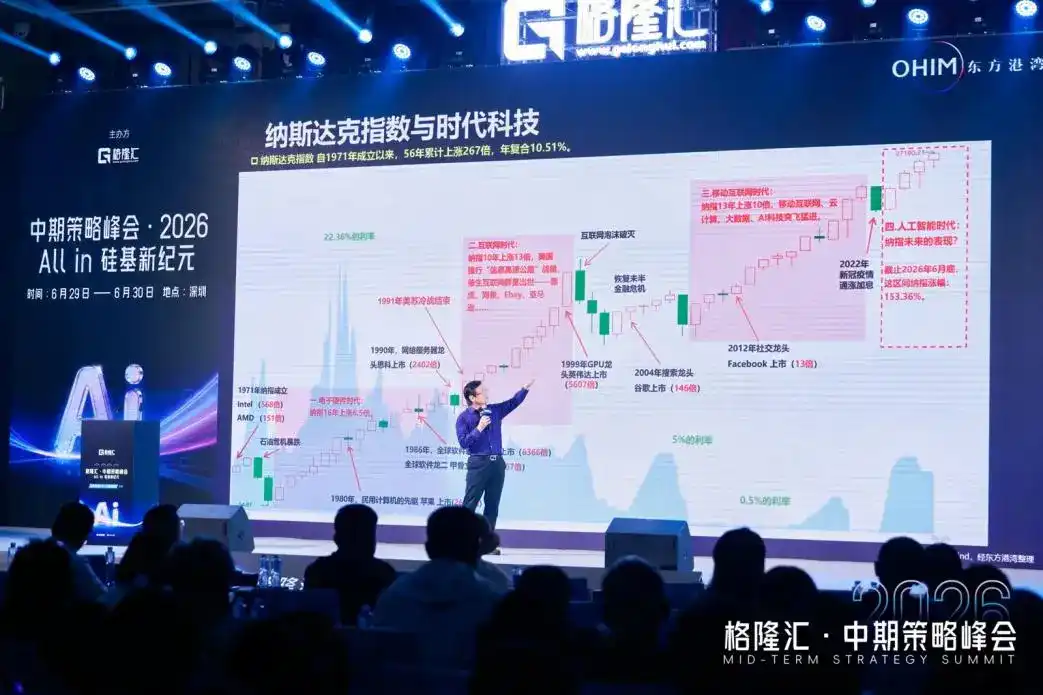
Some worry that a high-interest-rate environment will lead to a market crash.

Let's look at history: In the 1970s, the US benchmark interest rate reached as high as 22%, yet the electronic hardware era saw a 6.5-fold increase over 16 years; the internet era experienced a complete interest rate cut-hike cycle and rose strongly for a full 10 years; the same was true for the mobile internet era. Interest rates have never been the primary cause; technological progress is the main driver.

02 The AI era is more disruptive than the previous three eras; at the industry level, it might follow the ten-year rhythm of the internet era

He further pointed out that at last year's annual meeting, he predicted that 2026 might resemble 1994—a doji star followed by a significant rally. After three years of strong gains in '23, '24, and '25, this year still shows strong industry momentum.

"Why? Because the AI era is more disruptive than the previous three eras—the electronic era, the internet era, and the mobile internet era."

But Bin's basic judgment is: The AI era will likely have a long industry cycle, similar to the internet era.—ChatGPT was released at the end of 2022. If we follow the historical "ten-year" rhythm of the internet, that point (around 2033) is likely to be a reference window where risk needs to be examined. Before then, the AI industry's evolution is unlikely to conclude in just three or four years. However, short-term market volatility and local bubbles objectively exist; investors must still rationally assess based on their own circumstances.

03 The Long-Term Vision of Silicon-Based Life: A Thought Experiment from a Civilizational Perspective

But Bin showed two videos, elevating the perspective from capital markets to the dimension of human civilization.

His viewpoint is highly imaginative: Silicon-based life replacing carbon-based life is an extremely probable direction. If Earth's civilization is to persist, silicon-based life will likely replace carbon-based life or become the dominant productive force.

He provided a set of vastly different time coordinates:

In 4.1 billion years, the sun may expand into a red giant, swallowing Earth, or it may collapse into a white dwarf.

Voyager has been flying for 77 years and is still about 70,000 light-years away from exiting the solar system.

In 10 billion years, the Andromeda Galaxy might collide with the Milky Way—by then, humanity must fly out of the Milky Way.

"Carbon-based life cannot fly out of the Milky Way. But silicon-based life—it is a million times smarter than us, thinking and working non-stop 24/7. The revolutionary changes it brings may propel civilization far beyond our comprehension."

But Bin stated this is not a short-term investment judgment but rather provides a thinking framework: The economic growth paradigm brought by silicon-based intelligence may have limitless possibilities and longer industrial chains. Understanding this helps to transcend immediate distractions and examine long-term trends.

04 Technology Rewrites the Rules of War; Neither the US nor China Can Afford to Lose the AI Race

But Bin showed a recent case from the Russia-Ukraine battlefield: a Russian soldier was captured by Ukrainian drones and robots.

"The weaponization of AI is an exponential change; this is an inevitable process."

He believes that neither the United States nor China can afford to lose this AI race. The US has a first-mover advantage in foundational technology and top talent, while China has formed differentiated competitiveness in application scenarios, data scale, and industrial chain completeness. Both sides continue to reinforce their long-term AI layouts.

05 Buffett's "Regret" and Oriental Harbor's Cognitive Evolution

But Bin compared the portfolio changes of the "elders" in China and the US.

Buffett bought Google in Q3 last year and continued adding this year; Google has now entered Berkshire Hathaway's top five holdings.

"Before Charlie Munger passed, he said in an interview that his generation should have made 100 billion or even 1 trillion. He was so close to Bill Gates yet only symbolically bought 100 shares of Microsoft. Microsoft has risen 7,000-fold."

"If he had taken 100 million from Coca-Cola to buy Microsoft, that would be 700 billion, more than all the money he ever made."

But Bin admitted that these historical fragments cannot predict the future but remind us that investment requires continuously breaking cognitive boundaries. Oriental Harbor is also iterating and evolving: our company's research team continues to conduct in-depth tracking on foundational AI computing power, storage, and other segments.

06 Calmly Maintain Perspective, Rationally Hold the Chips Bestowed by the Era

But Bin concluded with a poem he wrote:

"The tide never turns back; the wheel of the era rolls forward silently.

Some are trapped in the immediate clamor of details, while others stand above the cycles, gazing at the starry river.

Do not dwell on momentary rises and falls, nor blindly follow fleeting trends of cold and heat.

Mountains and rivers are reborn amidst upheaval; opportunities bloom through persistent, lengthy endurance.

To be born in this time is already immense fortune. Do not let hesitation shackle your steps, nor let short-sightedness betray the years.

Live well, forge ahead earnestly, and never miss out on this magnificent, great era that belongs to us."


Trending Cryptos

Related Questions

QAccording to Dan Bin, what is the bigger risk compared to worrying about short-term AI bubbles?

ADan Bin states that, from an industry cycle perspective, the risk of missing out on an entire era (the AI era) is far greater than the risk of short-term bubbles.

QWhat does Dan Bin identify as the primary driver for long-term capital market growth, as evidenced by Nasdaq's history?

ADan Bin identifies technological progress, not factors like interest rates or macro policies, as the core driving force for long-term capital market growth throughout Nasdaq's 55-year history.

QWhat timeframe does Dan Bin suggest for the AI industry cycle, using the launch of ChatGPT as a starting point?

ADan Bin suggests that the AI industry cycle could follow a similar ten-year rhythm as the internet era. With ChatGPT launching in late 2022, a significant risk evaluation point might not arrive until around 2033.

QWhat is Dan Bin's 'civilizational perspective' thought experiment regarding the long-term future of intelligence?

ADan Bin presents a thought experiment suggesting that silicon-based life (AI) is highly likely to replace or become the dominant productive force over carbon-based life (humans) for the long-term survival and expansion of civilization beyond Earth and the galaxy.

QWhat historical investment example does Dan Bin use to illustrate the cost of missing a major technological shift?

ADan Bin cites Charlie Munger's regret about only buying 100 shares of Microsoft despite his close relationship with Bill Gates. He calculates that investing just $100 million from Coca-Cola into Microsoft could have yielded $700 billion, far surpassing their actual total earnings, highlighting the cost of missing a transformative technology.

Related Reads

Anthropic Creates an AI Jailbreak 'Penal Code': Your Requests, Four Ways to Die

Anthropic has publicly detailed its security measures and a new "Cyber Jailbreak Severity" (CJS) framework following the controversial takedown of its Fable 5 model. The incident, triggered by simple user requests like counting letters or stating a profession, highlighted overzealous safety filters. Anthropic classifies cybersecurity-related prompts into four tiers: malicious activities (blocked), high-risk dual-use (like pentesting, with strict limits), low-risk dual-use (often blocked by "safety margin" errors), and harmless tasks (theoretically allowed but still frequently flagged). The company admits its classifiers are tuned for high sensitivity, leading to many false positives. The newly proposed CJS framework aims to objectively score the severity of AI "jailbreaks" (prompts that bypass safety rules) on a 0-10 scale across four dimensions: Capability Gain (does it grant new attack abilities?), Breadth (does it work across multiple attack types?), Weaponization Ease (how hard is it to turn into a real attack?), and Discoverability (how easy is it to find?). The score determines the response, from no action (CJS-0) to a potential model takedown (CJS-4). The score is context-dependent; for example, discovering a major unknown vulnerability today scores high, while asking about a well-known one scores low. The article raises concerns about Anthropic's dual role: it is both creating powerful models (like the restricted Mythos 5) and defining the rules (CJS) for judging their misuse, potentially giving it disproportionate influence. This is set against the backdrop of U.S. export controls, which for the first time directly restricted API access to a model (Fable 5), creating a "tiered" system where public models are heavily filtered and advanced ones are limited to vetted partners. The CJS framework is portrayed as potentially providing regulators with a metric to justify future API shutdowns. For users, the advice is to carefully phrase prompts, watch for signs of being downgraded to a weaker model, and wait indefinitely for promised filter improvements.

marsbit24m ago

Anthropic Creates an AI Jailbreak 'Penal Code': Your Requests, Four Ways to Die

marsbit24m ago

$100M Annual Revenue, Two Berkeley Roommates in Their 20s Build the Most Profitable AI Business

Arena, the AI model ranking platform, has become a $100 million annual revenue business just eight months after launching its commercial service. Originally a UC Berkeley open-source research project called Chatbot Arena, it created a "battle arena" where users blind-test and vote on anonymous AI model responses. This has generated a highly trusted, community-driven leaderboard based on over 10 million user evaluations and 82 million votes. Major AI companies like OpenAI, Google, and Anthropic submit their flagship models to be ranked. The core monetization strategy is its AI Evaluations service, where model developers and large enterprises pay for in-depth performance analysis from Arena's massive user community. This provides real-world feedback on model strengths, weaknesses, and hallucinations—a critical service as models become more complex. The company, spun out from Berkeley in early 2025, quickly raised $100 million in seed funding at a $600 million valuation and later secured a $150 million Series A at a $1.7 billion valuation. The founding team includes CEO Anastasios Angelopoulos, a mathematician focused on rigorous model evaluation; CTO Wei-Lin Chiang, creator of the popular Vicuna chatbot; and co-founder Ion Stoica, a renowned Berkeley professor. Arena is now expanding beyond chat benchmarks into "Agent Mode," evaluating AI agents on complex, multi-step tasks like coding and research. The company's success illustrates the growing value and cost of independent, real-world AI model evaluation as the industry intensifies.

marsbit29m ago

$100M Annual Revenue, Two Berkeley Roommates in Their 20s Build the Most Profitable AI Business

marsbit29m ago

Racking Up 24,000 Stars: With One Command, AI Can Now Find Its Own Skills

Vercel, known for its developer tools like Next.js, has launched 'skills', a package manager for AI coding agents, garnering 24,000 GitHub stars. It allows developers to add specialized capabilities, such as React best practices, to AI assistants like Claude Code or Cursor with a single command: `npx skills add <package>`. Skills are shareable, reusable modules that define an AI agent's behavior for specific tasks, moving beyond one-off prompt engineering towards standardized 'capability engineering'. A key innovation is the 'find-skills' skill, which acts as an internal search engine, allowing an agent to autonomously find and install the right skill for a user's request. This lowers the barrier for non-developers to leverage advanced AI coding assistance. However, this 'npm moment' for AI brings significant security risks. Security audits of thousands of skills on platforms like skills.sh and ClawHub found over 30% contained security flaws, with about 13% classified as severe. Threats include malicious scripts that can access local files and credentials, and prompt injection hidden within skill documentation. Unlike traditional code packages, skills blend instructions, code, and system access, posing a direct risk to user machines and data. Experts advise treating skills like code—reviewing them carefully before installation, especially their scripts, and being wary of excessive permissions. Ultimately, Vercel's initiative represents a major shift towards modular, reusable AI capabilities, but its rapid adoption requires developers to bring the same caution used in managing traditional software dependencies.

marsbit30m ago

Racking Up 24,000 Stars: With One Command, AI Can Now Find Its Own Skills

marsbit30m ago

Claude Engineer Finally Unveils Fable 5's Ultimate Strategy, Teaching You How to Bridge the Information Gap with AI Models

This article, titled "Claude Engineer Finally Releases Fable 5 'Skill-Burning' Guide, Teaching How to Bridge the Information Gap with Models," details a blog post by Claude Code engineer Thariq Shihipar. The core concept is the "information gap" or "unknowns"—the disconnect between a user's instructions (the "map") and the actual task requirements (the "territory"). The article argues that with powerful models like Claude Fable 5, work quality depends on the user's ability to identify and clarify these unknowns. Shihipar categorizes unknowns into four types: Known Knowns (explicit instructions), Known Unknowns (awareness of gaps), Unknown Knowns (implicit, unstated knowledge), and Unknown Unknowns (unforeseen issues). The blog provides a framework for addressing these gaps throughout the workflow: * **Before Implementation:** Techniques include "Blindspot Scanning" to uncover Unknown Unknowns, brainstorming/prototyping for visual or complex tasks, having Claude ask clarifying questions, using reference code/examples, and creating implementation plans. * **During Implementation:** Maintaining an "implementation notes" file for Claude to document deviations and decisions made due to encountered edge cases. * **After Implementation:** Creating summary documents for review and having Claude generate quizzes to ensure the user fully understands the completed changes. The article concludes that as models become more capable, the key to success is systematically discovering and defining these unknowns through low-cost methods like prototyping and planning, allowing for more effective collaboration.

marsbit34m ago

Claude Engineer Finally Unveils Fable 5's Ultimate Strategy, Teaching You How to Bridge the Information Gap with AI Models

marsbit34m ago

Trading

Spot

Hot Articles

Discussions

Welcome to the HTX Community. Here, you can stay informed about the latest platform developments and gain access to professional market insights. Users' opinions on the price of S (S) are presented below.

活动图片