Analyst Who Called Cycle Top Says Bitcoin Bottom Could Be At $28,500 — Here’s When

bitcoinistPublished on 2026-06-06Last updated on 2026-06-06

Abstract

Bitcoin's price recently dropped below $60,000 for the first time in 2024, amidst a broader market sell-off. A crypto analyst, CryptoCon, who claims to have sold at the cycle top, now projects a potential bearish bottom for Bitcoin. Using a proprietary "Bear Bands" indicator, the analyst suggests BTC could first decline to a second bear band target around $44,500 between August and October. However, the predicted cycle low is on a third bear band at approximately $28,500, potentially reached between November 2026 and January 2027. This level has historically marked the low before a new bull cycle. As of the report, Bitcoin trades near $61,850, down over 15% in the past week. The analyst advises patience, emphasizing the importance of waiting for optimal entry conditions.

The Bitcoin price briefly fell below the $60,000 level for the first time since 2024, succumbing to intense bearish pressure that ravaged global financial markets on Friday, June 5th. While the imminent initial public offering of SpaceX in the United States has been identified as one of the catalysts behind the downturn, the US equities market was not spared on the day, as major large-cap stocks recorded double-digit losses.

Interestingly, a popular crypto trader on social media platform X who sold their Bitcoin holdings at the peak of the latest bullish cycle has come forward with a projection for the cryptocurrency’s bottom following the latest price action. According to the pundit, the Bitcoin price could fall to as low as $28,500 to find its cycle bottom.

Is A Fall To $28,500 Inevitable For BTC Price?

In a recent post on the X platform, pseudonymous trader CryptoCon shared an insight into a possible path for Bitcoin’s price over the next few months. The crypto analyst identified $44,500 and $28,500 as the potential next bear targets for the premier cryptocurrency.

This projection centers on the analyst’s Bear Bands, which helped pinpoint bear bottoms in past cycles. As shown in the chart below, this indicator comprises three bands: the First Low Bear Band, the Second Low Band, and the Third Low Bear Band.
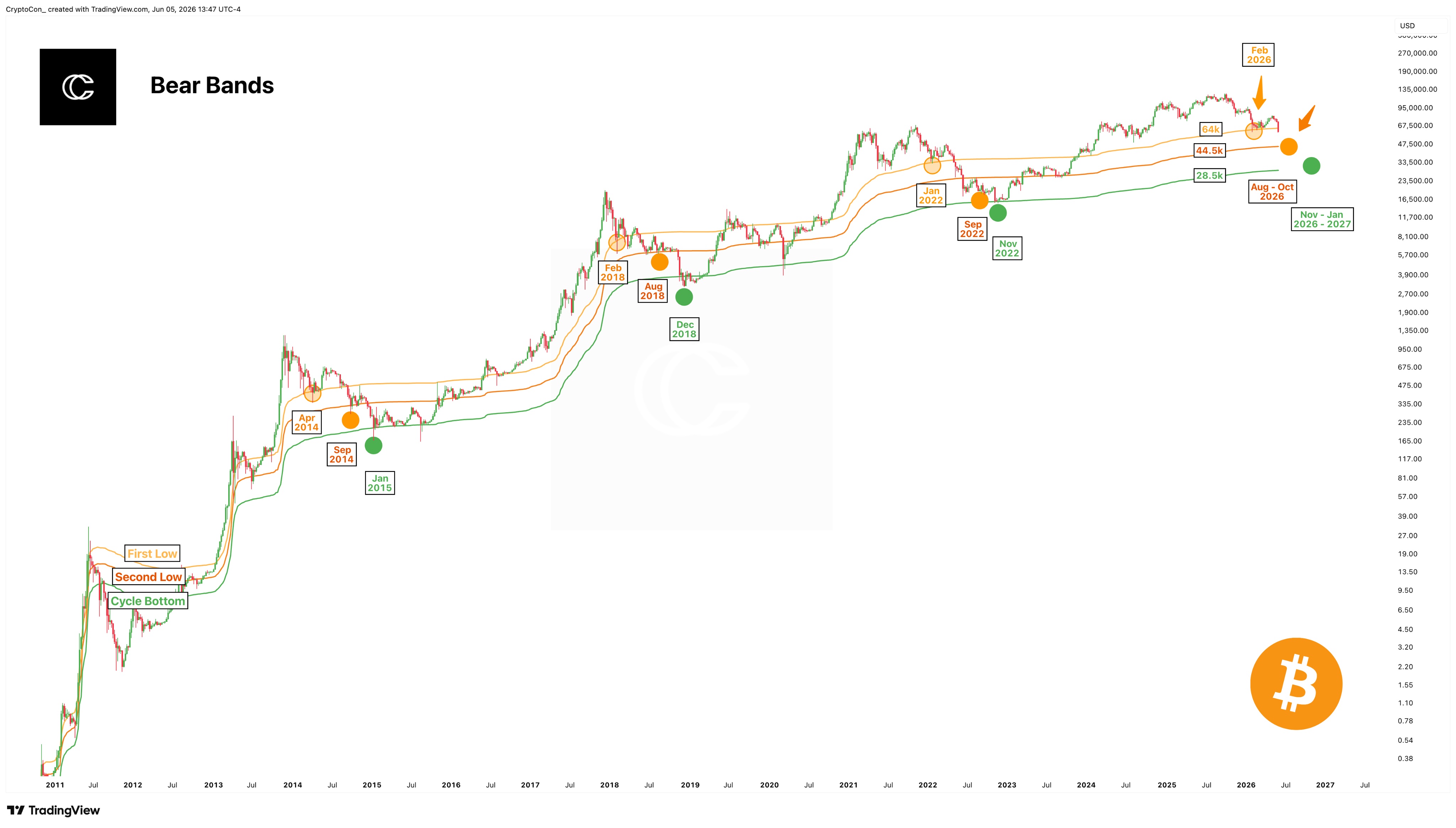
Source: @CryptoCon_ on X

As CryptoCon highlighted in their analysis, the Bitcoin price has broken beneath the First Low Bear Band after its recent downturn and appears very likely to close below the level. The market analyst noted that a confirmed close below this first band could mean a potential decline toward the Second Low Band at around $44,500.

However, CryptoCon said that the cycle bottom target lies on the Third Low Bear Band and “on the lower end of my projections” at around $28,500. If history is anything to go by, the Bitcoin price has always fallen into this bear band before kickstarting another bullish cycle.

CryptoCon wrote on X:

I am being very patient for the right cycle low conditions, I am not afraid of “missing out”. Especially as returns diminish and the possibility of a lackluster cycle (which most people find impossible) looms, it is more important than ever to wait for the best time to invest.

It is worth noting that the analyst also postulated a timeline for when the Bitcoin price would reach each of these downside targets. CryptoCon expects the flagship cryptocurrency to reach the Second Bear Band between August and October, then fall to a bottom of $28,500 around November 2026 and January 2027.

Bitcoin Price Overview

A drop to around $28,500 would represent a 77% decline from BTC’s all-time high. As of this writing, the price of Bitcoin stands at around $61,850, reflecting an over 2% decline in the past 24 hours.

While this single-day decline looks relatively modest, a broader timeframe provides more context for the market leader’s struggles over the past week. According to CoinGecko data, the Bitcoin price has dropped by more than 15% in the last seven days.

The price of BTC on the daily timeframe | Source: BTCUSDT chart on TradingView


Related Questions

QAccording to the analyst CryptoCon, what are the two potential downside price targets for Bitcoin mentioned in the article?

AThe two potential downside price targets are $44,500 and $28,500.

QWhat indicator does CryptoCon use to identify potential Bitcoin bear bottoms, and what are its three bands called?

ACryptoCon uses the 'Bear Bands' indicator, which comprises the First Low Bear Band, the Second Low Band, and the Third Low Bear Band.

QWhen does CryptoCon predict Bitcoin could reach its cycle bottom of around $28,500?

ACryptoCon predicts Bitcoin could reach a bottom of around $28,500 between November 2026 and January 2027.

QWhat recent price level did Bitcoin briefly fall below for the first time since 2024, as mentioned in the article?

ABitcoin briefly fell below the $60,000 level for the first time since 2024.

QWhat percentage decline from its all-time high would a drop to $28,500 represent for Bitcoin?

AA drop to around $28,500 would represent a 77% decline from Bitcoin's all-time high.

Related Reads

Google TPU Shipments Revised Up by 50%

Recent industry research indicates a significant upward revision in the shipments of Google's TPU (Tensor Processing Unit) chips. Previous expectations for 2027 were set at around 10 million units, but new estimates now point to 15 million units, a 50% increase. This substantial boost directly translates to higher demand across the entire supporting supply chain. Google's TPU clusters utilize a standardized all-optical interconnect architecture. Consequently, key hardware components are deeply integrated and scaled in fixed ratios with the chips. The 15 million TPU target will drive corresponding demand increases for NPO optical engines (roughly a 1:1 match), 1.6T optical modules, OCS optical switches, high-end server power supplies, fiber optics & MPO connectors, and liquid cooling solutions. Among these, liquid cooling is highlighted as the sector experiencing the most significant transformation and offering the most stable potential for excess returns. As next-generation TPU chips reach power levels where traditional air cooling is insufficient, liquid cooling becomes essential. 2026 is forecasted as the first year of substantial adoption for Google's liquid cooling solutions. This shift, coupled with delivery and capacity bottlenecks faced by incumbent overseas manufacturers, is creating a prime window for domestic Chinese suppliers to enter and secure Google's core supply chain. The market size for Google-specific liquid cooling is projected to potentially triple from a baseline of hundreds of billions to around 300 billion units by 2028. The logic for the fiber optic sector is also being rewritten. Once considered a cyclical commodity tied to telecom operator procurement, fiber is now a strategic and scarce resource for AI Data Centers (AIDC). A severe supply-demand imbalance, driven by the long lead time for preform production (18-24 months) and surging demand from cloud giants, is supporting strong performance. Chinese fiber manufacturers are well-positioned to capture a significant share of global AIDC demand, with exports potentially reaching 200-300 million core kilometers in 2026. Overall, the investment focus within the AI computing industry is shifting from pure "chip performance speculation" towards the more certain incremental growth in computing infrastructure and its supporting ecosystem. The upward revision in Google TPU shipments, along with the potential for further doubling by 2028, is seen as solidifying performance visibility for the entire supporting supply chain over the next two years.

marsbit48m ago

Google TPU Shipments Revised Up by 50%

marsbit48m ago

What Wall Street Really Wants After the Crypto Story Recedes

The tide of speculative crypto narratives has receded, revealing Wall Street's true objective: building a controlled, yield-generating, and compliant financial pipeline on distributed ledgers. They are migrating core functions onto blockchains, not for decentralization, but for efficiency and new revenue streams. Key developments include BlackRock's BUIDL fund, a tokenized treasury fund acting as a foundational reserve asset, and the rise of Securitize, which is going public and partnering with the NYSE to build a 24/7 digital securities trading and settlement system. This signals a major shift of securities clearing to blockchain technology. To make volatile assets like Bitcoin palatable for institutional investors, firms like BlackRock and Goldman Sachs are creating "covered call" ETFs (e.g., BITA). These products systematically sell options on Bitcoin holdings, transforming price volatility into stable monthly income, effectively repackaging crypto as a yield-bearing asset. Stablecoins are being positioned not as speculative tools but as efficient payment rails. Companies like Stripe and Mastercard are integrating them for instant, low-cost merchant settlements and cross-border card payments, respectively. Critically, new legislation like the GENIUS Act shapes them as non-interest-bearing, heavily regulated extensions of the US dollar system. In summary, Wall Street is quietly constructing a parallel, blockchain-based financial infrastructure featuring tokenized traditional assets, structured crypto yields, and programmable dollar pipelines—all under its control and fully integrated with existing regulatory and credit frameworks.

marsbit1h ago

What Wall Street Really Wants After the Crypto Story Recedes

marsbit1h ago

Tying Itself to SpaceX: Cursor's $60 Billion Rise

This article recounts the rapid rise of AI-powered coding startup Cursor and its 25-year-old MIT graduate CEO, Michael Truell. Launched in 2023, Cursor achieved explosive growth, reaching over 10 billion USD in revenue by late 2025. However, its journey highlights a central dilemma for AI application companies: dependence on foundational model providers. Cursor initially relied heavily on Anthropic's models but faced an existential threat when Anthropic launched its own competing coding tool, Claude Code. In response, Cursor declared an internal emergency in early 2026 and accelerated development of its own model, Composer. To secure the immense computing power needed, Truell struck a pivotal deal with Elon Musk's SpaceX in April 2026. The collaboration grants Cursor access to SpaceX's supercomputing resources for Composer, while SpaceX's Grok model benefits from Cursor's programming data. The agreement includes a potential 600 billion USD acquisition of Cursor by SpaceX later in the year, though a substantial termination fee is in place if the deal falls through. The story explores Cursor's intense, sometimes controversial hiring practices involving lengthy unpaid "work trials," its complex partnership-turned-rivalry with Anthropic, and its high-stakes gamble to ensure independence through the SpaceX alliance. The core question remains: will Cursor evolve into a defining, independent "generational" software company, or become a key piece in a tech giant's AI arsenal?

marsbit1h ago

Tying Itself to SpaceX: Cursor's $60 Billion Rise

marsbit1h ago

Trading

Spot
Futures

Hot Articles

Discussions

Welcome to the HTX Community. Here, you can stay informed about the latest platform developments and gain access to professional market insights. Users' opinions on the price of S (S) are presented below.

活动图片