Mengapa Integrasi Broadridge Avalanche Gagal Menghentikan Penurunan AVAX 10%

ambcryptoPublished on 2026-04-07Last updated on 2026-04-07

Abstract

Meskipun Avalanche mengumumkan integrasi dengan Broadridge Financial Solutions pada 6 April untuk mendukung pemungutan suara on-chain, harga AVAX justru turun hampir 10%. Penurunan ini disebabkan oleh melemahnya aktivitas on-chain, dengan Total Value Locked (TVL) anjlok ke $720 juta—level terendah sejak Juli 2024. Data derivatif menunjukkan dominasi posisi short, dengan rasio Long/Short di 0.89 dan Open Interest turun $37 juta. Tingkat Funding yang negatif memperkuat tekanan jual. Di pasar spot, meski ada volume beli, netflow exchange menunjukkan lebih banyak AVAX yang masuk ke bursa, mengindikasikan distribusi aset. Investor diduga telah menjual pada saat pengumuman, memanfaatkannya sebagai titik keluar daripada momentum bullish. Tekanan bearish dari fundamental yang lemah dan sentimen pasar yang negatif mengalahkan dampak positif integrasi institusional.

Pada tanggal 6 April, Broadridge Financial Solutions (NYSE: BR) memperluas platform tata kelolanya untuk mendukung pemungutan suara proksi on-chain. Peluncuran dimulai di Avalanche.

Perusahaan tersebut memproses hampir $8 triliun transaksi setiap bulannya, menunjukkan skalanya di pasar global.

Sistem ini memungkinkan perusahaan untuk mengelola pemungutan suara, aksi korporat, dan pengungkapan informasi di seluruh sekuritas tradisional dan yang ditokenisasi. Galaxy Digital (NASDAQ: GLXY) menjadi pengguna pertama, berencana menggunakannya untuk rapat pemegang sahamnya di bulan Mei.

Namun, Avalanche [AVAX] jatuh hampir 10% dalam sehari terlepas dari integrasi ini.

Fundamental on-chain yang lemah melemahkan sentimen

Perbedaan itu ditelusuri kembali ke melemahnya aktivitas on-chain karena modal keluar dari ekosistem.

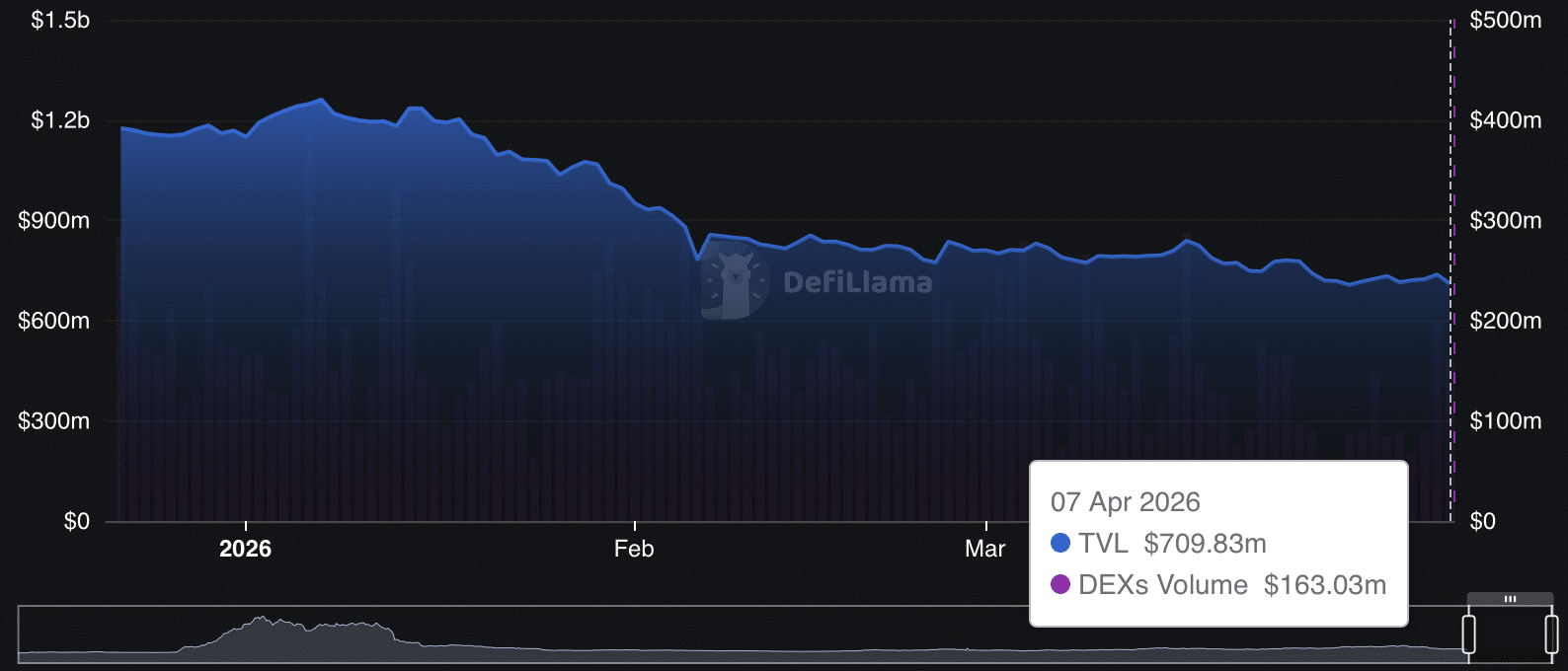
Total Value Locked [TVL] turun menjadi $720 juta, level terendah sejak 9 Juli 2024. Periode itu juga mencerminkan sentimen yang lemah dan aktivitas yang berkurang.
Sumber: DeFiLlama

Aliran keluar yang berkelanjutan menunjukkan investor tetap hati-hati, membatasi keyakinan pada pemulihan jangka pendek.

Selain itu, Volume Pertukaran Terdesentralisasi meningkat secara stabil sejak tanggal 4 April. Peningkatan ini mencerminkan distribusi daripada akumulasi.

Pasar derivatif mempercepat penurunan

Di pasar Derivatif, trader telah memperbesar pergerakan bearish.

Data dari CoinGlass menunjukkan peningkatan yang jelas dalam aktivitas penjualan di seluruh kontrak perpetual AVAX. Rasio Long/Short turun menjadi 0,89, mengkonfirmasi dominasi short.

Rasio di bawah 1 biasanya menandakan bahwa taruhan bearish lebih banyak daripada yang bullish, dan pembacaan saat ini mengarah pada posisi downside yang berkelanjutan.

Pada saat yang sama, Open Interest [OI] turun hampir $37 juta. Hal ini menunjukkan bahwa trader menutup posisi alih-alih menambah risiko.
Sumber: CoinGlass

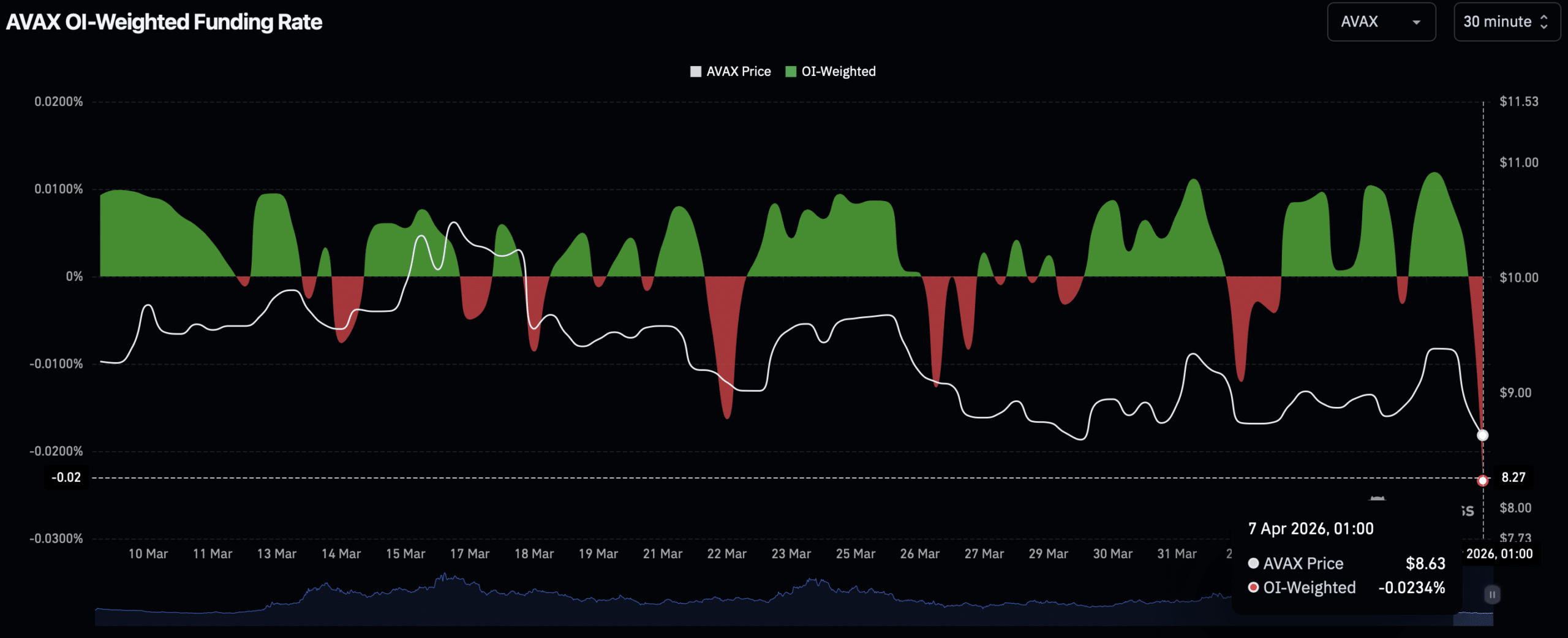
Funding Rates juga berubah menjadi negatif, memperkuat tekanan downside. Struktur ini berarti trader short membayar trader long, mencerminkan bias bearish yang persisten.

Pasar spot mengungkapkan distribusi

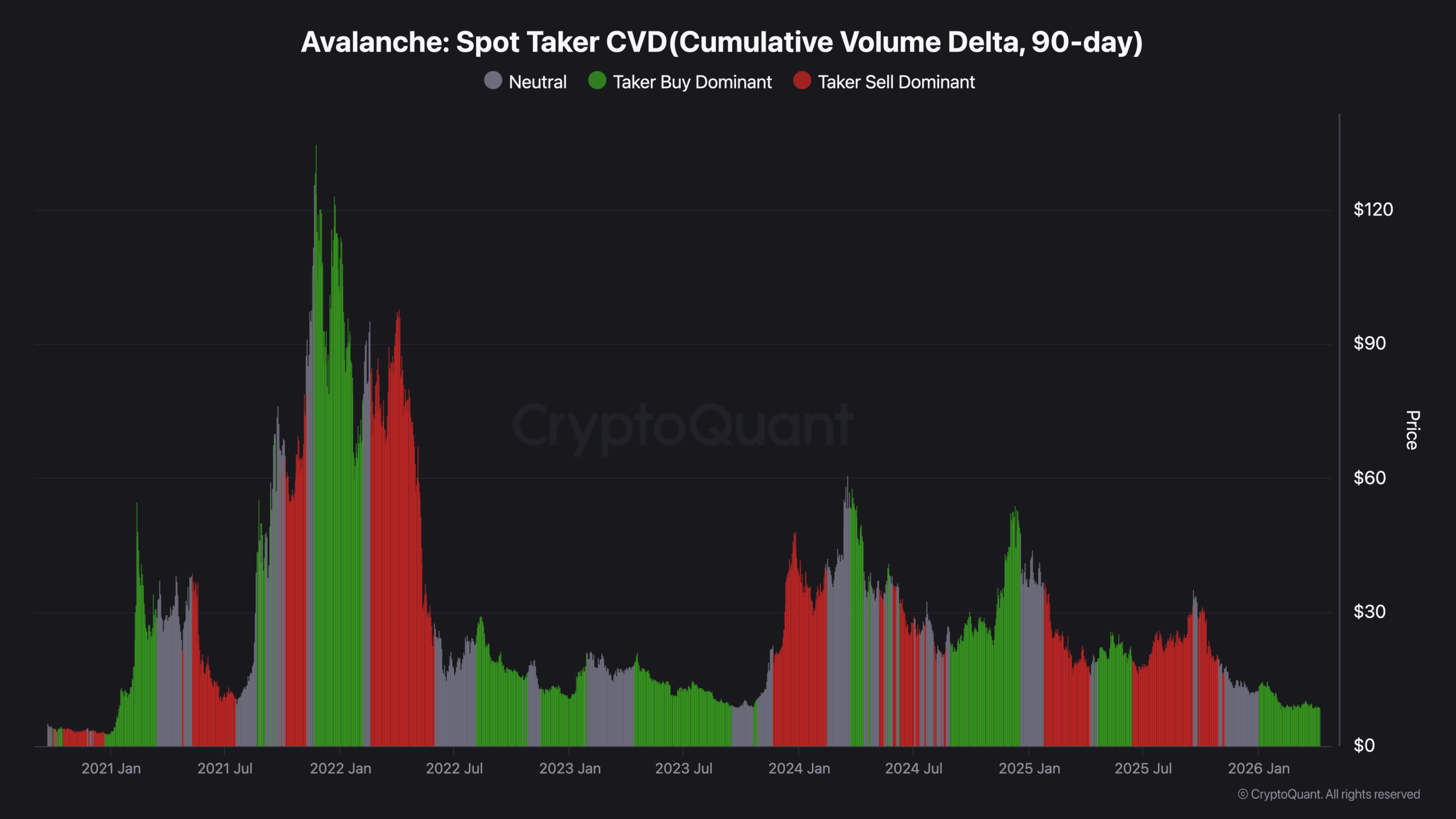
Sebaliknya, data Spot menunjukkan sinyal campuran sebelum selaras dengan tren yang lebih luas.

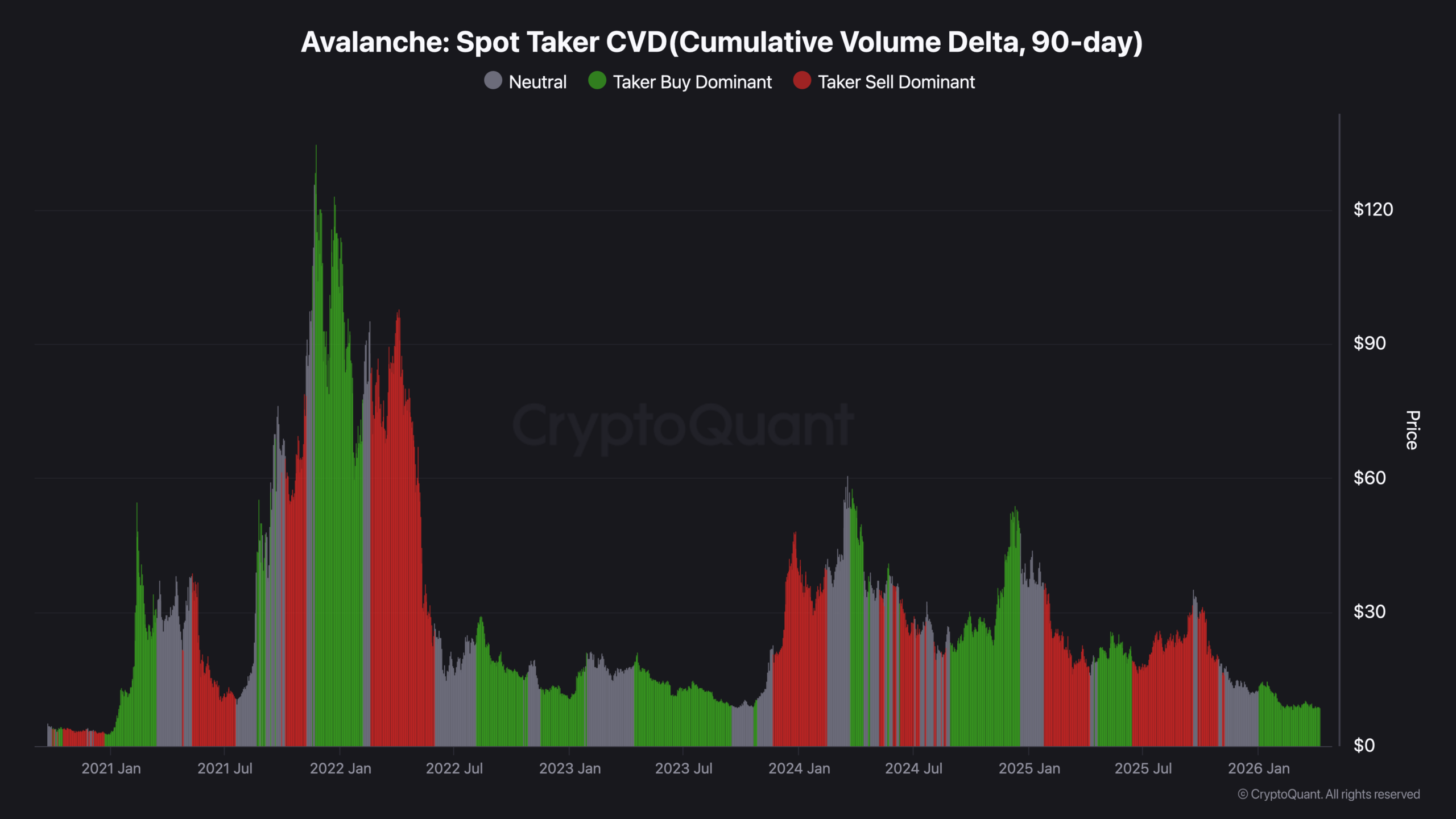
Taker Buy Volume meningkat, menunjukkan adanya permintaan. Namun, Exchange Netflows mengarah pada tekanan jual yang meningkat.

Lebih banyak AVAX yang pindah ke bursa daripada yang ditarik, menandakan potensi distribusi.
Sumber: CryptoQuant

Aliran masuk bersih mencapai $2,26 juta, sementara AVAX senilai $20,46 juta dijual setelah pengumuman.

Urutan itu menunjukkan investor memposisikan diri sebelum berita dan keluar begitu berita itu terwujud.

Untuk saat ini, AVAX tetap berada di bawah tekanan karena fundamental yang lemah dan posisi derivatif yang bearish lebih berat daripada perkembangan institusional.


Ringkasan Akhir

  • AVAX turun karena investor menjual pada saat berita, menggunakan pengumuman sebagai titik keluar daripada pemicu kenaikan.
  • Penurunan TVL ke level terendah tahunan menunjukkan modal meninggalkan ekosistem dan melemahnya aktivitas jaringan.


Trending Cryptos

Related Questions

QMengapa harga AVAX turun hampir 10% meskipun ada integrasi dengan Broadridge?

AHarga AVAX turun karena investor menjual aset mereka setelah pengumuman integrasi, menggunakan momentum berita sebagai titik keluar而不是sebagai pemicu kenaikan harga. Hal ini diperparah oleh melemahnya aktivitas on-chain dan sentimen negatif di pasar derivatif.

QApa yang ditunjukkan oleh penurunan Total Value Locked (TVL) di Avalanche?

ATVL Avalanche turun ke $720 juta, level terendah sejak Juli 2024, yang menunjukkan bahwa modal sedang keluar dari ekosistem dan aktivitas jaringan melemah, mencerminkan sentimen investor yang rendah.

QBagaimana pasar derivatif mempengaruhi penurunan harga AVAX?

APasar derivatif mempercepat penurunan dengan dominasi posisi short (rasio Long/Short 0.89), penurunan Open Interest sebesar $37 juta, dan Funding Rates yang negatif, yang semuanya menunjukkan tekanan jual dan bias bearish yang berkelanjutan.

QApa yang diindikasikan oleh Netflows Exchange yang positif untuk AVAX?

ANetflows Exchange yang positif (inflownya $2.26 juta) menunjukkan lebih banyak AVAX yang masuk ke exchange daripada yang ditarik, menandakan tekanan jual yang meningkat dan potensi distribusi aset oleh investor.

QSiapa yang pertama mengadopsi platform governance Broadridge di Avalanche dan untuk apa?

AGalaxy Digital (NASDAQ: GLXY) menjadi pengadopsi pertama yang berencana menggunakan platform tersebut untuk rapat pemegang saham mereka pada bulan Mei.

Related Reads

Private Credit in US Dollar

Stablecoins are evolving into a new type of money market fund, channeling crypto deposits into the $2 trillion private credit market. This mirrors the 1970s innovation where money market funds pooled small deposits to buy high-yield government securities, bypassing bank restrictions. Today, platforms like Apollo's ACRED tokenized fund and Figure's on-chain lending system allow stablecoin holders to access institutional private credit strategies with no minimum investment, offering yields of 8-12%. On-chain tokenization enables greater liquidity and DeFi composability (e.g., using tokens as collateral for leveraged positions) compared to traditional, locked-up private credit funds. Consequently, on-chain private credit has grown 15x in a year to $5.87 billion, though it remains a tiny fraction (0.3%) of the global market. However, this model carries significant risks, as illustrated by the failure of Goldfinch. Launched in 2021, it directed crypto deposits to motorcycle loans in Kenya and Nigeria. Critical issues included a lack of local oversight, leading to unauthorized fund transfers and borrower defaults. With $56 million now trapped in non-performing loans, its collapse highlights that while blockchain streamlines capital transfer, the essential 90% of lending—underwriting, monitoring, and recovery—remains a costly, localized challenge. Success requires robust, traditional credit infrastructure, not just on-chain execution.

marsbit12m ago

Private Credit in US Dollar

marsbit12m ago

Goldman Sachs: How to Invest in Tech Stocks in the Second Half of the Year?

Goldman Sachs remains bullish on tech stocks in the second half of the year, advising a shift from "buying the sector" to "picking individual companies." The firm's latest report indicates the AI-driven tech cycle shows no signs of peaking, with supply exceeding demand or technological progress slowing yet to materialize. Recent pullbacks are viewed as healthy corrections following rapid gains, not a trend reversal. Three core investment themes are highlighted: 1) Maintain overweight positions in AI server and data center-related hardware stocks. 2) Conduct more nuanced risk-reward assessments in sub-sectors where supply and demand are tightening. 3) During periods of declining risk appetite, consider software and IT services companies leveraging AI to create new business opportunities as a defensive play. The report emphasizes that future outperformance will depend more on individual company competitiveness (alpha) rather than broad sector momentum (beta). Companies likely to excel are those benefiting from price increases, possessing strong capacity expansion capabilities, having undervalued AI growth potential, or holding unique catalysts. For defense, Goldman suggests focusing on AI-enabling software and service firms—such as those in AI consulting, data infrastructure, and cybersecurity—which may see efficiency gains and new demand, rather than retreating to traditional defensive sectors. Overall, the strategy balances offensive exposure to AI infrastructure with defensive positioning in AI-applicable software and services.

链捕手17m ago

Goldman Sachs: How to Invest in Tech Stocks in the Second Half of the Year?

链捕手17m ago

Wall Street's Take on the June Fed Meeting Minutes: Focus on Core Inflation, No Short-Term Urgency to Hike Rates

Wall Street's View on Fed June Minutes: Inflation is the Key, No Urgency for Near-Term Hike The minutes of the Federal Reserve's June FOMC meeting revealed a unified Wall Street interpretation: inflation remains the true determinant for future policy moves. Major institutions including Goldman Sachs, Morgan Stanley, and Citigroup concluded that the Fed remains data-dependent, with its path hinging on upcoming inflation data. Key takeaways from the minutes: * **No Immediate Tightening**: Despite "a few" participants seeing reasons to hike, none actively advocated for it at the June meeting. The consensus was to hold the federal funds rate steady at 3.5%-3.75%. * **Inflation as the Decisive Factor**: The Fed outlined two primary scenarios. If inflation declines "soon" toward the 2% target, "almost all" officials would support maintaining or eventually cutting rates. If inflation persists high due to factors like AI demand or supply shocks, "almost all" would see some policy tightening as necessary. * **Patience is Warranted**: Officials noted inflation remains above target but cited anchored inflation expectations and a labor market not currently driving price pressures as reasons for patience. The Fed is focused on the *direction* of inflation over the next few months. * **No Policy Framework Shift**: The minutes reaffirmed a data-dependent approach rather than a fundamental shift toward pre-emptive tightening. Institutional Forecasts: * **Morgan Stanley**: Expects rates on hold in 2026, with potential cuts in 2027 if inflation cools. * **Goldman Sachs**: Baseline scenario sees rates unchanged through 2026, with inflation moderating gradually. * **Citigroup**: Takes a more dovish view, suggesting market pricing for a July hike is too aggressive and forecasting potential rate cuts starting in late 2026. Overall, the minutes were perceived as marginally dovish, emphasizing a watchful stance on inflation data with no near-term urgency to hike.

marsbit23m ago

Wall Street's Take on the June Fed Meeting Minutes: Focus on Core Inflation, No Short-Term Urgency to Hike Rates

marsbit23m ago

Trump Earns $2.2 Billion Annually, Two-Thirds from Cryptocurrency, with 87 Stock Trades Daily

Former U.S. President Donald Trump reported a personal income exceeding $2.2 billion in 2025, the highest annual income for a sitting president, according to U.S. government financial disclosures. This income primarily stemmed from cryptocurrency ventures and investments, starkly contrasting the standard presidential salary of $400,000. More than two-thirds ($1.4 billion) of his income originated from cryptocurrency-related activities. This includes over $1 billion in Bitcoin and Ethereum holdings, approximately $800 million from World Liberty Financial (a crypto project co-founded with his son), and about $635 million from sales of the TRUMP meme coin. Overall, Trump family crypto operations reportedly generated over $2.3 billion in profit after his 2025 inauguration. Trump's stock portfolio showed heavy trading activity, with over 22,000 trades executed in 2025—averaging 87 trades per day. Major holdings included tech giants like Google, Apple, Nvidia, and Microsoft. Notably, some large-scale stock purchases coincided with major policy announcements, such as tariffs, raising questions about potential insider trading. His traditional business empire, centered on real estate and branding, contributed $575 million. Additionally, he earned nearly $60 million through numerous "DT Marks" licensing companies, which leverage the Trump brand globally in locations like Dubai and Abu Dhabi. The report highlights significant conflicts of interest, as countries like the UAE and Saudi Arabia, whose entities invested in Trump's businesses, later received favorable U.S. policy treatment. Trump has stated he delegates financial management and is not directly involved in day-to-day investment decisions.

Odaily星球日报23m ago

Trump Earns $2.2 Billion Annually, Two-Thirds from Cryptocurrency, with 87 Stock Trades Daily

Odaily星球日报23m ago

Trading

Spot

Hot Articles

Discussions

Welcome to the HTX Community. Here, you can stay informed about the latest platform developments and gain access to professional market insights. Users' opinions on the price of S (S) are presented below.

活动图片