$405M Bitcoin buy puts Metaplanet behind only Strategy and XXI – Details!

ambcryptoPublished on 2026-04-03Last updated on 2026-04-03

Abstract

Metaplanet has become the world’s third-largest public Bitcoin treasury holder after acquiring an additional 5,075 BTC in Q1 2026 for approximately $405 million. The purchase, executed at an average price of $79,898 per Bitcoin, brings the company’s total holdings to 40,177 BTC, with a cumulative cost basis of nearly $4.18 billion. This strategic accumulation reflects Metaplanet’s long-term confidence in Bitcoin despite recent market volatility. The announcement follows a 3% dip in Bitcoin’s price, which fell to around $66,000 after former U.S. President Donald Trump made remarks about escalating military actions in Iran, triggering a brief market sell-off. Despite the short-term decline, Bitcoin showed signs of stabilization, with buying interest returning and technical indicators like the RSI recovering from near-oversold levels. Metaplanet now trails only behind MicroStrategy (762,099 BTC) and Twenty One Capital (43,514 BTC), surpassing other major holders like MARA Holdings. The company’s continued Bitcoin-focused strategy highlights its growing influence among non-U.S. publicly listed firms with significant cryptocurrency treasuries.

Metaplanet is now the world’s third-largest Bitcoin [BTC] treasury company! Its latest buys came after a 3% dip in BTC’s price over the last 24 hours, following U.S President Donald Trump’s war escalation remarks.

While the red candles may be proof of a short-term effect, Metaplanet’s accumulation is evidence of long-term belief in the first cryptocurrency.

Metaplanet’s Q1 BTC buy takes holdings to 40,177 BTC

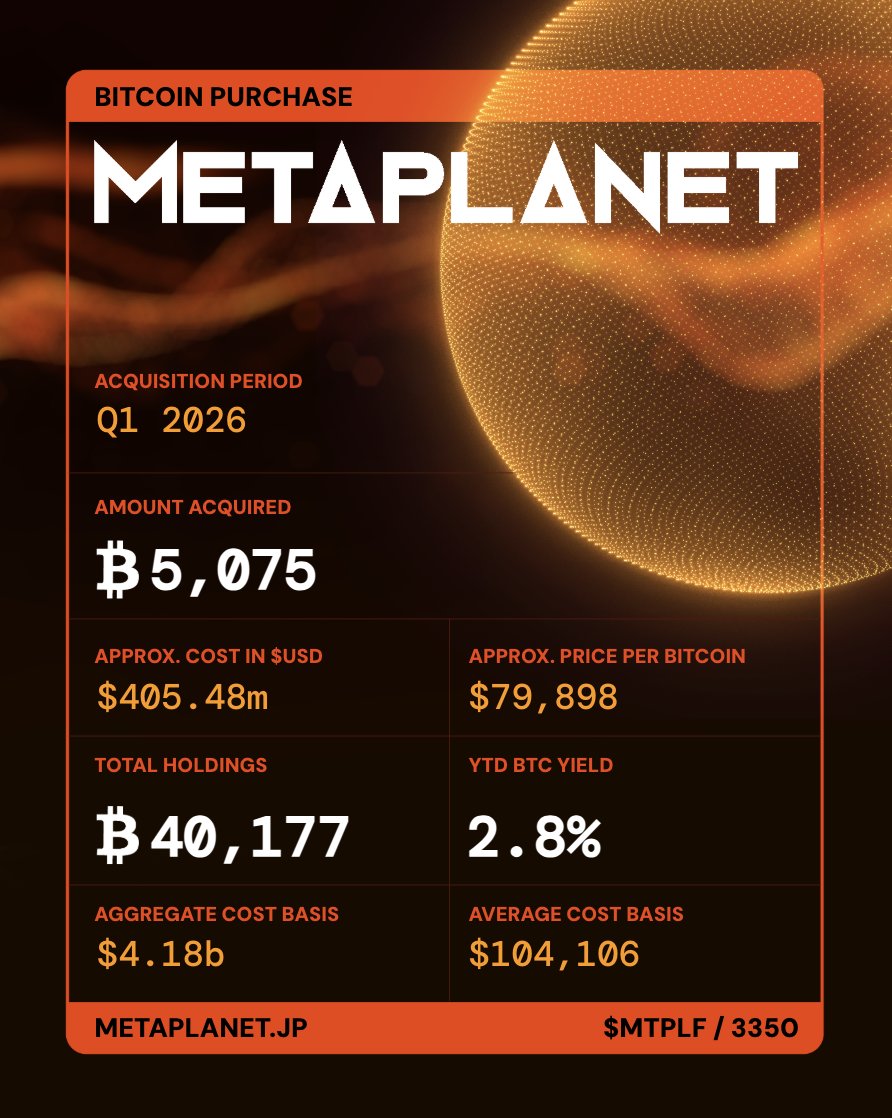
Metaplanet significantly expanded its Bitcoin treasury in the first quarter of 2026, adding 5,075 BTC for roughly $405.48 million. This, according to recent remarks from CEO Simon Gerovich.
Source: Simon Gerovich/X

The purchase was made at an average price of about $79,898 per Bitcoin, taking the company’s total holdings to 40,177 BTC as of 31 March. At current cost basis levels, those holdings were accumulated for nearly $4.18 billion, with an average acquisition price of $104,106 per coin.

The update also highlighted a 2.8% YTD BTC yield for 2026.

Gerovich celebrated the win for Metaplanet, saying,

We keep climbing. Now #3

Metaplanet now 3rd among public Bitcoin treasury firms

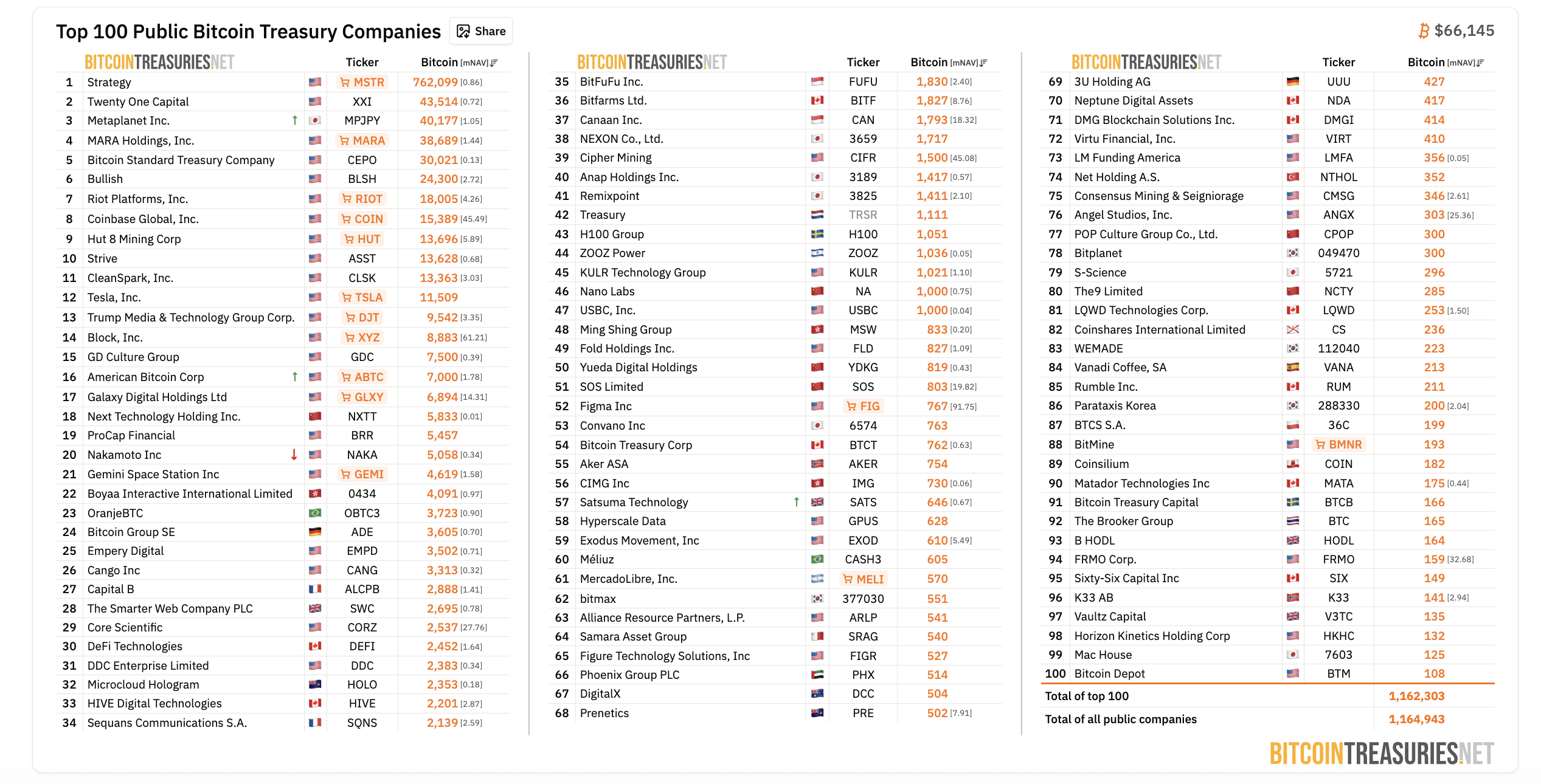
As expected, this has strengthened Metaplanet’s standing among the world’s largest public Bitcoin treasury companies. In fact, based on the latest treasury rankings, the firm is now ranked third globally.
Source: BitcoinTreasuries.Net

At the time of writing, the company was behind Strategy (762,099 BTC) and Twenty One Capital (43,514 BTC). It also moved ahead of MARA Holdings, which held 38,689 BTC.

Metaplanet has scaled its Bitcoin-first treasury strategy in a relatively short period, especially among publicly listed firms outside the United States. While the gap between them and the next-largest holder remains narrow, the latest Q1 addition has given it a clear edge for now.

BTC holds near $66.9K after a 3% slide

Bitcoin’s price has been chaotic over the past 24 hours as risk markets reacted to President Trump’s latest comments on the Iran conflict.

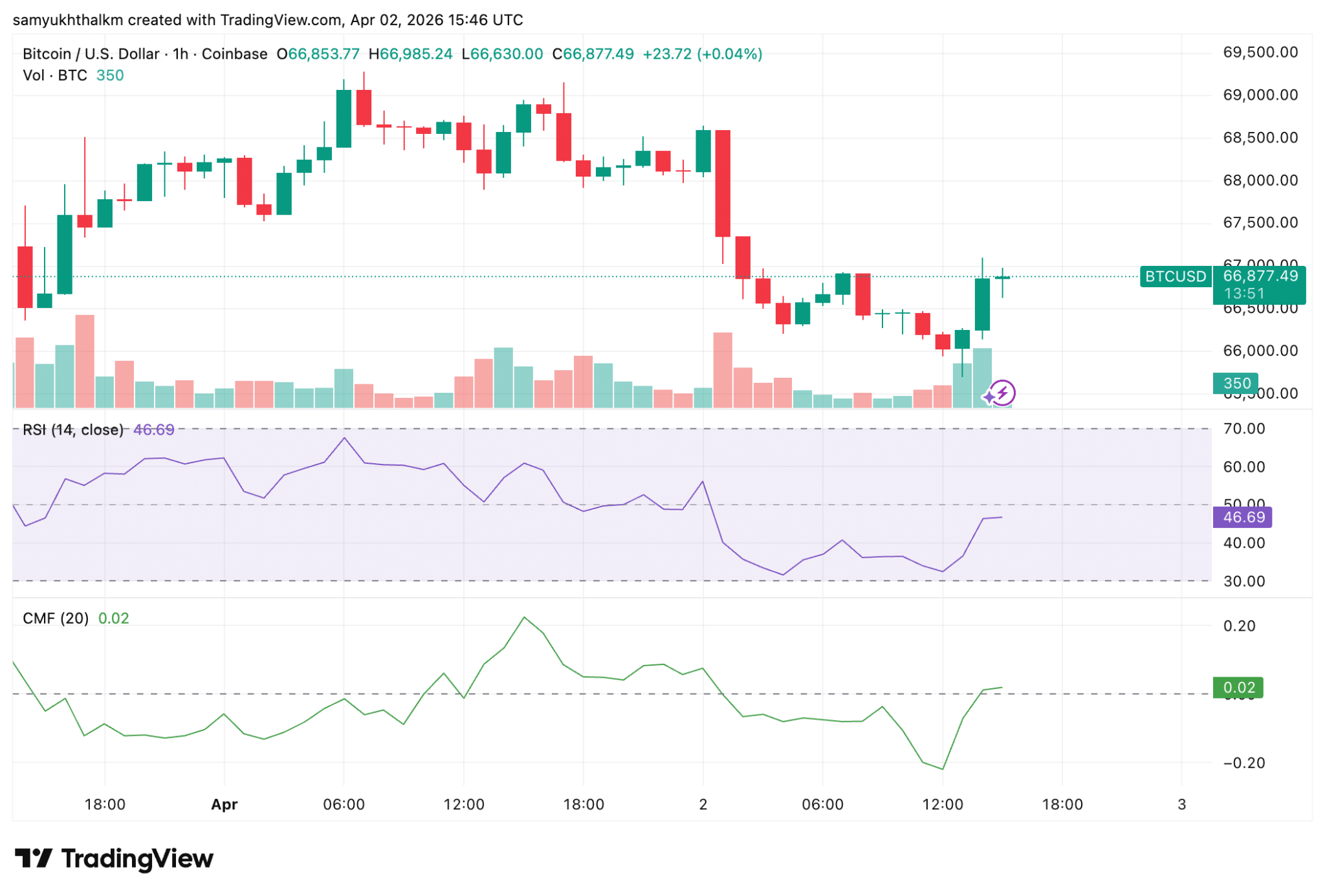
On the hourly chart, BTC briefly slipped from the $68,500-$69,000 zone to near $66,000; an intraday drop of roughly 3% before stabilizing around $66,877 at press time.
Source: Tradingview

The sell-off followed his statements that the war could conclude within “two to three weeks,” while also warning that military action would intensify. This caused a quick risk-off move across crypto.

The RSI recovered from near-oversold levels, while the CMF turned slightly positive at 0.02. Buying interest started to return after the dip too.


Final Summary

  • Metaplanet added 5,075 BTC in Q1 2026, making it the world’s third-largest public Bitcoin treasury.
  • Bitcoin’s price briefly fell by 3% to near $66,000 after Trump’s Iran war comments.

Trending Cryptos

Related Questions

QWhat is Metaplanet's new ranking among the world's largest public Bitcoin treasury companies after its latest purchase?

AMetaplanet is now the world's third-largest public Bitcoin treasury company, behind only Strategy and Twenty One Capital.

QHow many Bitcoins did Metaplanet purchase in Q1 2026 and at what average price?

AMetaplanet purchased 5,075 BTC in Q1 2026 at an average price of about $79,898 per Bitcoin.

QWhat was the total number of Bitcoins held by Metaplanet as of March 31, and what was the total cost basis for these holdings?

AAs of March 31, Metaplanet held 40,177 BTC, which were accumulated for nearly $4.18 billion at an average acquisition price of $104,106 per coin.

QWhat event caused a 3% dip in Bitcoin's price in the last 24 hours, according to the article?

AThe 3% dip in Bitcoin's price was caused by U.S. President Donald Trump's remarks on escalating the war, which caused a risk-off move across crypto markets.

QWhich company did Metaplanet surpass to become the third-largest Bitcoin treasury holder?

AMetaplanet moved ahead of MARA Holdings, which held 38,689 BTC, to become the third-largest holder.

Related Reads

human.tech Launches Clean SDK for Privacy-First Web3 Apps

human.tech has launched the Clean SDK, a toolkit enabling developers to build privacy-first Web3 applications with transparent accountability. Released alongside Aztec's version 5, the SDK provides components for integrating zero-knowledge identity verification, sanctions screening, and private transactions, without developers handling sensitive user data or building compliance infrastructure from scratch. It uses zero-knowledge proofs and programmable verification to allow apps to confirm user legitimacy and sanctions compliance while keeping identities confidential. The first application built on the SDK, Shield, a privacy bridge to Aztec, also launched. It allows users to transfer assets privately while proving a unique human is behind each transfer and that funds have passed sanctions checks, as verified by a May 2026 audit. The SDK offers three core verification techniques: Proof of Innocence (sanctions screening against 23 sources), Proof of Personhood (simpler verification via Human Passport), and Proof of Clean Hands (higher-assurance zero-knowledge government ID checks). This allows apps to authenticate users and transactions without exposing personal data. Designed for Aztec builders, the SDK lets developers add programmable privacy to decentralized apps, eliminating the need to create their own verification and ZK infrastructure. Shield demonstrates its practical use for private bridges, but the SDK aims to enable a wider ecosystem of private, accountable financial apps and services. The launch addresses growing demand for infrastructure that balances privacy and accountability. The SDK avoids traditional identity databases, storing encrypted data off-chain, screening at both entry and exit points, and including a gated disclosure mechanism for legal requests. human.tech's products, including the Clean SDK, focus on using zero-knowledge technology to enable verifiable personhood and privacy in digital systems.

TheNewsCrypto13m ago

human.tech Launches Clean SDK for Privacy-First Web3 Apps

TheNewsCrypto13m ago

Unlocking $100 Million in Liquidity? Pump.fun's New Policy Tests the 5-Minute Pump Technique

Pump.fun, a popular meme coin launchpad, has introduced a new standard mechanism called BOOST. It aims to address a significant capital efficiency issue: when a newly launched token graduates from its initial bonding curve to a liquidity pool (LP), roughly 20% of its liquidity becomes permanently locked as "dead liquidity," estimated to waste over $100 million annually. Instead of locking these funds permanently, BOOST repurposes them. Upon a token's migration, approximately 20% of the settlement funds (e.g., 17.6 SOL or ~$2516 USDC) are used to buy back the token on the open market over a 5-minute period via a Time-Weighted Average Price (TWAP) mechanism. All purchased tokens are immediately burned. This creates a brief, systematic buy pressure immediately after migration, potentially generating a short-term price surge ("pump") while permanently reducing the token's circulating supply. The goal is to enhance the immediate post-launch trading experience, potentially increasing trader retention and sustainable protocol revenue, which funds ongoing token buybacks. However, concerns exist that this artificial 5-minute boost could lower the barrier for launching low-quality tokens and lead to steeper price crashes once the buy pressure stops, if followed by large sell-offs. The feature automatically applies to tokens migrating after July 21, 2024, but not to previously migrated tokens or those launched via the Mayhem AI Agent lab.

marsbit21m ago

Unlocking $100 Million in Liquidity? Pump.fun's New Policy Tests the 5-Minute Pump Technique

marsbit21m ago

Podcast Notes | Conversation with GSR Asset Management Head: To Determine if This Crypto Rally is Real, Just Watch the Lending Rates on Aave

Podcast Summary: Dialogue with GSR's Head of Asset Management: To Determine if This Crypto Rally is Real, Just Check Lending Rates on Aave Andy Baehr, Managing Director of Asset Management at GSR, discusses the current crypto market, characterizing it as stuck in a state of "ambivalence" with short-lived, unsustainable rallies. He outlines a simple framework: the market moves between "ambivalence" and "conviction" (sustained upward momentum). Currently, every rally resembles a single-stage rocket booster that quickly fizzles out. Baehr identifies three key signals to watch: 1) DeFi lending rates, 2) the potential passage of the CLARITY Act, and 3) the market forming a consensus on the "Fed hawkish peak." He emphasizes that the most immediate indicator for the sustainability of the recent CPI-triggered rally is the USDC borrowing rate on Aave, currently around 3.75%—close to U.S. Treasury yields. The absence of a credit spread indicates low leverage demand and a lack of market energy. He explains that a healthy, sustained rally requires layered buying pressure. Last year's rally progressed from an ETH short squeeze to crypto-native trader influx and finally to ETF inflows. Currently, this structure is missing. Other potential structural buyers like Digital Asset Treasury (DAT) companies are absent, and ETF flows have proven transient. Baehr notes that while small-cap crypto tokens outperformed large caps in Q2—a potential sign of capitation in major assets—capital is also flowing to more exciting opportunities like AI stocks and tech IPOs, leaving crypto sidelined. Regarding DeFi, he highlights that platforms like Aave provide a clear, real-time signal of leverage demand through their supply/demand-driven interest rates. A significant, sustained rate increase would signal genuine market conviction. He also observes the quiet emergence of fixed-income-like products and vaults in DeFi. On regulation, the probability of the CLARITY Act passing before the August 7th deadline has dropped linearly from 75% to below 40% on Polymarket. Baehr suggests its passage would be treated as a bullish surprise, a potent driver for price movement. However, political hurdles, including ethical clause debates and disclosures about the First Family's crypto profits, remain significant obstacles. Ultimately, the market awaits clarity on the Fed's terminal rate under Chair Warsh. Until the "Fed Solstice"—the point where the market collectively understands the peak of hawkish policy—sustained conviction will be difficult to achieve.

marsbit52m ago

Podcast Notes | Conversation with GSR Asset Management Head: To Determine if This Crypto Rally is Real, Just Watch the Lending Rates on Aave

marsbit52m ago

Trading

Spot

Hot Articles

What is $BITCOIN

DIGITAL GOLD ($BITCOIN): A Comprehensive Analysis Introduction to DIGITAL GOLD ($BITCOIN) DIGITAL GOLD ($BITCOIN) is a blockchain-based project operating on the Solana network, which aims to combine the characteristics of traditional precious metals with the innovation of decentralized technologies. While it shares a name with Bitcoin, often referred to as “digital gold” due to its perception as a store of value, DIGITAL GOLD is a separate token designed to create a unique ecosystem within the Web3 landscape. Its goal is to position itself as a viable alternative digital asset, although specifics regarding its applications and functionalities are still developing. What is DIGITAL GOLD ($BITCOIN)? DIGITAL GOLD ($BITCOIN) is a cryptocurrency token explicitly designed for use on the Solana blockchain. In contrast to Bitcoin, which provides a widely recognized value storage role, this token appears to focus on broader applications and characteristics. Notable aspects include: Blockchain Infrastructure: The token is built on the Solana blockchain, known for its capacity to handle high-speed and low-cost transactions. Supply Dynamics: DIGITAL GOLD has a maximum supply capped at 100 quadrillion tokens (100P $BITCOIN), although details regarding its circulating supply are currently undisclosed. Utility: While precise functionalities are not explicitly outlined, there are indications that the token could be utilized for various applications, potentially involving decentralized applications (dApps) or asset tokenization strategies. Who is the Creator of DIGITAL GOLD ($BITCOIN)? At present, the identity of the creators and development team behind DIGITAL GOLD ($BITCOIN) remains unknown. This situation is typical among many innovative projects within the blockchain space, particularly those aligning with decentralized finance and meme coin phenomena. While such anonymity may foster a community-driven culture, it intensifies concerns about governance and accountability. Who are the Investors of DIGITAL GOLD ($BITCOIN)? The available information indicates that DIGITAL GOLD ($BITCOIN) does not have any known institutional backers or prominent venture capital investments. The project seems to operate on a peer-to-peer model focused on community support and adoption rather than traditional funding routes. Its activity and liquidity are primarily situated on decentralized exchanges (DEXs), such as PumpSwap, rather than established centralized trading platforms, further highlighting its grassroots approach. How DIGITAL GOLD ($BITCOIN) Works The operational mechanics of DIGITAL GOLD ($BITCOIN) can be elaborated on based on its blockchain design and network attributes: Consensus Mechanism: By leveraging Solana’s unique proof-of-history (PoH) combined with a proof-of-stake (PoS) model, the project ensures efficient transaction validation contributing to the network's high performance. Tokenomics: While specific deflationary mechanisms have not been extensively detailed, the vast maximum token supply implies that it may cater to microtransactions or niche use cases that are still to be defined. Interoperability: There exists the potential for integration with Solana’s broader ecosystem, including various decentralized finance (DeFi) platforms. However, the details regarding specific integrations remain unspecified. Timeline of Key Events Here is a timeline that highlights significant milestones concerning DIGITAL GOLD ($BITCOIN): 2023: The initial deployment of the token occurs on the Solana blockchain, marked by its contract address. 2024: DIGITAL GOLD gains visibility as it becomes available for trading on decentralized exchanges like PumpSwap, allowing users to trade it against SOL. 2025: The project witnesses sporadic trading activity and potential interest in community-led engagements, although no noteworthy partnerships or technical advancements have been documented as of yet. Critical Analysis Strengths Scalability: The underlying Solana infrastructure supports high transaction volumes, which could enhance the utility of $BITCOIN in various transaction scenarios. Accessibility: The potential low trading price per token could attract retail investors, facilitating wider participation due to fractional ownership opportunities. Risks Lack of Transparency: The absence of publicly known backers, developers, or an audit process may yield skepticism regarding the project's sustainability and trustworthiness. Market Volatility: The trading activity is heavily reliant on speculative behavior, which can result in significant price volatility and uncertainty for investors. Conclusion DIGITAL GOLD ($BITCOIN) emerges as an intriguing yet ambiguous project within the rapidly evolving Solana ecosystem. While it attempts to leverage the “digital gold” narrative, its departure from Bitcoin's established role as a store of value underscores the need for a clearer differentiation of its intended utility and governance structure. Future acceptance and adoption will likely depend on addressing the current opacity and defining its operational and economic strategies more explicitly. Note: This report encompasses synthesised information available as of October 2023, and developments may have transpired beyond the research period.

973 Total ViewsPublished 2025.05.13Updated 2025.05.13

What is $BITCOIN

Discussions

Welcome to the HTX Community. Here, you can stay informed about the latest platform developments and gain access to professional market insights. Users' opinions on the price of BTC (BTC) are presented below.

活动图片















