4 Years After Terra’s Collapse, Hodlnaut’s Former CEO Faces Fraud Charges In Singapore Court

bitcoinistPublished on 2026-05-26Last updated on 2026-05-26

Abstract

Zhu Juntao, co-founder and former CEO of the defunct Singapore crypto lender Hodlnaut, has been charged with fraud by false representation in a Singapore court. The charges relate to alleged misleading statements made to users in mid-2022, claiming the platform had no exposure or losses from the Terra (UST) collapse. Investigations later revealed Hodlnaut lost nearly $190 million from Terra, contributing to a $193 million shortfall that led to its liquidation. Zhu pleaded not guilty to all six charges, which carry potential imprisonment of up to 20 years. His case highlights ongoing legal accountability efforts stemming from the 2022 crypto market contagion.

Zhu Juntao, co-founder and former Chief Executive Officer of the now-defunct Singapore-based crypto lending platform Hodlnaut, was charged in a Singapore court on May 26, 2026 with fraud by false representation — nearly four years after the Terra/LUNA ecosystem implosion triggered a $193 million financial shortfall that ultimately ended the platform and stranded more than 30,000 users worldwide.

The charges were announced by the Commercial Affairs Department of the Singapore Police Force, which has been investigating Hodlnaut and its directors since November 2022. Zhu, 36, faces six counts in total — three under Section 424A(1)(a) read with Section 424A(3) of Singapore’s Penal Code 1871, and three under the same provision read together with Section 109 of the same code, which covers abetment. If convicted on each charge, he faces imprisonment of up to 20 years, a fine, or both, per the police statement.
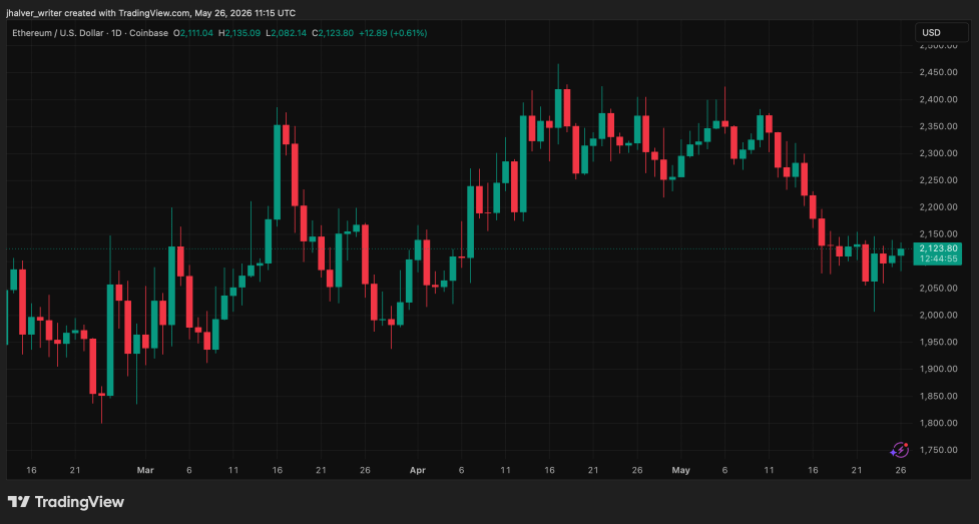
ETH's price moving sideways, per the daily chart. Source: ETHUSD on Tradingview

What The Charges Allege

The fraud charges center on a specific window: May to July 2022, the weeks immediately following TerraUSD’s catastrophic de-pegging in early May of that year. According to the Singapore Police Force’s official statement, Zhu allegedly directed Hodlnaut employees to make misleading statements on the company’s official Telegram group and in emails sent directly to users — assertions that Hodlnaut had no direct exposure to UST and had not suffered losses from the collapse.

The statements, as documented in Mothership SG’s reporting of court filings, included a post in which Hodlnaut wrote that it had “not taken any losses as a firm” and that only users who personally held UST were affected. Zhu also allegedly directed a separate employee to email 30 recipients stating the company had assumed no losses. Those statements, prosecutors now allege, were false and intended to deceive users during the most critical period of the platform’s deterioration.

What Actually Happened With Terra

The judicial record that emerged after Hodlnaut suspended withdrawals in August 2022 told a starkly different story. An interim judicial managers’ report seen by Bloomberg found that Hodlnaut had lost nearly $190 million through its exposure to the collapsed Terra ecosystem — a figure the platform had actively downplayed to users while the losses accumulated. On-chain analytics firms subsequently confirmed material exposure to UST and TerraForm Labs-linked activity that Hodlnaut had not previously acknowledged.

Court documents filed in Singapore in August 2022, when the platform sought creditor protection, disclosed a $193 million financial shortfall. Court-appointed managers later confirmed an additional $13.1 million in user assets were stranded on the collapsed FTX exchange.

Hodlnaut was subsequently ordered to liquidate by Singapore’s High Court, with EY partners appointed as joint liquidators. Zhu indicated he was not guilty and disputed all charges at his May 26 hearing — a pre-trial conference has been scheduled for June 2026, per Channel News Asia.

This development marks a significant moment for the nascent sector’s long-running accountability reckoning following the 2022 crypto contagion. The Terra collapse set off a chain of platform failures — Celsius, Voyager, Three Arrows Capital, and eventually FTX among them — that collectively cost retail users hundreds of billions of dollars.

That four years have elapsed between Hodlnaut’s collapse and its former CEO’s first day in court is itself a reflection of how slowly the legal system processes crypto’s most consequential failures — and a reminder that the cases are far from closed.

Cover image from Grok, ETHUSD chart from Tradingview

Trending Cryptos

Related Questions

QWhat specific charges does Zhu Juntao face in the Singapore court, and under which laws?

AZhu Juntao faces six counts of fraud by false representation. Three counts are under Section 424A(1)(a) read with Section 424A(3) of Singapore's Penal Code 1871, and three counts are under the same provision read together with Section 109 of the same code, which covers abetment.

QWhat was the alleged falsehood communicated by Hodlnaut during the May-July 2022 period, according to the charges?

AAccording to the charges, Zhu Juntao allegedly directed employees to make misleading statements on Telegram and via email, asserting that Hodlnaut had no direct exposure to UST and had not suffered any losses from the Terra collapse. In reality, the platform had lost nearly $190 million from its exposure.

QWhat was the total financial shortfall and additional user asset loss reported for Hodlnaut following the Terra collapse?

ACourt documents disclosed a $193 million financial shortfall. Additionally, court-appointed managers later confirmed that an extra $13.1 million in user assets were stranded on the collapsed FTX exchange.

QWhat was the final outcome for the Hodlnaut platform as ordered by the Singapore High Court?

AHodlnaut was ordered to be liquidated by Singapore's High Court, with EY partners appointed as joint liquidators.

QHow did Zhu Juntao plead to the charges during his court hearing on May 26, 2026?

ADuring his hearing on May 26, 2026, Zhu Juntao indicated he was not guilty and disputed all charges.

Related Reads

Is Ethereum Truly a "World Computer"?

Ethereum has long been branded as a "world computer," yet its current infrastructure reveals significant geographic concentration, challenging this claim. An analysis of validator node distribution shows the network heavily leans toward Western nations. The U.S. alone hosts 38.19% of all validators, while Germany accounts for 13.04%, meaning these two countries comprise over half the network. Notably, a substantial portion of U.S. validators are residential nodes run from home connections, reflecting grassroots participation. In contrast, representation from Asia, South America, the Middle East, and Africa is minimal. Examining only professionally-operated institutional validators shows a more balanced picture, with countries like Singapore, Hong Kong, Japan, and South Korea collectively reaching nearly 25%. This shift indicates strategic institutional deployment to meet local regulatory requirements and reduce latency for regional users. A core problem is Ethereum's peer-to-peer gossip protocol, which systematically disadvantages regions with low node density. Late message arrival reduces a node's "peer score," pushing it to the network's periphery, further delaying future messages. This can impact validator rewards and network performance in these areas, posing a challenge to decentralization. However, this geographic imbalance also presents a significant opportunity. For Ethereum to truly become a global settlement layer, localized infrastructure is essential. Pioneering reliable validator operations in underserved regions like the Middle East, South America, or Africa could establish a crucial first-mover advantage, meeting growing demand for compliant, low-latency staking services in these markets.

marsbit27m ago

Is Ethereum Truly a "World Computer"?

marsbit27m ago

Trading

Spot

Hot Articles

Discussions

Welcome to the HTX Community. Here, you can stay informed about the latest platform developments and gain access to professional market insights. Users' opinions on the price of S (S) are presented below.

活动图片