# Data Infrastructure Related Articles

HTX News Center provides the latest articles and in-depth analysis on "Data Infrastructure", covering market trends, project updates, tech developments, and regulatory policies in the crypto industry.

Two Funding Rounds Secured in 40 Days, Embodied Data Practitioner Enters the Arena

Investment news outlet learned on August 12th that ScaleForce, an Embodied AI data infrastructure company, has raised two funding rounds within 40 days from investors including top domestic embodied AI industry players, Hengxu Capital, and Capital Today. Established less than three months ago, ScaleForce has already secured a multi-million-yuan data order from its lighthouse customer, TaShi Zhihang. It has also established collaborations with multiple world model companies, leading embodied intelligence hardware manufacturers, and industry solution providers. Founder Guo Jiangliang believes that the competition in embodied intelligence has entered its second phase, which focuses on data and intelligence. ScaleForce aims to enable data to flow through the entire lifecycle of physical AI, fostering infinite intelligence within the physical world. The immense popularity of embodied intelligence contrasts sharply with a severe shortage of high-quality, real-world interactive data needed for training. Unlike large language models that can scrape training material from the internet, embodied AI requires multimodal physical interaction data involving vision, touch, joint trajectories, object mechanics, and environmental temporal alignment, which must be collected in the real world. The industry faces challenges such as uncontrollable data quality, insufficient scale, and poor data generalization across different robotic platforms. ScaleForce addresses these issues with its core product, the MatrixOS physical AI operating system. It features the ADA (Action-Data Alignment) data generalization engine, which reportedly increases cross-platform task success rates from 65% to 92%. Its GDP (Global-Deep-Proactive) data quality engine employs various analytical methods to optimize data collection, achieving an 80% usable conversion rate. The company has built a global, scalable data production network with over 95% automation, utilizing human-centric collection paradigms and sub-millisecond multi-sensor synchronization kits. MatrixOS functions as a comprehensive data "production system" for embodied intelligence, connecting the physical world for data acquisition, processing, and management, then delivering it to models and applications. ScaleForce is building what it claims will be the world's largest and lowest-cost high-quality data production and distribution network. The company has secured its position in the emerging embodied AI data industry chain by providing tailored scene data to hardware makers, real physical interaction data to world model companies, and task-specific data closed loops to industry clients. Its partnership network includes world model firms like ZhiZai WuJie, Huawei's Ascend ecosystem, and academic institutions like Peking University and Beihang University. International expansion is also underway, starting in Southeast Asia. The founding team brings deep industry experience. Founder Guo Jiangliang was a founding member of Baidu Intelligent Cloud and former Technology VP of AInnovation. Chief Scientist Alex, a Peking University PhD, has held core roles at Meta AI and Huawei Noah's Ark Lab. The team's combined expertise in technology, product, and commercialization forms the foundation for ScaleForce's rapid progress. With 2026 considered the "first year of embodied data," and 2027-2029 viewed as a critical window for the scaled commercialization of humanoid robots, the demand for robust data infrastructure is poised for significant growth. As companies like Unitree approach IPOs, the next phase of competition in embodied intelligence will heavily rely on data, marking a crucial time window for the embodied data sector.

marsbit08/12 02:46

Two Funding Rounds Secured in 40 Days, Embodied Data Practitioner Enters the Arena

marsbit08/12 02:46

They Raised 17 Billion in Six Months: Data "Tool Sellers" Became the Most Profitable Business in the Embodied Intelligence Track

Over the past six months, data-centric companies serving the embodied AI sector (robotics) have secured over 17 billion RMB in funding in China, highlighting "data" as the most profitable niche. These "shovel sellers"—providing crucial data, models, and infrastructure for training robots—are flourishing despite robots themselves not yet being widely profitable. The surge is driven by a severe scarcity of high-quality physical interaction data needed for robot training. Companies are tackling this through five main approaches: 1) **Teleoperation/Haptic Data**: Building factories for high-precision data collection (e.g., Paxini, Noitom Robotics). 2) **Simulation/Synthetic Data**: Generating vast amounts of virtual training data (e.g., Lightwheel Intelligence, Transcend Dimension). 3) **UMI/Portable Collection**: Using wearable devices to capture human motions directly, bypassing robots (e.g., Jianzhi Robotics, Tashizhihang). 4) **Video Distillation/World Models**: Extracting actionable data from internet videos or using AI world models (e.g., Shutu Technology, Deep Genius). 5) **Data Infrastructure/Platforms**: Offering data processing, standardization, and platform services (e.g., Wuwen Zhike, Yiren Technology). Key players include LiberAI (founded by a 00-year-old PhD), which focuses on human UMI data and world models and recently raised hundreds of millions, and Lightwheel Intelligence, which became a unicorn and secured large orders. However, the industry faces a critical dependency: most data buyers are unprofitable robotics startups relying on venture capital. Data company revenues essentially redistribute this investment. Long-term viability likely belongs only to companies that become essential industry-standard platforms or masters of continuous, high-quality data supply for real-world deployment. The boom is real, but its sustainability hinges on the success of the broader embodied AI ecosystem.

marsbit08/05 08:27

They Raised 17 Billion in Six Months: Data "Tool Sellers" Became the Most Profitable Business in the Embodied Intelligence Track

marsbit08/05 08:27

Qingyan Jingzhun Raises Hundreds of Millions in Funding, with Investment from National Equipment Manufacturing Giants

Qingyan Precision, a provider of physical AI infrastructure, has secured billions of RMB in Series B financing. The investment round, led by prominent automotive industry funds and notably featuring the state-owned China National Machinery Industry Corp. (Sinomach) fund, underscores a strategic shift in the capital market towards companies with proven industrial application capabilities. The company positions itself as the "engineering foundation for physical AI," specializing in enabling embodied intelligence (like humanoid robots) to operate in complex, real-world industrial environments. Its core offering is the "TsingLoop" multi-modal data engineering pipeline, which captures and standardizes data from physical workspaces (like visual, force, and process parameters) to create reusable data assets. This system supports a "Robot-in-the-Loop" testing framework that validates robotic performance in digital twin simulations and real-world conditions before deployment. Qingyan Precision leverages over eight years of experience and a network of 2000+ industrial sensor nodes across sectors like automotive and mining. This provides a crucial "training ground" for embodied AI models. The founding team combines academic pedigree from Tsinghua University and Stanford with deep industry experience from leading robotics firms. The company's vision is to build "one foundation, one brain, and hundreds of vertical applications," using its data platform and industrial world model to deploy scalable physical intelligence across various industrial tasks.

marsbit07/13 04:30

Qingyan Jingzhun Raises Hundreds of Millions in Funding, with Investment from National Equipment Manufacturing Giants

marsbit07/13 04:30

Nearly a Hundred Players Rush into Embodied Data: With 4.47 Billion Yuan in Financing in One Year, Who Can Really Make Money by 'Selling Data'?

The domestic embodied AI data industry has attracted nearly 100 players, with 70 focused on data collection and 27 on data infrastructure. In the past year, 15 independent embodied data service providers raised approximately 4.47 billion yuan. Despite this growth, the sector remains early-stage, fragmented, and faces significant challenges. Data collection methods are diverse, categorized into four main routes: teleoperation of real robots, human demonstration without a robot (using motion capture, exoskeletons, etc.), simulation synthesis, and distillation from internet videos. Most companies (43%) adopt hybrid approaches, combining multiple routes, as no single method can meet all training needs. Teleoperation alone is pursued by 31% of players, often by state-owned platforms and robot companies, while newer firms favor asset-light, no-hardware human demonstration. Independent data service providers now form the largest player group (40%), indicating the emergence of a distinct industry segment rather than just a subsidiary function for robot makers. Two-thirds of all players are "embodied-native" startups, while one-third are companies that pivoted from fields like AI data annotation, which are more prevalent in the data infrastructure layer. Current annual industry capacity is estimated at 1.6-1.8 million hours plus 70-80 million data points, with a short-term goal to increase this 15-20 fold within 1-3 years. Data collection factories are spread across 20 provinces in China, concentrated in the Yangtze River Delta, Beijing-Tianjin-Hebei, and Pearl River Delta regions. Financially, the 4.47 billion yuan raised in the past year pales compared to the 43.8 billion yuan raised by the broader embodied intelligence sector in just the first half of 2026, highlighting that data remains a less "sexy" bet for investors. The 15 funded independent providers show clear stratification: a top tier led by a unicorn (Lightwheel Intelligence, 3.1 billion yuan), a middle tier of 11 firms raising tens to hundreds of millions, and an early-stage tier of 3 companies. Sixty-nine investment institutions have participated, but none have made concentrated bets, reflecting uncertainty about viable business models. Over half of these funded companies are less than a year old, most are at pre-A or A rounds, and profitability remains largely unproven. In summary, the embodied data industry has become an independent track creating jobs and local economic activity. However, it is still nascent, with unformed consensus, unsolved problems, and unproven business models. The coming 1-2 years will be a critical validation window to see if companies can build sustainable, profitable businesses purely by "selling data."

marsbit07/12 02:30

Nearly a Hundred Players Rush into Embodied Data: With 4.47 Billion Yuan in Financing in One Year, Who Can Really Make Money by 'Selling Data'?

marsbit07/12 02:30

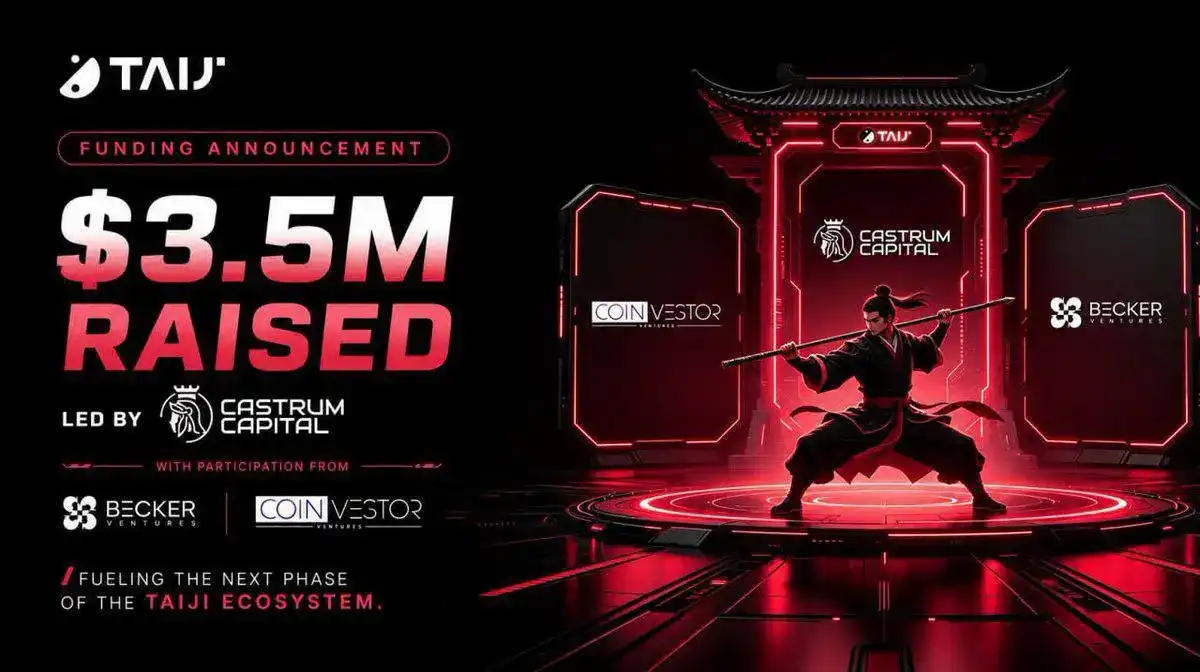
TaiJi Completes $3.5 Million Strategic Financing with Participation from Castrum Capital, Becker Ventures, and Coinvestor Ventures

TaiJi, an AI-driven market intelligence platform for Web3, has completed a $3.5 million strategic funding round. The investment was led by Castrum Capital, Becker Ventures, and Coinvestor Ventures. The funds will be allocated to product R&D, upgrading its AI inference engine, building a multi-agent analysis system, improving market data infrastructure, expanding its global community, and advancing ecosystem partnerships, particularly within the BSC ecosystem. TaiJi aims to transform how users understand the Web3 market by moving beyond simple data display. It integrates market data, on-chain signals, liquidity changes, social sentiment, and news events into a unified AI system. This system generates structured event inferences, impact pathways, risk assessments, and follow-up indicators. The platform's core approach involves a multi-agent framework where specialized agents (Market, On-chain, Sentiment, Risk, Event) collaboratively analyze disparate signals to produce coherent market intelligence. Its initial product will feature modules including Market Intelligence, a Scenario Engine for AI-powered event analysis, an Impact Map, Risk Signals, and a personalized user dashboard called "My TaiJi." TaiJi emphasizes that it does not custody user assets, execute trades, provide investment advice, or promise returns. Following this funding round, the company plans to accelerate product development and testing, gradually rolling out its core features to the broader Web3 market.

marsbit06/02 09:47

TaiJi Completes $3.5 Million Strategic Financing with Participation from Castrum Capital, Becker Ventures, and Coinvestor Ventures

marsbit06/02 09:47

活动图片