Conflit entre les deux fondateurs du vieux projet de blockchain chinois NEO, l'opacité financière en est la cause principale

marsbitPubblicato 2026-01-01Pubblicato ultima volta 2026-01-01

Introduzione

Absence de transparence financière au sein de la fondation NEO : les deux cofondateurs de l'ancienne blockchain chinoise s'affrontent publiquement Erik Zhang (张铮文) et Da Hongfei (达鸿飞), cofondateurs de NEO depuis 2014, sont engagés dans un conflit public concernant la gestion financière opaque de la fondation NEO. Zhang, noyau technique du projet, a quitté NEO il y a quelques années avant de revenir en septembre dernier. Le différend a éclaté en novembre lorsque Zhang a demandé l'accès aux rapports financiers détaillés de la fondation, ce qui lui a été refusé. Zhang accuse Da Hongfei de contrôler seul les actifs de la fondation (hors jetons NEO/GAS) sans aucun mécanisme d'audit transparent. Il révèle que son départ initial était dû à une proposition de Da pour "améliorer l'efficacité", mais qu'il est revenu après avoir découvert que Da utilisait les ressources de NEO pour développer sa propre blockchain EON. En décembre, Zhang a exigé que Da honore ses engagements de transparence financière et a annoncé unilatéralement qu'à partir du 1er janvier 2026, Da ne participerait plus aux affaires du réseau principal NEO. Da Hongfei a contre-attaqué en affirmant que Zhang contrôle la majorité des fonds de l'écosystème NEO et retarde délibérément leur transfert vers une adresse multisignature. Da a promis de publier un rapport financier pour fin 2025 au premier trimestre 2026.

Il est surprenant qu'un vieux projet de blockchain chinois en arrive là, et ce qui est encore plus triste, c'est que les projets d'IA chinois de premier plan comme Manus, Kimi et Minimax ont eu des nouvelles importantes pendant deux jours consécutifs, soit acquis pour des milliards de dollars, soit ayant levé des centaines de millions, mais cette vieille blockchain en est à se déchirer.

Il semble actuellement que les deux cofondateurs de la blockchain NEO, fondée en 2014, Zhang Zhengwen (Erik Zhang) et Da Hongfei, soient pratiquement en rupture totale, continuant de s'affronter sur X. En se basant sur leurs déclarations et les informations publiques disponibles en ligne, tentons de comprendre ce qui s'est passé entre ces deux fondateurs de cette vieille blockchain.

Opacité financière

En fait, Zhang Zhengwen avait quitté NEO il y a quelques années, ce qu'il a confirmé sur son propre compte Twitter, puis il est officiellement revenu en septembre de cette année. L'élément déclencheur de ce conflit remonte à novembre. Selon des messages de la communauté et des documents publics, Zhang Zhengwen, noyau technique du projet, a rencontré des obstacles en cherchant à obtenir le rapport financier détaillé de la Fondation Neo et la destination des fonds.
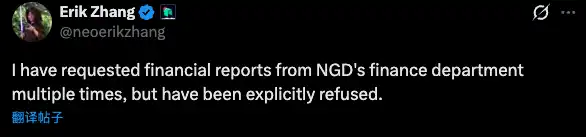
Par la suite, Zhang Zhengwen a accusé la Fondation Neo de fonctionner depuis longtemps de manière opaque, avec une situation patrimoniale qualifiée de « boîte noire ». Il a indiqué que Da Hongfei contrôlait seul de manière prolongée les actifs de la fondation autres que les jetons NEO/GAS, et qu'il manquait un mécanisme de divulgation complet et auditable.

Dans leur échange mutuel aujourd'hui, nous avons également découvert la raison du départ précédent de Zhang Zhengwen. Il a déclaré que Da Hongfei l'avait contacté seul, disant que la direction conjointe des deux pour NEO était inefficace, c'est pourquoi il avait choisi de se retirer temporairement de la gestion pour « améliorer l'efficacité ». Cependant, il a découvert que Da Hongfei utilisait les ressources de NEO pour développer un projet indépendant de blockchain, EON. Ceci l'a poussé à revenir et à intervenir dans la gouvernance de la fondation.

Lors des échanges communautaires de novembre, Zhang Zhengwen avait déclaré que NEO s'était auparavant appuyé sur des hackathons pour créer une « prospérité artificielle », sans utilisateurs réels, de nombreux projets de hackathon disparaissant après avoir reçu des prix.

Escalade du conflit

En décembre, Zhang Zhengwen a publié une déclaration publique, exigeant que Da Hongfei remplisse ses obligations de divulgation financière promises depuis le 9 décembre. Plus explosif encore, Zhang Zhengwen a annoncé unilatéralement que, conformément à un accord téléphonique antérieur entre les deux parties, à compter du 1er janvier 2026, Da Hongfei ne participerait plus aux affaires du mainnet de NEO, se concentrant plutôt sur le développement et l'exploitation de la sidechain NeoX et du nouveau projet SpoonOS.

Da Hongfei a immédiatement répondu, affirmant que Zhang Zhengwen contrôlait en réalité la grande majorité des fonds de l'écosystème NEO (y compris les actifs principaux que sont les jetons NEO et GAS), et dirigeait le droit de vote des nœuds de consensus. Il a également accusé Zhang Zhengwen d'avoir retardé pendant des années, sous divers prétextes (comme attendre la fin de la migration vers N3), le transfert des fonds vers l'adresse multisignature (Multisig) de la fondation.

Da Hongfei a promis de publier le rapport financier de fin 2025 au premier trimestre 2026, et de partager au préalable les données préliminaires.


Domande pertinenti

QQuel est le principal point de discorde entre les deux cofondateurs de NEO, Erik Zhang et Da Hongfei ?

ALe principal point de discorde est le manque de transparence financière. Erik Zhang accuse Da Hongfei de contrôler de manière unilatérale les actifs de la Fondation NEO (autres que les jetons NEO/GAS) dans une "boîte noire", sans mécanisme complet et vérifiable de divulgation.

QPourquoi Erik Zhang a-t-il initialement quitté NEO, selon ses propres déclarations ?

AErik Zhang a déclaré qu'il avait initialement quitté la direction parce que Da Hongfei lui avait dit que la direction conjointe des deux était inefficace. Il a donc choisi de se retirer temporairement pour "améliorer l'efficacité".

QQu'est-ce qui a motivé le retour d'Erik Zhang et son implication dans la gouvernance de la Fondation NEO ?

ASa motivation pour revenir a été la découverte que Da Hongfei utilisait les ressources de NEO pour développer un projet de blockchain indépendant appelé EON.

QQuelle mesure Erik Zhang a-t-il annoncée de manière unilatérale concernant le rôle de Da Hongfei à partir de 2026 ?

AErik Zhang a annoncé unilatéralement qu'à partir du 1er janvier 2026, Da Hongfei ne participerait plus aux affaires du mainnet de NEO et se concentrerait plutôt sur le développement et l'exploitation de la sidechain NeoX et du nouveau projet SpoonOS.

QQuelle est la réponse de Da Hongfei aux accusations concernant le contrôle des actifs ?

ADa Hongfei a répliqué en affirmant qu'Erik Zhang contrôlait en fait la grande majorité des fonds de l'écosystème NEO (y compris les actifs principaux que sont les jetons NEO et GAS) et détenait le pouvoir de vote des nœuds de consensus. Il a également accusé Zhang d'avoir retardé pendant des années, sous divers prétextes, le transfert de ces fonds vers l'adresse multisig de la Fondation.

Letture associate

The Trillion-Yuan Market Cap 'Yi Zhong Tian': Who is the True Value King?

The article analyzes the three leading Chinese optical module companies, collectively nicknamed "Yi Zhong Tian": Xinyisheng, Zhongji Innolight, and TFC Optical Communication. It evaluates their "cost-performance" not by current stock price, but through three lenses: PEG ratio (growth vs. valuation), earnings quality, and premium/discount for certainty. Xinyisheng shows the most attractive PEG ratio and high profitability, but its valuation reflects discounts for risks like high customer concentration and reliance on overseas markets. Zhongji Innolight, the most expensive, commands a premium for its market leadership, dominant share in key products like 800G/1.6T modules, and higher earnings certainty, though it faces geopolitical risks. TFC Optical, as an upstream component supplier ("water seller"), has the highest gross margin and bets on the long-term CPO/NPO architecture trend, but trades at a high valuation with more stable, less explosive growth. The core argument is that while these companies dominate module assembly, the true profit pool and technological moat lie upstream in laser and switch chips, currently controlled by U.S. firms like Lumentum and Coherent. The long-term "cost-performance" for these Chinese leaders hinges on whether the domestic industry, exemplified by companies like Yuanjie Technology, can successfully move up the value chain into high-power laser chips. Otherwise, their high growth may remain confined to the lower-margin assembly segment.

marsbit3 min fa

The Trillion-Yuan Market Cap 'Yi Zhong Tian': Who is the True Value King?

marsbit3 min fa

Has the Crypto Market Bottomed? Here's What Institutions Think

The crypto market is in a period of significant debate, with leading institutions offering differing views on whether a bottom has been reached. Three prominent firms have published detailed analyses: * **Galaxy Digital** argues Bitcoin has **not yet bottomed**. Their analysis of 13 historical indicators across six dimensions (valuation, profit-taking, miner pressure, etc.) shows only four are fully met. They project a potential bottom range between $30k and $54k. * **NYDIG** states a bottom is **possible but not likely**. While metrics are close to historic bear market extremes, they note the absence of a classic panic-selling event. They also suggest increased institutional adoption may have structurally altered the market cycle, potentially leading to a shallower downturn. * **Standard Chartered Bank** asserts the **bottom has already occurred** at around $59k. They cite two key factors: potential US-Iran diplomatic progress and the anticipated SpaceX IPO, which they believe absorbed capital and caused ETF selling pressure that is now subsiding. They forecast a year-end price target of $100k. Despite the surface-level disagreement, the reports share critical common ground more valuable for long-term investors: 1. All three believe the market bottom will form **within this year**. 2. All agree the current price is **closer to the bottom than to previous highs**. 3. All maintain a **bullish long-term outlook** for Bitcoin and a new cycle. The core takeaway is that while the exact bottom price ($40k, $50k, or $60k) is debated, the consensus is that a bottom is imminent. For long-term holders, the primary focus should not be pinpointing the absolute low, but on the future potential for prices to reach $100k, $200k, or higher. The fundamental thesis for Bitcoin—sovereign debt accumulation, inflation, declining trust in centralized institutions, global digitization, and improved accessibility—remains intact and is arguably strengthening. The overall landscape is viewed as more favorable than in previous crypto winters.

marsbit13 min fa

Has the Crypto Market Bottomed? Here's What Institutions Think

marsbit13 min fa

The 'Chip' Challenge and Breakthroughs in China's Optical Industry Chain

China's Photonics Industry: Bottlenecks and Breakthroughs In the global AI race, computing chips dominate the narrative, but the underlying bottleneck increasingly defining the scale of AI clusters is light—or more specifically, optical connectivity. Optical modules, which translate electrical signals to light and vice versa, are crucial for connecting thousands of GPUs in AI data centers, preventing data congestion and ensuring efficient model training. High-speed modules (800G, 1.6T) are now standard, with performance hinging on advanced DSP (Digital Signal Processor) chips. This is where a critical dependency lies. Two US giants—Marvell and Broadcom—collectively dominate over 90% of the high-end DSP chip market. Chinese optical module leaders like Zhongji Innolight and Eoptolink rely on these chips to manufacture modules for overseas AI customers, primarily in North America. While this creates a supply chain vulnerability, complete decoupling is difficult. Marvell derives over half its revenue from Greater China, and the US firms depend on Chinese partners for chip packaging and optical components. The risk from laser chips (e.g., from Lumentum), another key component, is considered more manageable due to multiple global suppliers and faster progress in domestic alternatives from companies like YOFC and Accelink. To mitigate risks, China's industry is pursuing a multi-pronged strategy: diversifying supply chains and locking in long-term orders; fostering a domestic market ecosystem to adopt homegrown DSPs from firms like Huawei HiSilicon and CETC; accelerating R&D in high-speed DSPs and advanced packaging; and investing in next-gen technologies like silicon photonics and Co-Packaged Optics (CPO) to reduce reliance on discrete DSPs. The ultimate solution lies not in short-term博弈 but in persistent advancement of domestic high-end chip R&D and manufacturing. While challenges remain in performance, certification, and ecosystem building, China's vast domestic market and manufacturing base provide a crucial buffer, buying time for the industry to achieve greater technological independence.

marsbit27 min fa

The 'Chip' Challenge and Breakthroughs in China's Optical Industry Chain

marsbit27 min fa

Behind SpaceX's $2 Trillion Market Cap: Why Does Musk Always Have the Next Move Planned?

On June 12th, SpaceX debuted on the Nasdaq, reaching a valuation that briefly touched $2 trillion. This marked the culmination of a 24-year journey from its founding in 2002, driven by Elon Musk's frustration at the high cost of buying rockets. The company's path was defined by early failures, with its first three Falcon 1 launches ending in explosions before a successful 2008 flight opened the era of commercial spaceflight. Key to its model was a fixed-price NASA contract, incentivizing cost reduction. SpaceX mastered rocket reusability, first achieving a Falcon 9 landing in 2015, which drastically cut launch costs. This enabled its profitable Starlink satellite internet constellation, envisioned years before reusability was proven, to create an internal market for frequent launches. Similarly, the next-generation Starship rocket was in development long before its first flight, with its business case evolving from Mars colonization to supporting the emerging concept of in-orbit data centers for AI—a story now central to its valuation. The company's recent IPO, a reversal of its long-standing "no IPO" stance, is funding this ambitious "space-based compute" vision. While major tech players like Google, Blue Origin, and others are investing heavily, significant technical and cost hurdles remain. Ultimately, SpaceX's history is one of creating its own demand: first with Starlink and now with space-based AI compute, betting that its next rocket will enable its next giant market.

marsbit30 min fa

Behind SpaceX's $2 Trillion Market Cap: Why Does Musk Always Have the Next Move Planned?

marsbit30 min fa

Trading

Spot
Futures

Articoli Popolari

Come comprare CORE

Benvenuto in HTX.com! Abbiamo reso l'acquisto di CORE (CORE) semplice e conveniente. Segui la nostra guida passo passo per intraprendere il tuo viaggio nel mondo delle criptovalute.Step 1: Crea il tuo Account HTXUsa la tua email o numero di telefono per registrarti il tuo account gratuito su HTX. Vivi un'esperienza facile e sblocca tutte le funzionalità,Crea il mio accountStep 2: Vai in Acquista crypto e seleziona il tuo metodo di pagamentoCarta di credito/debito: utilizza la tua Visa o Mastercard per acquistare immediatamente CORECORE.Bilancio: Usa i fondi dal bilancio del tuo account HTX per fare trading senza problemi.Terze parti: abbiamo aggiunto metodi di pagamento molto utilizzati come Google Pay e Apple Pay per maggiore comodità.P2P: Fai trading direttamente con altri utenti HTX.Over-the-Counter (OTC): Offriamo servizi su misura e tassi di cambio competitivi per i trader.Step 3: Conserva CORE (CORE)Dopo aver acquistato CORE (CORE), conserva nel tuo account HTX. In alternativa, puoi inviare tramite trasferimento blockchain o scambiare per altre criptovalute.Step 4: Scambia CORE (CORE)Scambia facilmente CORE (CORE) nel mercato spot di HTX. Accedi al tuo account, seleziona la tua coppia di trading, esegui le tue operazioni e monitora in tempo reale. Offriamo un'esperienza user-friendly sia per chi ha appena iniziato che per i trader più esperti.

229 Totale visualizzazioniPubblicato il 2024.12.13Aggiornato il 2026.06.02

Come comprare CORE

Discussioni

Benvenuto nella Community HTX. Qui puoi rimanere informato sugli ultimi sviluppi della piattaforma e accedere ad approfondimenti esperti sul mercato. Le opinioni degli utenti sul prezzo di CORE CORE sono presentate come di seguito.

活动图片












