Balaji Srinivasan has distilled 15 years of crypto experimentation down to a stark claim: after Bitcoin, only two core protocol breakthroughs truly matter—Ethereum for programmability and Zcash for privacy.
In a wide-ranging appearance on Mert Mumtaz’s “Accelerate with Mert” podcast, Srinivasan argued that the industry has already completed the “programmability era” and is now entering a decisive phase where privacy and zero-knowledge cryptography become central to crypto’s mission. “The two major innovations on Bitcoin were programmability in the form of Ethereum and privacy in the form of Zcash,” he said.
From Bitcoin To Programmability To Zcash
Srinivasan breaks crypto’s history into three arcs. First, Bitcoin simply had to prove that non-sovereign, cryptographic money could work at all. Then, Ethereum generalized that into a programmable platform with smart contracts, stablecoins, NFTs, DEXs and on-chain capital markets.
By now, he argued, that second phase is effectively validated. “We now have scalable on-chain smart contracts that can support [a] large number of users, large numbers of transactions with finality. There’s multiple good chains. It works. It runs 24/7,” he said, noting that crypto is already functioning in developing markets: “In Bolivia, they quote prices in Tether. In Nigeria, they save in Bitcoin. This stuff is no longer theory. It’s actually there.”
The next phase, he says, is privacy by design. “Now the next eight years… privacy,” Srinivasan said. “Taking everything we just did and encrypting it using ZK.” That includes ZK-based KYC (“ZKYC”), privacy-preserving DEXs, and smart contracts that reveal only the minimum necessary information. He pointed to industry work showing how traditional KYC could be replicated with zero-knowledge proofs: “If you nail ZK then you can replace the entire [compliance] system.”
This is where Zcash matters: not as a marketing brand, but as the first mainstream proof that advanced zero-knowledge privacy can be embedded at the protocol level. Ethereum represents programmability; Zcash represents privacy. In Srinivasan’s framing, the future is about merging those ideas—Ethereum-style expressivity with Zcash-style cryptographic concealment—across L1s, rollups and application-specific systems.
.@balajis thinks the next 8 years in crypto will be the age of privacy.
2009-2017: proving Bitcoin would work
2017-2025: proving programmability + scalability would work
2025 onwards: privacy pic.twitter.com/LrU8ATsZI8— genzcash (@genzcash) November 13, 2025
Srinivasan pushed back hard on the idea that crypto is now primarily a speculative or commercial arena. “Crypto isn’t just about the commercial part,” he said. “It’s about the ideological part. It’s about the fact that the banks have failed. It’s about the fact the political system has failed. It’s about the fact that we need an exit. It’s about the fact that we need self-sovereignty. And the missing part of that is privacy.”
He compared this to the way Christmas is often defended by religious believers as more than shopping and Santa. “Remember the reason for the season” becomes, in his telling, a reminder that crypto’s “season” is about exit and self-sovereignty, not just yield, DeFi and token prices. Privacy, he argued, is what reconnects modern “commercial crypto” to those original cypherpunk and anti-censorship roots.
Notably, Srinivasan is a long-time advocate for ZK based technologies. In November 2024, he wrote via X: “Yes, Zcash is great and it’s already fit for purpose. One can continue using it for private transactions. But ZK is to encryption what the transformer is to AI. It generalizes many special case hacks into a new compute paradigm. We will get a ZK economy. So we do want a chain with ZK primitives in addition to a simple Zcash-like chain.”
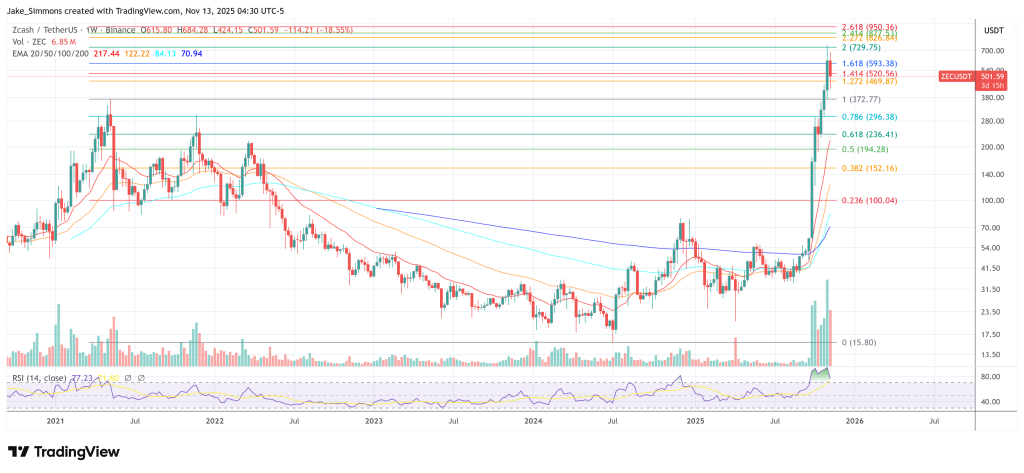
At press time, ZCash traded at $501.59.

Related Posts