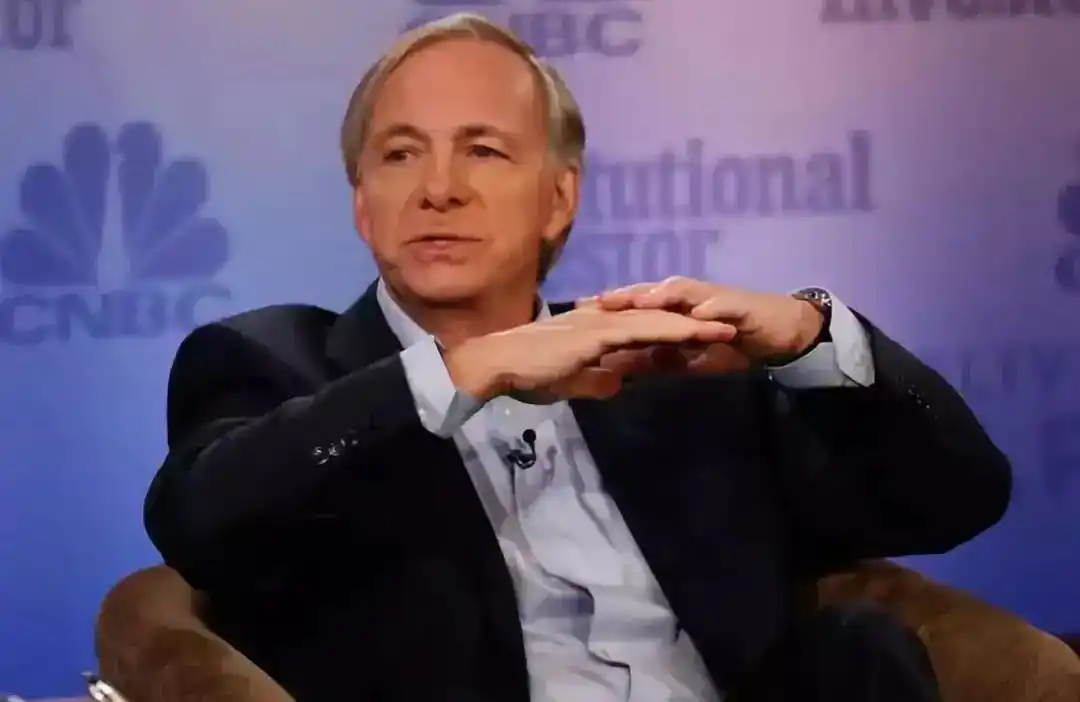
In an interview with Bloomberg’s Haslinda Amin on the sidelines of Token2025, Cardano founder Charles Hoskinson sketched an unabashedly expansionary roadmap for both crypto markets and the Cardano ecosystem, arguing that the next phase of adoption will be institutional, privacy-aware, and integrated with legacy finance—and that Cardano is positioned to be a core settlement layer in that world. The X quip that Cardano will “break the internet,” he said, was less a meme than a signal of the scope of partnerships and primitives he believes are nearing product readiness.
Bitcoin And Crypto Enter The Bull Run: Hoskinson
Hoskinson dismissed the latest market drawdown as a transient pause. “Quick pit stop at the gas station,” he said when asked if the recent sell-off suggested fading momentum. He described crypto’s underlying strength as “incredibly strong,” tying the next leg to policy catalysts. “The Clarity Act is likely to get passed and bring institutional players in,” he argued, placing regulation—not retail cycles—at the heart of the coming expansion.
On macro linkages, Hoskinson urged investors to decide what they believe crypto is—a high-beta tech proxy or a counter-cyclical hedge—because the answer shapes expectations through rate and dollar regimes. “When the dollar is weak, it wakes up,” he noted, adding that crypto has recently tracked tech, then gold, with the goal that the asset class becomes “large enough to be in its own asset class.”
He remains explicitly constructive on Bitcoin, placing a marker on timing and magnitude while cautioning his trading acumen: “I think by the middle of next year, $250,000 Bitcoin… depends on the macroeconomics… I’m the worst trader in the world.” The message was less a price call than a framing device: if institutions drive the next cycle, flows and correlations will not look like prior, retail-led four-year rhythms. “Those cycles were retail driven… this [one is] institutional and [about the] Clarity Act… a billion users,” he said, adding that banks are stirring “because the Genius Act,” which he cast as a bridge for mainstream capital.
Pressed on whether enthusiasm could be derailed by tariffs, geopolitics, or slower-than-expected easing, Hoskinson acknowledged the sector is “not immune to the macro,” reminding that heightened uncertainty makes allocators “more conservative and wait to deploy capital.” Yet he returned to a secular bull thesis: “I think we are headed towards the bull market,” with crypto continuing to “follow tech stocks” even as it matures toward standalone status.
Why Cardano Could ‘Break The Internet’
The interview’s pivot—and the line that lit up social media—was Amin’s reference to his recent post that “Cardano is going to break the internet.” Hoskinson tied the rhetoric to concrete pillars: an energized community, expanding collaborations, and privacy-preserving infrastructure designed for regulated finance.
“We’re having a lot of fun… a lot of wonderful partnerships and collaborations like Google Cloud,” he said, adding that the ecosystem “has been running and [has] never been hacked,” which in his view underpins why “a lot of institutional [capital sees Cardano as] one of the blue chips of the industry.”
For Hoskinson, the last mile between blockchains and capital markets is privacy and programmability that fit compliance envelopes. “Tokens are financial brain cells… Having 24/7 global settlement is a really powerful thing. Only thing missing is privacy,” he said. The remedy, he argued, is contract design that separates public and private data paths so that broker-dealers and custodians can meet obligations without forfeiting blockchain’s composability. “You need contracts to sort out the public side and private side… solving that last mile problem,” he said. Once such rails exist, “there is no reason to run on the legacy system.”
He located the time horizon in a regulatory cadence rather than a product roadmap alone. “Next three to five years,” he said when asked when this flips. “The regulation is getting done and [then] two to three years of rulemaking… every jurisdiction in Europe [will] be operable and [we’ll] not talk about tokens in securities law [terms]. We can adapt our software accordingly. Everything else is sky is the limit.”
Cardano’s privacy-focused Midnight stack is the bet he described as tailored to Wall Street workflows, according to Hoskinson. “We have Midnight coming out… a big bet because we wanted something for Wall Street and something for the custodians and exchanges [to] tokenize what they have and bring it into the crypto space,” he said.
The project, he added, is “coming towards the end of the year,” framed as a bridge for legacy financial institutions to issue and settle assets with policy-compliant confidentiality on public rails. That emphasis on privacy and compatibility also informed his comments about reconciling blockchains with supervisors. “We’re talking [to] the Federal Reserve and SEC and now we have to reconcile the legacy world,” he said. “Everybody has a role to play… It’s going to take a little bit of time what privacy looks like and how global settlement is going to look like.”
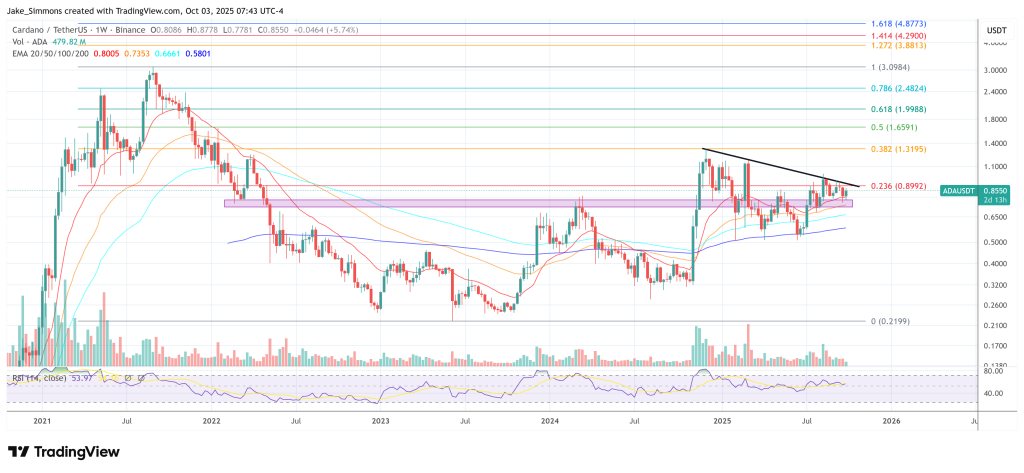
At press time, ADA traded at $0.855.

Related Posts