Tether’s Uruguay Mining Operations Stall Due To $5-M Energy Debt — Details

bitcoinistPublished on 2025-09-21Last updated on 2025-09-21

Abstract

Tether’s expansion into Bitcoin mining in Uruguay has run into a major setback after the state-owned electricity provider UTE suspended...

Trusted Editorial content, reviewed by leading industry experts and seasoned editors. Ad Disclosure

Tether’s expansion into Bitcoin mining in Uruguay has run into a major setback after the state-owned electricity provider UTE suspended service to the stablecoin operator’s two mining facilities over unpaid bills of roughly $5 million. The disruption, confirmed on July 25, 2025, comes only two years after Tether unveiled the Bitcoin mining project in the South American nation, citing a rich supply of renewable energy sources.

Tether’s Operational Fallout With Rising Energy Bill

According to local media Busqueda, the payment defaults by Tether began in May 2025. By June, UTE’s president, Andrea Cabrera, signed a Memorandum of Understanding (MoU) with Microfin, the local operator tied to the mining project, in an effort to negotiate a settlement. However, after arrears continued to mount, UTE invoked standard procedures, using security deposits before suspending power supply at the mining sites in Flores and Florida on July 25.

The power cut produces immediate operational consequences, compromising the facilities’ computing nodes and reducing hash rate output, while slowing down general expansion goals. Meanwhile, restarting the sites will also incur additional costs, from renegotiating contracts to restoring technical capacity. And even such processes often require weeks, depending on the guarantees offered and compliance with regulatory protocols.

Tether entered Uruguay in 2023 with plans to leverage the country’s renewable energy profile through its “Tether Energy” initiative. Uruguay generates approximately 95% of its electricity from non-fossil sources, making it one of the most attractive jurisdictions globally for “low-carbon” industrial activity. The project was positioned as a step toward diversifying Tether’s business model beyond stablecoin issuance, with ambitions to eventually secure 1% of Bitcoin’s global hash rate.

Back in 2023, the company’s CTO, Paolo Ardoino, said about the project: 

By harnessing the power of Bitcoin and Uruguay’s renewable energy capabilities, Tether is leading the way in sustainable and responsible Bitcoin mining; Our unwavering commitment to renewable energy ensures that every Bitcoin we mine leaves a minimal ecological footprint while upholding the security and integrity of the Bitcoin network. Tether is proud to spearhead a movement that combines cutting-edge technology, sustainable practices, and financial innovation

Following the recent revelations by the Uruguayan media, neither Tether nor Microfin has yet to reveal their official position.

USDT Reaches New Market Cap High At $171.5 Billion

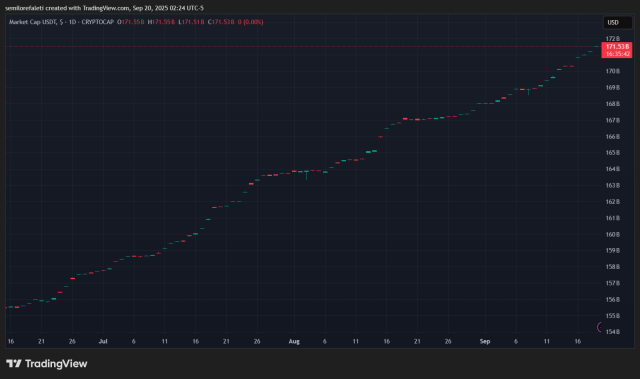
In other news, Tether’s stablecoin USDT has attained a new market cap value of $171.5 billion, strengthening its dominant market position. Presently, USDT now accounts for 58.9% of the stablecoins market while remaining the fourth largest cryptocurrency in the world.

Tether
USDT market cap valued at $171.53 billion | Source: Tradingview.com
Featured image from Flickr, chart from Tradingview
Editorial Process for bitcoinist is centered on delivering thoroughly researched, accurate, and unbiased content. We uphold strict sourcing standards, and each page undergoes diligent review by our team of top technology experts and seasoned editors. This process ensures the integrity, relevance, and value of our content for our readers.

Semilore Faleti works as a crypto-journalist at Bitconist, providing the latest updates on blockchain developments, crypto regulations, and the DeFi ecosystem. He is a strong crypto enthusiast passionate about covering the growing footprint of blockchain technology in the financial world.

Trending Cryptos

Related Reads

The Full Story of How Crypto Unicorn Blockstream Is Mired in Serious Fraud Allegations

This article details serious allegations of fraud against Bitcoin infrastructure company Blockstream, founded by Bitcoin pioneer Adam Back. In June 2024, investigative account NatInfoSec published a report accusing Blockstream's mining note (BMN) program of potentially operating a multi-billion dollar scheme with Ponzi-like characteristics. The core allegations focus on Blockstream Mining Notes (BMNs), which offer investors fixed annual yields up to approximately 20% from Bitcoin mining. NatInfoSec's investigation raises several key issues: 1. **Suspicious Hashrate & Payout Capacity**: The analysis suggests Blockstream would need 20-45 EH/s of mining power to cover its BMN obligations, but its public dashboard shows only around 15 EH/s. Furthermore, no verifiable public evidence (e.g., grid connection records, import data) was found to support the massive mining operation required. 2. **Questionable Payout Source**: The BMN contract allows Blockstream to use Bitcoin from *any source* (Substitute Performance BTC) to fulfill investor payouts, raising concerns that payouts may not come from actual mining revenue. 3. **High-Risk, Fixed Returns**: Offering ~20% fixed yields in the volatile, cyclical Bitcoin mining industry is viewed as highly unusual and requires clear explanation. 4. **Undisclosed Criminal Record of Key Figure**: Christopher William Cook, a key figure in Blockstream's mining operations and CEO of spin-off Exacore, was found to have a federal felony conviction for mail fraud in 2008, a fact not disclosed in BMN offering documents. His background was also allegedly embellished. 5. **Potential Contagion to BSTR SPAC**: Questions were raised about whether these liabilities and Cook's record should have been disclosed in the SEC filings for Bitcoin Standard Treasury Company (BSTR), a separate Adam Back-associated firm planning a SPAC merger. The crypto community is divided. BitMEX Research validated Cook's criminal record and expressed concern over the high yields but found other evidence lacking or misleading, noting the legal separation between BMN, Blockstream, and BSTR. Blockstream defenders, like Samson Mow, argue the mining is real. Critics, however, emphasize the lack of independent, verifiable proof of the mining operation's scale and the true source of investor payouts. The article concludes that BMN remains shrouded in key unanswered questions regarding its actual size, the verifiability of its underlying mining assets and payouts, the source of its high yields, and the full role and disclosure concerning Chris Cook. Blockstream had not issued a comprehensive response at the time of writing.

marsbit8h ago

The Full Story of How Crypto Unicorn Blockstream Is Mired in Serious Fraud Allegations

marsbit8h ago

Trading

Spot
Futures

Hot Articles

Discussions

Welcome to the HTX Community. Here, you can stay informed about the latest platform developments and gain access to professional market insights. Users' opinions on the price of S (S) are presented below.

活动图片