Record Outflows Hit Crypto Funds, But Ethereum May Be Turning the Tables on Bitcoin

bitcoinistPublished on 2025-08-26Last updated on 2025-08-26

Abstract

Crypto asset investment products recorded their most significant outflows in months, as investor sentiment swung sharply amid signals from US...

Trusted Editorial content, reviewed by leading industry experts and seasoned editors. Ad Disclosure

Crypto asset investment products recorded their most significant outflows in months, as investor sentiment swung sharply amid signals from US monetary policymakers. According to the latest report from CoinShares, a total of $1.43 billion exited crypto investment vehicles last week, the heaviest weekly outflow since March.

CoinShares noted that trading volumes in exchange-traded products (ETPs) rose to $38 billion over the same period, around 50% above the 2025 average.

This increase in trading activity reflected polarized market sentiment, as investors weighed the Federal Reserve’s policy outlook.  James Butterfill, head of research at CoinShares, explained:

Outflows of $2 billion were recorded in the first part of the week, but sentiment shifted after Jerome Powell’s address at the Jackson Hole Symposium, which many interpreted as more dovish than expected. By the end of the week, we saw inflows of $594 million.

Divergence Between Bitcoin and Ethereum Flows

While the market overall faced pressure, the performance of Bitcoin and Ethereum diverged. Bitcoin bore the brunt of outflows, losing around $1 billion, while Ethereum’s outflows were more limited at $440 million.

The mid-week rebound particularly favored Ethereum, which now shows $2.5 billion in net inflows month-to-date, compared to Bitcoin’s $1 billion in outflows.

This shift has adjusted the year-to-date picture for both assets. Ethereum inflows now represent about 26% of total assets under management (AuM), while Bitcoin accounts for just 11%.

The report  pointed out that this could signal a change in how institutional investors are allocating capital between the two leading cryptocurrencies.

Ethereum’s role in most layer two networks and the anticipation around broader adoption through ETFs may be supporting this trend, while Bitcoin continues to face challenges tied to its macroeconomic narrative as “digital gold.”

Altcoin Performance Reflects Broader Market Rotation

Beyond Bitcoin and Ethereum, altcoins recorded mixed results. Several tokens posted positive inflows, including XRP ($25 million), Solana ($12 million), and Cronos ($4.4 million).

These movements suggest selective confidence in certain blockchain ecosystems, particularly those with strong user activity or institutional exposure.
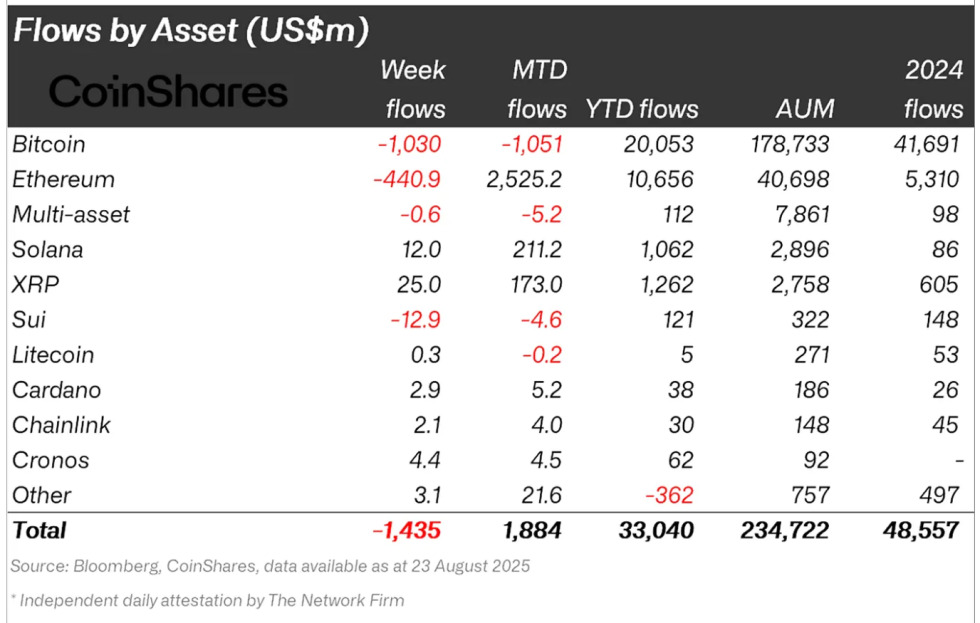
Crypto asset fund flows.
Crypto asset fund flows. | Source: CoinShares

Conversely, some projects faced headwinds. Sui ($12.9 million outflows) and Ton ($1.5 million outflows) were among the most affected, reflecting investor caution or profit-taking in assets that had seen speculative runs earlier in the year.

Butterfill noted that trading behavior remains highly sensitive to both regulatory developments and macroeconomic expectations, with US monetary policy continuing to act as a key driver of crypto investment flows.

Looking ahead, it is expected that fund flows will remain volatile as markets digest further policy signals and macroeconomic data. However, the contrasting performance between Bitcoin and Ethereum suggests that investors may increasingly diversify within digital assets, rather than treating the sector as a single, homogeneous market.

The global crypto market cap valuation on TradingView
The global digital currency market cap valuation. | Source: TradingView.com

Featured image created with DALL-E, Chart from TradingView

Editorial Process for bitcoinist is centered on delivering thoroughly researched, accurate, and unbiased content. We uphold strict sourcing standards, and each page undergoes diligent review by our team of top technology experts and seasoned editors. This process ensures the integrity, relevance, and value of our content for our readers.

Edyme is a writer, a content writer that specialises in writing about the crypto realm. Asides Bitcoinist and NewsBTC, Edyme's writing has been featured in top sites such as Blockchain.News, CoinMonk, Blockchain Reporter, Bitcoin Insider among others.

Trending Cryptos

Related Reads

From SpaceX to Galaxy Digital: A Detailed Look at 37 New AI Companies and 7 Crypto Dark Horses Added to the Russell Indexes

On June 26th, following its annual reconstitution, the Russell US Indexes finalized their new components, with changes taking effect for market trading on June 29th. The Russell 3000 Index, representing approximately 98% of the investable US equity market, saw significant turnover. A record $334 billion was traded during Nasdaq's closing cross on reconstitution day, highlighting the massive passive fund flows tied to these benchmarks. Companies newly added to the index are set to benefit from mandatory buying by these funds. The reconstitution raised the market cap threshold between the large-cap Russell 1000 and small-cap Russell 2000 by 24% to $5.7 billion. Overall, 224 new companies entered the Russell 3000. Of these, 19 joined the Russell 1000, and 205 joined the Russell 2000, while 118 firms were removed. Notably, among the newcomers, approximately 37 are companies operating in the AI and semiconductor ecosystem, accounting for roughly 17% of new additions. The most prominent is SpaceX, which, following its recent IPO and soaring valuation, was fast-tracked directly into the Russell 1000 and Top 200 indexes. Additionally, about 7 cryptocurrency-related companies were newly included, representing about 3% of new entrants. These include Galaxy Digital, Bitmine, and Tron, among others. The inclusion of several Decentralized Autonomous Trust (DAT) entities signals the model's sustained market presence. For these smaller AI and crypto firms, index inclusion boosts visibility, potentially attracting further institutional investment and supporting their stock performance.

Odaily星球日报3m ago

From SpaceX to Galaxy Digital: A Detailed Look at 37 New AI Companies and 7 Crypto Dark Horses Added to the Russell Indexes

Odaily星球日报3m ago

Token Uneconomical

"Token Inefficiency" explores the rising economic burden of AI model token usage in enterprises, where escalating costs often fail to match tangible productivity gains. Major companies like Microsoft, Uber, and Meta are facing "token inefficiency"—characterized by budget overruns for tools like Claude Code with unclear returns. This inefficiency stems from supply-side factors like strategic model price hikes by leaders (e.g., Anthropic) and price increases in budget-friendly models, alongside technical waste in Agent systems through context traps, tokenizer inflation, redundant skill calls, and multi-Agent coordination overhead. A deeper demand-side challenge limits token value: their primary utility remains confined to highly digitalized domains like programming, which benefits from automatic, low-cost feedback loops. Extending tokens to physical world tasks or less digitalized industries faces the "Sim-to-Real Gap," where real-world validation is costly and slow, unlike in code compilation. The article warns that this inefficiency concentrates financial risk in mid-tier model developers, potentially fueling circular financing schemes and shadow credit bubbles. It also highlights societal externalities, as data center expansion strains local power grids and inflates utility costs for residents. To achieve a positive net token economy, the path forward requires dual efforts: technical optimizations (context compression, skill reduction, model routing, budget constraints) and business-side discipline (governance, cost attribution, ROI focus). The ultimate goal is shifting from showcasing AI capabilities to maximizing value per token, finding scalable commercial applications that justify the investment and bridge the digital-physical divide.

marsbit22m ago

Token Uneconomical

marsbit22m ago

Stock Price Halved in 45 Days, Is Circle Actually the "DeFi Barometer"?

Over a 45-day period, Circle's stock price plummeted by approximately 50% to around $63, coinciding with a significant $70 billion decline in the circulation of its USDC stablecoin from its peak. In contrast, Tether's USDT saw a much smaller reduction. Analyst Ed Engel posits that Circle acts as a barometer for DeFi activity, as a high correlation exists between USDC supply and ETH price movements. The vast majority of USDC is concentrated within crypto exchanges and DeFi protocols for yield generation, rather than for widespread daily use in payments or commerce, unlike USDT which has stronger real-world adoption in various regions. The recent contraction in DeFi Total Value Locked (TVL), following security incidents like the Kelp DAO attack, appears to mirror Circle's declining stock performance. While Circle is actively promoting USDC's use as a settlement asset on platforms like Hyperliquid and in institutional payment corridors—where its organic transfer volume surpasses USDT's—these efforts have not sufficiently driven growth in USDC's overall supply. The company's revenue remains heavily tied to DeFi's expansion. For Circle's investment narrative to change, it must either significantly reduce its reliance on the volatile DeFi sector or demonstrably prove that real-world adoption can substantially and sustainably increase USDC circulation. In the near term, market confidence hinges on DeFi addressing its inherent risk-reward imbalances.

marsbit55m ago

Stock Price Halved in 45 Days, Is Circle Actually the "DeFi Barometer"?

marsbit55m ago

Trading

Spot

Hot Articles

What is $BITCOIN

DIGITAL GOLD ($BITCOIN): A Comprehensive Analysis Introduction to DIGITAL GOLD ($BITCOIN) DIGITAL GOLD ($BITCOIN) is a blockchain-based project operating on the Solana network, which aims to combine the characteristics of traditional precious metals with the innovation of decentralized technologies. While it shares a name with Bitcoin, often referred to as “digital gold” due to its perception as a store of value, DIGITAL GOLD is a separate token designed to create a unique ecosystem within the Web3 landscape. Its goal is to position itself as a viable alternative digital asset, although specifics regarding its applications and functionalities are still developing. What is DIGITAL GOLD ($BITCOIN)? DIGITAL GOLD ($BITCOIN) is a cryptocurrency token explicitly designed for use on the Solana blockchain. In contrast to Bitcoin, which provides a widely recognized value storage role, this token appears to focus on broader applications and characteristics. Notable aspects include: Blockchain Infrastructure: The token is built on the Solana blockchain, known for its capacity to handle high-speed and low-cost transactions. Supply Dynamics: DIGITAL GOLD has a maximum supply capped at 100 quadrillion tokens (100P $BITCOIN), although details regarding its circulating supply are currently undisclosed. Utility: While precise functionalities are not explicitly outlined, there are indications that the token could be utilized for various applications, potentially involving decentralized applications (dApps) or asset tokenization strategies. Who is the Creator of DIGITAL GOLD ($BITCOIN)? At present, the identity of the creators and development team behind DIGITAL GOLD ($BITCOIN) remains unknown. This situation is typical among many innovative projects within the blockchain space, particularly those aligning with decentralized finance and meme coin phenomena. While such anonymity may foster a community-driven culture, it intensifies concerns about governance and accountability. Who are the Investors of DIGITAL GOLD ($BITCOIN)? The available information indicates that DIGITAL GOLD ($BITCOIN) does not have any known institutional backers or prominent venture capital investments. The project seems to operate on a peer-to-peer model focused on community support and adoption rather than traditional funding routes. Its activity and liquidity are primarily situated on decentralized exchanges (DEXs), such as PumpSwap, rather than established centralized trading platforms, further highlighting its grassroots approach. How DIGITAL GOLD ($BITCOIN) Works The operational mechanics of DIGITAL GOLD ($BITCOIN) can be elaborated on based on its blockchain design and network attributes: Consensus Mechanism: By leveraging Solana’s unique proof-of-history (PoH) combined with a proof-of-stake (PoS) model, the project ensures efficient transaction validation contributing to the network's high performance. Tokenomics: While specific deflationary mechanisms have not been extensively detailed, the vast maximum token supply implies that it may cater to microtransactions or niche use cases that are still to be defined. Interoperability: There exists the potential for integration with Solana’s broader ecosystem, including various decentralized finance (DeFi) platforms. However, the details regarding specific integrations remain unspecified. Timeline of Key Events Here is a timeline that highlights significant milestones concerning DIGITAL GOLD ($BITCOIN): 2023: The initial deployment of the token occurs on the Solana blockchain, marked by its contract address. 2024: DIGITAL GOLD gains visibility as it becomes available for trading on decentralized exchanges like PumpSwap, allowing users to trade it against SOL. 2025: The project witnesses sporadic trading activity and potential interest in community-led engagements, although no noteworthy partnerships or technical advancements have been documented as of yet. Critical Analysis Strengths Scalability: The underlying Solana infrastructure supports high transaction volumes, which could enhance the utility of $BITCOIN in various transaction scenarios. Accessibility: The potential low trading price per token could attract retail investors, facilitating wider participation due to fractional ownership opportunities. Risks Lack of Transparency: The absence of publicly known backers, developers, or an audit process may yield skepticism regarding the project's sustainability and trustworthiness. Market Volatility: The trading activity is heavily reliant on speculative behavior, which can result in significant price volatility and uncertainty for investors. Conclusion DIGITAL GOLD ($BITCOIN) emerges as an intriguing yet ambiguous project within the rapidly evolving Solana ecosystem. While it attempts to leverage the “digital gold” narrative, its departure from Bitcoin's established role as a store of value underscores the need for a clearer differentiation of its intended utility and governance structure. Future acceptance and adoption will likely depend on addressing the current opacity and defining its operational and economic strategies more explicitly. Note: This report encompasses synthesised information available as of October 2023, and developments may have transpired beyond the research period.

510 Total ViewsPublished 2025.05.13Updated 2025.05.13

What is $BITCOIN

Discussions

Welcome to the HTX Community. Here, you can stay informed about the latest platform developments and gain access to professional market insights. Users' opinions on the price of BTC (BTC) are presented below.

活动图片