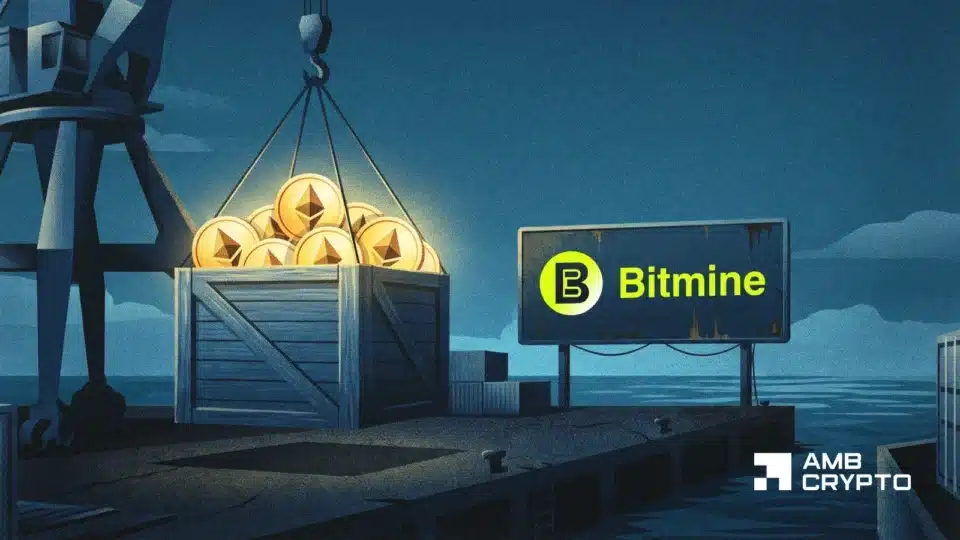
BlackRock’s 5% MicroStrategy stake: Is Bitcoin’s biggest whale in danger?

ambcryptoPublished on 2025-08-17Last updated on 2025-08-18

Key Takeaways

BlackRock’s growing influence in Bitcoin and Ethereum ETFs and a stake in Strategy raises fears of market manipulation. What was once “the people’s money” risks becoming another Wall Street asset.


BlackRock’s growing influence in the crypto sector has sparked intense speculation, with reports suggesting the firm may be orchestrating one of the largest market shake-ups yet.

After acquiring a 5% stake in Strategy (formerly MicroStrategy), potentially to influence Michael Saylor’s massive Bitcoin [BTC] holdings, BlackRock has propelled both Bitcoin and Ethereum [ETH] ETFs to fresh highs.

BlackRock’s BTC and ETH ETF

Ethereum took center stage on Wall Street as spot ETH ETFs logged a record $1.019 billion net inflow on the 11th of August, with BlackRock’s iShares Ethereum Trust (ETHA) surpassing $10 billion.

Meanwhile, its iShares Bitcoin Trust (IBIT) also clocked a milestone, crossing $91.06 billion in assets under management amid Bitcoin’s surge to a new all-time high of $124,500.

This shows that BlackRock is no longer just holding Bitcoin; it’s moving to control it.

It may look minor, but this move effectively connects the two largest Bitcoin whales, BlackRock and Michael Saylor’s Strategy.

For those unaware, Strategy’s Bitcoin strategy depends on debt and stock issuance, making it vulnerable if its stock price drops, and BlackRock knows this.

By pressuring MSTR shares, it could push Saylor into liquidating reserves, crashing BTC’s price, only to buy it back cheaply and tighten its grip on the market.

This isn’t speculation without evidence.

What if Strategy sells?

Additionally, in June, Strategy moved 7,382 BTC (around $850 million) to Coinbase Prime, not typical behavior for long-term holders, but a clear sign of preparation for potential liquidation.

Around the same time, BlackRock sold over $500 million worth of Bitcoin in just 48 hours.

For a firm of their size, that’s pocket change, but symbolically, it points toward a broader reset strategy.

If BlackRock triggers this cascade, the fallout could be brutal and Bitcoin could plunge to $65K–$60K, Ethereum to $1.7K, while altcoins face losses of 80–90%.

Derivatives markets would also implode, exchanges might freeze, and retail investors would capitulate at the worst possible moment.

Meanwhile, institutions would be quietly accumulating the very assets retail abandoned in fear.

The most dangerous part would be that BlackRock’s ETF, IBIT, already controls flows of hundreds of thousands of BTC.

By adding influence over Strategy, they would dominate both direct Bitcoin supply and corporate reserves.

What looks like a market strategy is actually a bid for a monopoly. If one entity can corner 70% of Bitcoin’s supply, decentralization, the very foundation of crypto, collapses.

What’s more?

For BlackRock, it’s not about short-term profits. It’s about accumulation, dominance, and rewriting the rules of the Bitcoin market.

If such a strategy unfolds, it could mark a turning point for Bitcoin’s identity.

What began as a decentralized alternative to traditional finance may risk being reshaped into yet another Wall Street instrument, traded, leveraged, and collateralized like gold or oil.

The recent slip in Strategy’s stock price to $366.32, down 1.78% in the past 24 hours, underscores the fragility of this balance.

Therefore, as institutional giants tighten their grip, the crypto community faces a pressing question.

Will Bitcoin remain “the people’s money,” or evolve into a tool of centralized financial power?

Share

Trending Cryptos

Related Reads

In the AI Era, What's Left for Bitcoin?

As Bitcoin falls below $60,000, the author reflects on the relationship between AI and Bitcoin, seeing them as two sides of the same coin. In the AI era, the cost of generating content has plummeted, making fake text, images, and videos increasingly easy and cheap to produce. This has led to a fundamental shift: while AI dramatically lowers the cost of information production, it also undermines trust and authenticity online. What becomes truly valuable is not more content, but the ability to verify what is real—"verifiability." This perspective offers a new lens for Bitcoin. Its massive energy consumption, often criticized as wasteful, is reinterpreted. While AI burns energy to enhance "capability" and efficiency, Bitcoin burns energy to produce "verifiability." Its purpose is not to be trusted but to enable a system where no trust in intermediaries—banks, platforms, or developers—is needed. Every transaction and the entire ledger's history is secured by cryptography and a decentralized network of nodes, making it independently verifiable. AI cannot forge a transaction on the Bitcoin network because the system is designed for proof, not generation. The author draws a historical parallel to the Renaissance: the printing press drastically reduced the cost of copying knowledge, while double-entry bookkeeping reduced the cost of trust in commerce. Today, AI is the new printing press, reducing content creation costs to near zero. Blockchain, and Bitcoin as its pioneer, may be the modern equivalent of double-entry bookkeeping—a foundational technology for verifying digital asset ownership and historical records without centralized authorities. Thus, AI and blockchain are not competitors. AI lowers the cost of creation; blockchain lowers the cost of verification. In an age where AI can generate anything, true scarcity may lie not in more content, but in independently verifiable facts. Whether the market will reprice Bitcoin accordingly remains uncertain, but its core value proposition as a "machine for producing verifiability" becomes strikingly relevant.

marsbit11m ago

In the AI Era, What's Left for Bitcoin?

marsbit11m ago

In the Age of AI, What's Left for Bitcoin?

Author: Sevclub, Seven Research Amid Bitcoin's recent drop below $60k, the author reflects on a growing sense that AI and Bitcoin are two sides of the same coin. Today, encountering any content triggers a new default question: "Was this made by AI?" The cost of generating convincing text, images, and video is now negligible. While the internet lowered information *distribution* costs, AI is crashing information *production* costs to near zero. The consequence is a flood of content where truth and falsehood are increasingly indistinguishable. In this environment, what becomes truly valuable is not more information, but the ability to verify what is real—"verifiability." This reframes the common criticism that Bitcoin "wastes electricity." AI consumes power to produce "capability" (e.g., more powerful models). Bitcoin consumes power to produce something else: "verifiability." Bitcoin's core purpose isn't about belief or trust in any institution, developer, or even its creator. It's about enabling independent verification. Every bitcoin's origin, every transaction, and the integrity of the entire ledger are secured by mathematics, cryptography, and a global network of nodes. AI can fabricate convincing media, but it cannot falsify a transaction on the Bitcoin network. The expended energy makes篡改历史 (tampering with history) prohibitively expensive, purchasing a globally verifiable ledger. The author draws a historical parallel to the Renaissance. The printing press drastically reduced the cost of copying knowledge, while double-entry bookkeeping reduced the cost of trust in commerce—one enabled creation, the other verification. Today, AI is the new printing press, driving content production costs toward zero. The question becomes: what is this era's "double-entry bookkeeping"? Blockchain appears to be the leading candidate. It doesn't verify which news is true or which image is real, but it provides a foundational layer for independently verifying asset ownership and historical records in the digital realm without centralized authorities. Therefore, AI and blockchain are not in competition. AI lowers the cost of *generation*. Blockchain (and Bitcoin as a prime example) lowers the cost of *verification*. One creates, the other proves. Whether Bitcoin ultimately succeeds remains uncertain, facing potential challenges from quantum computing, regulation, and technical evolution. However, the author now sees it less as a "machine for making bitcoin" and more as a "machine for making verifiability." In an age where AI can generate anything, true scarcity may no longer be "more content," but "more independently verifiable facts." Whether the market will price this accordingly is a separate question.

链捕手19m ago

In the Age of AI, What's Left for Bitcoin?

链捕手19m ago

Trading

Spot

Hot Articles

Discussions

Welcome to the HTX Community. Here, you can stay informed about the latest platform developments and gain access to professional market insights. Users' opinions on the price of S (S) are presented below.

活动图片