BitMine теряет 27% стоимости акций, несмотря на прогнозы цены ETH в $60 тыс

cryptonews.ruPublished on 2025-01-29Last updated on 2025-07-30

Партнёр венчурной компании Finality Capital Дэвид Грайдер, однако, считает, что стратегия BitMine по формированию казначейских резервов Ethereum в долгосрочной перспективе окажет положительное влияние на цену актива.

В понедельник BitMine представила первую серию «Обращений председателя», где Том Ли из FundStrat изложил долгосрочные планы компании в отношении Ethereum. Среди заявленных целей — накопление 5% от общего предложения ETH и амбициозные ценовые прогнозы. На опубликованном компанией слайде фигурировала предполагаемая стоимость Ethereum в $60 000, основанная на данных неназванных исследовательских агентств.
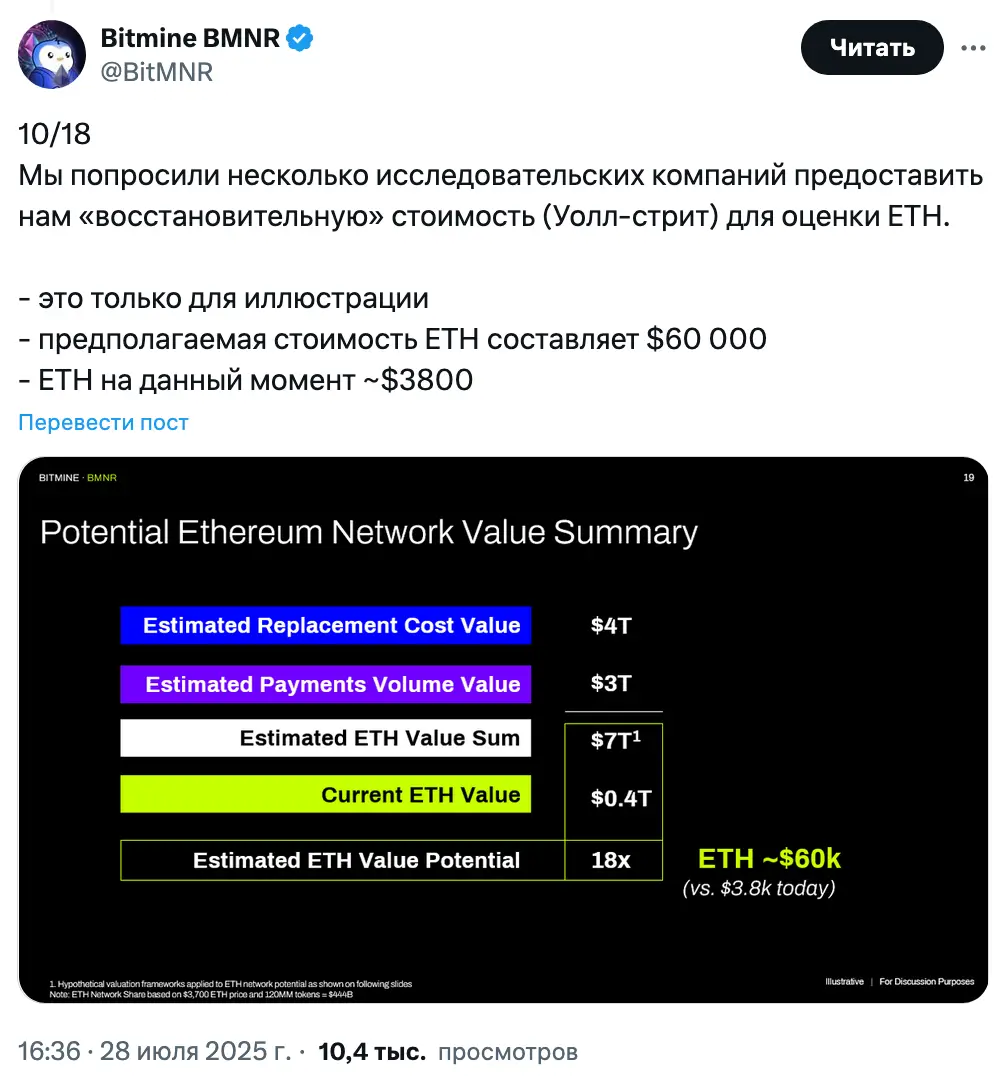

Источник: BitMine

Однако эти заявления не остановили падение акций: в течение торгового дня бумаги BitMine (BMNR) потеряли более 11%, опустившись до $35,11, а после закрытия торгов снижение продолжилось и достигло 15%. Это резко контрастирует с июльским ростом на 3000%, когда акции достигали годового максимума в $135 после анонса планов по закупке Ethereum.
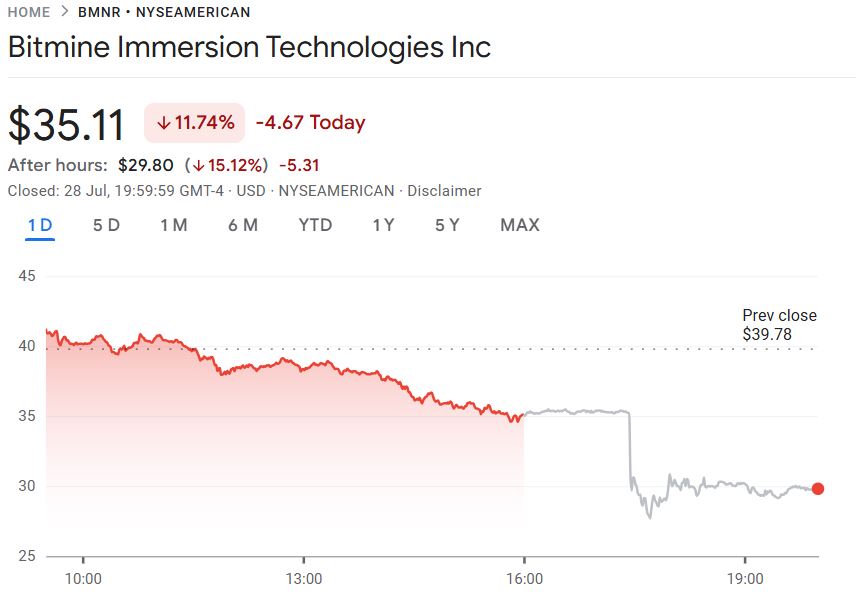

Акции BitMine упали как на торгах, так и после закрытия торгов. Источник: Google Finance

BitMine заявляет о резервах в 600 000 ETH

В ходе презентации Том Ли подтвердил, что резервы BitMine составляют 600 000 Ethereum (около $2,2 млрд по текущим ценам). Компания позиционирует себя как «американскую сеть валидаторов» с полным циклом операций на территории США и заявляет о намерении владеть и размещать в стекинге 5% от общего предложения ETH.
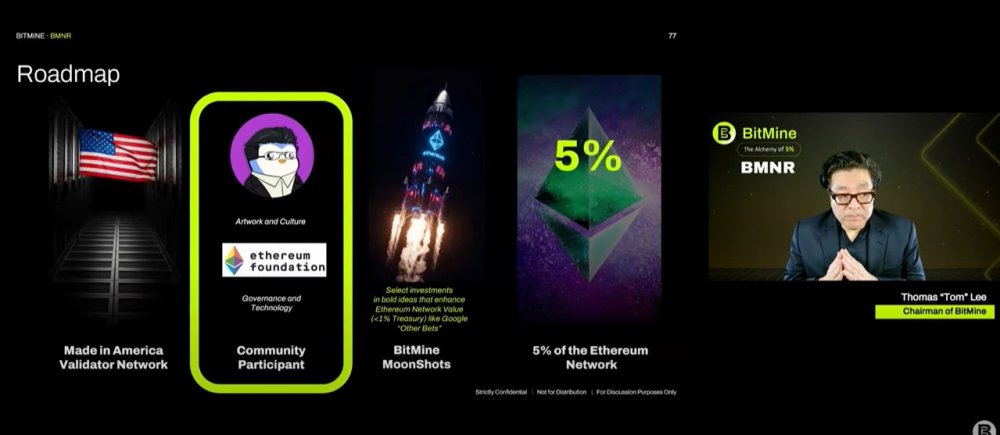

Ли заявил, что BitMine, помимо прочего, планирует осуществлять свою деятельность в США. Источник: YouTube

В июне Винсент Лю, инвестиционный директор Kronos Research, подчеркивал, что успешные казначейские стратегии требуют «чёткого плана защиты капитала и управления ликвидностью», без которого невозможно создать устойчивую ценность.

Казначейские резервы ETH могут стимулировать рост цен

Дэвид Грайдер из Finality Capital в своём посте на X провёл параллель между влиянием MicroStrategy на биткоин и потенциальным воздействием BitMine на Ethereum. По его мнению, корпоративные казначейские стратегии способствуют притоку инвестиций и росту цен. Грайдер также подтвердил, что его компания имеет долю в BitMine.
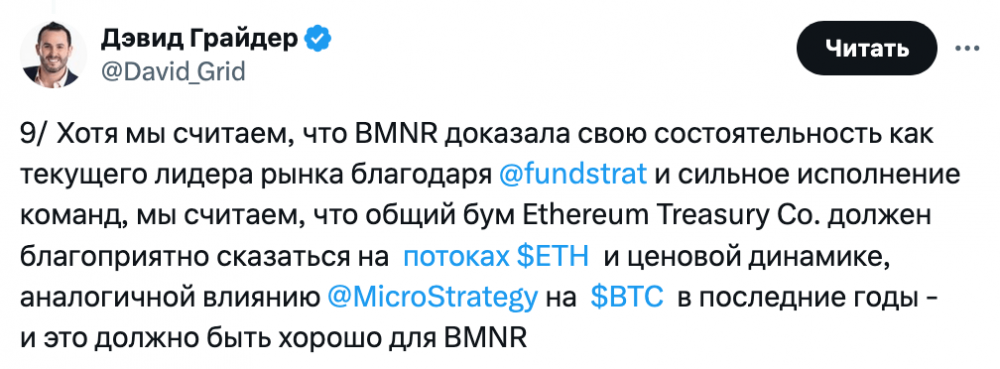

Источник: Дэвид Грайдер

Среди других заметных корпоративных держателей Ethereum — SharpLink Gaming (438 000 ETH), Bit Digital (свыше 100 000 ETH) и Blockchain Technology Consensus Solutions (29 122 ETH после привлечения $62,4 млн). Рэй Юсеф, CEO финансового приложения NoOnes, отмечает растущий интерес корпораций к Ethereum как к ключевой инфраструктурной составляющей.


Trending Cryptos

Related Reads

In the AI Era, What's Left for Bitcoin?

As Bitcoin falls below $60,000, the author reflects on the relationship between AI and Bitcoin, seeing them as two sides of the same coin. In the AI era, the cost of generating content has plummeted, making fake text, images, and videos increasingly easy and cheap to produce. This has led to a fundamental shift: while AI dramatically lowers the cost of information production, it also undermines trust and authenticity online. What becomes truly valuable is not more content, but the ability to verify what is real—"verifiability." This perspective offers a new lens for Bitcoin. Its massive energy consumption, often criticized as wasteful, is reinterpreted. While AI burns energy to enhance "capability" and efficiency, Bitcoin burns energy to produce "verifiability." Its purpose is not to be trusted but to enable a system where no trust in intermediaries—banks, platforms, or developers—is needed. Every transaction and the entire ledger's history is secured by cryptography and a decentralized network of nodes, making it independently verifiable. AI cannot forge a transaction on the Bitcoin network because the system is designed for proof, not generation. The author draws a historical parallel to the Renaissance: the printing press drastically reduced the cost of copying knowledge, while double-entry bookkeeping reduced the cost of trust in commerce. Today, AI is the new printing press, reducing content creation costs to near zero. Blockchain, and Bitcoin as its pioneer, may be the modern equivalent of double-entry bookkeeping—a foundational technology for verifying digital asset ownership and historical records without centralized authorities. Thus, AI and blockchain are not competitors. AI lowers the cost of creation; blockchain lowers the cost of verification. In an age where AI can generate anything, true scarcity may lie not in more content, but in independently verifiable facts. Whether the market will reprice Bitcoin accordingly remains uncertain, but its core value proposition as a "machine for producing verifiability" becomes strikingly relevant.

marsbit17m ago

In the AI Era, What's Left for Bitcoin?

marsbit17m ago

In the Age of AI, What's Left for Bitcoin?

Author: Sevclub, Seven Research Amid Bitcoin's recent drop below $60k, the author reflects on a growing sense that AI and Bitcoin are two sides of the same coin. Today, encountering any content triggers a new default question: "Was this made by AI?" The cost of generating convincing text, images, and video is now negligible. While the internet lowered information *distribution* costs, AI is crashing information *production* costs to near zero. The consequence is a flood of content where truth and falsehood are increasingly indistinguishable. In this environment, what becomes truly valuable is not more information, but the ability to verify what is real—"verifiability." This reframes the common criticism that Bitcoin "wastes electricity." AI consumes power to produce "capability" (e.g., more powerful models). Bitcoin consumes power to produce something else: "verifiability." Bitcoin's core purpose isn't about belief or trust in any institution, developer, or even its creator. It's about enabling independent verification. Every bitcoin's origin, every transaction, and the integrity of the entire ledger are secured by mathematics, cryptography, and a global network of nodes. AI can fabricate convincing media, but it cannot falsify a transaction on the Bitcoin network. The expended energy makes篡改历史 (tampering with history) prohibitively expensive, purchasing a globally verifiable ledger. The author draws a historical parallel to the Renaissance. The printing press drastically reduced the cost of copying knowledge, while double-entry bookkeeping reduced the cost of trust in commerce—one enabled creation, the other verification. Today, AI is the new printing press, driving content production costs toward zero. The question becomes: what is this era's "double-entry bookkeeping"? Blockchain appears to be the leading candidate. It doesn't verify which news is true or which image is real, but it provides a foundational layer for independently verifying asset ownership and historical records in the digital realm without centralized authorities. Therefore, AI and blockchain are not in competition. AI lowers the cost of *generation*. Blockchain (and Bitcoin as a prime example) lowers the cost of *verification*. One creates, the other proves. Whether Bitcoin ultimately succeeds remains uncertain, facing potential challenges from quantum computing, regulation, and technical evolution. However, the author now sees it less as a "machine for making bitcoin" and more as a "machine for making verifiability." In an age where AI can generate anything, true scarcity may no longer be "more content," but "more independently verifiable facts." Whether the market will price this accordingly is a separate question.

链捕手25m ago

In the Age of AI, What's Left for Bitcoin?

链捕手25m ago

Trading

Spot

Hot Articles

Discussions

Welcome to the HTX Community. Here, you can stay informed about the latest platform developments and gain access to professional market insights. Users' opinions on the price of ETH (ETH) are presented below.

活动图片