SEC Set To Shake Up Bitcoin, Ethereum ETFs With In-Kind Approval

bitcoinistPublished on 2025-07-23Last updated on 2025-07-23

Abstract

The US Securities and Exchange Commission is edging toward a structural makeover of spot‑Bitcoin and Ethereum exchange‑traded funds, after five...

Trusted Editorial content, reviewed by leading industry experts and seasoned editors. Ad Disclosure

The US Securities and Exchange Commission is edging toward a structural makeover of spot‑Bitcoin and Ethereum exchange‑traded funds, after five Cboe BZX‑listed products simultaneously asked to swap their cash‑only creation and redemption model for the in‑kind mechanics long used by commodity and equity ETFs.

Filings submitted late on 22 July cover the ARK 21Shares Bitcoin ETF and the 21Shares Core Ethereum ETF (together in SR‑CboeBZX‑2025‑010 Amendment No. 3), WisdomTree’s Bitcoin Fund (SR‑CboeBZX‑2025‑033 Amendment No. 1) and both the Fidelity Wise Origin Bitcoin Fund and Fidelity Ethereum Fund (SR‑CboeBZX‑2025‑023 Amendment No. 1). Each amendment rewrites language inserted in early‑2024 approval orders that had locked the trusts into cash creations and redemptions, substituting the phrase “cash or in‑kind transactions” and adding detailed settlement workflows for direct transfers of Bitcoin or Ether between the trust’s custodian and an authorised participant.

Bloomberg ETF analyst James Seyffart, who first spotted the coordinated move, told his followers on X that the quintet of filings is “more positive signs regarding Bitcoin & Ethereum ETFs obtaining the ability to do in‑kind creation and redemption… This indicates to me that there is positive movement and likely fine‑tuning happening with the SEC.”

Anticipating confusion, he added: “No, this is not going to be for retail or normies to trade in shares of their ETFs for the underlying asset or vice versa. This would only be for the Authorized Participants (think big wall street firms and market makers) […] This will make current and future crypto ETFs more efficient. But the vast majority of people won’t even see a difference because the products on the market now already trade extremely efficiently. This will treat crypto ETPs the same as other ETPs are treated.”

Commenting on a time horizon when retail investors could use the in-kind redemption process, Seyffart added: “Would be cool to see consumers being able to withdraw and deposit actual ETH into the ETF with a certain threshold. I personally think withdrawals like this will eventually happen. But it may be in the distant future. One step at a time. This already exists for some gold ETFs.”

Why In-Kind Matters For Bitcoin And Ether ETFs

Under the cash model imposed when spot Bitcoin ETPs were finally approved on 10 January 2024, an AP delivers dollars to the fund, which then buys the cryptocurrency in the spot market; redemptions reverse the process. That design solved SEC concerns under Chair Gensler about custody and settlement risk but introduced two frictions: the trust itself must trade in the underlying market, and the resulting order flow can push net asset value away from share price when spot liquidity is thin.

In‑kind processing hands those trades back to authorised participants. When creating shares the AP ships Bitcoin or Ether directly to the fund’s cold‑wallet; when redeeming it receives coins instead of cash. The structure is standard in the broader ETF ecosystem and is associated with tighter spreads, smaller primary‑market imbalances and material tax advantages because portfolio securities — or in this case, crypto‑assets — are released “in kind” rather than being sold and realising capital gains inside the fund. The SEC itself notes that ETFs “can be more tax efficient… because ETF shares generally are redeemable ‘in‑kind’.

Commodity trusts already employing in‑kind redemptions provide the regulatory template the crypto issuers are invoking. SPDR Gold Shares, for example, lets an authorised participant exchange a 100,000‑share basket for physical bullion, a feature that ultimately allows an individual investor to “take physical possession of the gold backing his or her shares,” albeit through a broker‑facilitated arrangement. By mirroring that language, the Bitcoin and Ether trusts argue they are simply seeking parity with existing commodity ETPs.

Operational pressure has also mounted as primary‑market volumes grow. Since launch the eleven spot Bitcoin ETFs approved in 2024 have drawn nearly $55 billion in cumulative net inflows; market‑making desks face the hurdle of sourcing billions of dollars at 4 p.m. every settlement day — then unwinding the crypto exposure after the trust purchases coins. This ties up the balance sheet and widens spreads during volatile sessions. Allowing in‑kind hand‑offs lets desks source or hedge Bitcoin and Ether continuously and deliver the assets straight into the trust’s wallet at T + 0.

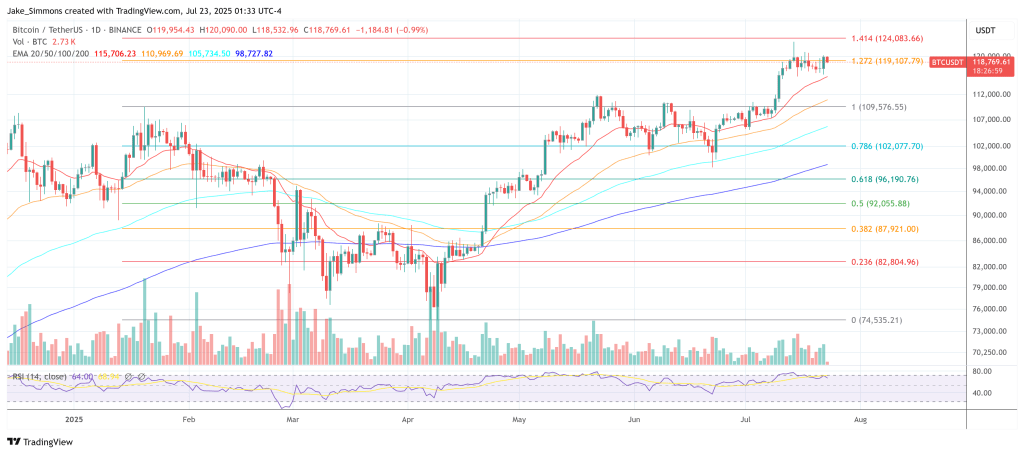
At press time, BTC traded at $118,769.
Bitcoin price
BTC needs to close above the 1.272 Fib again, 1-day chart | Source: BTCUSDT on TradingView.com
Featured image created with DALL.E, chart from TradingView.com
Editorial Process for bitcoinist is centered on delivering thoroughly researched, accurate, and unbiased content. We uphold strict sourcing standards, and each page undergoes diligent review by our team of top technology experts and seasoned editors. This process ensures the integrity, relevance, and value of our content for our readers.

Jake Simmons has been a Bitcoin enthusiast since 2016. Ever since he heard about Bitcoin, he has been studying the topic every day and trying to share his knowledge with others. His goal is to contribute to Bitcoin's financial revolution, which will replace the fiat money system. Besides BTC and crypto, Jake studied Business Informatics at a university. After graduation in 2017, he has been working in the blockchain and crypto sector. You can follow Jake on Twitter at @realJakeSimmons.

Trending Cryptos

Related Reads

Li Fei-Fei's Latest Long-Form Article: When Video Generation, Robotics, and NVIDIA All Call Themselves World Models, We Need a Taxonomy

In a new article, Dr. Fei-Fei Li addresses the widespread and often inconsistent use of the term "world model" in AI. She proposes a clear, functional taxonomy rooted in the classic Partially Observable Markov Decision Process (POMDP) loop (agent → action → state → observation → agent). According to this framework, current systems called "world models" are different projections of this loop, categorized by their primary output: 1. **Renderers**: Output observations (pixels). Their goal is visual fidelity for human consumption (e.g., video generation models like Sora). They are the most commercially mature but are limited by a focus on appearance over physical accuracy. 2. **Simulators**: Output states (geometric, physical, dynamic representations). They provide a structurally accurate world for both human professionals (e.g., architects) and computational agents (e.g., robots for training). Li argues simulators are the crucial, underappreciated bridge, as they can underpin both rendering and planning. 3. **Planners**: Output actions. Given an observation and a goal, they decide what an agent should do next (e.g., robotic action models). This area is highly promising but remains the least mature for real-world deployment. Li highlights a key trend: the boundaries between these three categories are beginning to blur, as they all rely on a shared underlying understanding of geometry, physics, and dynamics. The logical endpoint is a unified world foundation model capable of switching between rendering, simulation, and planning based on downstream needs. This convergence, she concludes, is central to advancing spatial intelligence—enabling machines not just to talk about the world, but to truly understand, imagine, and interact with it.

marsbit1h ago

Li Fei-Fei's Latest Long-Form Article: When Video Generation, Robotics, and NVIDIA All Call Themselves World Models, We Need a Taxonomy

marsbit1h ago

Forbes Feature: Stablecoin Cross-Border Payments Are Faster, But Not Yet Cheaper

A Forbes feature delves into the state of stablecoin-based cross-border payments, noting rapid growth but a key shortfall: while faster and more accessible, they are not yet cheaper. At a recent industry conference in Mexico City, optimism about technology, regulation, and volume was tempered by discussions with practitioners. The core issue is liquidity. Traditional FX brokers charge 60-70 basis points, and stablecoins promise to slash this to 2-5 basis points. However, this theoretical cost advantage cannot be realized until deep liquidity pools are established at scale, requiring significant institutional capital inflow. A major adoption barrier is trust. Businesses often rely on long-standing relationships with traditional brokers, valuing reliability over marginal cost savings. This shift will be gradual. Furthermore, successful companies in the space are not positioning themselves as replacements for legacy systems like SWIFT, but as complements. They leverage stablecoins for speed while using traditional rails for their standardization and reliability in ensuring accurate payment details—a critical factor for supplier payments to avoid customs issues. Companies like Caliza, experiencing high monthly growth, exemplify this hybrid approach. The industry anticipates consolidation, as long-term viability will depend on securing the essential trifecta: proper licensing, robust fiat on/off-ramps, and deep liquidity. Without these, firms risk being mere intermediaries rather than building sustainable businesses.

marsbit1h ago

Forbes Feature: Stablecoin Cross-Border Payments Are Faster, But Not Yet Cheaper

marsbit1h ago

Li Feifei's Latest Article: When Video Generation, Robotics, and NVIDIA All Claim to Have 'World Models,' We Need a Taxonomy

"World Model" has become a widely used yet ambiguous term in AI. Drawing from the classic POMDP framework (agent → action → state → observation), this article proposes a functional taxonomy to clarify the concept. It identifies three distinct types, categorized by their output in the perception-action loop: 1. **Renderers**: Output visual observations (pixels). These models, like advanced video generators, prioritize visual fidelity but often lack underlying physical accuracy. 2. **Simulators**: Output the state of the world (geometry, physics, dynamics). They provide a structurally accurate representation for professionals (e.g., architects) and serve as training environments for robots and AI agents. 3. **Planners**: Output actions. Given an observation and a goal, they determine what an agent should do next, closing the perception-action loop (e.g., vision-language-action models). While renderers are currently the most commercially mature and planners are the most aspirational, the article argues that **simulators are the crucial, underappreciated hub**. By working at the level of geometry and physics, a simulator can project upwards to create visuals for humans and downwards to predict action consequences for agents. The future lies in the convergence of these three functions. Emerging research and products, like World Labs' Marble model which outputs both visual splats and physical collision meshes, are beginning to blur these boundaries. The logical endpoint is a unified world foundation model capable of rendering, simulating, and planning based on a shared understanding of spatial and temporal structures—ultimately enabling machines to understand, imagine, and interact with the physical world.

链捕手2h ago

Li Feifei's Latest Article: When Video Generation, Robotics, and NVIDIA All Claim to Have 'World Models,' We Need a Taxonomy

链捕手2h ago

Trading

Spot

Hot Articles

What is $BITCOIN

DIGITAL GOLD ($BITCOIN): A Comprehensive Analysis Introduction to DIGITAL GOLD ($BITCOIN) DIGITAL GOLD ($BITCOIN) is a blockchain-based project operating on the Solana network, which aims to combine the characteristics of traditional precious metals with the innovation of decentralized technologies. While it shares a name with Bitcoin, often referred to as “digital gold” due to its perception as a store of value, DIGITAL GOLD is a separate token designed to create a unique ecosystem within the Web3 landscape. Its goal is to position itself as a viable alternative digital asset, although specifics regarding its applications and functionalities are still developing. What is DIGITAL GOLD ($BITCOIN)? DIGITAL GOLD ($BITCOIN) is a cryptocurrency token explicitly designed for use on the Solana blockchain. In contrast to Bitcoin, which provides a widely recognized value storage role, this token appears to focus on broader applications and characteristics. Notable aspects include: Blockchain Infrastructure: The token is built on the Solana blockchain, known for its capacity to handle high-speed and low-cost transactions. Supply Dynamics: DIGITAL GOLD has a maximum supply capped at 100 quadrillion tokens (100P $BITCOIN), although details regarding its circulating supply are currently undisclosed. Utility: While precise functionalities are not explicitly outlined, there are indications that the token could be utilized for various applications, potentially involving decentralized applications (dApps) or asset tokenization strategies. Who is the Creator of DIGITAL GOLD ($BITCOIN)? At present, the identity of the creators and development team behind DIGITAL GOLD ($BITCOIN) remains unknown. This situation is typical among many innovative projects within the blockchain space, particularly those aligning with decentralized finance and meme coin phenomena. While such anonymity may foster a community-driven culture, it intensifies concerns about governance and accountability. Who are the Investors of DIGITAL GOLD ($BITCOIN)? The available information indicates that DIGITAL GOLD ($BITCOIN) does not have any known institutional backers or prominent venture capital investments. The project seems to operate on a peer-to-peer model focused on community support and adoption rather than traditional funding routes. Its activity and liquidity are primarily situated on decentralized exchanges (DEXs), such as PumpSwap, rather than established centralized trading platforms, further highlighting its grassroots approach. How DIGITAL GOLD ($BITCOIN) Works The operational mechanics of DIGITAL GOLD ($BITCOIN) can be elaborated on based on its blockchain design and network attributes: Consensus Mechanism: By leveraging Solana’s unique proof-of-history (PoH) combined with a proof-of-stake (PoS) model, the project ensures efficient transaction validation contributing to the network's high performance. Tokenomics: While specific deflationary mechanisms have not been extensively detailed, the vast maximum token supply implies that it may cater to microtransactions or niche use cases that are still to be defined. Interoperability: There exists the potential for integration with Solana’s broader ecosystem, including various decentralized finance (DeFi) platforms. However, the details regarding specific integrations remain unspecified. Timeline of Key Events Here is a timeline that highlights significant milestones concerning DIGITAL GOLD ($BITCOIN): 2023: The initial deployment of the token occurs on the Solana blockchain, marked by its contract address. 2024: DIGITAL GOLD gains visibility as it becomes available for trading on decentralized exchanges like PumpSwap, allowing users to trade it against SOL. 2025: The project witnesses sporadic trading activity and potential interest in community-led engagements, although no noteworthy partnerships or technical advancements have been documented as of yet. Critical Analysis Strengths Scalability: The underlying Solana infrastructure supports high transaction volumes, which could enhance the utility of $BITCOIN in various transaction scenarios. Accessibility: The potential low trading price per token could attract retail investors, facilitating wider participation due to fractional ownership opportunities. Risks Lack of Transparency: The absence of publicly known backers, developers, or an audit process may yield skepticism regarding the project's sustainability and trustworthiness. Market Volatility: The trading activity is heavily reliant on speculative behavior, which can result in significant price volatility and uncertainty for investors. Conclusion DIGITAL GOLD ($BITCOIN) emerges as an intriguing yet ambiguous project within the rapidly evolving Solana ecosystem. While it attempts to leverage the “digital gold” narrative, its departure from Bitcoin's established role as a store of value underscores the need for a clearer differentiation of its intended utility and governance structure. Future acceptance and adoption will likely depend on addressing the current opacity and defining its operational and economic strategies more explicitly. Note: This report encompasses synthesised information available as of October 2023, and developments may have transpired beyond the research period.

612 Total ViewsPublished 2025.05.13Updated 2025.05.13

What is $BITCOIN

Discussions

Welcome to the HTX Community. Here, you can stay informed about the latest platform developments and gain access to professional market insights. Users' opinions on the price of BTC (BTC) are presented below.

活动图片