# Tether Related Articles

HTX News Center provides the latest articles and in-depth analysis on "Tether", covering market trends, project updates, tech developments, and regulatory policies in the crypto industry.


Tether Completes Full Audit by KPMG U.S., 150 Tons of Gold and 100,000 BTC Reserves Verified

Tether Announces Completion of Full Financial Audit by KPMG US, Confirming Gold and BTC Reserves Tether CEO Paolo Ardoino announced that the company has completed its first-ever full financial audit by the "Big Four" accounting firm KPMG US. The audit covers the financial statements of Tether International, S.A. de C.V. as of December 31, 2025. Ardoino stated that Tether's delay in obtaining a full audit was primarily due to the previous US administration's hostile stance towards the digital asset industry. With a more favorable regulatory environment, the company engaged KPMG US for the rigorous review. Ardoino emphasized the audit confirmed the strength of Tether's reserves, including over $6 billion in excess equity. He also revealed the company holds substantial physical assets: approximately 150 tons of gold and over 100,000 Bitcoin (BTC). The audit process reportedly involved physically verifying each gold bar. Addressing past criticism and ongoing skepticism, Ardoino pointed to Tether's ability to handle large-scale redemptions, citing the processing of around $7 billion within 48 hours during market stress in 2022. He stated the company plans to undergo annual full financial audits alongside its ongoing quarterly attestation reports. Regarding a potential private equity round, Ardoino clarified that Tether, as a highly profitable company, does not require external capital but acknowledges significant market interest in its shares. The company remains private and mission-focused, aiming to serve users outside the traditional financial system. Looking ahead, Ardoino expressed Tether's interest in potentially funding initiatives like the "Bitcoin Red Team," which uses AI to audit Bitcoin's code and wallet security for vulnerabilities.

marsbit08/27 00:42

Tether Completes Full Audit by KPMG U.S., 150 Tons of Gold and 100,000 BTC Reserves Verified

marsbit08/27 00:42

$120 Million Vanishes Overnight! Crypto's 'Steadiest Giant' Stumbles in South America

Summary: Tether's $120 million Bitcoin mining venture in Uruguay, initiated in May 2023, was abruptly shut down in July 2025 when the national power utility UTE cut off electricity. The project, developed in partnership with local firm Microfin in Florida province, was touted as a model for leveraging the country's nearly 98% renewable energy grid. The collapse stemmed from a fundamental contract dispute over electricity supply. Tether interpreted the agreed power volume as a "minimum guaranteed supply," expecting to request more as the mining operation expanded. UTE, however, viewed it as a "strict maximum cap." This disagreement led to frequent power curtailments for the 24/7 mining facility, causing significant revenue loss from lost computing power. Following the 2025 election of left-wing President Yamandú Orsi and a management change at UTE, negotiations broke down. Microfin stopped paying electricity bills in May 2025, formally notified UTE of contract termination in June, and did not attend a final meeting where UTE presented a revised contract. By the July 25 power cut, Microfin's debt approached $5 million. The operation ceased, laying off 30 of its 38 local staff, with all outstanding debts settled by December 2025. The failure highlights key risks for heavy-asset overseas investments: Uruguay's green energy proved not to be cheap energy, especially after the 2024 Bitcoin halving squeezed industry profits. Furthermore, political changes can swiftly alter utility company policies, undermining the long-term regulatory stability critical for such projects. While financially absorbable for Tether, the incident underscores that operational success depends on unambiguous contracts and genuine cost advantages, not just technological scale.

marsbit08/26 13:41

$120 Million Vanishes Overnight! Crypto's 'Steadiest Giant' Stumbles in South America

marsbit08/26 13:41

Foreign Capital Sells Off $29 Billion in Short-Term US Treasuries, Why is the US Betting on Stablecoins to "Take Over"?

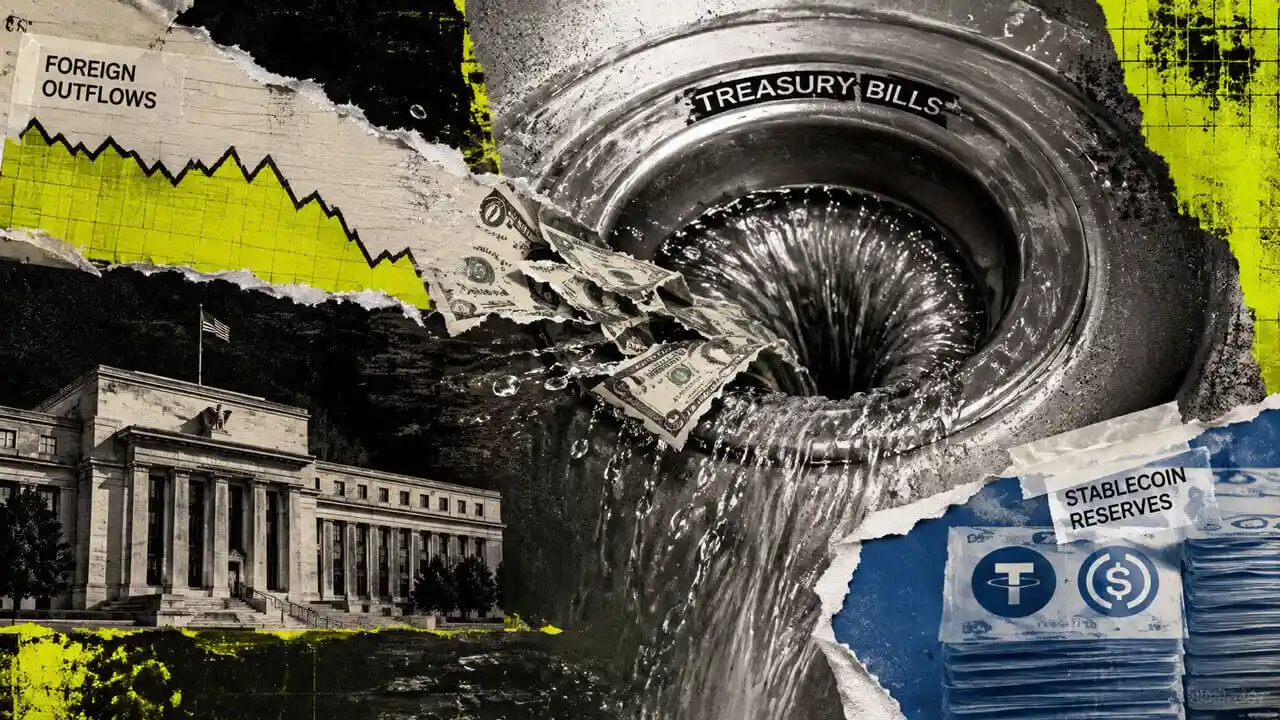
In June, foreign investors netted $133.5 billion into U.S. financial markets but simultaneously sold $29 billion in short-term U.S. Treasury bills. This divergence highlights a strong preference for U.S. equities over government debt. While overseas buyers purchased $181.4 billion in stocks, demand for Treasuries weakened significantly. This trend explains why the U.S. is looking to stablecoins as a potential new source of demand for its debt. Stablecoin issuers like Tether and Circle back their tokens primarily with highly liquid assets, including short-term Treasuries. As users buy stablecoins, issuers convert that dollar demand into Treasury purchases. Recent U.S. legislative efforts, such as the proposed rules under the *GENIUS Act*, formalize this by mandating stablecoin reserves be held in assets like cash and short-term Treasuries. Currently, stablecoins represent a substantial existing buyer base. For instance, Tether alone held nearly $115 billion in direct T-bill exposure in Q2. However, recent stablecoin supply growth has been minimal and does not account for the $29 billion sell-off by foreign investors in June. For stablecoins to act as a meaningful counterbalance to waning foreign demand, their circulating supply would need to expand significantly. The next TIC report will be crucial to monitor whether foreign selling continues and if stablecoin growth begins to fill the demand gap. Ultimately, the U.S. is strategically positioning the regulated stablecoin sector as a potential new pillar of demand for its government debt.

marsbit08/24 10:15

Foreign Capital Sells Off $29 Billion in Short-Term US Treasuries, Why is the US Betting on Stablecoins to "Take Over"?

marsbit08/24 10:15

"We have long ceased to be a crypto company": Tether CEO made a statement after KPMG audit

Stablecoin giant Tether has engaged Big Four auditor KPMG to verify its reserves, including a physical count of roughly 150 tons of gold in a Swiss vault. The audit confirmed the gold is present and that Tether's total reserves exceed its liabilities by $6.8 billion. CEO Paolo Ardoino described the process as "a physically heavy exercise" in an interview with Fortune. The audit aimed to address a long-standing conspiracy theory in the crypto world that USDT is not properly backed and could face a mass default. In a significant statement, Ardoino declared, "We haven't considered ourselves a crypto company for a long time. I think we are a digital dollar and digital gold company." He noted Tether has over 650 million users globally, with a strong focus in Africa and South America, where demand for stable digital assets is high due to recurring currency devaluations. Beyond financial services, Tether has been investing in decentralized communications, agriculture, and solar-powered kiosk networks for low-cost autonomous electricity. The company's next strategic move is to provide basic AI services to its user base in developing countries. Ardoino emphasized that even in the poorest nations, most people have a mobile phone capable of running simple AI models. The goal is to offer affordable, fundamental tools in sectors like healthcare, finance, and sports for a few dollars per month, payable via Tether or other digital payments. Ardoino expressed concern about societal inequality transforming from a wealth gap into a deeper "intellectual gap."

cryptonews.ru08/18 09:58

"We have long ceased to be a crypto company": Tether CEO made a statement after KPMG audit

cryptonews.ru08/18 09:58

Tether CEO Ardoino Gives Clear Response to Blockchain Accusations: 'We Are Not Developing Our Own Network!'

Tether CEO Paolo Ardoino has issued a clear denial in response to market reports alleging that the company behind the USDT stablecoin is developing its own proprietary blockchain. An analytical report had suggested Tether was building a private blockchain, or "stablechain," to reduce its reliance on existing networks and gain greater control over its ecosystem. Ardoino firmly stated via social media that these claims are false, emphasizing that Tether is not developing any blockchain technology and has no such plans. He reiterated the company's strategy is to continue operating across multiple existing blockchain networks. USDT is currently available on several major blockchains, including Ethereum, Tron, Solana, Avalanche, and TON. This multi-chain approach allows users to choose networks based on transaction costs and speed requirements. While experts speculated that a proprietary blockchain could significantly impact the stablecoin sector, Ardoino's statement appears to have quelled these rumors for now. The article notes that Tether has also drawn attention for its investments in artificial intelligence, mining, and digital infrastructure. However, company leadership maintains that ensuring the smooth operation of USDT across various blockchains remains a top priority. The cryptocurrency market continues to watch Tether's strategic moves closely.

cryptonews.ru08/17 10:01

Tether CEO Ardoino Gives Clear Response to Blockchain Accusations: 'We Are Not Developing Our Own Network!'

cryptonews.ru08/17 10:01

活动图片