Selling Ether and Buying Bitcoin Is a Better Trade Says Peter Schiff. Here’s Why $HYPER Could Gain

bitcoinistPublished on 2025-07-22Last updated on 2025-07-22

Abstract

Sell $ETH and Buy $BTC? Peter Schiff says to ignore Ethereum, and bet big on Bitcoin instead. In a controversial...

Trusted Editorial content, reviewed by leading industry experts and seasoned editors. Ad Disclosure

Sell $ETH and Buy $BTC? Peter Schiff says to ignore Ethereum, and bet big on Bitcoin instead.

In a controversial call, gold advocate and Bitcoin skeptic Peter Schiff has urged crypto investors to sell Ethereum and buy Bitcoin, citing ETH’s surge to a six‑month peak as evidence that its rally is nearing its end.

Peter Schiff Ether near upper end

Of course, coming from Schiff – longtime crypto skeptic and firm believer in gold and silver – it’s possible that there’s some exaggeration happening.

Is Schiff onto something? Is Ethereum at its peak – or is it just getting started?

A Rally Ripe for Reversal?

Ethereum’s price recently climbed 25% in a week, reaching highs around $3.8K, its highest since January. The surge was propelled in part by record inflows into spot ETH ETFs and increased institutional activity.
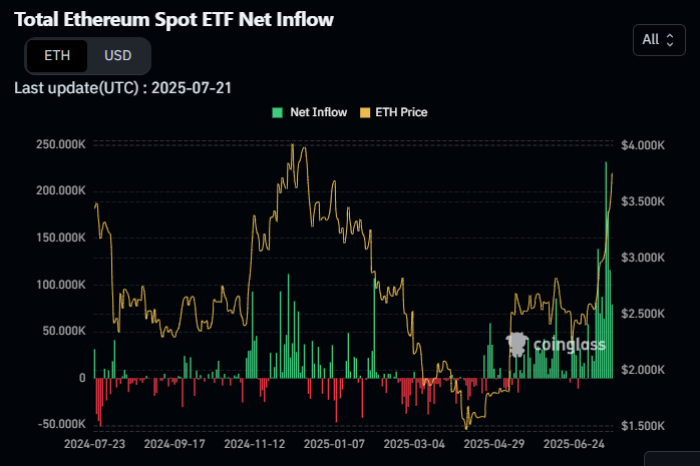
Total Ethereum Spot ETF Net Inflow

Since mid-May, $ETH ETFs have seen only a handful of days with relatively minor outflows; in July alone, over $4.5B has poured into spot Ethereum ETFs.

That doesn’t seem like a bad thing, but Schiff argues that Ethereum is still in a bear market when compared to Bitcoin. In his own words:

I would not buy either myself, but I think Ether is in a bear market in terms of Bitcoin, and I think it just had a bear market rally. So if you want to won (sic) crypto, selling Ether to buy Bitcoin makes sense.

—Peter Schiff, X

Schiff also compared the long-term case for Ethereum versus Bitcoin, noting that there’s much more competition in the spaces Ethereum occupies – DeFi, staking, etc. In contrast, no other crypto works as a store of value quite like Bitcoin does.

Also remember that Schiff called Bitcoin a ‘Ponzi scheme’ the same day and returned to a familiar theme: the benefits of investing in gold and silver.

Peter Schiff gold is about to move

But while Schiff correctly noted the competition in the DeFi space, he may have overlooked another aspect: ever-growing institutional $ETH adoption.

In two recent examples:

It’s that last element – the ability to put $ETH treasuries to work generating additional assets – that could put Ethereum in the best position to compete with Bitcoin long-term

Of course, Bitcoin may gain its own advantages. While the Bitcoin Layer 1 blockchain isn’t natively compatible with the growing crypto economy of dApps and DeFi, planned Layer 2 projects – like Bitcoin Hyper ($HYPER) – could level the playing field with Ethereum.

Bitcoin Hyper ($HYPER) – Unlock Fast, Cheap Bitcoin Transactions

Want to beat Ethereum at its own game? Design a blockchain that unlocks faster, cheaper transactions with the only crypto that’s bigger than Ethereum.

As the long-awaited Bitcoin Layer 2, Bitcoin Hyper ($HYPER) does all that and more. Deploying a Bitcoin Canonical Bridge via the Solana Virtual Machine (SVM), $HYPER unleashes payments, meme coins, dApps and more with Bitcoin.

Bitcoin Layer 2

That’s what Bitcoin Hyper is – the natural successor to Bitcoin, able to leverage all of Bitcoin’s cultural and market strength and apply it to the broader crypto economy.

Staking is one example. Users will be able to stake Bitcoin natively on Bitcoin Hyper; in the meantime, early investors can earn an estimated 231% APY by buying and staking $HYPER in the ongoing presale.

There’s real excitement over the project’s potential; the presale has raised $4.1M so far, with tokens currently priced at $0.01235. See how far we think the token’s price could go in our $HYPER price prediction.

Learn how to buy Bitcoin Hyper and visit the presale page today.

Schiff’s Tale: Caution, or Paranoia?

Peter Schiff’s recommendation to trade $ETH for $BTC stands as a provocative challenge to the prevailing bullish sentiment. Is there any truth to it?

While Ethereum’s outlook remains positive with institutional flows and staking strategies, Bitcoin Hyper shows the future still runs through Bitcoin, until proven otherwise.

Do your own research and come to your own conclusions; this isn’t financial advice.

Editorial Process for bitcoinist is centered on delivering thoroughly researched, accurate, and unbiased content. We uphold strict sourcing standards, and each page undergoes diligent review by our team of top technology experts and seasoned editors. This process ensures the integrity, relevance, and value of our content for our readers.

As a crypto writer, Bogdan’s responsibilities are split between researching and writing articles and entertaining the team with his humor bordering on the politically incorrect, an aspiring Bill Burr, if you will. Thanks to his 12+ years of writing experience in just as many fields, including tech, cybersecurity, modelling, fitness, crypto, and other topics-that-shall-not-be-named, he's become a genuine asset to the team. While his position as a senior writer at PrivacyAffairs thought him valuable lessons about the power of self-management, his entire writing career was and is an exercise in self-improvement. Now, he's ready to sink his teeth into crypto and teach people how to take control of their own money on the blockchain. With fiat as an eternally devaluing currency, Bitcoin and altcoins seem like the best-fitting alternative for Bogdan. Bogdan’s biggest professional accomplishment, aside from securing a position as a main writer for Bitcoinist, was his 5-year run as a writing manager at Blackwood Productions, where he coordinated a team of four writers. During that time, he learned the value of teamwork and that of creating a working environment that breeds efficiency, positivity, and friendship.

Trending Cryptos

Related Reads

Li Fei-Fei's Latest Long-Form Article: When Video Generation, Robotics, and NVIDIA All Call Themselves World Models, We Need a Taxonomy

In a new article, Dr. Fei-Fei Li addresses the widespread and often inconsistent use of the term "world model" in AI. She proposes a clear, functional taxonomy rooted in the classic Partially Observable Markov Decision Process (POMDP) loop (agent → action → state → observation → agent). According to this framework, current systems called "world models" are different projections of this loop, categorized by their primary output: 1. **Renderers**: Output observations (pixels). Their goal is visual fidelity for human consumption (e.g., video generation models like Sora). They are the most commercially mature but are limited by a focus on appearance over physical accuracy. 2. **Simulators**: Output states (geometric, physical, dynamic representations). They provide a structurally accurate world for both human professionals (e.g., architects) and computational agents (e.g., robots for training). Li argues simulators are the crucial, underappreciated bridge, as they can underpin both rendering and planning. 3. **Planners**: Output actions. Given an observation and a goal, they decide what an agent should do next (e.g., robotic action models). This area is highly promising but remains the least mature for real-world deployment. Li highlights a key trend: the boundaries between these three categories are beginning to blur, as they all rely on a shared underlying understanding of geometry, physics, and dynamics. The logical endpoint is a unified world foundation model capable of switching between rendering, simulation, and planning based on downstream needs. This convergence, she concludes, is central to advancing spatial intelligence—enabling machines not just to talk about the world, but to truly understand, imagine, and interact with it.

marsbit3h ago

Li Fei-Fei's Latest Long-Form Article: When Video Generation, Robotics, and NVIDIA All Call Themselves World Models, We Need a Taxonomy

marsbit3h ago

Forbes Feature: Stablecoin Cross-Border Payments Are Faster, But Not Yet Cheaper

A Forbes feature delves into the state of stablecoin-based cross-border payments, noting rapid growth but a key shortfall: while faster and more accessible, they are not yet cheaper. At a recent industry conference in Mexico City, optimism about technology, regulation, and volume was tempered by discussions with practitioners. The core issue is liquidity. Traditional FX brokers charge 60-70 basis points, and stablecoins promise to slash this to 2-5 basis points. However, this theoretical cost advantage cannot be realized until deep liquidity pools are established at scale, requiring significant institutional capital inflow. A major adoption barrier is trust. Businesses often rely on long-standing relationships with traditional brokers, valuing reliability over marginal cost savings. This shift will be gradual. Furthermore, successful companies in the space are not positioning themselves as replacements for legacy systems like SWIFT, but as complements. They leverage stablecoins for speed while using traditional rails for their standardization and reliability in ensuring accurate payment details—a critical factor for supplier payments to avoid customs issues. Companies like Caliza, experiencing high monthly growth, exemplify this hybrid approach. The industry anticipates consolidation, as long-term viability will depend on securing the essential trifecta: proper licensing, robust fiat on/off-ramps, and deep liquidity. Without these, firms risk being mere intermediaries rather than building sustainable businesses.

marsbit3h ago

Forbes Feature: Stablecoin Cross-Border Payments Are Faster, But Not Yet Cheaper

marsbit3h ago

Trading

Spot

Hot Articles

Discussions

Welcome to the HTX Community. Here, you can stay informed about the latest platform developments and gain access to professional market insights. Users' opinions on the price of S (S) are presented below.

活动图片