Wall Street Caught Manipulating Bitcoin? Expert Tells The Truth

bitcoinistPublished on 2025-06-23Last updated on 2025-06-23

Abstract

Allegations that Wall Street is deliberately suppressing Bitcoin’s price are nothing new—but according to James “Checkmate” Check, they’re nothing more...

Trusted Editorial content, reviewed by leading industry experts and seasoned editors. Ad Disclosure

Allegations that Wall Street is deliberately suppressing Bitcoin’s price are nothing new—but according to James “Checkmate” Check, they’re nothing more than fiction. In a wide-ranging appearance on the G’day Bitcoin podcast, the Check on Chain analyst directly addressed the conspiracy theories circulating across X, asserting that the appearance of price stagnation is entirely natural—and misunderstood.

Is Bitcoin Being Held Down?

“The number one source of price suppression is people’s boredom,” Check said early in the interview, responding to a wave of online frustration about Bitcoin’s apparent refusal to rally despite consistent institutional demand. In his view, the idea that the price is being “held down” by some external manipulator fails to grasp the basic mechanics of markets: every buyer requires a seller.

At the heart of the claim is a contradiction. Users on X point to billion-dollar purchases from entities like Strategy and ask why the price has gone nowhere. Check’s answer was as simple as it was blunt: “People are selling billions of dollars to Saylor.” That’s how the price stays flat.

The misconception, he argues, stems from a flawed understanding of how markets absorb liquidity. “It’s just really, really simple,” he repeated. “When you hit the buy button, you don’t want the market to send. Saylor wants to buy and then the market moves, right? That’s just how markets work. Get over it.” Far from being evidence of foul play, the sideways action—what he calls “chop-solidation”—is a normal, healthy process in which markets digest previous gains.

He explained the term “chop-solidation” as a fusion of technical consolidation and the Choppiness Index, a volatility oscillator that signals the degree to which a market is trending or ranging. The current period of stasis, hovering above $100,000 for weeks, follows an aggressive multi-month rally from the post-FTX lows. In such conditions, according to Check, a pause is inevitable. “Markets cannot go up or down in a straight line.”

But why does the idea of manipulation persist? For Check, it’s psychological. “People get so bored,” he said. “They start concocting these stories.” He likened the current mood to earlier phases in the cycle—$20–$30K in 2023, or the long sideways movement between $45K and $75K. In both cases, people cried manipulation, only for the market to eventually break higher.

The real frustration, he suggests, lies in investors’ emotional volatility, not price volatility. “You’re a stone’s throw from the all-time high,” he said. “It goes down to go up. Like, that’s so often how this plays out.” Either the market spikes violently upward, catching traders off guard, or it dips just enough to trigger fear and capitulation—before snapping back and leaving skeptics behind. “People will capitulate and panic and then it will just springboard straight up to new all-time highs.”

Chop-Solidation Is Needed

In Check’s view, the pattern is clear. Consolidation after expansion. Panic after boredom. Breakout after capitulation. There is no need to invent dark motives. “This is how bottoms get formed.” And if you’ve been around Bitcoin long enough, he implies, you’ve seen this movie before.

His broader message is aimed at calming emotional overreactions. “Chop-solidation is part of the process,” he insisted. “That’s how markets work.” Far from being orchestrated by institutions to accumulate at low prices, the range-bound nature of Bitcoin is the market’s way of preparing for the next leg—whether up or down.

In sum, Check dismantled the manipulation narrative with a data-backed, experience-driven view: the illusion of suppression isn’t a function of centralized control but of collective impatience. The price isn’t rigged—it’s resting. And when it moves, it won’t be because of a conspiracy. It’ll be because the market, as it always does, is simply doing its job.

At press time, BTC traded at $101,940.
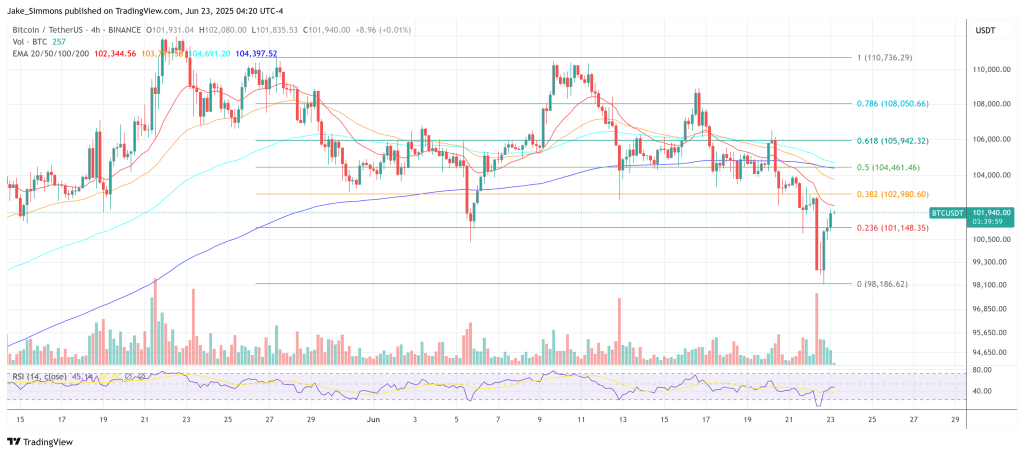
Bitcoin price
BTC price, 4-hour chart | Source: BTCUSDT on TradingView.com
Featured image created with DALL.E, chart from TradingView.com
Editorial Process for bitcoinist is centered on delivering thoroughly researched, accurate, and unbiased content. We uphold strict sourcing standards, and each page undergoes diligent review by our team of top technology experts and seasoned editors. This process ensures the integrity, relevance, and value of our content for our readers.

Jake Simmons has been a Bitcoin enthusiast since 2016. Ever since he heard about Bitcoin, he has been studying the topic every day and trying to share his knowledge with others. His goal is to contribute to Bitcoin's financial revolution, which will replace the fiat money system. Besides BTC and crypto, Jake studied Business Informatics at a university. After graduation in 2017, he has been working in the blockchain and crypto sector. You can follow Jake on Twitter at @realJakeSimmons.

Trending Cryptos

Related Reads

Collateral Dollars: How Does a 'Second-Layer Dollar' Above Stablecoins Form?

Collateral Dollars: How Does a "Second Layer of Dollars" Form on Top of Stablecoins? Most assume stablecoins replicate Eurodollar functions, expanding the offshore dollar system. However, stablecoins primarily replace specific functions like operational dollar balances for settlement. They do not inherently create new dollar credit; they substitute existing claims. The key question is: what happens when financial intermediaries use stablecoins as collateral to create a new layer of dollar-denominated claims? This "collateral dollar" channel operates through secured lending, not direct money creation. A money-like event only occurs when a liability issued against the controlled stablecoin is funded, rolled over, or accepted at near-par value by another balance sheet. The discount (haircut) prices the gap between "effective control over the token" and "reliable convertibility to bank dollars." Elasticity stems not from the stablecoin itself but from the liability issued against it and the willingness of third-party balance sheets to treat that liability as a near-par asset. Compared to the traditional Eurodollar system—where elasticity originates from bank deposit creation—the stablecoin collateral chain is structurally different. Eurodollar deposits are credit-expansive from inception. Stablecoins are initially substitutive; elasticity emerges later if an intermediary's liability against them gains monetary acceptance. Stablecoins disrupt specific tiers of the offshore dollar system, mainly replacing operational settlement balances. They do not replace the need for full dollar balance-sheet capacity (credit lines, hedging, maturity transformation). For systemic impact, the second-layer liability must pass three tests: transferability, funding capacity, and monetary acceptance (being fundable or held at par by others). Pressure transmission also differs. In the Eurodollar system, stress moves up a hierarchy of claims. In a stablecoin collateral chain, the second-layer liability can lose its money-like status well before the underlying stablecoin faces a run, often triggered by haircut increases and margin calls that create a dynamic spiral of falling token prices and rising discounts. In conclusion, the "collateral dollar" is not the stablecoin itself. It is the second-layer liability issued against a controlled token balance that is willing to be funded and maintained at near-par value. Its existence depends on that liability surviving the leap from "token liquidity" to "bank dollar liquidity."

marsbit59m ago

Collateral Dollars: How Does a 'Second-Layer Dollar' Above Stablecoins Form?

marsbit59m ago

Trading

Spot

Hot Articles

What is $BITCOIN

DIGITAL GOLD ($BITCOIN): A Comprehensive Analysis Introduction to DIGITAL GOLD ($BITCOIN) DIGITAL GOLD ($BITCOIN) is a blockchain-based project operating on the Solana network, which aims to combine the characteristics of traditional precious metals with the innovation of decentralized technologies. While it shares a name with Bitcoin, often referred to as “digital gold” due to its perception as a store of value, DIGITAL GOLD is a separate token designed to create a unique ecosystem within the Web3 landscape. Its goal is to position itself as a viable alternative digital asset, although specifics regarding its applications and functionalities are still developing. What is DIGITAL GOLD ($BITCOIN)? DIGITAL GOLD ($BITCOIN) is a cryptocurrency token explicitly designed for use on the Solana blockchain. In contrast to Bitcoin, which provides a widely recognized value storage role, this token appears to focus on broader applications and characteristics. Notable aspects include: Blockchain Infrastructure: The token is built on the Solana blockchain, known for its capacity to handle high-speed and low-cost transactions. Supply Dynamics: DIGITAL GOLD has a maximum supply capped at 100 quadrillion tokens (100P $BITCOIN), although details regarding its circulating supply are currently undisclosed. Utility: While precise functionalities are not explicitly outlined, there are indications that the token could be utilized for various applications, potentially involving decentralized applications (dApps) or asset tokenization strategies. Who is the Creator of DIGITAL GOLD ($BITCOIN)? At present, the identity of the creators and development team behind DIGITAL GOLD ($BITCOIN) remains unknown. This situation is typical among many innovative projects within the blockchain space, particularly those aligning with decentralized finance and meme coin phenomena. While such anonymity may foster a community-driven culture, it intensifies concerns about governance and accountability. Who are the Investors of DIGITAL GOLD ($BITCOIN)? The available information indicates that DIGITAL GOLD ($BITCOIN) does not have any known institutional backers or prominent venture capital investments. The project seems to operate on a peer-to-peer model focused on community support and adoption rather than traditional funding routes. Its activity and liquidity are primarily situated on decentralized exchanges (DEXs), such as PumpSwap, rather than established centralized trading platforms, further highlighting its grassroots approach. How DIGITAL GOLD ($BITCOIN) Works The operational mechanics of DIGITAL GOLD ($BITCOIN) can be elaborated on based on its blockchain design and network attributes: Consensus Mechanism: By leveraging Solana’s unique proof-of-history (PoH) combined with a proof-of-stake (PoS) model, the project ensures efficient transaction validation contributing to the network's high performance. Tokenomics: While specific deflationary mechanisms have not been extensively detailed, the vast maximum token supply implies that it may cater to microtransactions or niche use cases that are still to be defined. Interoperability: There exists the potential for integration with Solana’s broader ecosystem, including various decentralized finance (DeFi) platforms. However, the details regarding specific integrations remain unspecified. Timeline of Key Events Here is a timeline that highlights significant milestones concerning DIGITAL GOLD ($BITCOIN): 2023: The initial deployment of the token occurs on the Solana blockchain, marked by its contract address. 2024: DIGITAL GOLD gains visibility as it becomes available for trading on decentralized exchanges like PumpSwap, allowing users to trade it against SOL. 2025: The project witnesses sporadic trading activity and potential interest in community-led engagements, although no noteworthy partnerships or technical advancements have been documented as of yet. Critical Analysis Strengths Scalability: The underlying Solana infrastructure supports high transaction volumes, which could enhance the utility of $BITCOIN in various transaction scenarios. Accessibility: The potential low trading price per token could attract retail investors, facilitating wider participation due to fractional ownership opportunities. Risks Lack of Transparency: The absence of publicly known backers, developers, or an audit process may yield skepticism regarding the project's sustainability and trustworthiness. Market Volatility: The trading activity is heavily reliant on speculative behavior, which can result in significant price volatility and uncertainty for investors. Conclusion DIGITAL GOLD ($BITCOIN) emerges as an intriguing yet ambiguous project within the rapidly evolving Solana ecosystem. While it attempts to leverage the “digital gold” narrative, its departure from Bitcoin's established role as a store of value underscores the need for a clearer differentiation of its intended utility and governance structure. Future acceptance and adoption will likely depend on addressing the current opacity and defining its operational and economic strategies more explicitly. Note: This report encompasses synthesised information available as of October 2023, and developments may have transpired beyond the research period.

668 Total ViewsPublished 2025.05.13Updated 2025.05.13

What is $BITCOIN

Discussions

Welcome to the HTX Community. Here, you can stay informed about the latest platform developments and gain access to professional market insights. Users' opinions on the price of BTC (BTC) are presented below.

活动图片