Bitcoin Breaks Macro Rules: Risk Appetite Grows Despite Hawkish Signals

bitcoinistPublished on 2025-06-14Last updated on 2025-06-14

Abstract

Bitcoin is trading just above the pivotal $103,600 level, a critical support zone that has acted as a key threshold...

Trusted Editorial content, reviewed by leading industry experts and seasoned editors. Ad Disclosure

Bitcoin is trading just above the pivotal $103,600 level, a critical support zone that has acted as a key threshold for bulls throughout this cycle. If it fails to hold, analysts warn that BTC could swiftly drop below $100,000, triggering a broader correction across the crypto market. This comes as global markets react to escalating geopolitical risk—Israel launched a surprise attack on Iran, prompting immediate retaliation and fueling volatility across commodities, equities, and digital assets.

Despite the turmoil, Bitcoin continues to show relative strength, holding above the $100K psychological level even as investors flee risk assets. Top analyst Darkfost highlights a unique dynamic in this cycle: the unusual decoupling between Bitcoin and bond yields. Historically, rising US Treasury yields have coincided with crypto drawdowns. However, in the current environment, Bitcoin has continued to trend upward, even as yields sit near some of the highest levels in its history.

According to crypto analyst Darkfost, Bitcoin’s bullish momentum appears to be increasingly influenced by weakness in the US Dollar Index (DXY). Each time the dollar retreats, BTC has shown strong acceleration, suggesting global liquidity flows may be favoring Bitcoin as an alternative macro hedge. The next few days will be crucial.

Bitcoin Shows Resilience Amid Geopolitical Risk

After failing to break above the $112,000 resistance, Bitcoin dropped over 6%, sparking concern that bears may push the price below critical support. However, despite the volatility, BTC remains resilient—holding above the $103,600 mark—even as the ongoing conflict between Israel and Iran rattles global markets.

Darkfost emphasizes the growing importance of macroeconomic indicators like the DXY and US Treasury yields. These metrics increasingly dictate institutional sentiment and global liquidity flows. Traditionally, when both the DXY and yields climb, capital exits risk assets, leading to sharp corrections in Bitcoin and broader crypto markets. Historically, this macro environment has marked the onset of bear markets for BTC.
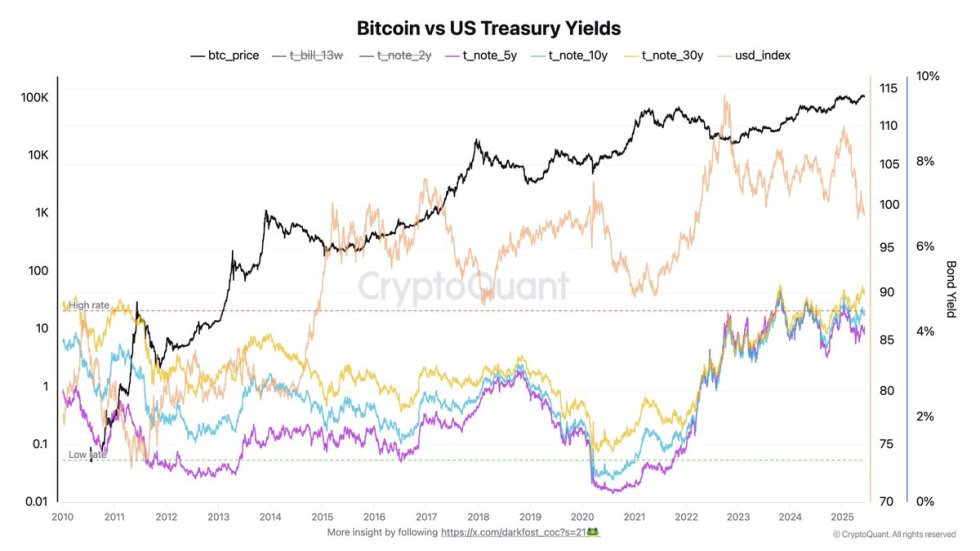
Bitcoin vs US Treasury Yields | Source: Darkfost on X

Conversely, when the DXY and yields begin to stall or fall, investor confidence in risk assets tends to return. Such periods often coincide with monetary easing or speculation over future interest rate cuts by the Federal Reserve—conditions that ignite bullish momentum in the crypto space.

What makes this cycle unique, according to Darkfost, is Bitcoin’s divergence from rising yields. Despite yields reaching multi-year highs, BTC has continued trending upward, particularly when the DXY softens. This decoupling signals a possible structural shift in how Bitcoin behaves relative to traditional financial metrics.

One explanation for this anomaly is the evolving perception of Bitcoin as a macro hedge and store of value. With inflation concerns and sovereign debt risks on the rise, institutional capital may now be treating BTC not merely as a speculative asset, but as a hedge against systemic risk. If this narrative continues gaining traction, Bitcoin could carve out a new role within the global financial landscape—one that redefines its relationship with macro forces.

Bulls Defend Critical Support Amid Renewed Volatility

Bitcoin is currently trading around $105,300 after a volatile session triggered by geopolitical tensions and macro uncertainty. The chart shows that BTC briefly dipped below the $103,600 support level—a key horizontal demand zone—but managed to reclaim it swiftly, suggesting strong interest from buyers at lower levels.
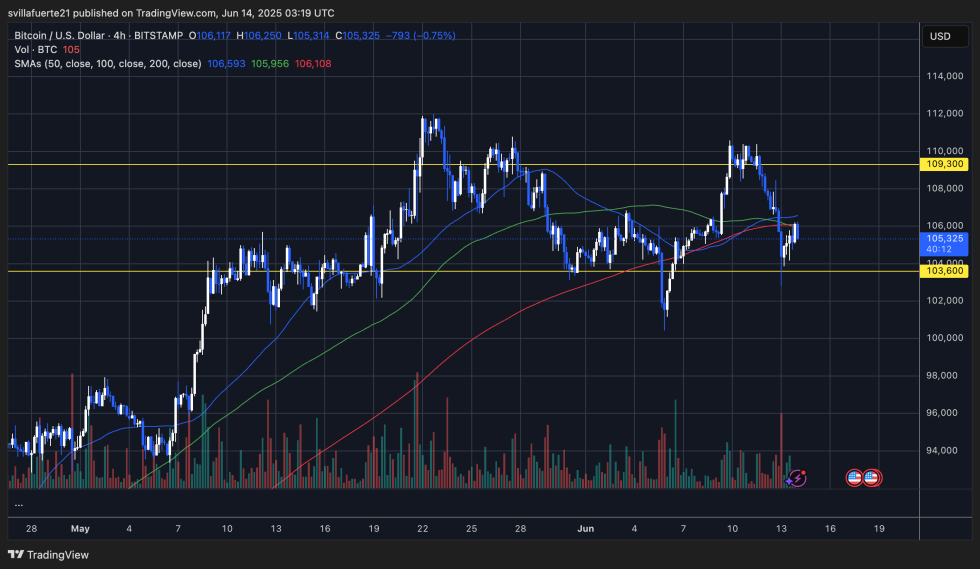
BTC testing key moving averages as resistance | Source: BTCUSDT chart on TradingView

The 50, 100, and 200-period SMAs are clustered between $105,950 and $106,600, and currently act as dynamic resistance. For Bitcoin to regain bullish momentum, it must break above this confluence of moving averages and reclaim the $106,600–$107,000 zone. Failing to do so could open the door to another retest of the $103,600 level, which has been tested multiple times since early May.

Volume spiked during the most recent drop, indicating capitulation or forced selling, often followed by short-term recoveries. However, buyers will want to see sustained strength above $106,000 to consider this a true reversal rather than a relief bounce.

Featured image from Dall-E, chart from TradingView

Editorial Process for bitcoinist is centered on delivering thoroughly researched, accurate, and unbiased content. We uphold strict sourcing standards, and each page undergoes diligent review by our team of top technology experts and seasoned editors. This process ensures the integrity, relevance, and value of our content for our readers.

Sebastian's journey into the world of crypto began four years ago, driven by a fascination with the potential of blockchain technology to revolutionize financial systems. His initial exploration focused on understanding the intricacies of various crypto projects, particularly those focused on building innovative financial solutions. Through countless hours of research and learning, Sebastian developed a deep understanding of the underlying technologies, market dynamics, and potential applications of cryptocurrencies. As his knowledge grew, Sebastian felt compelled to share his insights with others. He began actively contributing to online discussions on platforms like X and LinkedIn, focusing on fintech and crypto-related content. His goal was to expose valuable trends and insights to a wider audience, fostering a deeper understanding of the rapidly evolving crypto landscape. Sebastian's contributions quickly gained recognition, and he became a trusted voice in the online crypto community. To further enhance his expertise, Sebastian pursued a UC Berkeley Fintech: Frameworks, Applications, and Strategies certification. This rigorous program equipped him with valuable skills and knowledge regarding Financial Technology, bridging the gap between traditional finance (TradFi) and decentralized finance (DeFi). The certification deepened his understanding of the broader financial landscape and its intersection with blockchain technology. Sebastian's passion for finance and writing is evident in his work. He enjoys delving into financial research, analyzing market trends, and exploring the latest developments in the crypto space. In his spare time, Sebastian can often be found immersed in charts, studying 10-K forms, or engaging in thought-provoking discussions about the future of finance. Sebastian's journey as a crypto analyst and investor has been marked by a relentless pursuit of knowledge and a dedication to sharing his insights. His ability to navigate the complex world of crypto, combined with his passion for financial research and communication, makes him a valuable asset to the industry. As the crypto landscape continues to evolve, Sebastian remains at the forefront, providing valuable insights and contributing to the growth of this revolutionary technology.

Trending Cryptos

Related Reads

Pantera Capital: As Perpetual Contracts Move Towards the Financial Center, Hyperliquid Aims to Be All-Encompassing

Perpetual futures ("perps"), once a crypto-native phenomenon, are becoming a dominant global financial instrument, evolving into a fundamental market structure shift that traditional finance can no longer ignore. This article outlines the advantages of perpetual contracts over traditional futures, highlighting their simplicity (no expiry/rollover), easier risk management, and native 24/7 operation. While the concept is not new, digital assets provided the ideal environment for its explosive growth. Initially dominated by centralized exchanges (CEX), perps have recently migrated significantly to decentralized exchanges (DEX), with Hyperliquid emerging as the leading DEX for perps, capturing ~40% of the on-chain volume. Hyperliquid, built on its own purpose-built L1 blockchain, has successfully expanded beyond crypto into traditional assets like stocks, commodities, and indices, driven by its permissionless listing framework (HIP-3) and 24/7 availability. It has become a crucial price discovery venue during off-hours and for pre-IPO companies, attracting attention from traditional hedge funds and major exchanges like ICE, which now views it as serious competition. The investment thesis for Hyperliquid's token, HYPE, rests on its large and growing total addressable market (TAM) across all finance, strong execution, superior user experience, and direct value accrual via aggressive token buybacks using 99% of protocol revenue. Key risks remain, primarily regulatory uncertainty in the U.S., though recent CFTC actions approving certain regulated crypto perp contracts signal a potential shift toward broader acceptance. The core question is no longer if perpetuals matter beyond crypto, but whether blockchain-based infrastructure like Hyperliquid can become the primary venue for pricing, trading, and discovering risk across all financial domains.

marsbit5h ago

Pantera Capital: As Perpetual Contracts Move Towards the Financial Center, Hyperliquid Aims to Be All-Encompassing

marsbit5h ago

Trading

Spot

Hot Articles

What is $BITCOIN

DIGITAL GOLD ($BITCOIN): A Comprehensive Analysis Introduction to DIGITAL GOLD ($BITCOIN) DIGITAL GOLD ($BITCOIN) is a blockchain-based project operating on the Solana network, which aims to combine the characteristics of traditional precious metals with the innovation of decentralized technologies. While it shares a name with Bitcoin, often referred to as “digital gold” due to its perception as a store of value, DIGITAL GOLD is a separate token designed to create a unique ecosystem within the Web3 landscape. Its goal is to position itself as a viable alternative digital asset, although specifics regarding its applications and functionalities are still developing. What is DIGITAL GOLD ($BITCOIN)? DIGITAL GOLD ($BITCOIN) is a cryptocurrency token explicitly designed for use on the Solana blockchain. In contrast to Bitcoin, which provides a widely recognized value storage role, this token appears to focus on broader applications and characteristics. Notable aspects include: Blockchain Infrastructure: The token is built on the Solana blockchain, known for its capacity to handle high-speed and low-cost transactions. Supply Dynamics: DIGITAL GOLD has a maximum supply capped at 100 quadrillion tokens (100P $BITCOIN), although details regarding its circulating supply are currently undisclosed. Utility: While precise functionalities are not explicitly outlined, there are indications that the token could be utilized for various applications, potentially involving decentralized applications (dApps) or asset tokenization strategies. Who is the Creator of DIGITAL GOLD ($BITCOIN)? At present, the identity of the creators and development team behind DIGITAL GOLD ($BITCOIN) remains unknown. This situation is typical among many innovative projects within the blockchain space, particularly those aligning with decentralized finance and meme coin phenomena. While such anonymity may foster a community-driven culture, it intensifies concerns about governance and accountability. Who are the Investors of DIGITAL GOLD ($BITCOIN)? The available information indicates that DIGITAL GOLD ($BITCOIN) does not have any known institutional backers or prominent venture capital investments. The project seems to operate on a peer-to-peer model focused on community support and adoption rather than traditional funding routes. Its activity and liquidity are primarily situated on decentralized exchanges (DEXs), such as PumpSwap, rather than established centralized trading platforms, further highlighting its grassroots approach. How DIGITAL GOLD ($BITCOIN) Works The operational mechanics of DIGITAL GOLD ($BITCOIN) can be elaborated on based on its blockchain design and network attributes: Consensus Mechanism: By leveraging Solana’s unique proof-of-history (PoH) combined with a proof-of-stake (PoS) model, the project ensures efficient transaction validation contributing to the network's high performance. Tokenomics: While specific deflationary mechanisms have not been extensively detailed, the vast maximum token supply implies that it may cater to microtransactions or niche use cases that are still to be defined. Interoperability: There exists the potential for integration with Solana’s broader ecosystem, including various decentralized finance (DeFi) platforms. However, the details regarding specific integrations remain unspecified. Timeline of Key Events Here is a timeline that highlights significant milestones concerning DIGITAL GOLD ($BITCOIN): 2023: The initial deployment of the token occurs on the Solana blockchain, marked by its contract address. 2024: DIGITAL GOLD gains visibility as it becomes available for trading on decentralized exchanges like PumpSwap, allowing users to trade it against SOL. 2025: The project witnesses sporadic trading activity and potential interest in community-led engagements, although no noteworthy partnerships or technical advancements have been documented as of yet. Critical Analysis Strengths Scalability: The underlying Solana infrastructure supports high transaction volumes, which could enhance the utility of $BITCOIN in various transaction scenarios. Accessibility: The potential low trading price per token could attract retail investors, facilitating wider participation due to fractional ownership opportunities. Risks Lack of Transparency: The absence of publicly known backers, developers, or an audit process may yield skepticism regarding the project's sustainability and trustworthiness. Market Volatility: The trading activity is heavily reliant on speculative behavior, which can result in significant price volatility and uncertainty for investors. Conclusion DIGITAL GOLD ($BITCOIN) emerges as an intriguing yet ambiguous project within the rapidly evolving Solana ecosystem. While it attempts to leverage the “digital gold” narrative, its departure from Bitcoin's established role as a store of value underscores the need for a clearer differentiation of its intended utility and governance structure. Future acceptance and adoption will likely depend on addressing the current opacity and defining its operational and economic strategies more explicitly. Note: This report encompasses synthesised information available as of October 2023, and developments may have transpired beyond the research period.

726 Total ViewsPublished 2025.05.13Updated 2025.05.13

What is $BITCOIN

Discussions

Welcome to the HTX Community. Here, you can stay informed about the latest platform developments and gain access to professional market insights. Users' opinions on the price of BTC (BTC) are presented below.

活动图片