TRUMP memecoin gala winners include suspected foreign investors

AmbcryptoPublished on 2025-05-14Last updated on 2025-05-14

Abstract

Scrutiny intensifies with NFT perks and loyalty teasers – yet there are some serious questions.

  • TRUMP coin contest ends with NFTs and a loyalty program, but scrutiny over top holders intensifies.
  • Foreign-linked wallets and shifting prize language spark legal and political concerns around the memecoin’s intent.
  • The gala dinner contest wrapped up with a flourish – NFT rewards, flashy announcements, and announcements of a loyalty program aimed at turning casual holders into diehard evangelists.

But all that glitters isn’t quite gold.

From eyebrow-raising perks to allegations of foreign investor winners gaming the system, here’s what’s really going on beneath the surface.

The contest is over, but the game’s just begun

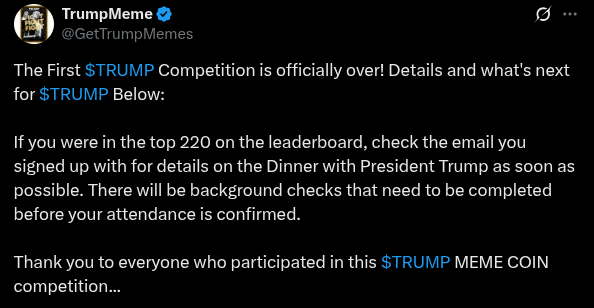
The TRUMP coin dinner contest has officially ended, with the top 220 holders now awaiting exclusive access to a high-profile gala dinner.

All participants received NFTs, but the real twist lies in what comes next. A special “Diamond Hand” NFT will be awarded to those who don’t sell their TRUMP tokens before the event on the 22nd of May.

This a clear move to discourage sell-offs and inflate perceived market strength.

In a post-contest announcement, organizers teased the “Next Era of TRUMP” alongside a new Trump rewards points program, stating:

“DIAMOND HAND Holders will also give you more TRUMP REWARDS POINTS!”

The market seems to have responded – TRUMP has gained nearly 50% over the past month, driven largely by these speculative incentives.

Who’s really holding TRUMP?

The top coin holders are raising eyebrows – not just for the size of their bags, but for their global connections.

Leading the pack is “Sun,” a wallet holding $16.6 million in TRUMP, allegedly linked to a foreign crypto exchange advised by Chinese billionaire Justin Sun. He recently shared a stage with Eric Trump in Dubai and is a key investor in World Liberty Financial, another Trump-linked crypto venture.

The second-largest holder, “MeCo,” tied to Singapore-based MemeCore, openly solicited tokens to climb the leaderboard. While rules favored time-weighted holdings, at least 17 of the top 220 wallets held zero TRUMP as of Monday.

Legal gray zones and political red flags

As Official Trump’s [TRUMP] ecosystem grows, scrutiny intensifies.

The dinner contest’s fine print now distances the event from the White House, naming Fight Fight Fight LLC as the organizer and listing President Donald Trump only as a “guest.”

Meanwhile, concerns rise over top holders with foreign ties and possible political motives, sparking debates on pay-to-play optics and regulatory evasion.

Critics argue the rewards system may verge on market manipulation, while others see the SEC’s quiet retreat from prosecuting major investors as a troubling signal.

At what point does a memecoin cross into political impropriety—or something more concerning?

Related Reads

Dalio's Latest Warning: Don't Get Carried Away by AI, Real Returns on US Stocks in the Next 5-10 Years Could Be -5% to -10%

Ray Dalio, founder of Bridgewater Associates, warns investors against excessive concentration in AI stocks. He argues the current market, dominated by a few AI giants, mirrors historical patterns where revolutionary new technologies lead to high risk, volatility, and uncertainty. While acknowledging AI's transformative potential, Dalio emphasizes that most investors fail at this stage of the cycle by over-concentrating in a handful of leading companies. He cites inherent risks: companies cannot accurately forecast investment needs or external shocks (e.g., monetary policy, geopolitics, taxes), face potential disruption from future technologies and international competition (notably from China), and experience significant price swings. Dalio's core advice is diversification, calling it his "Holy Grail of Investing." He presents a mathematical case that a well-diversified portfolio of 15-20 uncorrelated, good bets offers a superior risk-adjusted return compared to a concentrated position. Dalio also offers a cautious outlook, suggesting U.S. stocks may deliver real returns of -5% to -10% over the next 5-10 years based on valuation and bubble indicators. He concludes that in the face of high uncertainty, the prudent strategy is not to avoid betting entirely, but to avoid large, concentrated bets where one lacks sufficient informational edge. Instead, investors should build a strategically balanced, diversified portfolio.

marsbit1h ago

Dalio's Latest Warning: Don't Get Carried Away by AI, Real Returns on US Stocks in the Next 5-10 Years Could Be -5% to -10%

marsbit1h ago

Rain Valuation Approaches $20 Billion: The Battle for U-Cards Extends to Rewards Systems

Rain, a stablecoin payments infrastructure company, is shifting the competitive focus for U Cards from simple issuance to user retention and repeated usage. On June 15, Rain launched "Rain Rewards," an embedded loyalty program capability within its card-issuing infrastructure. This allows partner businesses—like fintech platforms and neobanks—to configure branded loyalty points, earning rules, redemptions, and merchant promotions directly within their card products. The system, built from the 2025 acquisition of Uptop, ensures points are only issued upon final transaction settlement, preventing liabilities from refunds. Trials, such as with Avalanche Card, reportedly boosted spending by 25% among enrolled users. Founded by Farooq Malik and Charles Yoo-Naut, Rain evolved from a tool for managing Web3 company expenses into a full-stack enterprise platform. It is a Principal Member of Visa and Mastercard, enabling partners to issue stablecoin-backed cards and wallets while leveraging traditional payment networks. Notably, the popular U Card Plasma One is issued by Rain under Visa's authority. Rain also integrates with Visa's stablecoin settlement pilot, using USDC for network settlement. Rain's rapid funding reflects growing institutional interest in stablecoin payment infrastructure. It raised a $245 million Series A in March 2025, a $58 million Series B in August 2025, and a $250 million Series C in January of this year, reaching a $19.5 billion valuation. Annualized transaction volume exceeds $3 billion, serving over 200 partners including Western Union and Nuvei. Beyond cards, Rain is expanding into programmable payments. Its June 2026 "Agent Control Layer" allows businesses to set spending rules—like merchant categories, amounts, and frequency—for AI agents before transactions occur. This positions Rain not as a single product but as an operating system for stablecoin payments, handling everything from card issuance and wallet management to rewards, on/off-ramps, and automated compliance. The goal is to enable seamless, often invisible, real-world spending of on-chain assets.

Foresight News1h ago

Rain Valuation Approaches $20 Billion: The Battle for U-Cards Extends to Rewards Systems

Foresight News1h ago

Google TPU Shipments Revised Up by 50%

Recent industry research indicates a significant upward revision in the shipments of Google's TPU (Tensor Processing Unit) chips. Previous expectations for 2027 were set at around 10 million units, but new estimates now point to 15 million units, a 50% increase. This substantial boost directly translates to higher demand across the entire supporting supply chain. Google's TPU clusters utilize a standardized all-optical interconnect architecture. Consequently, key hardware components are deeply integrated and scaled in fixed ratios with the chips. The 15 million TPU target will drive corresponding demand increases for NPO optical engines (roughly a 1:1 match), 1.6T optical modules, OCS optical switches, high-end server power supplies, fiber optics & MPO connectors, and liquid cooling solutions. Among these, liquid cooling is highlighted as the sector experiencing the most significant transformation and offering the most stable potential for excess returns. As next-generation TPU chips reach power levels where traditional air cooling is insufficient, liquid cooling becomes essential. 2026 is forecasted as the first year of substantial adoption for Google's liquid cooling solutions. This shift, coupled with delivery and capacity bottlenecks faced by incumbent overseas manufacturers, is creating a prime window for domestic Chinese suppliers to enter and secure Google's core supply chain. The market size for Google-specific liquid cooling is projected to potentially triple from a baseline of hundreds of billions to around 300 billion units by 2028. The logic for the fiber optic sector is also being rewritten. Once considered a cyclical commodity tied to telecom operator procurement, fiber is now a strategic and scarce resource for AI Data Centers (AIDC). A severe supply-demand imbalance, driven by the long lead time for preform production (18-24 months) and surging demand from cloud giants, is supporting strong performance. Chinese fiber manufacturers are well-positioned to capture a significant share of global AIDC demand, with exports potentially reaching 200-300 million core kilometers in 2026. Overall, the investment focus within the AI computing industry is shifting from pure "chip performance speculation" towards the more certain incremental growth in computing infrastructure and its supporting ecosystem. The upward revision in Google TPU shipments, along with the potential for further doubling by 2028, is seen as solidifying performance visibility for the entire supporting supply chain over the next two years.

marsbit2h ago

Google TPU Shipments Revised Up by 50%

marsbit2h ago

Trading

Spot
Futures

Hot Articles

What is TRUMP CAT

Trump Cat Family, $Trump Cat: An Unraveled Mystery Introduction In the constantly evolving landscape of crypto projects and web3 innovations, a curious phenomenon has emerged—one that appears to straddle the line between cryptocurrency and internet meme culture. This is the enigmatic “Trump Cat Family”, also referred to as “$Trump Cat”. Though it might arouse curiosity among crypto enthusiasts, the reality appears far removed from the standard definition of a crypto project. This article aims to explore the concept of Trump Cat Family, bringing to light the context surrounding it and clarifying its status in the crypto realm. What is Trump Cat Family, $Trump Cat? At first glance, one might think that “Trump Cat Family” refers to a legitimate cryptocurrency or web3 project. However, upon deeper investigation, it becomes evident that the term lacks the trappings of a traditional crypto venture. Instead, “Trump Cat” seems to be predominantly associated with the viral meme culture that surged following controversial statements made by former U.S. President Donald Trump regarding Haitian immigrants. The media coverage sparked a myriad of memes, humoristic interpretations, and a wave of social commentary. These memes depict various forms of satire centered on Trump's dialogue, often utilizing cats in comedic and sometimes absurd scenarios. Rather than a structured project aimed at addressing technological advancements or financial transactions, the “Trump Cat Family” concept exists predominantly in the realm of internet humor. Who is the Creator of Trump Cat Family, $Trump Cat? In the investigation of who stands behind the “Trump Cat Family,” it becomes apparent that there exists no identifiable creator or founding figure. The phenomenon seems to have originated from collective internet expression, rather than from a singular visionary with a defined project goal. This anonymity further emphasizes its status as a meme rather than a structured initiative akin to most known crypto projects. Who are the Investors of Trump Cat Family, $Trump Cat? Given that “Trump Cat Family” does not conform to the characteristics of a reputable crypto project, the question of investment becomes moot. There have been no established foundations or organizations expressing support for a project by this name. Instead, what exists are individual contributors to meme culture—hobbyists, artists, and social media users who collectively populate the internet with their interpretations and humor surrounding the term “Trump Cat.” This organic growth within digital human communication reflects more of a social commentary than a financial investment landscape. How Does Trump Cat Family, $Trump Cat Work? If one seeks to establish how “Trump Cat Family” operates, the answer is vastly different from what might be expected of standard crypto projects. There are no operational mechanisms, technological innovations, or unique features inherent to this phenomenon. Instead, it exists through viral spread online, relying upon social media platforms for proliferation. The “how” lies in the realm of culture and communication—its essence derived from the dynamics of social interaction rather than from established crypto protocols or blockchain functionalities. What makes “Trump Cat” unique, if anything, is the way it dramatizes a political dialogue through humor. People utilize engaging visuals, inside jokes, and inventive storytelling to convey sentiments regarding political figures and societal issues. The power of memes transcends traditional communication, encapsulating complex thoughts in a form that resonates widely, yet remains elusive in terms of quantifiable success or structured goals. Timeline of Trump Cat Family, $Trump Cat September 2024: The discourse surrounding Donald Trump's comments about Haitian immigrants allegedly consuming pets gains traction online, leading to a blossoming of memes and parodic interpretations across various platforms. Continuing Impact: Following this period, the “Trump Cat” phenomenon sees continued life as social media users leverage humor to address, critique, or simply celebrate the absurdity of political conversations and events. It is essential to note that as “Trump Cat Family” lacks the formal structure of a traditional project, the timeline consists primarily of anecdotal observation rather than remarkable milestones commonly found in recognized crypto ventures. Key Points Meme Culture: Rather than a structured crypto initiative, “Trump Cat” aligns more with the evolving landscape of internet memes. Origin of the Term: The genesis of “Trump Cat” relates directly to commentary on President Trump's remarks about Haitian immigrants, sparking widespread humoristic representation. Absence of a Project Framework: The term fails to align with any defined project objectives, creators, or investors, marking it as a novel cultural experience rather than a crypto project. Conclusion In summary, the investigation into “Trump Cat Family, $Trump Cat” reveals a phenomenon entrenched in internet meme culture rather than a recognized project within the cryptocurrency or web3 sectors. The virality surrounding the term is birthed from collective user engagement, reflective of modern digital discourse rather than a formalized initiative with structure or strategic foresight. For all the curiosity it may invoke among those seeking the next big crypto project, “Trump Cat Family” serves as a testament to humanity's creativity, humor, and often absurd relationship with politics in the digital age.

2.9k Total ViewsPublished 2025.01.22Updated 2025.01.22

What is TRUMP CAT

TRUMP: Decoding Trump's Crypto "Game of Power"

This article analyzes the underlying mechanics and participation approaches within the $TRUMP ecosystem, examining its technical, narrative, and community aspects.

40.6k Total ViewsPublished 2025.04.23Updated 2025.04.29

TRUMP: Decoding Trump's Crypto "Game of Power"

Discussions

Welcome to the HTX Community. Here, you can stay informed about the latest platform developments and gain access to professional market insights. Users' opinions on the price of TRUMP (TRUMP) are presented below.

活动图片