ETH的“换庄”结束了吗?

投研日志Published on 2025-05-11Last updated on 2026-06-30

Abstract

所以,大持有者募集筹码的过程会让市场比较煎熬或者说很难跟上节奏;最好的办法就是“持有并无视涨跌”或者“看不参与”。但无论如何预见的是,当ETH进入“第三阶段”后,它的表现应该会和以往周期都不一样了。

作者:@Murphychen888

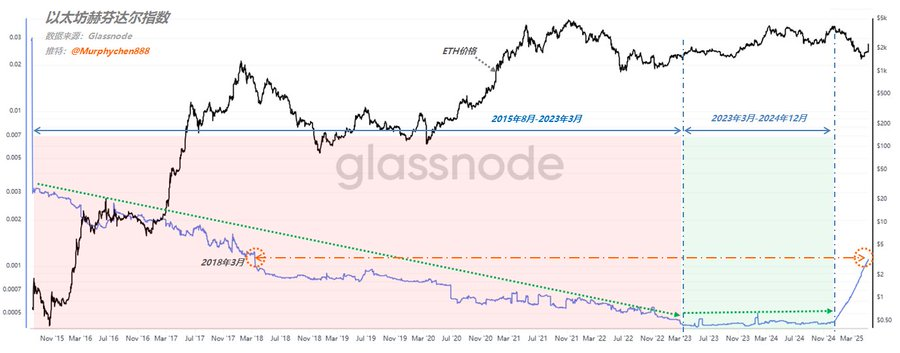
前几天有小伙伴问到关于ETH的筹码集中度。之前我曾分享过,赫芬达尔指数能够很好的反映筹码集中度问题。其网络地址在当前供应量中所占的份额,可以估计指数代表筹码正在向少数持有者集中度,指数低则表示筹码分配情况较好。在3月18日的推文中该指数为0.75‰,而当前已经上涨到1.1‰。从整个以太坊的时间数据上,我们可以看到有明显的三个阶段(如图1):

图1

第一阶段:2015年8月-2023年3月,赫芬达尔指数从3‰的高点开始下跌;这个过程非常缓慢,整整经历了7年的时间。说明在这7年中,无论价格涨跌,ETH都朝着更加分散的趋势在发展。

第二阶段:2023年3月-2024年12月,赫芬达尔指数在0.4‰左右触底;此后无论是ETF通过后的大量买入,还是牛市中的涨涨跌跌,指数一直在底部徘徊。我们分析其背后的逻辑:照理说ETF通过后机构大量买入应该会导致集中度上涨,但实际并没有。说明在大约一个期限,也同样有大持有者地址将筹码派发给了更多的分散地址,对冲了ETF的买入。有小伙伴将这个过程称为“ETH正在换庄”也无无。

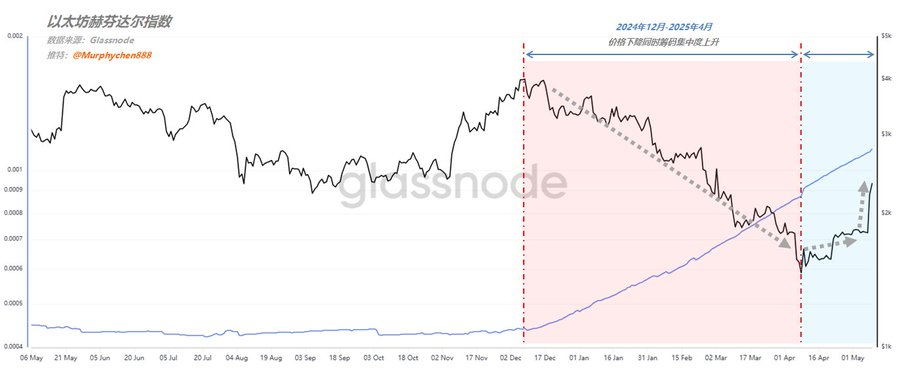
第三阶段:2024年12月至今,赫芬达尔指数从底部开始快速上涨,目前已达到2018年3月时的同等高度。可以说只是用了5个月的时间来归集,就完成了曾经走过5年之久的分散之路。

(图2)

从2024年12月到2025年4月,ETH价格从4000美元跌至1500美元,而同期赫芬达尔指数却在快速上涨。说明在币价下跌时有少数持有者正在大量收集筹码,且同时并没有大量持有者在分散筹码。这就导致赫芬达尔指数能在短期内快速上涨的直接原因,即集中度越来越高。

筹码更集中虽然不代表一定就拉盘,但一定更有利于控盘,且波动性会被放大。就像这几天ETH的波动性就远远大于其他币种主流。当然,现在的筹码集中度是1.1‰,距离历史高点3‰还有大量的一段距离。

大持有者是否还会继续募集筹码?

——我绝对会,毕竟开弓没有终点;

他们在收集筹码的过程中是否会持续不断的拉盘?

——我觉得不会,作为专业投资者应该非常懂得如何控制自己的成本; 所以,大持有者募集筹码的过程会让市场比较煎熬或者说很难跟上节奏;最好的办法就是“持有并无视涨跌”或者“看不参与”。但无论如何预见的是,当ETH进入“第三阶段”后,它的表现应该会和以往周期都不一样了。

Trending Cryptos

Related Reads

In the AI Era, What's Left for Bitcoin?

As Bitcoin falls below $60,000, the author reflects on the relationship between AI and Bitcoin, seeing them as two sides of the same coin. In the AI era, the cost of generating content has plummeted, making fake text, images, and videos increasingly easy and cheap to produce. This has led to a fundamental shift: while AI dramatically lowers the cost of information production, it also undermines trust and authenticity online. What becomes truly valuable is not more content, but the ability to verify what is real—"verifiability." This perspective offers a new lens for Bitcoin. Its massive energy consumption, often criticized as wasteful, is reinterpreted. While AI burns energy to enhance "capability" and efficiency, Bitcoin burns energy to produce "verifiability." Its purpose is not to be trusted but to enable a system where no trust in intermediaries—banks, platforms, or developers—is needed. Every transaction and the entire ledger's history is secured by cryptography and a decentralized network of nodes, making it independently verifiable. AI cannot forge a transaction on the Bitcoin network because the system is designed for proof, not generation. The author draws a historical parallel to the Renaissance: the printing press drastically reduced the cost of copying knowledge, while double-entry bookkeeping reduced the cost of trust in commerce. Today, AI is the new printing press, reducing content creation costs to near zero. Blockchain, and Bitcoin as its pioneer, may be the modern equivalent of double-entry bookkeeping—a foundational technology for verifying digital asset ownership and historical records without centralized authorities. Thus, AI and blockchain are not competitors. AI lowers the cost of creation; blockchain lowers the cost of verification. In an age where AI can generate anything, true scarcity may lie not in more content, but in independently verifiable facts. Whether the market will reprice Bitcoin accordingly remains uncertain, but its core value proposition as a "machine for producing verifiability" becomes strikingly relevant.

marsbit17m ago

In the AI Era, What's Left for Bitcoin?

marsbit17m ago

In the Age of AI, What's Left for Bitcoin?

Author: Sevclub, Seven Research Amid Bitcoin's recent drop below $60k, the author reflects on a growing sense that AI and Bitcoin are two sides of the same coin. Today, encountering any content triggers a new default question: "Was this made by AI?" The cost of generating convincing text, images, and video is now negligible. While the internet lowered information *distribution* costs, AI is crashing information *production* costs to near zero. The consequence is a flood of content where truth and falsehood are increasingly indistinguishable. In this environment, what becomes truly valuable is not more information, but the ability to verify what is real—"verifiability." This reframes the common criticism that Bitcoin "wastes electricity." AI consumes power to produce "capability" (e.g., more powerful models). Bitcoin consumes power to produce something else: "verifiability." Bitcoin's core purpose isn't about belief or trust in any institution, developer, or even its creator. It's about enabling independent verification. Every bitcoin's origin, every transaction, and the integrity of the entire ledger are secured by mathematics, cryptography, and a global network of nodes. AI can fabricate convincing media, but it cannot falsify a transaction on the Bitcoin network. The expended energy makes篡改历史 (tampering with history) prohibitively expensive, purchasing a globally verifiable ledger. The author draws a historical parallel to the Renaissance. The printing press drastically reduced the cost of copying knowledge, while double-entry bookkeeping reduced the cost of trust in commerce—one enabled creation, the other verification. Today, AI is the new printing press, driving content production costs toward zero. The question becomes: what is this era's "double-entry bookkeeping"? Blockchain appears to be the leading candidate. It doesn't verify which news is true or which image is real, but it provides a foundational layer for independently verifying asset ownership and historical records in the digital realm without centralized authorities. Therefore, AI and blockchain are not in competition. AI lowers the cost of *generation*. Blockchain (and Bitcoin as a prime example) lowers the cost of *verification*. One creates, the other proves. Whether Bitcoin ultimately succeeds remains uncertain, facing potential challenges from quantum computing, regulation, and technical evolution. However, the author now sees it less as a "machine for making bitcoin" and more as a "machine for making verifiability." In an age where AI can generate anything, true scarcity may no longer be "more content," but "more independently verifiable facts." Whether the market will price this accordingly is a separate question.

链捕手25m ago
In the Age of AI, What's Left for Bitcoin?

链捕手25m ago

Trading

Spot

Hot Articles

Discussions

Welcome to the HTX Community. Here, you can stay informed about the latest platform developments and gain access to professional market insights. Users' opinions on the price of ETH (ETH) are presented below.

活动图片