比特币周期大猜想:谁在主导涨跌?我们正站在历史的哪个关口?

Odaily星球日报Published on 2025-04-21Last updated on 2025-04-21

Abstract

本轮周期比过去周期更慢且更不均衡,但并未打破历史结构。

原文作者:Bitcoin Magazine Pro

原文编译:白话区块链

2025 年比特币并未如许多人预期的那样迎来爆发式开局。在价格突破 10 万美元后,出现了大幅回调,投资者和分析师们开始质疑我们在比特币整体周期中所处的位置。

本文将透过市场噪音,深入分析一系列关键的链上数据和宏观指标,以评估比特币的牛市是否仍然完好,或者是否将面临更深的调整。

健康回调还是周期终结?

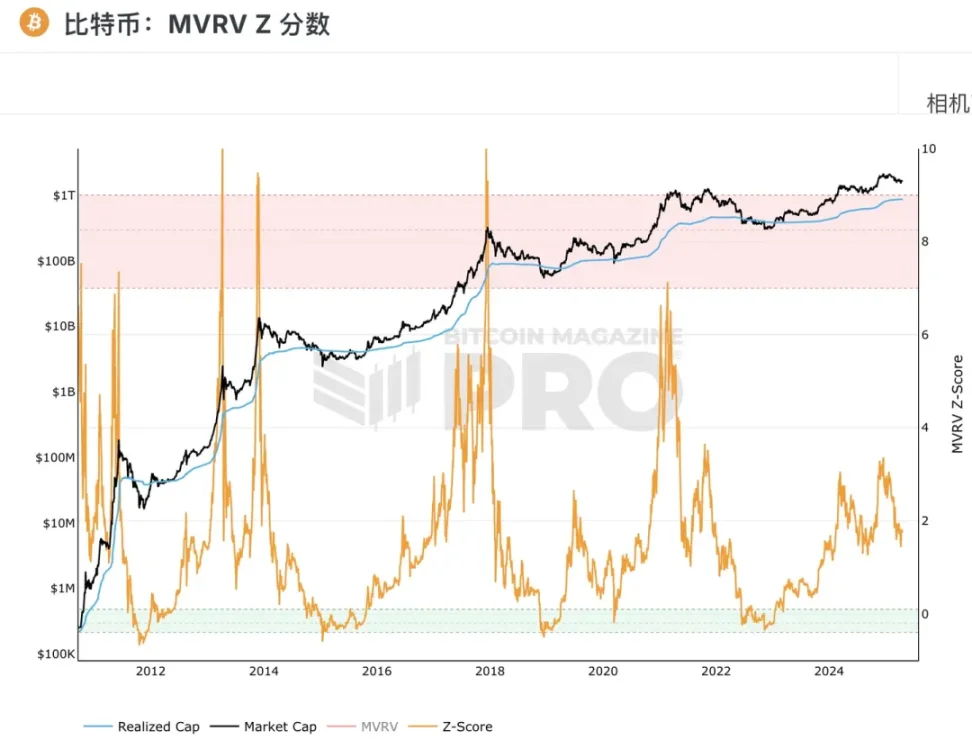
一个很好的起点是 MVRV-Z 分数,这是一个长期使用的估值指标,用于比较市场价值与已实现价值。在达到约 3.36 的峰值后,MVRV-Z 分数已降至约 1.43 ,与比特币从 10 万美元以上跌至 7.5 万美元的低点相吻合。乍看之下,这 30% 的回调似乎很严重。

比特币周期大猜想:谁在主导涨跌?我们正站在历史的哪个关口?

图 1 :近期 MVRV Z 分数已从 2025 年的低点 1.43 反弹。

历史上,与当前 MVRV-Z 分数水平相当的时期往往标志着局部底部,而非顶部。此前的周期,包括 2017 年和 2021 年,都出现过类似的回调,随后价格恢复上涨。简而言之,尽管此次下跌动摇了投资者的信心,但它与牛市期间的历史性回调一致。

关注聪明钱

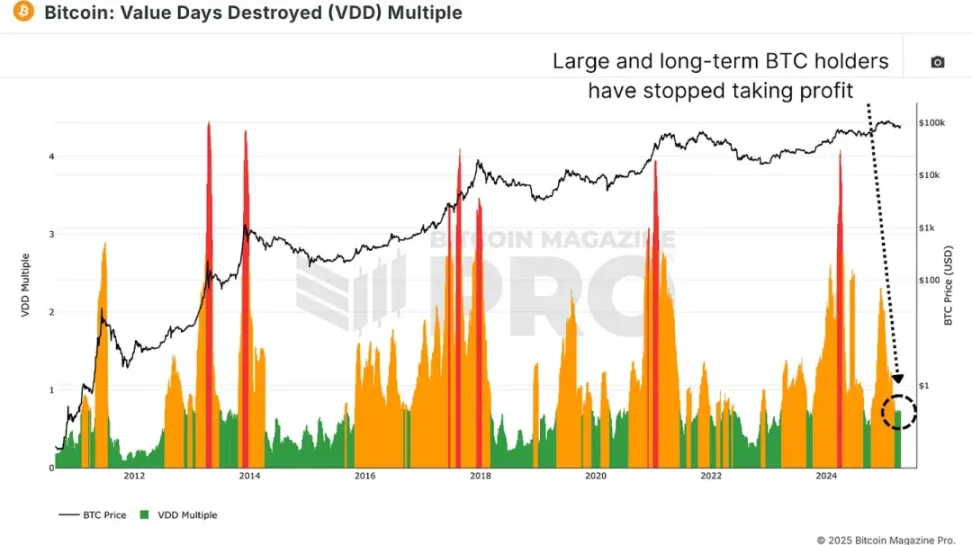
另一个关键指标是价值天数销毁(VDD)倍数。该指标衡量比特币的移动速度,并根据币被持有时间加权。VDD 倍数的高峰通常表明老练的持有者在获利了结,而低水平则暗示积累。

目前,该指标处于「绿色区域」的低位,类似于熊市后期或早期恢复阶段的水平。鉴于价格从 10 万美元以上的急剧反转,我们可能正在见证获利了结浪潮的结束,长期积累的迹象再次出现,预示着对更高价格的预期。

比特币周期大猜想:谁在主导涨跌?我们正站在历史的哪个关口?

图 2 :当前的 VDD 倍数表明长期持有者正处于积累阶段。

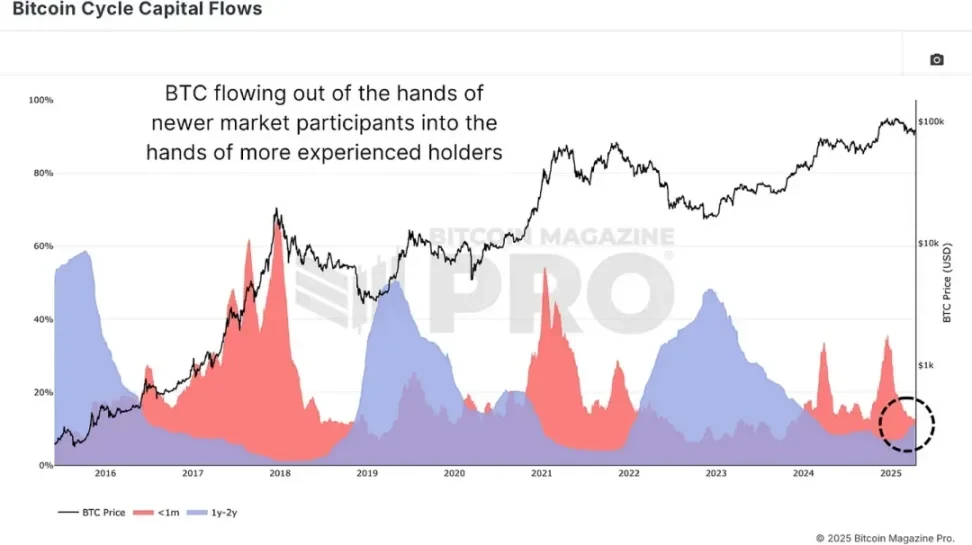
比特币周期资本流动图是链上数据中最具洞察力的图表之一,它按币龄细分实现了资本流动。它区分了不同群体,如新市场参与者(持有不到 1 个月)和中期持有者(1-2 年),以观察资本迁移情况。在比特币价格达到 10.6 万美元峰值时,红色带(新持有者)的活动激增,表明 FOMO 驱动的买家在顶部附近蜂拥而入。此后,该群体的活动显著降温,回到了与牛市早期至中期一致的水平。

相反, 1-2 年持有者群体(通常是宏观敏锐的积累者)开始再次上升。这种反向相关性很关键:长期持有者在市场低点积累,而较新的参与者则在低点投降或退出。这些动态与早前牛市周期(特别是 2020 年和 2021 年)的积累 - 分配模式相似。

比特币周期大猜想:谁在主导涨跌?我们正站在历史的哪个关口?

图 3 :比特币周期资本流动图显示比特币正流向更有经验的持有者

我们现在处于什么阶段?

从宏观视角来看,我们将比特币市场周期分为三个关键阶段:

  • 熊市阶段:深度回调(70-90% )

  • 恢复阶段:收复前高

  • 牛市 / 指数阶段:突破前高后的抛物线式上涨

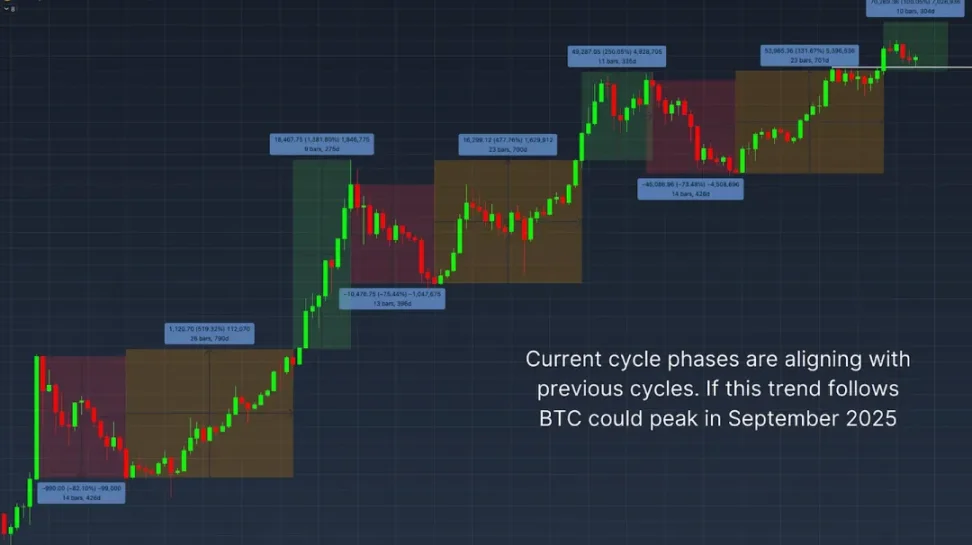
2015 年和 2018 年的熊市持续了大约 13-14 个月。我们最近的熊市周期也持续了 14 个月。过去周期的恢复阶段持续了大约 23-26 个月,而我们当前的周期正处于这一时间窗口内。

比特币周期大猜想:谁在主导涨跌?我们正站在历史的哪个关口?

图 4 :利用过去周期趋势估算潜在的牛市峰值

然而,这一轮牛市阶段有些不同寻常。在突破历史高点后,价格并未立即飙升,而是出现了回调。这可能表明我们只是在进入指数阶段的更陡峭部分之前形成了一个更高的低点。如果我们取过去周期指数阶段 9 个月和 11 个月的平均值,预计牛市可能在 2025 年 9 月左右达到顶峰,前提是牛市阶段恢复。

宏观风险

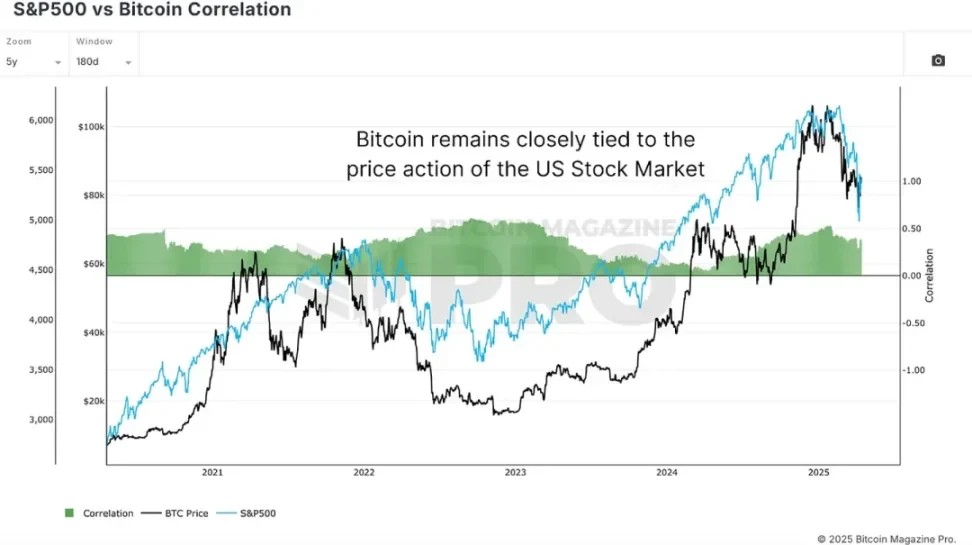
尽管链上数据令人鼓舞,但宏观阻力依然存在。标普 500 与比特币相关性图表分析显示,比特币与美国股市仍高度相关。随着对全球经济衰退的担忧加剧,传统市场的持续疲软可能在短期内限制比特币的上涨能力。

比特币周期大猜想:谁在主导涨跌?我们正站在历史的哪个关口?

图 5 :比特币与美国股市的相关性

小结

正如我们在分析中所见,关键链上指标,如 MVRV Z 分数、价值天数销毁和比特币周期资本流动,显示出健康且与周期一致的行为,以及长期持有者积累的迹象。然而,市场中仍存在显著的宏观不确定性,这是需要关注的关键风险。

本轮周期比过去周期更慢且更不均衡,但并未打破历史结构。如果能避免传统市场的进一步恶化,比特币似乎已准备好迎来下一波上涨,可能在第三季度或第四季度初达到顶峰。

Trending Cryptos

Related Reads

The Trillion-Dollar Credit Market Leveraged by Stablecoins, Stuck in Off-Chain Risk Control

**Stablecoins Fueling Trillion-Dollar Private Credit Market, Hampered by Off-Chain Risk Management** This article examines how interest-bearing stablecoins are replicating the business model of money market funds to democratize access to the $2 trillion private credit market, while highlighting the significant risks posed by inadequate off-chain risk controls. Historically, private credit investments had high minimums (e.g., $1 million+) due to costly due diligence and loan servicing. Stablecoins like Apollo's ACRED and Figure's YLDS are bridging this gap. They tokenize institutional credit funds, allowing small investors to gain exposure and enabling new functionalities like using these tokens as collateral in DeFi for leveraged yield. The on-chain private credit market has grown 15x in a year to $5.87 billion, yet remains a tiny fraction of the global total. However, the core challenge is not blockchain technology but managing the inherent risks of lending, which occur off-chain. The failure of Goldfinch, a pioneer in on-chain private credit, serves as a stark warning. It raised funds in crypto (USDC) to lend to small businesses in markets like Kenya and Nigeria. While smart contracts handled fund distribution, critical functions—local due diligence, monitoring loan use, and debt collection—relied on off-chain partners. A major breach, where a local partner misappropriated nearly 40% of funds, went undetected for months. When borrowers defaulted, crypto depositors had no effective legal recourse or means to seize assets, leaving $56 million trapped in non-performing loans with a projected 8-15 year recovery timeline. The article concludes that tokenization addresses only 10% of the credit business—the distribution. The remaining 90%—rigorous risk assessment and collection infrastructure—is expensive and localization-dependent. Without solving these fundamental off-chain challenges, the sector risks repeating Goldfinch's collapse.

Foresight News2m ago

The Trillion-Dollar Credit Market Leveraged by Stablecoins, Stuck in Off-Chain Risk Control

Foresight News2m ago

Solana Expands Validator Power With Launch of On-Chain Governance

Solana has formally launched its on-chain governance system, empowering token holders and validators with a more open and decentralized way to influence major protocol decisions. Governance debates and voting are now conducted entirely on-chain using the new Solana Governance Proposals (SGP) framework, supported by stake-weighted voting and cryptographic verification. Validators with at least 100,000 SOL in delegated stake can submit an SGP. To proceed to a formal vote, a proposal must first gain support from at least 15% of the network's total staked SOL, ensuring only ideas with significant backing move forward. SGPs serve a distinct purpose from the technical Solana Improvement Documents (SIMDs). While SIMDs focus on *how* to implement protocol upgrades, SGPs determine *whether* the broader ecosystem believes a proposal should proceed, via an on-chain, stake-weighted vote. This separation allows core developers to continue building effectively while reserving community-wide votes for impactful decisions. A key feature grants delegators greater control: they can now override their validator's governance vote. If a validator votes against a delegator's preference or abstains, the delegator can cast a vote directly using their own stake weight through Solana's governance portal. The voting process is secured using Merkle proofs to verify participant stakes against an on-chain consensus snapshot. With this implementation, Solana aims to broaden community participation in governance without hindering development, combining decentralized decision-making with efficient protocol evolution.

TheNewsCrypto32m ago

Solana Expands Validator Power With Launch of On-Chain Governance

TheNewsCrypto32m ago

Trillion-Won Bet on Semiconductors: Is South Korea Really Panicking This Time?

**Summary:** South Korea, traditionally adept at "counter-cyclical" investments during industry downturns, has launched an unprecedented trillion-dollar (approximately 6.4 trillion RMB) semiconductor investment plan during a current AI-driven boom. This shift signals deep strategic anxiety, driven by the rapid rise of China's memory chip challengers. The article traces this dynamic through the history of East Asian semiconductor competition. In the 1980s, Japan used a "national system + industrial capital" model to surpass the US in DRAM, only to be overtaken in the 1990s by South Korea employing the same aggressive, efficiency-focused tactics—most notably massive, loss-tolerant investments during downturns to crush competitors like Japan's Elpida. Now, China's memory giants, Yangtze Memory (YMTC) and ChangXin Memory Technologies (CXMT), are employing a strikingly similar playbook. Starting from near-zero a decade ago, they've used a combination of government-backed capital, strategic technology acquisition (e.g., CXMT leveraging Qimonda's legacy), and innovative architectural leaps (e.g., YMTC's Xtacking) to achieve rapid technological catch-up. Crucially, during the severe industry downturn of 2023, while Korean and US giants cut production, the Chinese firms expanded capacity and competed on price, rapidly gaining global market share (reaching ~11% in NAND and ~7.67% in DRAM by 2025). South Korea's current massive investment, therefore, is a defensive move born of fear. The historical pattern suggests that once a technological gap closes, scale and integrated supply chain advantages—areas where China holds significant potential—can determine the leader. Having used counter-cyclical strategies to become the incumbent, South Korea now faces the prospect of a formidable challenger using those very same tactics. This investment marks not just a bet on the AI cycle, but the opening chapter in a new battle for dominance in the memory industry.

marsbit42m ago

Trillion-Won Bet on Semiconductors: Is South Korea Really Panicking This Time?

marsbit42m ago

Trading

Spot

Hot Articles

What is $BITCOIN

DIGITAL GOLD ($BITCOIN): A Comprehensive Analysis Introduction to DIGITAL GOLD ($BITCOIN) DIGITAL GOLD ($BITCOIN) is a blockchain-based project operating on the Solana network, which aims to combine the characteristics of traditional precious metals with the innovation of decentralized technologies. While it shares a name with Bitcoin, often referred to as “digital gold” due to its perception as a store of value, DIGITAL GOLD is a separate token designed to create a unique ecosystem within the Web3 landscape. Its goal is to position itself as a viable alternative digital asset, although specifics regarding its applications and functionalities are still developing. What is DIGITAL GOLD ($BITCOIN)? DIGITAL GOLD ($BITCOIN) is a cryptocurrency token explicitly designed for use on the Solana blockchain. In contrast to Bitcoin, which provides a widely recognized value storage role, this token appears to focus on broader applications and characteristics. Notable aspects include: Blockchain Infrastructure: The token is built on the Solana blockchain, known for its capacity to handle high-speed and low-cost transactions. Supply Dynamics: DIGITAL GOLD has a maximum supply capped at 100 quadrillion tokens (100P $BITCOIN), although details regarding its circulating supply are currently undisclosed. Utility: While precise functionalities are not explicitly outlined, there are indications that the token could be utilized for various applications, potentially involving decentralized applications (dApps) or asset tokenization strategies. Who is the Creator of DIGITAL GOLD ($BITCOIN)? At present, the identity of the creators and development team behind DIGITAL GOLD ($BITCOIN) remains unknown. This situation is typical among many innovative projects within the blockchain space, particularly those aligning with decentralized finance and meme coin phenomena. While such anonymity may foster a community-driven culture, it intensifies concerns about governance and accountability. Who are the Investors of DIGITAL GOLD ($BITCOIN)? The available information indicates that DIGITAL GOLD ($BITCOIN) does not have any known institutional backers or prominent venture capital investments. The project seems to operate on a peer-to-peer model focused on community support and adoption rather than traditional funding routes. Its activity and liquidity are primarily situated on decentralized exchanges (DEXs), such as PumpSwap, rather than established centralized trading platforms, further highlighting its grassroots approach. How DIGITAL GOLD ($BITCOIN) Works The operational mechanics of DIGITAL GOLD ($BITCOIN) can be elaborated on based on its blockchain design and network attributes: Consensus Mechanism: By leveraging Solana’s unique proof-of-history (PoH) combined with a proof-of-stake (PoS) model, the project ensures efficient transaction validation contributing to the network's high performance. Tokenomics: While specific deflationary mechanisms have not been extensively detailed, the vast maximum token supply implies that it may cater to microtransactions or niche use cases that are still to be defined. Interoperability: There exists the potential for integration with Solana’s broader ecosystem, including various decentralized finance (DeFi) platforms. However, the details regarding specific integrations remain unspecified. Timeline of Key Events Here is a timeline that highlights significant milestones concerning DIGITAL GOLD ($BITCOIN): 2023: The initial deployment of the token occurs on the Solana blockchain, marked by its contract address. 2024: DIGITAL GOLD gains visibility as it becomes available for trading on decentralized exchanges like PumpSwap, allowing users to trade it against SOL. 2025: The project witnesses sporadic trading activity and potential interest in community-led engagements, although no noteworthy partnerships or technical advancements have been documented as of yet. Critical Analysis Strengths Scalability: The underlying Solana infrastructure supports high transaction volumes, which could enhance the utility of $BITCOIN in various transaction scenarios. Accessibility: The potential low trading price per token could attract retail investors, facilitating wider participation due to fractional ownership opportunities. Risks Lack of Transparency: The absence of publicly known backers, developers, or an audit process may yield skepticism regarding the project's sustainability and trustworthiness. Market Volatility: The trading activity is heavily reliant on speculative behavior, which can result in significant price volatility and uncertainty for investors. Conclusion DIGITAL GOLD ($BITCOIN) emerges as an intriguing yet ambiguous project within the rapidly evolving Solana ecosystem. While it attempts to leverage the “digital gold” narrative, its departure from Bitcoin's established role as a store of value underscores the need for a clearer differentiation of its intended utility and governance structure. Future acceptance and adoption will likely depend on addressing the current opacity and defining its operational and economic strategies more explicitly. Note: This report encompasses synthesised information available as of October 2023, and developments may have transpired beyond the research period.

555 Total ViewsPublished 2025.05.13Updated 2025.05.13
What is $BITCOIN

Discussions

Welcome to the HTX Community. Here, you can stay informed about the latest platform developments and gain access to professional market insights. Users' opinions on the price of BTC (BTC) are presented below.

活动图片