Will JUP’s price hit $0.28 on the back of these THREE catalysts?

ambcryptoPublished on 2026-07-02Last updated on 2026-07-02

Abstract

Jupiter (JUP) surged over 15% in 24 hours, outperforming the broader crypto market. Three key catalysts drove the rally: 1) The integration of its native stablecoin, JupUSD, into the Jupiter Liquidity Provider (JLP), enabling a major USDC-to-JupUSD transition. 2) Growing discussions about Jupiter developing its own Omnichain Ledger, reflecting its evolution into a comprehensive on-chain finance system. 3) Active buying and supply reduction by the Jupiter Strategic Reserve (Litterbox Trust), which has accumulated millions of JUP tokens, contributing to a decreased total supply. Technically, JUP's price reclaimed a key trendline support level. If it holds above $0.24, a move toward $0.28 is possible, contingent on sustained buying pressure and a confirmed trend shift.

Jupiter [JUP] is in the news today after it hiked by more than 15% in the last 24 hours, outperforming both Bitcoin [BTC] and the broader crypto market. Its daily trading volume surged by 72%, hitting $48 million too.

That’s not all though as the Solana [SOL] DEX Aggregator seemed to be up by this margin due to a couple of factors too. Hence, it’s worth looking at the finer details here.

3 catalysts behind Jupiter’s double-digit rally

To start with, Jupiter added its own stablecoin, JupUSD, to Jupiter Liquidity Provider (JLP) as a custody asset. This step makes it possible for the planned $500 million USDC-to-JupUSD transition inside Jupiter’s perps pool.

JupUSD is now the sixth asset after Solana [SOL], Bitcoin [BTC], Ethereum [ETH], USDC and USDT. As such, the stablecoin addition means more liquidity into the exchange.

This has further reignited talks of Jupiter building its own Omnichain Ledger. This move echoes Jupiter’s growth since 2021 from a swap aggregator into a full on-chain finance system. In fact, Jupiter drives more than 80% of total retail liquidity on movement on Solana.

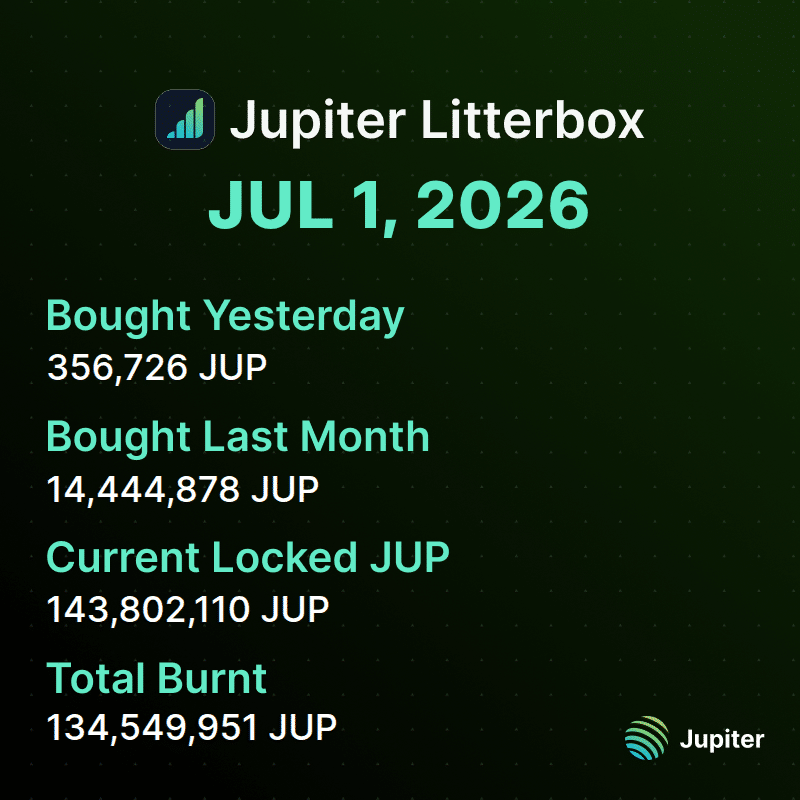
That is not all there is though. Jupiter Strategic Reserve, Litterbox Trust, is creating buying pressure in the market as well as shrinking supply.

Over the last 24 hours alone, the strategic reserve added 356,726 JUP. This, on top of 14.44 million JUP bought last month, taking the total locked JUP tokens to 143.8 million.
Source: X

On the supply tokenomics side, a total of about 134.55 JUP have been burned from the reserve’s effort.

This is a big step towards reducing total supply of the token after 3 billion tokens were burned in January 2025. The altcoin’s total supply is now below 7 billion, down from 10 billion.

Has JUP reclaimed the lost trendline support level?

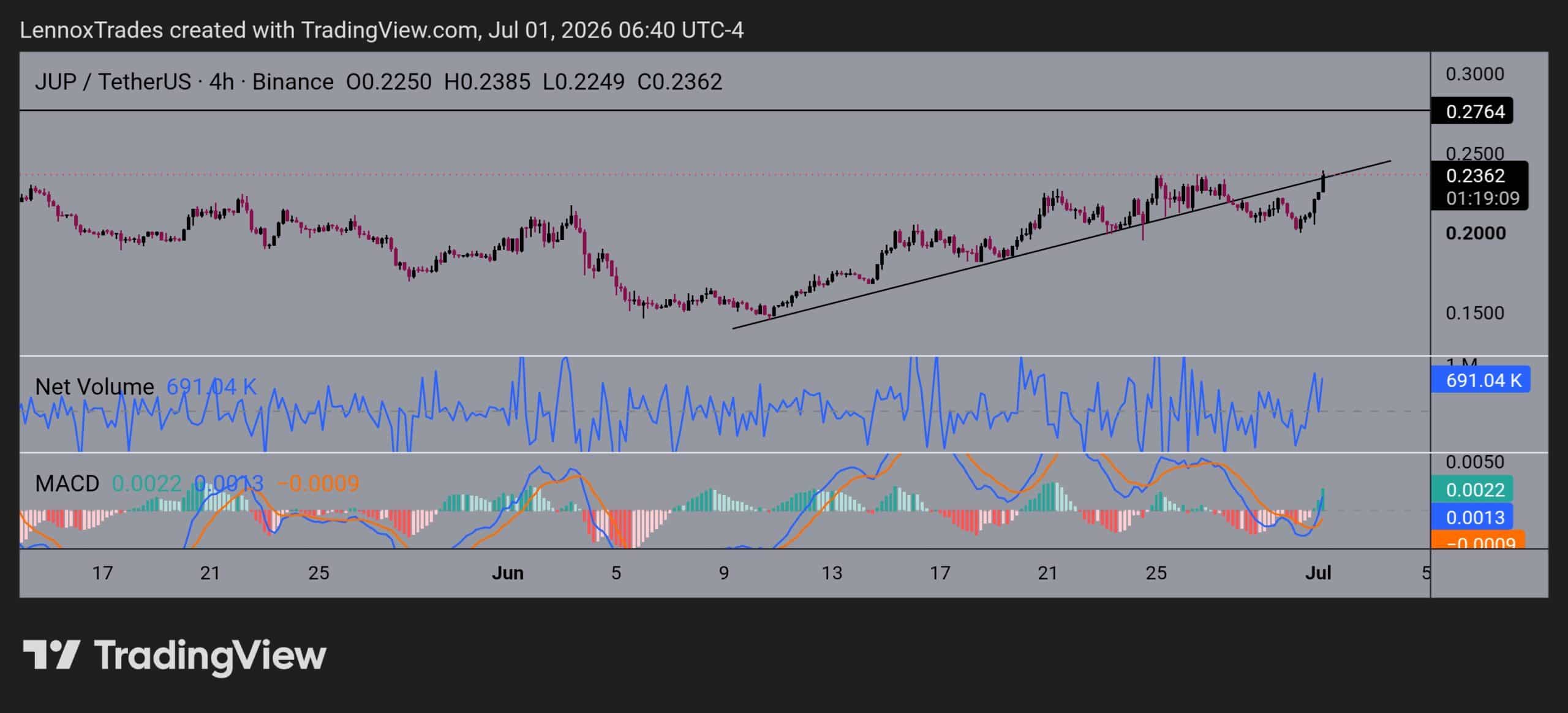
JUP showed similar strength on the 4-hour chart, as it attempted to reclaim the lost trendline support level. The altcoin has traded above the trendline for the better part of June, but it was lost in the last five days of the month.

At press time, JUP’s price was above this level. However, it was yet to create a base above it to ascertain a true shift. If the price stays above the minor resistance at $0.24, it may mean that the altcoin could push to $0.28.

This scenario can probably be supported by the market’s buying pressure too. In fact, Net Volume revealed that more than 800K JUP were bought on the day as bulls reclaimed market momentum.
Source: JUP/USDT on TradingView

All in all, turning the resistance into support would mean a trend shift in the short term. Otherwise, failure would extend the bear structure that had started to form.


Final Summary

  • Jupiter rallied by more than 15% after JupUSD’s integration into JLP, talks of its own Omnichain Ledger, and its strategic reserve accumulation.
  • JUP’s price action reclaimed its lost trendline support, but was yet to form a base level at press time.


Trending Cryptos

Related Questions

QWhat are the three main catalysts behind Jupiter's (JUP) recent double-digit price rally?

AThe three main catalysts are: 1) The addition of its own stablecoin, JupUSD, to Jupiter Liquidity Provider (JLP) as a custody asset, facilitating a planned $500 million USDC-to-JupUSD transition. 2) Reignited talks of Jupiter building its own Omnichain Ledger. 3) The Jupiter Strategic Reserve (Litterbox Trust) creating buying pressure and shrinking supply by accumulating JUP tokens, with 356,726 JUP added in the last 24 hours and a total of 143.8 million JUP now locked.

QWhat is the potential next price target for JUP mentioned in the article, and what condition must be met?

AThe article states that JUP's price may push to $0.28. For this to happen, the price must stay above the minor resistance level at $0.24 to confirm a true shift and turn that resistance into support.

QWhat significant change has occurred to JUP's total token supply according to the article?

AJUP's total token supply is now below 7 billion, down from the original 10 billion. This reduction follows the burning of 3 billion tokens in January 2025 and ongoing burns from the strategic reserve's efforts, with about 134.55 JUP burned recently.

QWhat does Net Volume data indicate about market activity for JUP?

AThe Net Volume data reveals that more than 800,000 JUP were bought on the day, indicating strong buying pressure and that bulls have reclaimed market momentum.

QWhat role does Jupiter play in the Solana ecosystem based on the information provided?

AJupiter drives more than 80% of the total retail liquidity movement on Solana. It has grown from a swap aggregator in 2021 into a full on-chain finance system.

Related Reads

The Trillion-Dollar Credit Market Leveraged by Stablecoins, Stuck in Off-Chain Risk Control

**Stablecoins Fueling Trillion-Dollar Private Credit Market, Hampered by Off-Chain Risk Management** This article examines how interest-bearing stablecoins are replicating the business model of money market funds to democratize access to the $2 trillion private credit market, while highlighting the significant risks posed by inadequate off-chain risk controls. Historically, private credit investments had high minimums (e.g., $1 million+) due to costly due diligence and loan servicing. Stablecoins like Apollo's ACRED and Figure's YLDS are bridging this gap. They tokenize institutional credit funds, allowing small investors to gain exposure and enabling new functionalities like using these tokens as collateral in DeFi for leveraged yield. The on-chain private credit market has grown 15x in a year to $5.87 billion, yet remains a tiny fraction of the global total. However, the core challenge is not blockchain technology but managing the inherent risks of lending, which occur off-chain. The failure of Goldfinch, a pioneer in on-chain private credit, serves as a stark warning. It raised funds in crypto (USDC) to lend to small businesses in markets like Kenya and Nigeria. While smart contracts handled fund distribution, critical functions—local due diligence, monitoring loan use, and debt collection—relied on off-chain partners. A major breach, where a local partner misappropriated nearly 40% of funds, went undetected for months. When borrowers defaulted, crypto depositors had no effective legal recourse or means to seize assets, leaving $56 million trapped in non-performing loans with a projected 8-15 year recovery timeline. The article concludes that tokenization addresses only 10% of the credit business—the distribution. The remaining 90%—rigorous risk assessment and collection infrastructure—is expensive and localization-dependent. Without solving these fundamental off-chain challenges, the sector risks repeating Goldfinch's collapse.

Foresight News39m ago

The Trillion-Dollar Credit Market Leveraged by Stablecoins, Stuck in Off-Chain Risk Control

Foresight News39m ago

Solana Expands Validator Power With Launch of On-Chain Governance

Solana has formally launched its on-chain governance system, empowering token holders and validators with a more open and decentralized way to influence major protocol decisions. Governance debates and voting are now conducted entirely on-chain using the new Solana Governance Proposals (SGP) framework, supported by stake-weighted voting and cryptographic verification. Validators with at least 100,000 SOL in delegated stake can submit an SGP. To proceed to a formal vote, a proposal must first gain support from at least 15% of the network's total staked SOL, ensuring only ideas with significant backing move forward. SGPs serve a distinct purpose from the technical Solana Improvement Documents (SIMDs). While SIMDs focus on *how* to implement protocol upgrades, SGPs determine *whether* the broader ecosystem believes a proposal should proceed, via an on-chain, stake-weighted vote. This separation allows core developers to continue building effectively while reserving community-wide votes for impactful decisions. A key feature grants delegators greater control: they can now override their validator's governance vote. If a validator votes against a delegator's preference or abstains, the delegator can cast a vote directly using their own stake weight through Solana's governance portal. The voting process is secured using Merkle proofs to verify participant stakes against an on-chain consensus snapshot. With this implementation, Solana aims to broaden community participation in governance without hindering development, combining decentralized decision-making with efficient protocol evolution.

TheNewsCrypto1h ago

Solana Expands Validator Power With Launch of On-Chain Governance

TheNewsCrypto1h ago

Trillion-Won Bet on Semiconductors: Is South Korea Really Panicking This Time?

**Summary:** South Korea, traditionally adept at "counter-cyclical" investments during industry downturns, has launched an unprecedented trillion-dollar (approximately 6.4 trillion RMB) semiconductor investment plan during a current AI-driven boom. This shift signals deep strategic anxiety, driven by the rapid rise of China's memory chip challengers. The article traces this dynamic through the history of East Asian semiconductor competition. In the 1980s, Japan used a "national system + industrial capital" model to surpass the US in DRAM, only to be overtaken in the 1990s by South Korea employing the same aggressive, efficiency-focused tactics—most notably massive, loss-tolerant investments during downturns to crush competitors like Japan's Elpida. Now, China's memory giants, Yangtze Memory (YMTC) and ChangXin Memory Technologies (CXMT), are employing a strikingly similar playbook. Starting from near-zero a decade ago, they've used a combination of government-backed capital, strategic technology acquisition (e.g., CXMT leveraging Qimonda's legacy), and innovative architectural leaps (e.g., YMTC's Xtacking) to achieve rapid technological catch-up. Crucially, during the severe industry downturn of 2023, while Korean and US giants cut production, the Chinese firms expanded capacity and competed on price, rapidly gaining global market share (reaching ~11% in NAND and ~7.67% in DRAM by 2025). South Korea's current massive investment, therefore, is a defensive move born of fear. The historical pattern suggests that once a technological gap closes, scale and integrated supply chain advantages—areas where China holds significant potential—can determine the leader. Having used counter-cyclical strategies to become the incumbent, South Korea now faces the prospect of a formidable challenger using those very same tactics. This investment marks not just a bet on the AI cycle, but the opening chapter in a new battle for dominance in the memory industry.

marsbit1h ago

Trillion-Won Bet on Semiconductors: Is South Korea Really Panicking This Time?

marsbit1h ago

Trading

Spot

Hot Articles

How to Buy JUP

Welcome to HTX.com! We've made purchasing Jupiter (JUP) simple and convenient. Follow our step-by-step guide to embark on your crypto journey.Step 1: Create Your HTX AccountUse your email or phone number to sign up for a free account on HTX. Experience a hassle-free registration journey and unlock all features.Get My AccountStep 2: Go to Buy Crypto and Choose Your Payment MethodCredit/Debit Card: Use your Visa or Mastercard to buy Jupiter (JUP) instantly.Balance: Use funds from your HTX account balance to trade seamlessly.Third Parties: We've added popular payment methods such as Google Pay and Apple Pay to enhance convenience.P2P: Trade directly with other users on HTX.Over-the-Counter (OTC): We offer tailor-made services and competitive exchange rates for traders.Step 3: Store Your Jupiter (JUP)After purchasing your Jupiter (JUP), store it in your HTX account. Alternatively, you can send it elsewhere via blockchain transfer or use it to trade other cryptocurrencies.Step 4: Trade Jupiter (JUP)Easily trade Jupiter (JUP) on HTX's spot market. Simply access your account, select your trading pair, execute your trades, and monitor in real-time. We offer a user-friendly experience for both beginners and seasoned traders.

3.3k Total ViewsPublished 2024.03.29Updated 2026.06.02

How to Buy JUP

Discussions

Welcome to the HTX Community. Here, you can stay informed about the latest platform developments and gain access to professional market insights. Users' opinions on the price of JUP (JUP) are presented below.

活动图片