A quantum‑computing collective known as Project Eleven has thrown down a public gauntlet to the global cryptography community, offering a reward of one Bitcoin to the first team that can break a deliberately down‑scaled version of Bitcoin’s elliptic‑curve cryptography using a genuine quantum computer before 5 April 2026.
Announcing what it calls the “Q‑Day Prize” on X, the group wrote: “We just launched the Q‑Day Prize. 1 BTC to the first team to break a toy version of Bitcoin’s cryptography using a quantum computer. Deadline: April 5, 2026. Mission: Protect 6 M BTC (over $500 B).” The post crystallises a concern that has hovered over the Bitcoin ecosystem for more than a decade: the eventual arrival of large‑scale, error‑corrected quantum hardware capable of running Shor’s algorithm against real‑world keys.
Project Eleven is not asking contestants to shatter Bitcoin’s 256‑bit curve directly. Instead, teams must demonstrate Shor’s algorithm against elliptic‑curve keys ranging from one to twenty‑five bits—sizes derisively called “toy” by professional cryptographers but still orders of magnitude beyond what has been publicly achieved on physical quantum processors. The organisers argue that even a three‑bit break would be “big news,” because it would provide the first quantitatively verifiable benchmark of quantum progress on the elliptic‑curve discrete‑log problem (ECDLP). In their words, “Nobody has rigorously benchmarked this threat yet.”
To qualify, a submission must include gate‑level code or explicit instructions runnable on actual quantum hardware, along with a narrative of methods employed, error‑rates managed and the classical post‑processing required. Hybrid attacks that lean on classical shortcuts are disallowed. All entries will be published, a decision the group frames as an exercise in radical transparency: “Instead of waiting for breakthroughs to happen behind closed doors, we believe in facing this challenge head‑on, in a transparent and rigorous manner.”
Why 1 Bitcoin—And Why Now?
Bitcoin’s security ultimately rests on the hardness of the discrete‑logarithm problem over the secp256k1 curve. While classical attacks scale exponentially, Peter Shor’s 1994 quantum algorithm could in principle solve the problem in polynomial time, collapsing the cost from cosmic to merely gargantuan. Current research estimates that on the order of two thousand fully error‑corrected logical qubits—perhaps backed by millions of physical qubits—would be sufficient to threaten a 256‑bit key. Firms such as Google, IBM, IonQ and newcomer QuEra are racing to cross the four‑digit logical‑qubit threshold, though none has publicly demonstrated anything close to that capability today.
Project Eleven says its prize is intended less as a bounty and more as a diagnostic. More than ten million Bitcoin addresses, holding over six million coins, have already exposed their public keys through prior spending activity. If quantum technology crosses the critical threshold before those coins are migrated to post‑quantum addresses, the funds would be vulnerable to immediate theft. “Quantum computing is steadily progressing,” the group warns. “When that happens, we need to know.”
The initiative lands amid a flurry of quantum‑resilience proposals within the wider Bitcoin ecosystem. Earlier this month, a group of developers submitted the Quantum‑Resistant Address Migration Protocol (QRAMP), a Bitcoin Improvement Proposal that would orchestrate a network‑wide move to post‑quantum key formats. Because QRAMP would require a consensus‑breaking hard fork, its political prospects remain uncertain.
Separately, Canadian startup BTQ has pitched an exotic proof‑of‑work alternative called Coarse‑Grained Boson Sampling, which would substitute today’s hash‑based mining puzzles with photonic sampling tasks executed on quantum hardware. Like QRAMP, BTQ’s concept demands a hard fork and has yet to garner broad support.
From a technical standpoint, running even a five‑bit elliptic‑curve version of Shor’s algorithm is brutally unforgiving: qubits with fidelities above 99.9 %, coherent for hundreds of microseconds, and orchestrated through deep circuits numbering in the thousands of two‑qubit gates would be required. Error‑correction overhead further compounds the engineering burden, meaning that contenders will likely have to employ small‑code logical qubits and impressive compilation techniques merely to keep noise under control.
Yet the prize may prove irresistible for university labs and corporate R&D teams eager to demonstrate practical quantum advantage. Cloud‑accessible devices from IBM’s Quantum System Two, Quantinuum’s H‑series and OQC’s superconducting platforms already allow limited, pay‑per‑shot access to dozens—or in IBM’s case, hundreds—of physical qubits. Whether any of those machines can sustain the circuit depth necessary remains to be seen.
Either outcome supplies invaluable data. In the words of Project Eleven’s launch tweet, the objective is stark: “Break the biggest ECC key with Shor’s algorithm. The reward: 1 BTC + go down in cryptography history.”
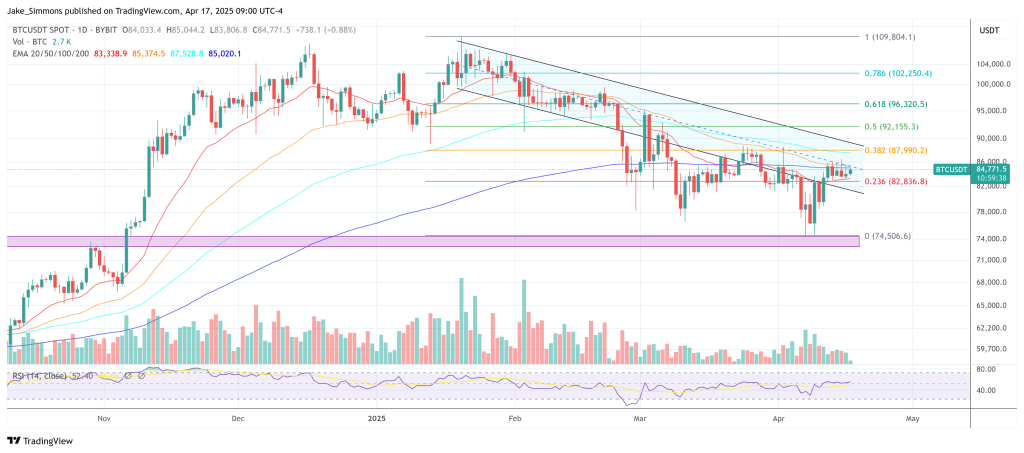
At press time, BTC traded at $84,771.

Related Posts