三个月亏完所有仓位后,这是我的一点点感悟

深潮TechFlowPublished on 2025-03-14Last updated on 2025-03-14

Abstract

金钱只是衡量你进步的方式,但这并不意味着你能在达到目标时「保存进度」。

过去的三个月里,在损失了投资组合中的大部分资产后,我一直在反思一个问题:

“当你的投资组合达到目标时卖出,而不要拖到你认为市场见顶时。”

我一直认为,根据个人目标卖出是适得其反的,因为你的交易风险和行为应该由市场决定。附带一提,你可以看到@DegenSpartan的帖子,他为这种观点进行了辩护。
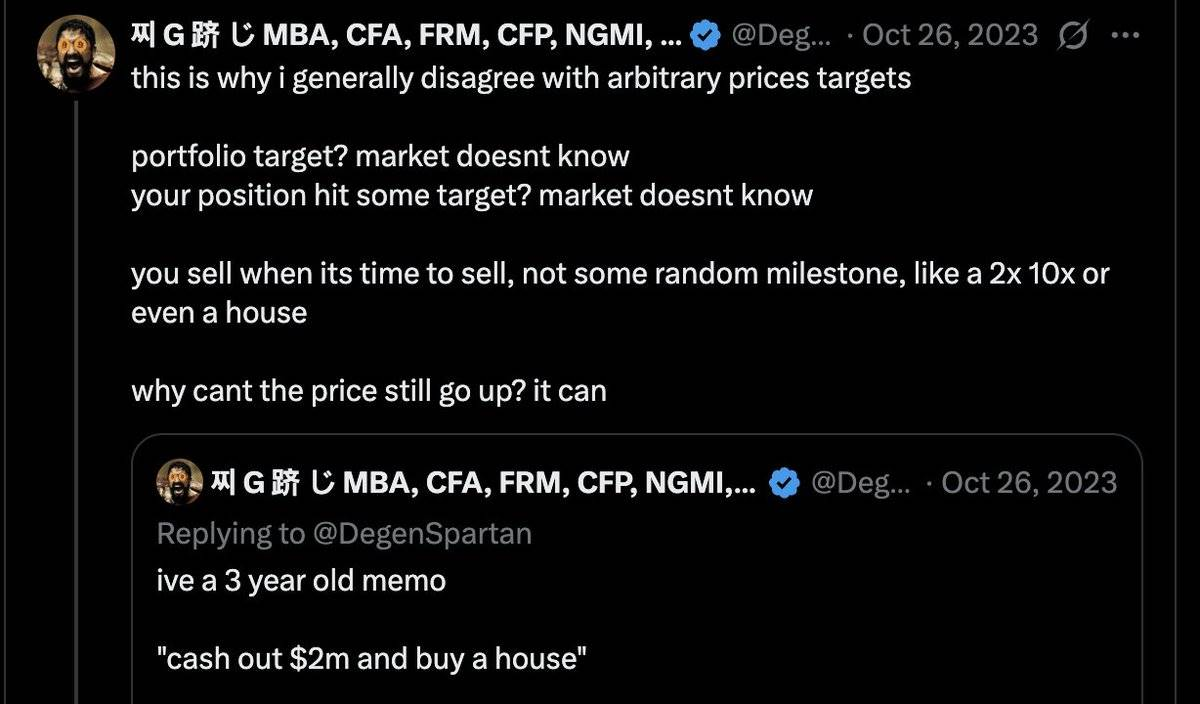
如果我在比特币(BTC)达到5万美元时实现了我的目标,为什么我要在认为它可能涨到10万美元的情况下卖出呢?这对我来说没有意义。

同样地,如果你的投资组合已经达到87万美元,而你的目标是100万美元,你不会因为目标是100万美元而强迫市场继续上涨,特别是在市场可能已经见顶的情况下。

你必须接受现实,然后放手。

然而,这种心态过于理想化,或者说只有那0.01%的人才可能做到。是的,这种方式是完美的,但现实是,你无法精准把握市场的顶点。

有多少人经历过资金从高点回落?我敢打赌,这里有很多人曾经在几个月甚至几年前达到了他们梦寐以求的财务自由,却在几周内看着这些财富蒸发。

流动性差的垃圾币、报复性交易、杠杆操作……有些人甚至从八位数的资产跌到一无所有。

你永远无法知道市场是否见顶,因为你没有那种能力。

让你赚到大钱的原因,往往也是让你失去一切的原因——大多数时候你是个“长期看多者”(perma-bull),你的高风险承受能力在行情好的时候带来了巨大的回报,但这种行为模式和因持续胜利而来的正反馈会让你在行情不佳时失去理智,最终被“收割”。

更别提市场的时机问题:底部通常需要几个月才能形成,而顶部往往在几天内突然出现,尤其是在指数级上涨之后。

除了那些极少数的优秀交易者,大多数人在应该卖出的时候,仍然会看涨,因为他们的交易方式就是这样设定的。

而当他们犯错,尤其是犯了大错时,有些人甚至无法承受。如果你已经达到了自己的目标,为什么不“保存游戏进度”,然后从一种冷静、充裕和客观的状态重新开始呢?这就像玩电子游戏——你不会在一次性通关的情况下不保存进度。

当你失去了很多之后,你会意识到,你曾经拥有的东西,比屏幕上的数字更加真实,价值更加深刻。

另一方面,我不认为那些抱着“我到达某个点就会停止”的心态的人能够成功。这种心态永远不会让你接近目标,因为你必须热爱这个游戏:学习 > 提升 > 胜利。金钱只是衡量你进步的方式,但这并不意味着你能在达到目标时“保存进度”。

有时候,更多的收益对你的生活改变并不大,但你所承担的风险却很高。你总是会被诱惑去认为现在是全力押注的时候,你总会有理由看多市场。

绝大多数在这些市场中交易的人,应该采用一种系统化的方法来实现盈利和风险管理:

1. 避免“全仓”行为。接受现实,你不是那个顶级交易员。也许有一天会是,但现在还不是。

2. 在获利的同时,无论你对市场的看法如何,都要逐步取出资金。

3. 根据生活方式设定更大的目标,并明确风险与收益的比率(R:R)。当你的净资产达到一定水平后,你应该开始减少风险,因为进一步的收益可能不会显著改变你的生活,但损失却会带来巨大的影响。

例如,从50万美元涨到90万美元对你的生活改变可能并不大,但从50万美元跌到10万美元的影响却是巨大的,尽管两者的净差额都是40万美元。

在你设定的水平上取出更多资金并降低风险。你的目标是从一种充裕的心态出发,而不是被恐惧和匮乏驱动。你会惊讶于自己能变得多么客观——突然之间,情绪不再控制你。

4. 根据市场动态管理风险。在某些情况下,你可以更激进地承担风险,比如ETF获得批准、美联储开始降息、特朗普胜选,或者下次特朗普、鲍威尔或其他关键人物明确释放买入信号时。

你的风险管理和投资组合分配应该是 1)市场依据和 2)个人生活依据的结合,而不是只之考虑其中一个因素的结果。

大多数人只关注市场因素,最终无法实现目标,因为这对大多数人来说并不现实。

5. 热爱这个游戏,并专注于进步,金钱自然会随之而来。为了成功,你永远不能停下脚步。如果你想停止,那你就永远无法成功。

Trending Cryptos

Related Reads

Doubao and Qwen Will Discontinue Agent Functionality on July 15

On July 4th, Doubao and Tongyi Qianwen announced the impending shutdown of their user-created "AI Agent" features. Doubao confirmed its agent feature will be taken offline on July 15, directing users to ByteDance's CatBox app for similar needs. On the same day, Tongyi Qianwen notified users, specifying that personalized interactive agents and user-built agent functions will cease on July 10, with all agent features and services completely deactivated by July 15. After this date, access to agent configurations and historical chat records will be lost. This adjustment impacts core user scenarios like role-playing, personal assistants, and vertical tool agents. The shutdown date coincides with the official implementation of China's "Interim Measures for the Administration of Artificial Intelligence Human-like Interactive Services" on July 15. The new regulations impose strict rules on "human-like emotional interaction services," requiring platforms to implement measures like anti-addiction systems, minor verification, and content moderation. This move is widely seen as a proactive step by the platforms to align with regulatory timelines and mitigate compliance risks. Additionally, commercial challenges are a key driver. Analysis suggests that casual, human-like chat agents generate high-frequency, low-value interactions, leading to high computational costs with poor monetization. As the AI application market shifts from user growth to proving value, sustaining such "high-cost, low-efficiency" user-generated content becomes difficult. Both platforms have outlined transition plans. Doubao will allow data viewing and self-backup for a period after shutdown, with data scheduled for permanent deletion by October 15. Tongyi Qianwen similarly advised users to save important content via copying or screenshots before the deadline. This strategic retreat from C-end agent features signals a broader market shift. Compliance capability and sustainable business models are replacing user scale and feature richness as the new core competitive dimensions. Tongyi Qianwen's recent move to fully open its Agent and Skill platforms to third-party enterprises and developers further underscores a strategic pivot from low-value C-end services to high-value B-end enterprise scenarios.

marsbit3h ago

Doubao and Qwen Will Discontinue Agent Functionality on July 15

marsbit3h ago

Why Did Codex and ChatGPT Merge? What's Next for Codex? OpenAI Core Leader Answers Everything

In 2026, OpenAI's Codex saw explosive growth, with weekly active users surging over 5x to 5 million since January, driven largely by the February launch of its desktop app. Codex desktop lead Andrew Ambrosino explains key shifts behind its evolution. A core change is the inversion of development costs: implementation is now cheap, while curation and taste—judging which of many AI-generated prototypes is valuable—have become the new scarcities. Ambrosino defines taste as a blend of aesthetics, systems thinking, direction, and semantic coherence in interaction. He notes AI still struggles with design because evaluating it requires human cultural context and abstract reasoning about how components relate—capabilities beyond current models. Timing is critical: the same Codex app would have failed months earlier; success hinges on the model's capabilities at launch. Roles are blurring within his team, with engineers, designers, and PMs overlapping significantly. However, Ambrosino cautions against eliminating specialized roles entirely, as each field retains deep expertise. On AI-assisted development, the focus has shifted from measuring code written by AI to distinguishing between supervised and unsupervised generation. A current challenge is teaching models to simplify code, not just add complexity. The merger of Codex and ChatGPT stems from observed user behavior: non-developers adopted Codex for general knowledge work despite its developer-centric interface. This revealed a collapsing boundary between specialized tools and universal assistants. The vision is a "home base" that orchestrates tasks across external professional tools (like Excel or Premiere Pro) via connectors, rather than rebuilding everything internally. An internal example showed Codex helping edit video by interacting with Premiere Pro's files and even writing a plugin for it. The future direction is a unified, extensible platform that serves as a central hub for automating and managing work across any specialized tool the user employs.

marsbit3h ago

Why Did Codex and ChatGPT Merge? What's Next for Codex? OpenAI Core Leader Answers Everything

marsbit3h ago

Trading

Spot

Hot Articles

What is $BITCOIN

DIGITAL GOLD ($BITCOIN): A Comprehensive Analysis Introduction to DIGITAL GOLD ($BITCOIN) DIGITAL GOLD ($BITCOIN) is a blockchain-based project operating on the Solana network, which aims to combine the characteristics of traditional precious metals with the innovation of decentralized technologies. While it shares a name with Bitcoin, often referred to as “digital gold” due to its perception as a store of value, DIGITAL GOLD is a separate token designed to create a unique ecosystem within the Web3 landscape. Its goal is to position itself as a viable alternative digital asset, although specifics regarding its applications and functionalities are still developing. What is DIGITAL GOLD ($BITCOIN)? DIGITAL GOLD ($BITCOIN) is a cryptocurrency token explicitly designed for use on the Solana blockchain. In contrast to Bitcoin, which provides a widely recognized value storage role, this token appears to focus on broader applications and characteristics. Notable aspects include: Blockchain Infrastructure: The token is built on the Solana blockchain, known for its capacity to handle high-speed and low-cost transactions. Supply Dynamics: DIGITAL GOLD has a maximum supply capped at 100 quadrillion tokens (100P $BITCOIN), although details regarding its circulating supply are currently undisclosed. Utility: While precise functionalities are not explicitly outlined, there are indications that the token could be utilized for various applications, potentially involving decentralized applications (dApps) or asset tokenization strategies. Who is the Creator of DIGITAL GOLD ($BITCOIN)? At present, the identity of the creators and development team behind DIGITAL GOLD ($BITCOIN) remains unknown. This situation is typical among many innovative projects within the blockchain space, particularly those aligning with decentralized finance and meme coin phenomena. While such anonymity may foster a community-driven culture, it intensifies concerns about governance and accountability. Who are the Investors of DIGITAL GOLD ($BITCOIN)? The available information indicates that DIGITAL GOLD ($BITCOIN) does not have any known institutional backers or prominent venture capital investments. The project seems to operate on a peer-to-peer model focused on community support and adoption rather than traditional funding routes. Its activity and liquidity are primarily situated on decentralized exchanges (DEXs), such as PumpSwap, rather than established centralized trading platforms, further highlighting its grassroots approach. How DIGITAL GOLD ($BITCOIN) Works The operational mechanics of DIGITAL GOLD ($BITCOIN) can be elaborated on based on its blockchain design and network attributes: Consensus Mechanism: By leveraging Solana’s unique proof-of-history (PoH) combined with a proof-of-stake (PoS) model, the project ensures efficient transaction validation contributing to the network's high performance. Tokenomics: While specific deflationary mechanisms have not been extensively detailed, the vast maximum token supply implies that it may cater to microtransactions or niche use cases that are still to be defined. Interoperability: There exists the potential for integration with Solana’s broader ecosystem, including various decentralized finance (DeFi) platforms. However, the details regarding specific integrations remain unspecified. Timeline of Key Events Here is a timeline that highlights significant milestones concerning DIGITAL GOLD ($BITCOIN): 2023: The initial deployment of the token occurs on the Solana blockchain, marked by its contract address. 2024: DIGITAL GOLD gains visibility as it becomes available for trading on decentralized exchanges like PumpSwap, allowing users to trade it against SOL. 2025: The project witnesses sporadic trading activity and potential interest in community-led engagements, although no noteworthy partnerships or technical advancements have been documented as of yet. Critical Analysis Strengths Scalability: The underlying Solana infrastructure supports high transaction volumes, which could enhance the utility of $BITCOIN in various transaction scenarios. Accessibility: The potential low trading price per token could attract retail investors, facilitating wider participation due to fractional ownership opportunities. Risks Lack of Transparency: The absence of publicly known backers, developers, or an audit process may yield skepticism regarding the project's sustainability and trustworthiness. Market Volatility: The trading activity is heavily reliant on speculative behavior, which can result in significant price volatility and uncertainty for investors. Conclusion DIGITAL GOLD ($BITCOIN) emerges as an intriguing yet ambiguous project within the rapidly evolving Solana ecosystem. While it attempts to leverage the “digital gold” narrative, its departure from Bitcoin's established role as a store of value underscores the need for a clearer differentiation of its intended utility and governance structure. Future acceptance and adoption will likely depend on addressing the current opacity and defining its operational and economic strategies more explicitly. Note: This report encompasses synthesised information available as of October 2023, and developments may have transpired beyond the research period.

611 Total ViewsPublished 2025.05.13Updated 2025.05.13

What is $BITCOIN

Discussions

Welcome to the HTX Community. Here, you can stay informed about the latest platform developments and gain access to professional market insights. Users' opinions on the price of BTC (BTC) are presented below.

活动图片