Solana Under Serious Pressure Against Bitcoin – SOL/BTC Candle Close Is Crucial

bitcoinistPublished on 2025-02-18Last updated on 2025-02-19

Abstract

Solana has been under intense selling pressure since reaching its all-time high in late January. The price has struggled to...

Solana has been under intense selling pressure since reaching its all-time high in late January. The price has struggled to regain momentum, facing negative sentiment as the meme coin market continues to decline, significantly impacting Solana’s ecosystem. Analysts suggest that speculative meme coin trading is one of the primary reasons altcoins, including SOL, have underperformed compared to Bitcoin.

Crypto analyst Jelle shared a technical analysis on X, highlighting that the SOL/BTC pair is breaking down from a key support level. However, Jelle also noted that there are still 2 days and 15 hours left before the candle closes, meaning the final outcome remains uncertain. If the breakdown is confirmed, SOL could see further declines against BTC, signaling continued weakness in the altcoin market.

Solana’s performance has been closely tied to meme coin speculation, which initially fueled its surge but is now leading to downside pressure. The next few days will be crucial in determining whether SOL can reclaim key support levels or if further downside awaits. Investors are closely watching BTC’s dominance and Solana’s ability to hold its ground as the broader market seeks clarity on altcoins’ role in this cycle.

Solana Faces A Big Test

Solana is now trading at its lowest levels since November 2024, effectively erasing all the gains from the post-election rally. Once a leading altcoin that outperformed many in the market, Solana is now struggling to regain momentum amid a broader sell-off. Meme coin speculation, which was once a catalyst for its meteoric rise, has now become a major risk factor, contributing to sustained selling pressure and increasing concerns about the network’s long-term sustainability.

This shift in market sentiment was inevitable, as speculative frenzies often result in major corrections. Meme coins, which had driven record-breaking transaction volumes and high network activity, are now seen as a liability rather than an asset. Many investors who flocked to high-risk meme coin trading have either exited the market or are facing significant losses, which has led to reduced liquidity and further price declines.

Jelle shared an analysis on X, revealing that SOL/BTC is breaking down from a key support level. However, he cautioned that the 3-day candle still has 2 days and 15 hours before closing, meaning that a decisive breakdown is not yet confirmed. He also noted that while price action appears weak, a locked-in bullish divergence at support could still occur if buyers step in aggressively before the close.

SOL/BTC 3D price chart | Source: Jelle on X

For now, Solana remains at a critical juncture, with the next few days expected to be pivotal in determining its short-term trend. If bulls manage to defend key support levels, a recovery rally could follow. However, if the sell pressure persists and confidence remains low, SOL could experience further downside, extending its correction phase.

SOL Testing Fresh Demand Levels

Solana is currently trading at $168 after setting a new lower low around $163, signaling that bears still have the upper hand in the short term. Bulls are now testing fresh demand at this level, and they must push the price above $170 as soon as possible to maintain the bullish structure. This level will serve as a key short-term resistance, and reclaiming it would be the first step toward a recovery rally.
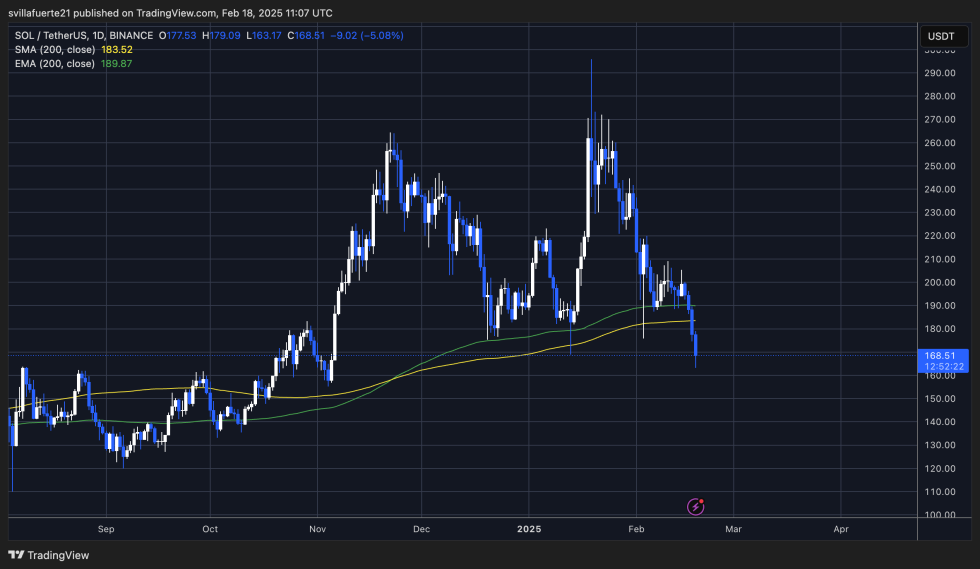
Solana setting fresh lows | Source: SOLUSDT chart on TradingView

If SOL fails to hold above $170, the risk of a massive correction increases, with the next key support zone around $150. A continued downtrend could expose SOL to deeper losses, especially if broader market sentiment remains bearish.

However, a successful reclaim of the $170 mark followed by a breakout above $190 in the coming days would be a strong signal of strength. A move above $190 would suggest that bulls are regaining control, setting the stage for a potential push back toward $200 and higher supply zones.

Featured image from Dall-E, chart from TradingView

Sebastian Villafuerte

Sebastian Villafuerte

Sebastian's journey into the world of crypto began four years ago, driven by a fascination with the potential of blockchain technology to revolutionize financial systems. His initial exploration focused on understanding the intricacies of various crypto projects, particularly those focused on building innovative financial solutions. Through countless hours of research and learning, Sebastian developed a deep understanding of the underlying technologies, market dynamics, and potential applications of cryptocurrencies. As his knowledge grew, Sebastian felt compelled to share his insights with others. He began actively contributing to online discussions on platforms like X and LinkedIn, focusing on fintech and crypto-related content. His goal was to expose valuable trends and insights to a wider audience, fostering a deeper understanding of the rapidly evolving crypto landscape. Sebastian's contributions quickly gained recognition, and he became a trusted voice in the online crypto community. To further enhance his expertise, Sebastian pursued a UC Berkeley Fintech: Frameworks, Applications, and Strategies certification. This rigorous program equipped him with valuable skills and knowledge regarding Financial Technology, bridging the gap between traditional finance (TradFi) and decentralized finance (DeFi). The certification deepened his understanding of the broader financial landscape and its intersection with blockchain technology. Sebastian's passion for finance and writing is evident in his work. He enjoys delving into financial research, analyzing market trends, and exploring the latest developments in the crypto space. In his spare time, Sebastian can often be found immersed in charts, studying 10-K forms, or engaging in thought-provoking discussions about the future of finance. Sebastian's journey as a crypto analyst and investor has been marked by a relentless pursuit of knowledge and a dedication to sharing his insights. His ability to navigate the complex world of crypto, combined with his passion for financial research and communication, makes him a valuable asset to the industry. As the crypto landscape continues to evolve, Sebastian remains at the forefront, providing valuable insights and contributing to the growth of this revolutionary technology.

Related Reads

Raised $1.3 Billion in Seven Weeks, Yet SpaceX's Weighting Halved: The Dilution Trap of the NASA ETF

A new ETF named NASA, launched just seven weeks ago, has rapidly become the world's largest space-themed fund, amassing $1.3 billion in assets. Its primary draw is its unique position as a "pure" space ETF holding SpaceX stock through a special purpose vehicle (SPV). However, its exposure to SpaceX has been drastically diluted from 10.3% to 4.6% due to a massive, rapid inflow of investor cash. New money is forced into buying other public space stocks like Rocket Lab, meaning investors seeking SpaceX exposure end up with a portfolio of other companies. Further complications arise from the SPV's valuation mechanism, which only updates during specific manager trades, potentially lagging behind SpaceX's market price. This SPV will also face a six-month lock-up post-IPO, preventing investors from selling that portion if SpaceX shares drop after listing. The article highlights a valuation bubble in the broader space sector, with stocks like Planet Labs surging nearly 1000% in a year, driven more by the "SpaceX IPO narrative" than underlying fundamentals. Meanwhile, SpaceX's own financials show significant losses in 2024, and its record-breaking IPO valuation bundles its space business with other Musk assets like xAI, creating a complex investment proposition. The core warning is that the NASA ETF essentially uses SpaceX as bait but delivers a different product. The real beneficiaries may be the ETF issuers collecting high fees, while investors face dilution and hidden risks ahead of SpaceX's historic IPO on June 12th.

marsbit2m ago

Raised $1.3 Billion in Seven Weeks, Yet SpaceX's Weighting Halved: The Dilution Trap of the NASA ETF

marsbit2m ago

NEAR Doubles: 3 Major Trends Become the 'Engine' for Token Price Surge

NEAR token price surged from around $1.24 in early May to over $2.5, with its market cap returning above $3 billion. This significant growth, occurring amidst broader market volatility, is attributed to three key factors. First, the AI narrative has been a major driver. NEAR co-founder Illia Polosukhin is a co-author of the seminal Transformer paper, the foundation of modern AI models like ChatGPT. NEAR has integrated AI capabilities into its ecosystem, notably through the Near.com super-app, positioning itself as a key decentralized AI infrastructure project. Endorsements from figures like Arthur Hayes further boosted market sentiment. Second, NEAR is enhancing its utility as a privacy-focused blockchain. With the launch of NEAR Intents for cross-chain transactions, privacy features like Confidential Payments and Confidential Intents have become critical to protect users from MEV attacks. These functionalities allow private transfers of assets like ETH and BTC across more than 35 chains, balancing privacy with usability and appealing to institutional and enterprise users. Third, a new tokenomics mechanism is providing buy-side pressure. Following the full unlocking of its initial supply in late 2025, NEAR now employs a fee-burn model. All protocol fees generated by the NEAR Intents layer are used to buy back and effectively remove NEAR tokens from circulation. With NEAR Intents TVL exceeding $80 million, this creates consistent monthly buybacks estimated around $3 million, reducing sell pressure. Additional technical upgrades planned for mid-2026, including dynamic re-sharding and post-quantum security, aim to further strengthen the network's scalability and robustness.

marsbit4m ago

NEAR Doubles: 3 Major Trends Become the 'Engine' for Token Price Surge

marsbit4m ago

After $HYPE Hits a New High, Is It Worth Considering the Stock of "HYPE Version MicroStrategy" $PURR?

**HYPE Hits New Highs: Is $PURR, the "HYPE Version of MicroStrategy," Worth Considering?** The stock of Hyperliquid Strategies (NASDAQ: $PURR), a publicly-traded company that exclusively buys and holds the cryptocurrency HYPE, has gained over 100% year-to-date, mirroring HYPE's own 150% surge to new all-time highs. This has sparked discussions about PURR being a more "capital-efficient" play than MicroStrategy's bitcoin strategy, given its reported ~$1 billion unrealized gain on a ~$220 million investment. The article clarifies that PURR is essentially a pure-play wrapper for HYPE, with no other business. It resulted from a 2025 SPAC merger led by firms like Paradigm and Atlas Merchant Capital, bringing traditional finance veterans to its board. Its value is entirely derived from the price of HYPE. While PURR offers a crucial compliance bridge for US-based institutional and retirement accounts unable to access HYPE directly, the analysis questions the "capital efficiency" narrative. The outsized gains are attributed to HYPE's exceptional performance, not superior corporate strategy. For investors who can buy HYPE directly, holding PURR introduces unnecessary risks: potential shareholder dilution from future stock offerings, incomplete passthrough of staking rewards, market hour mismatches, and counterparty risk via its single custodian. A key metric is its mNAV (modified net asset value). Current calculations show PURR trades at a discount to its HYPE holdings, but this could flip to a premium depending on the execution of registered share issuances. The article concludes that PURR is primarily a "conduit product." The investment thesis hinges entirely on one's bullishness on HYPE itself, not on the PURR wrapper, which adds friction and risk for those with direct crypto access.

marsbit33m ago

After $HYPE Hits a New High, Is It Worth Considering the Stock of "HYPE Version MicroStrategy" $PURR?

marsbit33m ago

The Real Progress and Investment Opportunities of Decentralized AI Computing Power Networks in 2026

In 2026, the AI compute market is marked by centralized GPU consolidation and a significant GPU shortage for smaller players. In this context, Decentralized Physical Infrastructure Networks (DePIN), valued at $9.4B+, have emerged as a viable, revenue-generating alternative. Leading protocols like Aethir ($150M ARR), io.net (130k+ GPUs), Akash, Bittensor, and Render are carving out distinct niches, moving beyond hype to deliver verifiable income primarily from non-crypto-native clients. The key advantage of decentralized GPU networks lies in serving latency-tolerant, cost-sensitive workloads like AI inference, fine-tuning, data preprocessing, and agent operations, offering substantial cost savings (45-80%) compared to major cloud providers. However, reliability variance, lack of robust SLAs, and fragmented tech stacks remain significant adoption hurdles. The sector is maturing with critical 2026 shifts: 1) Evolution of tokenomics towards demand-driven, revenue-linked models (e.g., Render's BME, io.net's IDE), and 2) Clearer enterprise adoption pathways, with traditional firms integrating decentralized compute. For new entrants, opportunities are now concentrated in specialized tooling layers (orchestration, verification, SLA management), vertical applications (e.g., bio-med, content generation), and innovative token designs tied to real usage, rather than generic GPU aggregation. The convergence with the emerging AI Agent economy presents a significant future growth vector.

marsbit34m ago

The Real Progress and Investment Opportunities of Decentralized AI Computing Power Networks in 2026

marsbit34m ago

Trading

Spot
Futures

Hot Articles

What is $BITCOIN

DIGITAL GOLD ($BITCOIN): A Comprehensive Analysis Introduction to DIGITAL GOLD ($BITCOIN) DIGITAL GOLD ($BITCOIN) is a blockchain-based project operating on the Solana network, which aims to combine the characteristics of traditional precious metals with the innovation of decentralized technologies. While it shares a name with Bitcoin, often referred to as “digital gold” due to its perception as a store of value, DIGITAL GOLD is a separate token designed to create a unique ecosystem within the Web3 landscape. Its goal is to position itself as a viable alternative digital asset, although specifics regarding its applications and functionalities are still developing. What is DIGITAL GOLD ($BITCOIN)? DIGITAL GOLD ($BITCOIN) is a cryptocurrency token explicitly designed for use on the Solana blockchain. In contrast to Bitcoin, which provides a widely recognized value storage role, this token appears to focus on broader applications and characteristics. Notable aspects include: Blockchain Infrastructure: The token is built on the Solana blockchain, known for its capacity to handle high-speed and low-cost transactions. Supply Dynamics: DIGITAL GOLD has a maximum supply capped at 100 quadrillion tokens (100P $BITCOIN), although details regarding its circulating supply are currently undisclosed. Utility: While precise functionalities are not explicitly outlined, there are indications that the token could be utilized for various applications, potentially involving decentralized applications (dApps) or asset tokenization strategies. Who is the Creator of DIGITAL GOLD ($BITCOIN)? At present, the identity of the creators and development team behind DIGITAL GOLD ($BITCOIN) remains unknown. This situation is typical among many innovative projects within the blockchain space, particularly those aligning with decentralized finance and meme coin phenomena. While such anonymity may foster a community-driven culture, it intensifies concerns about governance and accountability. Who are the Investors of DIGITAL GOLD ($BITCOIN)? The available information indicates that DIGITAL GOLD ($BITCOIN) does not have any known institutional backers or prominent venture capital investments. The project seems to operate on a peer-to-peer model focused on community support and adoption rather than traditional funding routes. Its activity and liquidity are primarily situated on decentralized exchanges (DEXs), such as PumpSwap, rather than established centralized trading platforms, further highlighting its grassroots approach. How DIGITAL GOLD ($BITCOIN) Works The operational mechanics of DIGITAL GOLD ($BITCOIN) can be elaborated on based on its blockchain design and network attributes: Consensus Mechanism: By leveraging Solana’s unique proof-of-history (PoH) combined with a proof-of-stake (PoS) model, the project ensures efficient transaction validation contributing to the network's high performance. Tokenomics: While specific deflationary mechanisms have not been extensively detailed, the vast maximum token supply implies that it may cater to microtransactions or niche use cases that are still to be defined. Interoperability: There exists the potential for integration with Solana’s broader ecosystem, including various decentralized finance (DeFi) platforms. However, the details regarding specific integrations remain unspecified. Timeline of Key Events Here is a timeline that highlights significant milestones concerning DIGITAL GOLD ($BITCOIN): 2023: The initial deployment of the token occurs on the Solana blockchain, marked by its contract address. 2024: DIGITAL GOLD gains visibility as it becomes available for trading on decentralized exchanges like PumpSwap, allowing users to trade it against SOL. 2025: The project witnesses sporadic trading activity and potential interest in community-led engagements, although no noteworthy partnerships or technical advancements have been documented as of yet. Critical Analysis Strengths Scalability: The underlying Solana infrastructure supports high transaction volumes, which could enhance the utility of $BITCOIN in various transaction scenarios. Accessibility: The potential low trading price per token could attract retail investors, facilitating wider participation due to fractional ownership opportunities. Risks Lack of Transparency: The absence of publicly known backers, developers, or an audit process may yield skepticism regarding the project's sustainability and trustworthiness. Market Volatility: The trading activity is heavily reliant on speculative behavior, which can result in significant price volatility and uncertainty for investors. Conclusion DIGITAL GOLD ($BITCOIN) emerges as an intriguing yet ambiguous project within the rapidly evolving Solana ecosystem. While it attempts to leverage the “digital gold” narrative, its departure from Bitcoin's established role as a store of value underscores the need for a clearer differentiation of its intended utility and governance structure. Future acceptance and adoption will likely depend on addressing the current opacity and defining its operational and economic strategies more explicitly. Note: This report encompasses synthesised information available as of October 2023, and developments may have transpired beyond the research period.

363 Total ViewsPublished 2025.05.13Updated 2025.05.13

What is $BITCOIN

Discussions

Welcome to the HTX Community. Here, you can stay informed about the latest platform developments and gain access to professional market insights. Users' opinions on the price of BTC (BTC) are presented below.

活动图片