Solana 努力达到 200 美元——SOL 价格会跌破 190 美元还是会强劲反弹至 210 美元?

金色财经Published on 2025-01-09Last updated on 2025-01-09

原文来源公众号:陈摆烂不摆烂

get?code=YjkzYTg1Y2M2N2JjYzMyNTQwOGFlMzM1MTFhYjNkOGEsMTczNjQwNTYyNzg2Ng==

由于多头未能守住直接支撑位,加密货币市场正面临明显的上行压力。结果,曾升至 200 美元以上的 Solana 价格跌破该水平,无法收复失地。预计不断增加的抛售压力将在未来几个小时内推低该水平,而跌破 190 美元可能会引发 FUD,从而可能将价格拉低至 188 美元的关键支撑位以下。

在这种情况下,您是否应该看跌SOL 价格?价格会失去动力并跌至 180 美元以下吗?

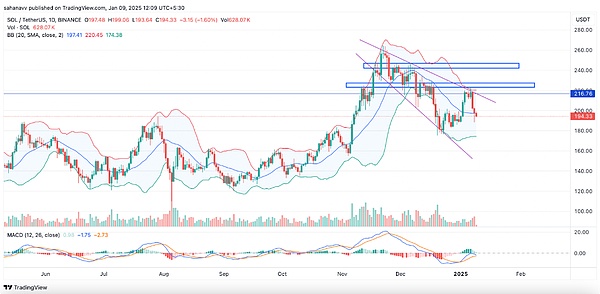
观察 Solana 的日线图,可以明显看出价格一直在不断形成较低的高点和低点。这表明空头对该代币拥有足够的主导地位,因此最终可能会频繁施加压力。与此同时,多头正努力捍卫 195 美元的支撑位,重燃看涨逆转的希望。

get?code=Zjc3OTdmNjdkOTJkNzE2MDc3NjQxYzIxYzExYmNhMWEsMTczNjQwNTYyNzg2Nw==

Solana 的日线图似乎看跌,因为技术面目前不支持看涨叙述。价格继续在下降楔形内交易,在面临阻力位的拒绝后,跌至支撑位似乎迫在眉睫。然而,人们可能不会预期会出现极端的挤压,因为反弹至 190 美元或 188 美元似乎是预先设定好的。MACD 中抛售压力的下降证实了看涨说法,而可能的看跌交叉已激活 190 美元以下的看跌目标。

因此,Solana 的价格有望保持下降趋势,并最终测试较低的目标,这是一个强劲的需求区域。每次测试这些水平时,该代币都会引发强劲反弹。此外,随着买家兴趣的下降,购买量未能积累。因此,在价格略微跌至 190 美元以下后,流动性可能会涌入,这可能有助于该代币恢复强劲反弹。

与此同时,如果价格突破 200 美元并稳定在 210 美元的水平,可能会抵消看跌影响,并可能将价格推高至 225 美元的年度高点之上。这可能是市场参与者看好 Solana (SOL) 价格并预期 2025 年创下新高的时候。

Trending Cryptos

Related Reads

Pantera Capital: As Perpetual Contracts Move Towards the Financial Center, Hyperliquid Aims to Be All-Encompassing

Perpetual futures ("perps"), once a crypto-native phenomenon, are becoming a dominant global financial instrument, evolving into a fundamental market structure shift that traditional finance can no longer ignore. This article outlines the advantages of perpetual contracts over traditional futures, highlighting their simplicity (no expiry/rollover), easier risk management, and native 24/7 operation. While the concept is not new, digital assets provided the ideal environment for its explosive growth. Initially dominated by centralized exchanges (CEX), perps have recently migrated significantly to decentralized exchanges (DEX), with Hyperliquid emerging as the leading DEX for perps, capturing ~40% of the on-chain volume. Hyperliquid, built on its own purpose-built L1 blockchain, has successfully expanded beyond crypto into traditional assets like stocks, commodities, and indices, driven by its permissionless listing framework (HIP-3) and 24/7 availability. It has become a crucial price discovery venue during off-hours and for pre-IPO companies, attracting attention from traditional hedge funds and major exchanges like ICE, which now views it as serious competition. The investment thesis for Hyperliquid's token, HYPE, rests on its large and growing total addressable market (TAM) across all finance, strong execution, superior user experience, and direct value accrual via aggressive token buybacks using 99% of protocol revenue. Key risks remain, primarily regulatory uncertainty in the U.S., though recent CFTC actions approving certain regulated crypto perp contracts signal a potential shift toward broader acceptance. The core question is no longer if perpetuals matter beyond crypto, but whether blockchain-based infrastructure like Hyperliquid can become the primary venue for pricing, trading, and discovering risk across all financial domains.

marsbit2h ago

Pantera Capital: As Perpetual Contracts Move Towards the Financial Center, Hyperliquid Aims to Be All-Encompassing

marsbit2h ago

Tiger Research: Zuckerberg Begins Betting on Prediction Markets, While Asian Nations Still View Them as Gambling

This article examines the rise of prediction markets, contrasting their growing institutional acceptance in the West with their restrictive regulation in Asia. It details how prediction markets, which originated from informal political betting and academic experiments like the Iowa Electronic Market, aggregate crowd wisdom into probabilistic prices through binary contracts. Their growth accelerated around 2020, reaching over $14 billion in monthly volume. A key driver is the "skin in the game" principle, where users risk their own capital, leading to high accuracy in predicting events like Fed rate decisions and elections, as demonstrated by platforms like Polymarket. Meta's entry, with Mark Zuckerberg reportedly leading the development of the Arena app, signals the market's maturation. In the U.S., court rulings have distinguished prediction markets from gambling, facilitating entry by traditional financial institutions. However, most Asian jurisdictions still classify them as gambling, focusing on social control rather than financial innovation. The article argues this stance creates three problems for Asia: 1) regulatory arbitrage pushes users to riskier offshore platforms, 2) loss of sovereign information infrastructure as valuable social sentiment data accumulates abroad, and 3) abandonment of user protection. It concludes that Asia needs a policy shift from prohibition to constructive regulation, integrating these markets into the formal system to harness their data as a national asset, as initiatives like Limitless Research are beginning to do.

marsbit4h ago

Tiger Research: Zuckerberg Begins Betting on Prediction Markets, While Asian Nations Still View Them as Gambling

marsbit4h ago

Trading

Spot

Hot Articles

Discussions

Welcome to the HTX Community. Here, you can stay informed about the latest platform developments and gain access to professional market insights. Users' opinions on the price of SOL (SOL) are presented below.

活动图片