Prediction markets have largely remained conceptual for years. Circa 2020, the situation began to change. A few small-scale projects started accumulating significant trading volume and broke through regulatory hurdles one by one, marking the formal formation of prediction markets as an industry.
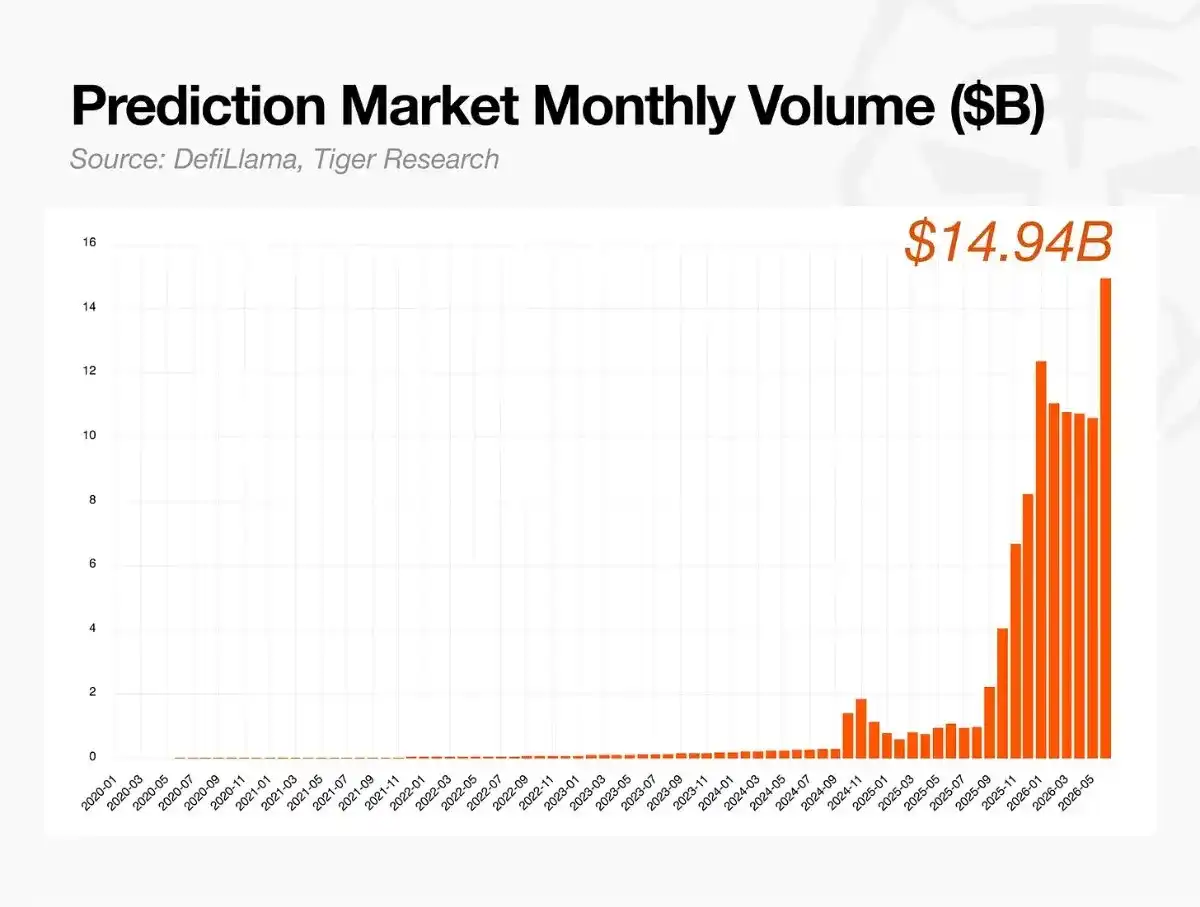
Since then, growth has accelerated. Current monthly trading volume exceeds $14 billion, and the combined valuation of major platforms is approximately $40 billion.
Meta's entry further proves it has moved beyond the early stage. A recent report by The New York Times revealed that Mark Zuckerberg personally leads a team developing a prediction market application called Arena. The dedication of such resources by a major tech company indicates this industry has left the experimental phase and established a proven business model.
Where Did Prediction Markets Originate?
Prediction markets are not a new phenomenon. They have been used informally in academia and finance for decades before blockchain technology brought them to the masses and helped them form an industry.
Informal Use
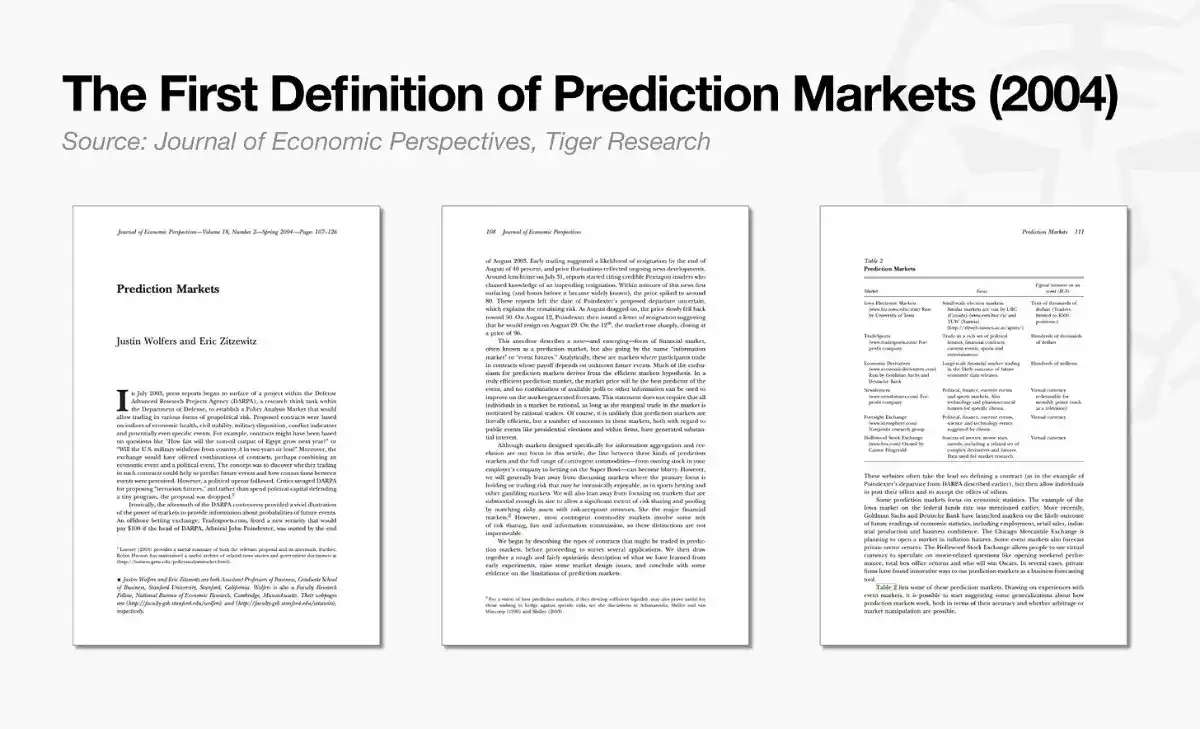
The term "prediction markets" itself emerged later than its history. By the 1980s, this concept went by various names such as information markets, decision markets, until a 2004 economics paper solidified it as "prediction markets."
However, the underlying practice predates the name. The earliest form was political betting on election outcomes. In 18th-century London coffee houses, people placed bets on parliamentary scandals and prime ministerial changes, with the resulting odds sometimes appearing in newspapers. In 19th-century New York, informal futures markets predicting presidential election outcomes were active in over-the-counter markets near Wall Street.
Academic Use
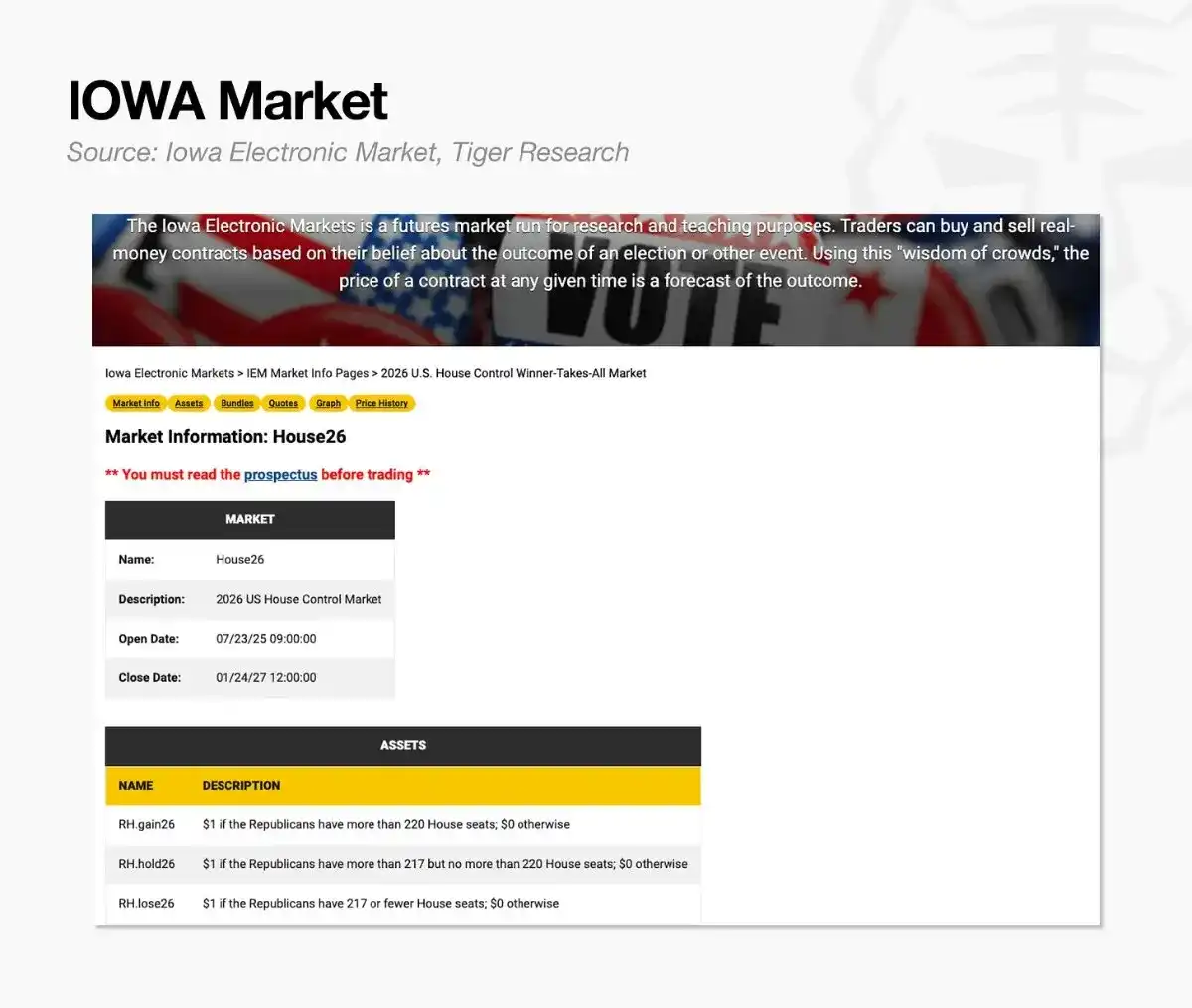
The academic starting point was three economists at the University of Iowa in 1988. Puzzled by polls failing to predict Jesse Jackson's win in the Michigan primary, they designed a market where people could directly trade election outcomes. This later became the Iowa Electronic Market (IEM).
In 1992 and 1993, the IEM received approval from the Commodity Futures Trading Commission (CFTC) for research purposes. Anyone could participate with $5. From 1988 to 2004, the IEM outperformed traditional polls about three-quarters of the time, serving as a laboratory for aggregating collective judgment into prices. Nonetheless, there was no regulatory framework at the time to allow its operation as a public market.
Binary Options
These early prediction markets closely resembled binary options in financial markets: contracts that are yes-or-no bets on whether a price would breach a certain threshold within a specified time. Their structure—settling at 1 if the event occurs, otherwise 0—is completely consistent with the logic of prediction markets.
Binary options also entered regulated exchanges. Examples include the Fixed Return Options by the American Stock Exchange in 2007 and S&P 500-based binary options by the Chicago Board Options Exchange in 2008. However, frequent fraud by offshore platforms led to bans on selling such products to retail investors in several major jurisdictions between 2017 and 2021. Despite this, this basic yes-or-no binary betting structure remains the logical foundation for how prediction markets operate today.
How Are Prediction Markets Traded Today?
Today, prediction markets cover topics encompassing almost any imaginable event.
Sports events account for the largest trading volume, benefiting from continuous schedules of leagues and global tournaments. The ongoing World Cup has further heightened the heat. Politics, geopolitics, and macroeconomics have expanded from indicators like inflation data to predictions on private company valuations, turning information itself into a tradable asset. Cryptocurrency and stock prices, along with some gossip-driven events, collectively form a complete spectrum from mass interest to professional information demand.
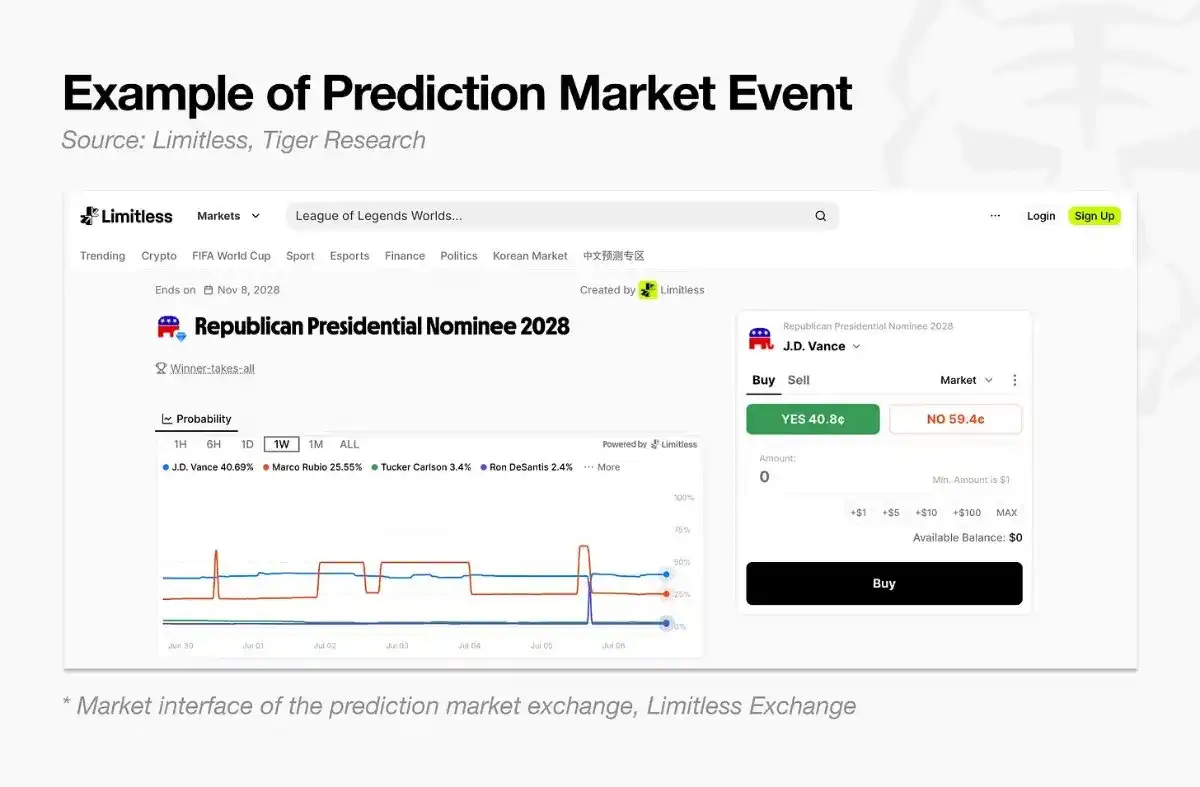
Each contract settles in a binary yes-or-no manner. Taking "Will J.D. Vance be the Republican presidential nominee in 2028?" as an example: If Vance is confirmed as the nominee, contracts betting "Yes" pay $1; otherwise, contracts betting "No" pay $1.
The simplest way to understand this structure is to think of $1 as 100%. A contract pays $1 (100%) if the event occurs, otherwise $0, so the intermediate trading price naturally reflects probability. A contract at 40 cents represents 40% of that dollar, meaning the market perceives a 40% probability of the event occurring. The cent value can be directly read as a percentage (ignoring bid-ask spreads and transaction costs).
Prices are formed through order books, not determined by any central party. Buy orders (e.g., buy at 39 cents) and sell orders (e.g., sell at 40 cents) accumulate at various price levels, with trades executed where both sides match. The price (and thus the implied probability) is generated in real-time by the interplay of funds from numerous participants. Traders can also sell their positions before expiration to lock in profits or cut losses, essentially exchanging their view on an event for cash.
Outcomes are recorded by oracles. No matter how precise a contract's price, someone still needs to determine "Yes" or "No" after the event concludes. Oracles are the mechanisms responsible for this judgment.
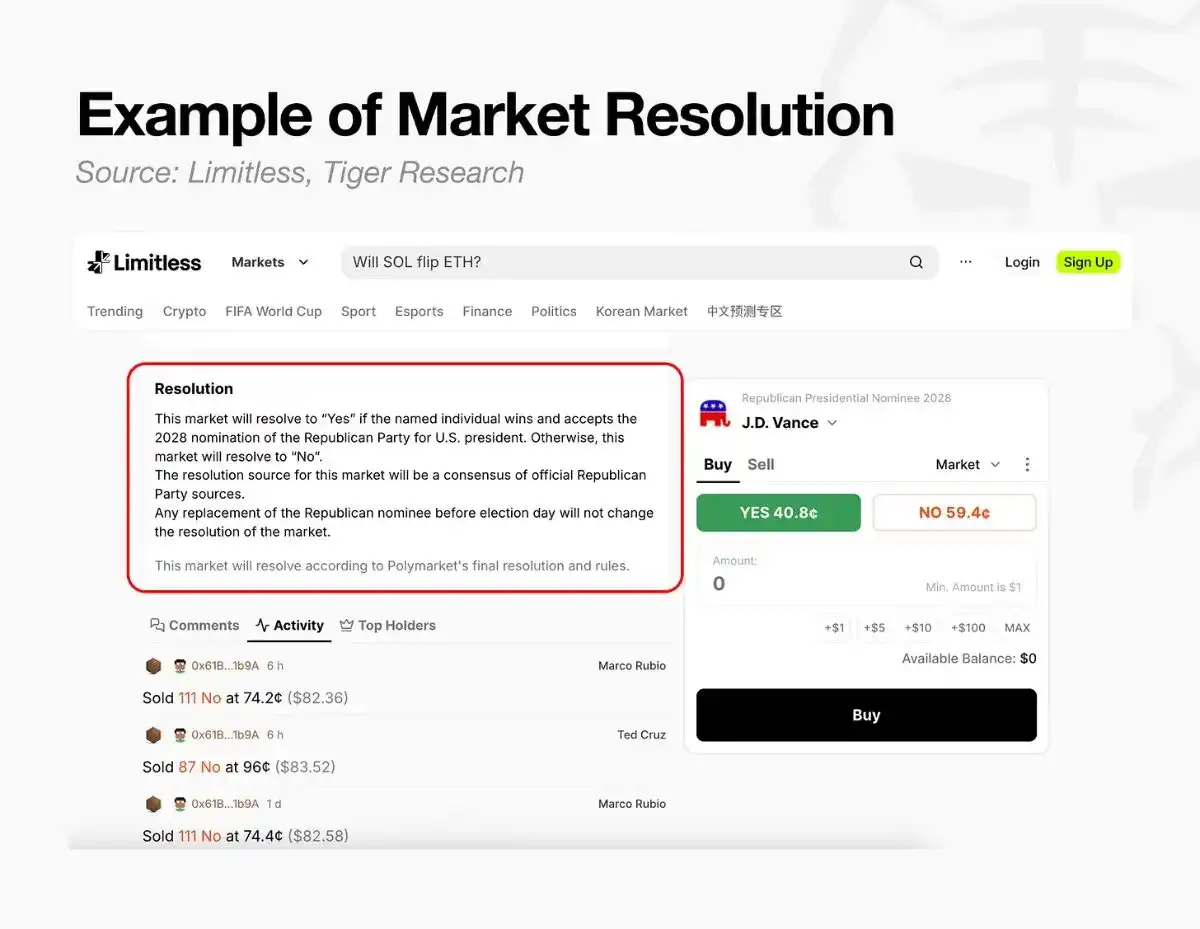
Oracles operate in two main ways:
- Decentralized Oracles: Proposers stake collateral and submit a proposed outcome. If unchallenged within a set period, it becomes the final result. If challenged, a re-proposal process begins, and only after further challenges does it proceed to voting.
- Centralized: Judgment criteria are set in advance. After the event concludes, the exchange directly applies the official result and immediately settles the market. This approach vests judgment authority entirely in a single exchange.
For example, on the Limitless platform, once a deadline passes, results are finalized according to preset rules. Reporting of real-world outcomes to the blockchain is completed by oracle services: most markets tracking crypto or stock prices report automatically via the Pyth Network, while custom markets for sports or politics are judged manually by an operations team within 24 to 72 hours.
At its core, a prediction market is an information system. It compresses the views of a large number of participants into a single number reflected in the price and, after the event, judges whether the prediction was correct based on preset rules.
The Evolution from Game to Information Finance
Prediction markets have evolved beyond simple betting platforms to become core infrastructure for information finance—turning future uncertainties into real-time price information. Their fundamental difference from traditional polls or expert forecasts lies in the "skin in the game" mechanism, where participants back their positions with their own capital.
In traditional methods, experts face little reputational cost for being wrong, and polls cannot filter out respondents' indifference or strategic misrepresentation. Prediction market prices carry a real cost for error—mistaken positions lose money—forcing participants to verify their beliefs with the most objective, up-to-date information. This willingness to bear a cost translates directly into market reliability.
This mechanism's performance is evident in multiple areas of real-world data:
Accuracy in Financial & Monetary Policy Predictions: Research by a Federal Reserve economist in February 2026 explains why. Since 2022, prediction market expectations for interest rates ahead of FOMC meetings have shown a statistically high degree of consistency with actual outcomes, outperforming federal funds futures and Bloomberg consensus. The reason is that participants immediately lose money if they are wrong, prompting stricter analysis of available information and pricing accordingly.
Transparent Probability Estimates for Politics & Elections: In South Korea's local elections in June 2026, Polymarket correctly predicted the winners in 14 out of 16 major cities and provinces. Where exit polls could only say "too close to call," prediction markets offered real-time probabilities backed by participants' real money, representing the aggregated judgment of numerous participants synthesizing multiple variables, not a simple forecast.
Responsiveness to Market Events & Company Valuations: When the issue of a stablecoin interest income cap emerged in March 2026, prediction markets immediately priced the probability of a Coinbase stock drop at 97.6%, serving as a real-time risk indicator rather than post-hoc analysis, demonstrating participants' sensitive response when their own capital is at risk. Academic research has reached similar conclusions: a 2015 study on internal prediction markets at companies like Google and Ford found prediction errors reduced by up to 25% compared to official forecast models, indicating prediction accuracy improves when insider knowledge is combined with capital at risk.
Information asymmetry remains a limitation. The Venezuela case in January 2026, where someone used confidential information for insider trading, exposed a real weakness. However, this attempt to distort prices was identified and prosecuted as a crime, also proving that markets aim to operate with transparency and accountability.
In areas where information is widely distributed, prediction markets are precision analytical tools; in areas where information is concentrated in few hands, they are monitoring mechanisms capable of identifying that concentration. Because participants' capital is genuinely at risk, the prices generated by these markets constitute objective information for assessing the value of financial assets.
The Absence of Prediction Markets in Asian Policy Discussions
The nature and trajectory of prediction markets vary greatly depending on national regulatory frameworks. The United States incorporated them into the regulated financial system through judicial rulings, while major jurisdictions in Asia still largely categorize them as traditional gambling.
In the U.S., litigation resolved much of the regulatory uncertainty. The CFTC attempted to classify Kalshi's election prediction contracts as gambling and sanction the platform, but courts ruled election prediction is not a game of chance, and regulators lacked the authority to ban it. This ruling shifted the regulatory stance, serving as a decisive catalyst for the entry of traditional financial institutions including ICE, Robinhood, and CME.
In contrast, in major Asian jurisdictions, the mainstream view still equates the binary settlement structure of prediction markets with traditional gambling. The dominant regulatory perspective is gambling control and public order, not financial policy. While approaches differ by country, prediction markets largely remain outside formal policy discussions in the region, with India and Indonesia being exceptions.
This divergence in treatment ultimately boils down to whether regulators view the market as a financial innovation or a social control issue.
Prediction Markets at a Crossroads: Regulatory Dilemma and Institutionalization
Prediction markets have become a core part of global financial and information infrastructure. A significant gap has emerged between the global trend and the rigid stance of Asian regulators. In an era where technological and financial boundaries have largely dissolved, attempts to confine new markets within old regulatory frameworks have inherent limitations. The current regulatory approach in major Asian jurisdictions faces three major problems.
The first is the paradox of regulatory arbitrage.
Prediction markets operate on borderless digital networks. Blocking platforms or restricting users in one country does not eliminate underlying demand. Users migrate to unregulated offshore platforms, assuming greater risks. This leads to capital outflow from the jurisdiction, with regulators losing both market oversight and associated tax revenue, weakening regional financial competitiveness in the long run.
The second is the loss of national information infrastructure sovereignty.
Prediction markets are advanced information infrastructure that translates complex social questions into precise numerical estimates, not merely betting venues. Recent elections in Asia have shown prediction markets reading public sentiment faster and more accurately than traditional polls. When excluded under the guise of regulation, the data that best reflects a society's mood accumulates on foreign servers. The result is that foreign media and institutions gain clearer insights into local societies than domestic analysts.
The third is the abandonment of user protection.
Users are in a blind spot, with no institutional safeguards. Policies that simply deny the market's existence without sufficient prior discussion only expose users to risk and push them outside the system.
The focus of discussion needs a fundamental shift.
The question is no longer how to block this market, but how to healthily utilize this data within the formal system. This shift in perspective requires dedicated study, yet related discussions remain limited.
In this field, Limitless Research is filling the gap, processing prediction data from Asian markets like South Korea and Japan into information assets. More participants are needed in the future to take on the role of building a healthy data ecosystem.
Regulation should not be a dam blocking the flow of water, but a channel to guide it correctly.
What Asia needs now is not stricter enforcement, but to initiate forward-looking discussions in response to this shift. Pushing transactions that are already happening into the shadows is the worst policy. It requires sustained effort to bring them into the formal system through constructive discussion, establish transparent oversight mechanisms, and return the data generated in the process as assets for the nation and society.