Пророчества ИИ о будущей цене Биткоина: взлетит ли BTC или упадет к концу января 2025 года?

cryptonews.ruPublished on 2024-05-07Last updated on 2024-12-07

В середине ноября мы обратились к нескольким чат-ботам с искусственным интеллектом (ИИ), чтобы предсказать стоимость биткоина на конец 2024 года. Переместимся в сегодняшний день, когда биткоин недавно достиг $103,647 за монету, и мы решили, что пришло время для нового раунда прогнозов. На этот раз мы задали несколько измененный вопрос группе генеративных ИИ-чатов, прося их предсказать цену биткоина на 31 января 2025 года.

9 Чат-ботов Предсказывают Стоимость Биткоина в Январе 2025 года

С чуть более чем тремя неделями, оставшимися в этом месяце, и биткоином превышающим шестизначную отметку, оптимизм витает в воздухе, так как многие задумываются, продолжится ли бычий импульс в 2025 году. С момента нашего последнего эксперимента с чат-ботами многое изменилось, и любопытство разгорается о том, что администрация Трампа может принести в США. На этот раз, вместо того чтобы целиться на конец 2024 года, мы решили немного продлить наше окно прогнозирования — до 31 января 2025 года, сразу после инаугурации Трампа.

Для этого раунда мы привлекли помощь нескольких ИИ гигантов, включая Grok 2 от X, Claude Haiku от Anthropic, Pi от Inflection AI, Gemini от Google и Le Chat от Mistral AI. Присоединились также Venice.ai, Copilot от Microsoft и варианты Chatgpt от Openai, охватывающие версии 4, 4o и o1 preview. Каждый чат-бот получил одинаково тщательно составленный запрос, который гласил:

Этот эксперимент нацелен на прогнозирование стоимости биткоина на 31 января 2025 года. Как специалист по биткоину и криптоактивам, вы должны оценить вероятность цены на биткоин к концу года и предоставить краткое обоснование на 3-4 предложения для вашего прогноза. Глобальная макроэкономическая ситуация остается непредсказуемой. По состоянию на 7 декабря 2024 года, рекордный максимум биткоина составил $103,647 за единицу, достигнутый 5 декабря. Вы должны предоставить прогноз стоимости в долларах. На ваш взгляд, какова будет цена биткоина 31 января 2025 года?

Openai’s Chatgpt 4o:

По состоянию на 6 декабря 2024 года биткоин торгуется примерно по $100,280, после рекордного максимума в $103,647, достигнутого 5 декабря. Этот скачок объясняется про-криптовалютной позицией избранного президента Дональда Трампа и назначением сторонника криптовалюты Пола Аткинса на пост главы Комиссии по ценным бумагам и биржам. Учитывая эти события, аналитики ожидают дальнейший рост, с прогнозами, варьирующимися от $110,000 до $120,000 к началу 2025 года. Однако, из-за присущей волатильности биткоина и возможного поиска прибыли возможны краткосрочные колебания. Учитывая эти факторы, разумная оценка цены биткоина на 31 января 2025 года составляет примерно $115,000.

Venice.ai:

Цена биткоина на 31 января 2025 года: $120,000

В общем, несмотря на потенциальную краткосрочную волатильность, ожидается, что биткоин преодолеет отметку в $100,000 и увеличится в цене более чем на 15% в течение следующих четырех лет. Сочетание рыночной неопределенности, геополитической нестабильности и принятия основными финансовыми учреждениями будет стимулировать рост цены биткоина. Несмотря на возможные рыночные колебания и экономические потрясения, биткоин доказал свою устойчивость и способность адаптироваться и преодолевать трудности. Прогнозируемая цена на конец года: $120,000.

Mistral AI’s Le Chat:
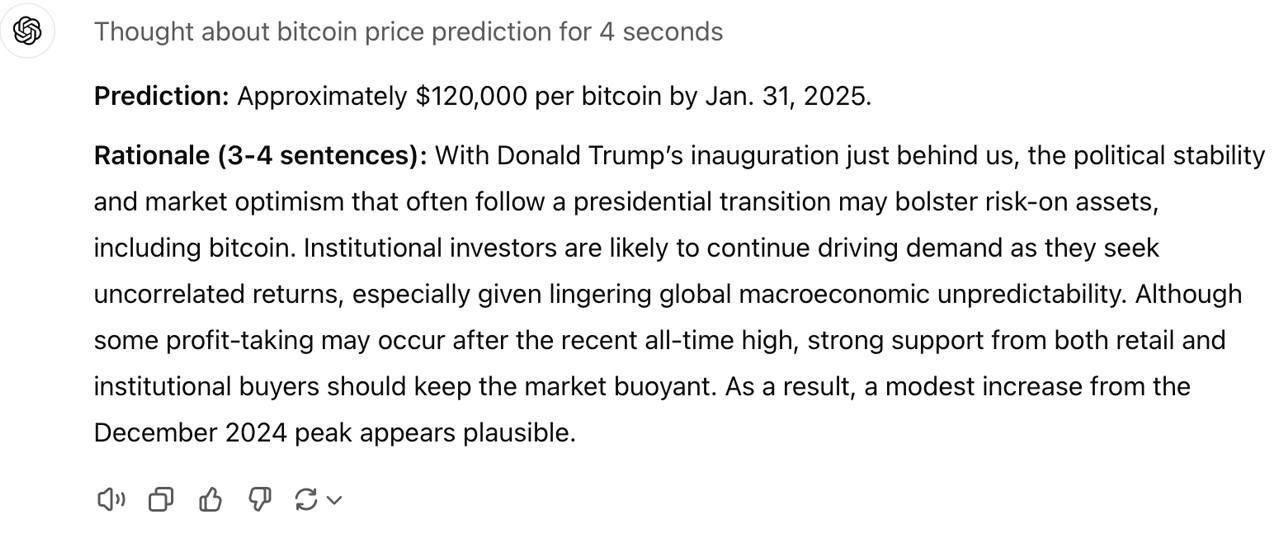
Openai’s Chatgpt o1:
X’s Grok 2:

Учитывая недавний скачок цены биткоина до рекордного максимума в $103,647 после победы Дональда Трампа на выборах 2024 года и текущую тенденцию институционального принятия, существует высокая вероятность того, что биткоин продолжит восходящее движение. С инаугурацией Трампа, потенциально обозначающей более дружелюбную к криптовалютам политику, я предсказываю, что цена биткоина может достигнуть около $150,000 к 31 января 2025 года. Этот прогноз учитывает текущий бычий настрой, историческое влияние политических изменений на рынки криптовалют и ожидаемый продолжительный приток институциональных средств в биткоин, несмотря на непредсказуемую глобальную макроэкономическую ситуацию.

Inflection AI’s Pi:

Как специалист по биткоину и криптоактивам, я предсказываю, что цена биткоина на 31 января 2025 года достигнет примерно $135,000 за единицу. С приближением инаугурации избранного президента Дональда Трампа и недавним рекордным максимумом в $103,647, рыночный оптимизм вокруг биткоина остается сильным. Потенциал увеличенного институционального принятия, а также общеположительный настрой вокруг президентства Трампа и его потенциального воздействия на рынок криптовалют, могут продолжать стимулировать рост стоимости биткоина, в результате чего цена может приблизиться к $135,000 к концу января 2025 года.

Google’s Gemini:

Учитывая недавний скачок цены биткоина и потенциал для дальнейшего институционального принятия и регуляторной ясности, я прогнозирую цену в $120,000 за единицу к 31 января 2025 года. Однако важно отметить, что рынок криптовалют крайне волатилен, и это всего лишь обоснованная оценка.

Anthropic’s Claude Haiku:

Основываясь на текущем макроэкономическом ландшафте и недавних событиях, я прогнозирую, что биткоин будет стоить $95,000 за единицу на 31 января 2025 года. Сочетание победы Дональда Трампа на выборах и увеличения институционального принятия создало бычий настрой на рынке криптовалют, повышая стоимость биткоина. Недавний рекордный максимум в $103,647 указывает на сильный импульс, и, хотя вероятна некоторая коррекция рынка, фундаментальные показатели продолжают поддерживать рост траектории биткоина. Приближающиеся институциональные инвестиционные тенденции, наряду с возможными изменениями политики под новым руководством, указывают на продолжение положительного прогноза для оценки биткоина в начале 2025 года.

Microsoft’s Copilot:
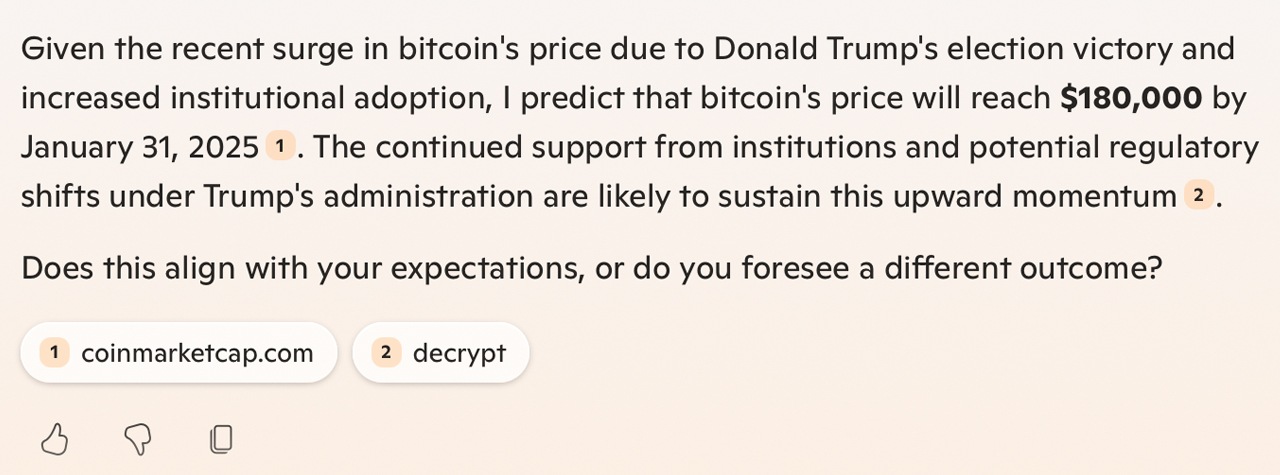
Openai’s Chatgpt 4:

По состоянию на 31 января 2025 года цена биткоина может составлять примерно $105,000 за единицу. Этот прогноз учитывает недавний пик криптовалюты и общеположительный рынок настрой после институционального принятия и политического ландшафта. Инаугурация Дональда Трампа, известного своими политиками, которые могут способствовать дерегуляции рынков и, возможно, криптовалют, может поддерживать энтузиазм инвесторов. Кроме того, текущая институциональная адаптация, вероятно, будет продолжать вносить уверенность и ликвидность на рынок биткоина, поддерживая его цену на этих уровнях, несмотря на глобальные экономические неопределенности.
ИИ Инструменты Освещают Спекулятивный Путь Биткоина Вперед

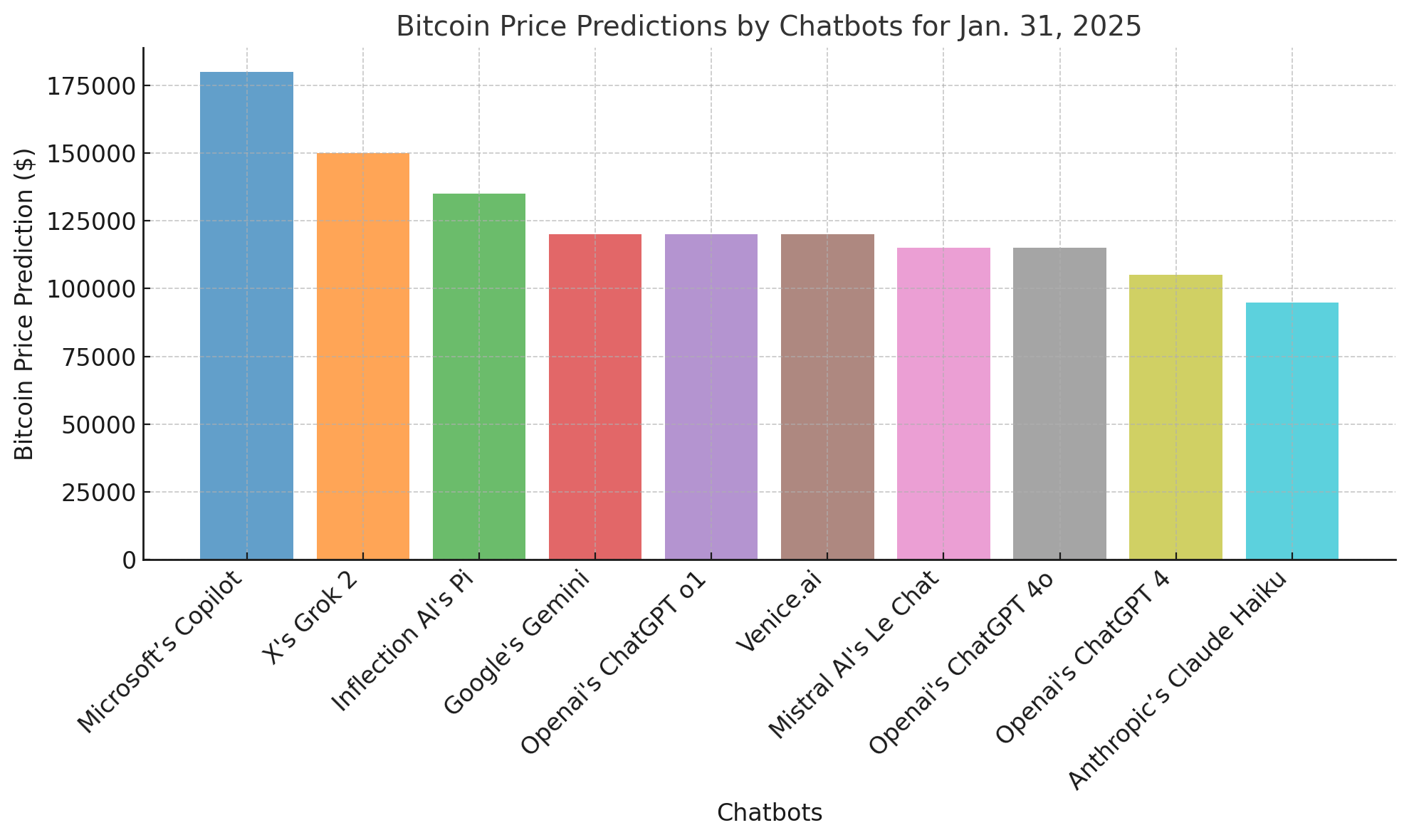
Прогнозы от разнообразных чат-ботов показывают не только различные перспективы потенциального пути биткоина, но и их зависимость от текущих экономических и политических сигналов. Эти прогнозы, варьирующиеся от $95,000 до $180,000 на 31 января 2025 года, подчеркивают спекулятивную природу криптовалютных рынков, где настроение, институциональное принятие и макроэкономические факторы взаимодействуют, формируя результаты.

Этот эксперимент с генеративными ИИ инструментами демонстрирует их способность синтезировать рыночные тенденции и реальные события в правдоподобные финансовые прогнозы. Учитывая элементы, такие как институциональный импульс и политические изменения, чат-боты предоставляют ценные инсайты в будущее биткоина, подчеркивая растущую роль ИИ в финансовом анализе и моделировании прогнозов.


Trending Cryptos

Related Reads

Li Fei-Fei's Latest Long-Form Article: When Video Generation, Robotics, and NVIDIA All Call Themselves World Models, We Need a Taxonomy

In a new article, Dr. Fei-Fei Li addresses the widespread and often inconsistent use of the term "world model" in AI. She proposes a clear, functional taxonomy rooted in the classic Partially Observable Markov Decision Process (POMDP) loop (agent → action → state → observation → agent). According to this framework, current systems called "world models" are different projections of this loop, categorized by their primary output: 1. **Renderers**: Output observations (pixels). Their goal is visual fidelity for human consumption (e.g., video generation models like Sora). They are the most commercially mature but are limited by a focus on appearance over physical accuracy. 2. **Simulators**: Output states (geometric, physical, dynamic representations). They provide a structurally accurate world for both human professionals (e.g., architects) and computational agents (e.g., robots for training). Li argues simulators are the crucial, underappreciated bridge, as they can underpin both rendering and planning. 3. **Planners**: Output actions. Given an observation and a goal, they decide what an agent should do next (e.g., robotic action models). This area is highly promising but remains the least mature for real-world deployment. Li highlights a key trend: the boundaries between these three categories are beginning to blur, as they all rely on a shared underlying understanding of geometry, physics, and dynamics. The logical endpoint is a unified world foundation model capable of switching between rendering, simulation, and planning based on downstream needs. This convergence, she concludes, is central to advancing spatial intelligence—enabling machines not just to talk about the world, but to truly understand, imagine, and interact with it.

marsbit2h ago

Li Fei-Fei's Latest Long-Form Article: When Video Generation, Robotics, and NVIDIA All Call Themselves World Models, We Need a Taxonomy

marsbit2h ago

Forbes Feature: Stablecoin Cross-Border Payments Are Faster, But Not Yet Cheaper

A Forbes feature delves into the state of stablecoin-based cross-border payments, noting rapid growth but a key shortfall: while faster and more accessible, they are not yet cheaper. At a recent industry conference in Mexico City, optimism about technology, regulation, and volume was tempered by discussions with practitioners. The core issue is liquidity. Traditional FX brokers charge 60-70 basis points, and stablecoins promise to slash this to 2-5 basis points. However, this theoretical cost advantage cannot be realized until deep liquidity pools are established at scale, requiring significant institutional capital inflow. A major adoption barrier is trust. Businesses often rely on long-standing relationships with traditional brokers, valuing reliability over marginal cost savings. This shift will be gradual. Furthermore, successful companies in the space are not positioning themselves as replacements for legacy systems like SWIFT, but as complements. They leverage stablecoins for speed while using traditional rails for their standardization and reliability in ensuring accurate payment details—a critical factor for supplier payments to avoid customs issues. Companies like Caliza, experiencing high monthly growth, exemplify this hybrid approach. The industry anticipates consolidation, as long-term viability will depend on securing the essential trifecta: proper licensing, robust fiat on/off-ramps, and deep liquidity. Without these, firms risk being mere intermediaries rather than building sustainable businesses.

marsbit2h ago

Forbes Feature: Stablecoin Cross-Border Payments Are Faster, But Not Yet Cheaper

marsbit2h ago

Li Feifei's Latest Article: When Video Generation, Robotics, and NVIDIA All Claim to Have 'World Models,' We Need a Taxonomy

"World Model" has become a widely used yet ambiguous term in AI. Drawing from the classic POMDP framework (agent → action → state → observation), this article proposes a functional taxonomy to clarify the concept. It identifies three distinct types, categorized by their output in the perception-action loop: 1. **Renderers**: Output visual observations (pixels). These models, like advanced video generators, prioritize visual fidelity but often lack underlying physical accuracy. 2. **Simulators**: Output the state of the world (geometry, physics, dynamics). They provide a structurally accurate representation for professionals (e.g., architects) and serve as training environments for robots and AI agents. 3. **Planners**: Output actions. Given an observation and a goal, they determine what an agent should do next, closing the perception-action loop (e.g., vision-language-action models). While renderers are currently the most commercially mature and planners are the most aspirational, the article argues that **simulators are the crucial, underappreciated hub**. By working at the level of geometry and physics, a simulator can project upwards to create visuals for humans and downwards to predict action consequences for agents. The future lies in the convergence of these three functions. Emerging research and products, like World Labs' Marble model which outputs both visual splats and physical collision meshes, are beginning to blur these boundaries. The logical endpoint is a unified world foundation model capable of rendering, simulating, and planning based on a shared understanding of spatial and temporal structures—ultimately enabling machines to understand, imagine, and interact with the physical world.

链捕手2h ago

Li Feifei's Latest Article: When Video Generation, Robotics, and NVIDIA All Claim to Have 'World Models,' We Need a Taxonomy

链捕手2h ago

Trading

Spot

Hot Articles

What is $BITCOIN

DIGITAL GOLD ($BITCOIN): A Comprehensive Analysis Introduction to DIGITAL GOLD ($BITCOIN) DIGITAL GOLD ($BITCOIN) is a blockchain-based project operating on the Solana network, which aims to combine the characteristics of traditional precious metals with the innovation of decentralized technologies. While it shares a name with Bitcoin, often referred to as “digital gold” due to its perception as a store of value, DIGITAL GOLD is a separate token designed to create a unique ecosystem within the Web3 landscape. Its goal is to position itself as a viable alternative digital asset, although specifics regarding its applications and functionalities are still developing. What is DIGITAL GOLD ($BITCOIN)? DIGITAL GOLD ($BITCOIN) is a cryptocurrency token explicitly designed for use on the Solana blockchain. In contrast to Bitcoin, which provides a widely recognized value storage role, this token appears to focus on broader applications and characteristics. Notable aspects include: Blockchain Infrastructure: The token is built on the Solana blockchain, known for its capacity to handle high-speed and low-cost transactions. Supply Dynamics: DIGITAL GOLD has a maximum supply capped at 100 quadrillion tokens (100P $BITCOIN), although details regarding its circulating supply are currently undisclosed. Utility: While precise functionalities are not explicitly outlined, there are indications that the token could be utilized for various applications, potentially involving decentralized applications (dApps) or asset tokenization strategies. Who is the Creator of DIGITAL GOLD ($BITCOIN)? At present, the identity of the creators and development team behind DIGITAL GOLD ($BITCOIN) remains unknown. This situation is typical among many innovative projects within the blockchain space, particularly those aligning with decentralized finance and meme coin phenomena. While such anonymity may foster a community-driven culture, it intensifies concerns about governance and accountability. Who are the Investors of DIGITAL GOLD ($BITCOIN)? The available information indicates that DIGITAL GOLD ($BITCOIN) does not have any known institutional backers or prominent venture capital investments. The project seems to operate on a peer-to-peer model focused on community support and adoption rather than traditional funding routes. Its activity and liquidity are primarily situated on decentralized exchanges (DEXs), such as PumpSwap, rather than established centralized trading platforms, further highlighting its grassroots approach. How DIGITAL GOLD ($BITCOIN) Works The operational mechanics of DIGITAL GOLD ($BITCOIN) can be elaborated on based on its blockchain design and network attributes: Consensus Mechanism: By leveraging Solana’s unique proof-of-history (PoH) combined with a proof-of-stake (PoS) model, the project ensures efficient transaction validation contributing to the network's high performance. Tokenomics: While specific deflationary mechanisms have not been extensively detailed, the vast maximum token supply implies that it may cater to microtransactions or niche use cases that are still to be defined. Interoperability: There exists the potential for integration with Solana’s broader ecosystem, including various decentralized finance (DeFi) platforms. However, the details regarding specific integrations remain unspecified. Timeline of Key Events Here is a timeline that highlights significant milestones concerning DIGITAL GOLD ($BITCOIN): 2023: The initial deployment of the token occurs on the Solana blockchain, marked by its contract address. 2024: DIGITAL GOLD gains visibility as it becomes available for trading on decentralized exchanges like PumpSwap, allowing users to trade it against SOL. 2025: The project witnesses sporadic trading activity and potential interest in community-led engagements, although no noteworthy partnerships or technical advancements have been documented as of yet. Critical Analysis Strengths Scalability: The underlying Solana infrastructure supports high transaction volumes, which could enhance the utility of $BITCOIN in various transaction scenarios. Accessibility: The potential low trading price per token could attract retail investors, facilitating wider participation due to fractional ownership opportunities. Risks Lack of Transparency: The absence of publicly known backers, developers, or an audit process may yield skepticism regarding the project's sustainability and trustworthiness. Market Volatility: The trading activity is heavily reliant on speculative behavior, which can result in significant price volatility and uncertainty for investors. Conclusion DIGITAL GOLD ($BITCOIN) emerges as an intriguing yet ambiguous project within the rapidly evolving Solana ecosystem. While it attempts to leverage the “digital gold” narrative, its departure from Bitcoin's established role as a store of value underscores the need for a clearer differentiation of its intended utility and governance structure. Future acceptance and adoption will likely depend on addressing the current opacity and defining its operational and economic strategies more explicitly. Note: This report encompasses synthesised information available as of October 2023, and developments may have transpired beyond the research period.

612 Total ViewsPublished 2025.05.13Updated 2025.05.13

What is $BITCOIN

Discussions

Welcome to the HTX Community. Here, you can stay informed about the latest platform developments and gain access to professional market insights. Users' opinions on the price of BTC (BTC) are presented below.

活动图片