Helium Investors Migrate To AI Dating Cryptocurrency GoodEgg For Better Returns, Analyst Say GEGG Will Overtake HNT

bitcoinistPublished on 2024-09-15Last updated on 2024-09-15

Abstract

In the ever-evolving world of cryptocurrency, there is always a buzz around the latest trends, projects, and investment opportunities. Helium...

In the ever-evolving world of cryptocurrency, there is always a buzz around the latest trends, projects, and investment opportunities. Helium (HNT) has been one of the most talked-about projects, especially due to its decentralized approach to providing wireless network coverage. However, recently, a significant shift has been noticed among investors as they migrate to a promising new token—GoodEgg (GEGG)—an AI-driven dating cryptocurrency.

Helium’s (HNT) Performance and Its Challenges

Helium (HNT) was a top player in the decentralized public infrastructure (DePIN) space, with a primary focus on revolutionizing the connectivity industry using blockchain technology. It allowed individuals to share their broadband connections in exchange for rewards, primarily in the form of HNT tokens. This unique utility and technology behind Helium initially led to impressive growth, particularly with trials in collaboration with two major U.S. carriers.

HNT’s value saw notable fluctuations. After reaching a low of $2.85 in June, the token managed to recover to nearly $8.00. It even formed a golden cross pattern on its 200-day and 50-day exponential moving averages, signaling a possible bullish trend. Analysts had set their sights on a crucial resistance level of $8.65, which, if broken, could lead to a further rise toward $11.03—a 42% increase from its current levels. However, despite these bullish indicators, the long-term growth prospects of Helium have been met with skepticism by some investors.

The Rise of GoodEgg (GEGG)

Amid the volatility and uncertainty surrounding Helium (HNT), investors are looking for the next big thing in the cryptocurrency space. GoodEgg (GEGG) has emerged as a major player, capturing the interest of not just casual investors but also cryptocurrency whales. With its unique AI-powered dating platform, GoodEgg (GEGG) integrates blockchain technology into a real-world application, allowing users to interact based on their crypto holdings and interests.

The project’s presale has already raised over $300,000, and 80% of the tokens in Stage 1 have been sold. With experts predicting that the price of GoodEgg (GEGG) could 100x from its current value of $0.00015, the token has quickly gained traction among investors who are eager to seize the opportunity for significant returns.

Why Helium Investors Are Moving to GoodEgg

Helium (HNT), despite its initial success, has faced challenges in terms of scalability and competition from other connectivity projects. The token’s price remains relatively volatile, and although its partnership with major carriers shows promise, the long-term prospects are uncertain. Additionally, with the broader cryptocurrency market experiencing a downturn, many investors are looking for projects with faster potential returns.

GoodEgg (GEGG), on the other hand, offers a unique investment opportunity that is both innovative and timely. The project combines two of the most talked-about technologies—artificial intelligence and blockchain—into a single platform. Unlike Helium (HNT), which focuses on the technical side of network connectivity, GoodEgg (GEGG) brings a social element into play by merging dating with crypto investments. This integration of AI and social interaction creates a new use case for digital assets that hasn’t been explored by many other projects.

Analysts Predict GoodEgg Will Overtake Helium (HNT)

Several analysts are bullish on GoodEgg (GEGG) potential, predicting that it could soon overtake Helium (HNT) in terms of market performance. The primary reasons for this optimism are the innovative application of AI in the crypto space and the platform’s appeal to a broad audience of both crypto enthusiasts and dating app users.

As Helium (HNT) continues to focus on its connectivity goals, it will likely face competition from other projects that offer similar services. GoodEgg (GEGG), on the other hand, is charting a different course by creating a platform that resonates with a wider audience, making it a highly versatile investment. With the growing popularity of AI-driven platforms and the demand for unique social engagement tools, GoodEgg is expected to capture a significant market share, pushing its value higher.

GoodEgg’s Bright Future 100x Prediction

While Helium (HNT) remains a strong contender in the decentralized infrastructure space, its investor base is increasingly looking for alternative opportunities that promise faster growth and better returns. GoodEgg (GEGG), with its innovative AI-driven dating platform and the promise of significant price appreciation, has become a major attraction for those looking to capitalize on the next big thing in the cryptocurrency world.

As analysts predict a 100x increase in the value of GoodEgg (GEGG), the migration of Helium investors to this new token is only expected to grow. The combination of AI technology and blockchain is proving to be a powerful draw, making GoodEgg (GEGG) one of the most exciting projects to watch in the crypto space.

Join GoodEgg (GEGG) For More Information On Presale, Use links below to join our community: 

Visit GoodEgg (GEGG)

Telegram: https://t.me/GEGG_OFFICIAL

X/Twitter: https://x.com/goodeggofficial


Bitcoinist

Bitcoinist

Bitcoinist is the ultimate news and review site for the crypto currency community!

Trending Cryptos

Related Reads

Tencent Buys Baidu Chips

China's internet giants, once defined by building closed, self-sufficient empires, are undergoing a fundamental shift. A key signal is Baidu's plan to spin off its AI chip unit, Kunlun Xin, for a Hong Kong IPO targeting a $50 billion valuation, potentially exceeding its parent company's worth. Concurrently, Alibaba's T-Head is also pursuing independence. Most significantly, reports indicate that rival Tencent has become a major customer for Kunlun Xin's chips. This move, where competitors begin procuring each other's core technologies, marks a decisive break from the past era of internal duplication and isolation. It signals the maturation of China's AI industry into a more open, specialized ecosystem. The underlying driver is the immense and clear cost of AI infrastructure, particularly the exploding demand for inference compute driven by AI agents and applications. Hardware is no longer just an internal cost center but a profitable, strategic business in itself. Globally, a parallel trend is evident as OpenAI, Google, Amazon, and others develop their own AI chips to control costs and optimize performance. The competition has moved beyond model benchmarks to a deeper, foundational war over token cost efficiency, inference cluster performance, and secure, scalable computing power. Baidu and Alibaba aren't dismantling their empires but are instead decoupling non-core, capital-intensive infrastructure to participate in and shape a larger, collaborative industrial base. The era of the all-encompassing super-app is giving way to an age of strategic specialization and open ecosystem building in the AI race.

marsbit10m ago

Tencent Buys Baidu Chips

marsbit10m ago

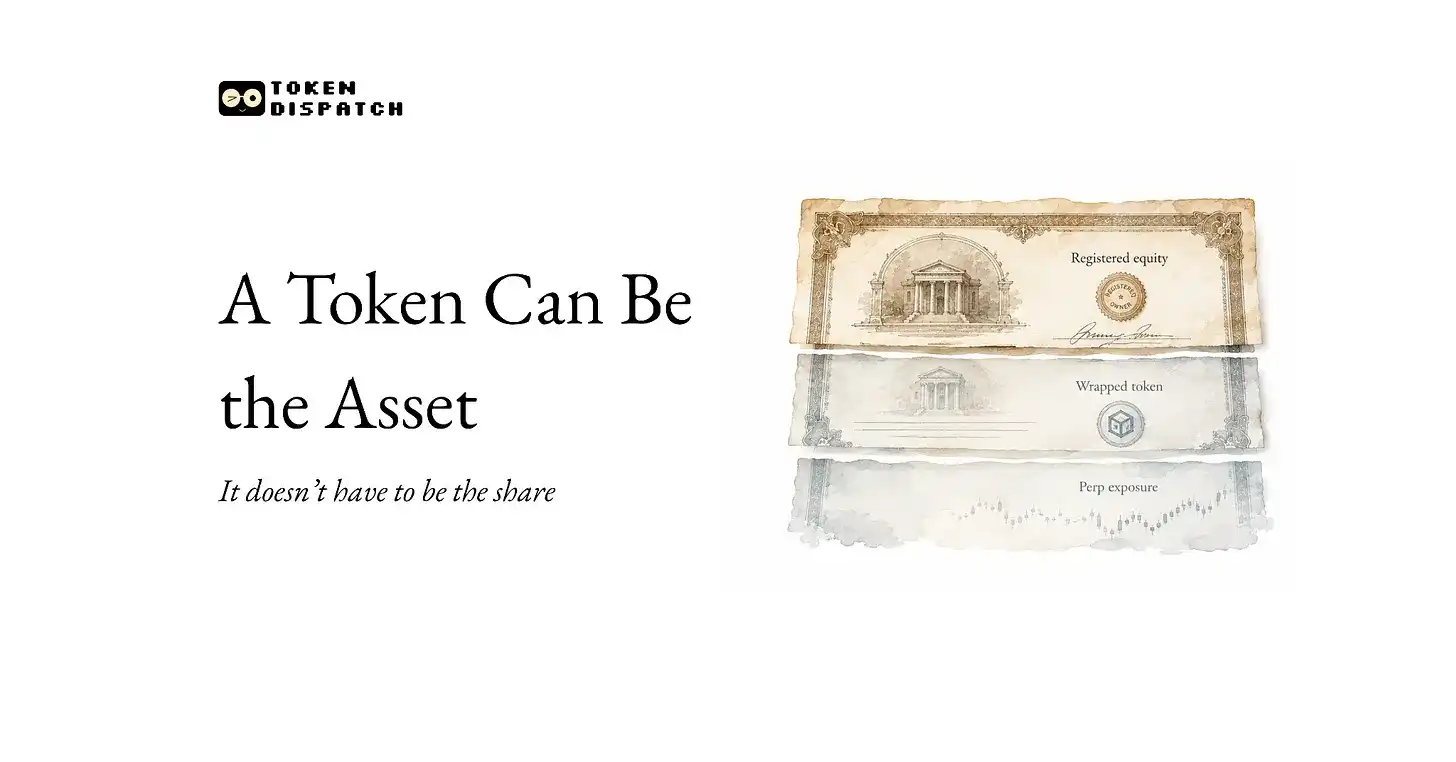
The Token Itself Is an Asset: Three Types of Tokenized Stocks, Which One Suits You?

"Tokenized Stocks: Three Types, Which One Fits You? For investors outside the US, buying stocks like SpaceX or Nvidia is difficult, requiring brokers, cross-border transfers, and often accredited investor status. Blockchain offers an alternative through tokenized stocks, a term encompassing three distinct products with vastly different ownership, voting, and profit rights. 1. **Full Real Ownership**: Companies like Superstate register native equity directly on-chain (e.g., Solana). Holders are on the official shareholder registry, with full voting rights, dividends, and legal ownership. This offers maximum rights but potentially less DeFi flexibility. 2. **SPV-Backed Tokens (Surrendered Ownership for DeFi Composability)**: Issuers like Backed (xStocks) and Ondo use offshore Special Purpose Vehicles (SPVs) to hold underlying shares 1:1 and issue tracking tokens. Investors get price exposure and dividends (reinvested as more tokens) but hold a claim on the SPV, not direct stock ownership. This enables use as collateral in DeFi protocols (Kamino, Morpho) and 24/7 minting/redemption, but carries SPV counterparty risk (highlighted by the PreStocks collapse). 3. **Perpetual Futures (Pure Price Speculation)**: Platforms like TradeXYZ (on Hyperliquid) and Ostium offer perpetual contracts. These are synthetic derivatives with no underlying stock ownership, using funding rates to track spot prices. They require only a price oracle, allowing extremely fast listing (e.g., SpaceX pre-IPO) and high leverage, attracting speculators. Their trading volume far exceeds tokenized spot products. The core value of tokens is that they don't need to replicate full stock ownership. Most retail investors never vote. Tokenization creates layered financial tools: full equity for institutions, composable tokens for DeFi users, and perpetuals for leveraged traders."

marsbit10m ago

The Token Itself Is an Asset: Three Types of Tokenized Stocks, Which One Suits You?

marsbit10m ago

AI as the Boss: Nearly Bankrupts 10 Companies...

A recent study from Princeton University tested 14 AI models, including large language models (LLMs) and a rule-based algorithm, in a simulation where they acted as CEOs of a virtual SaaS startup over 500 days. The goal was to grow an initial $1 million capital. The results were stark: only four "CEOs" ended with a profit. The top performer was Claude Fable 5, multiplying the capital 47-fold to $47.15 million. Claude Opus 4.8 and GPT-5.5 followed. Notably, the fourth profitable entity was a simple, pre-programmed rule-based algorithm, which outperformed many advanced LLMs with $15.76 million in profit. Five other models, including several major LLMs, went bankrupt before the simulation ended. Key takeaways from the research highlight that successful AI CEOs demonstrated a tendency for exploration and adaptation over caution. They excelled in discovering hidden information, predicting future cash flow, adapting quickly to changes (like competitor moves), and engaging in strategic "if-then" planning. The study also found that equipping LLMs with programming-agent frameworks, optimized for coding tasks, actually harmed their performance in this CEO role, suggesting a need for domain-specific adaptations. The article concludes by contrasting AI's current operational proficiency within defined frameworks with the type of visionary, intuitive decision-making—exemplified by figures like Steve Jobs—that truly drives transformative business strategy. This critical "matrix-drawing" capability, it argues, remains uniquely human.

marsbit20m ago

AI as the Boss: Nearly Bankrupts 10 Companies...

marsbit20m ago

Tokens as Assets: Which Type of Tokenized Stock Is Right for You?

**Tokenized Stocks: Three Models, Which Suits You?** For investors outside the US, accessing stocks like SpaceX or NVIDIA is often difficult, requiring compliant brokers and cross-border transfers. Blockchain offers an alternative through tokenized stocks, but this term encompasses three distinct models with vastly different ownership, voting rights, and economic benefits. The first model offers full, direct ownership. Platforms like Superstate register shares directly on-chain (e.g., Solana), with holders listed on the official shareholder registry, granting full voting rights, dividends, and legal status. The second model sacrifices direct ownership for DeFi composability. Issuers like Backed and Ondo use offshore Special Purpose Vehicles (SPVs) to issue tokens 1:1 backed by real shares. Holders gain price exposure and automated dividend accruals (via token balance increases), and tokens can be used as collateral in DeFi protocols. However, this introduces SPV counterparty risk, as seen in the PreStocks collapse. The third model abandons ownership entirely for pure price speculation. Perpetual futures platforms like TradeXYZ (on Hyperliquid) and Ostium create synthetic markets using price oracles and funding rates to track stock prices. They require no underlying shares, enabling rapid listing (e.g., SpaceX pre-IPO) and high leverage, which explains their trading volumes being 4-5x higher than tokenized spot markets. The core insight is that tokens derive value without needing to replicate full stock ownership. Most retail investors rarely exercise voting rights. These three models cater to different needs: direct ownership for institutions, DeFi-composable tokens for on-chain users, and perpetuals for leveraged, speculative traders. Tokenization is not a mere stock substitute but a new class of layered financial instruments.

Foresight News22m ago

Tokens as Assets: Which Type of Tokenized Stock Is Right for You?

Foresight News22m ago

Trading

Spot

Hot Articles

Discussions

Welcome to the HTX Community. Here, you can stay informed about the latest platform developments and gain access to professional market insights. Users' opinions on the price of AI (AI) are presented below.

活动图片