揭秘BTC现货ETF持仓机构:罗斯柴尔德、摩根大通挤不进前十,第一名是谁?

Odaily星球日报Published on 2024-05-11Last updated on 2024-05-11

Abstract

资管公司和银行机构成为主要购买力。

原创 | Odaily星球日报

作者 | 夫如何
揭秘BTC现货ETF持仓机构:罗斯柴尔德、摩根大通挤不进前十,第一名是谁?

2024 年是传统金融资本涌入加密世界的元年,这得益于年初发行的比特币现货 ETF。截止今天,SoSoValue数据显示,比特币现货 ETF 累计总流入 116.7 亿美元,净资产总值为 505.4 亿美元。

上线至今四个月的时间,比特币现货 ETF 带动加密市值最高涨幅为 64.93% ,最高市值为 28.45 万亿美元,并直接带动比特币市值最高涨幅为 59.25% 。

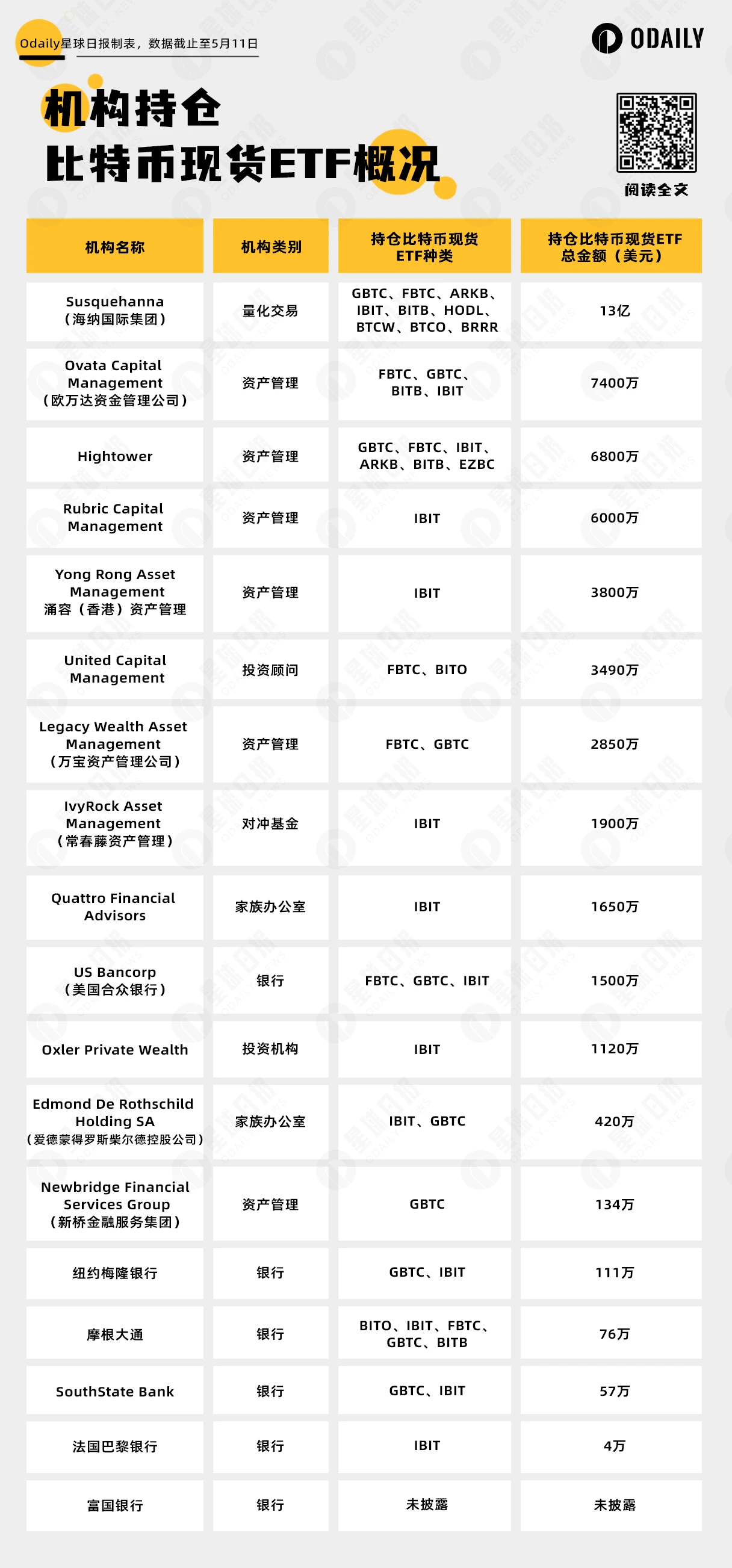
随着机构投资者陆续向美国 SEC 提交 13 F(机构持仓报告)文件披露关于比特币 ETF 的持仓情况,为大家揭开比特币现货 ETF 背后的惊人的购买力。Odaily星球日报整理了相关公司持仓情况,并发现资管公司已经成为 BTC 现货 ETF 的“主力军”。如下所示:
揭秘BTC现货ETF持仓机构:罗斯柴尔德、摩根大通挤不进前十,第一名是谁?

海纳国际集团(SIG)(13 亿美元)

海纳国际集团(SIG)是美国的金融服务公司,总部位于宾夕法尼亚州贝尔岡市。成立于 1987 年,由 Jeff Yass、Arthur Dantchik 和 Joel Greenberg 共同创立。SIG 在全球范围内开展业务,涵盖证券交易、期权交易、期货交易、衍生品交易、资产管理和私募股权投资等领域。SIG 以其专业化和技术化在金融市场中的表现而闻名,被认为是全球最大的量化交易公司之一。

SIG 购买了价值 13 亿美元的现货比特币 ETF,仅占该公司达 5759 亿美元投资总额的一小部分。

Ovata Capital(7400 万美元)

Ovata Capital 是一家总部位于香港的投资管理公司,成立于 2017 年。Ovata Capital 的旗舰产品是 Ovata Equity Strategies Master Fund,专注于亚洲股票,包括四个核心策略部分:套利、相对价值、事件驱动和多空头。

Ovata Capital 重仓了美国比特币现货 ETF,包括 FBTC、GBTC、BITB 和 IBIT,分别占其投资组合的 13.5% 、 11.2% 、 8.8% 和 5.6% ,总价值超过 7400 万美元。

Hightower(6834 万美元)

Hightower 是一家总部位于美国的全球性财富管理公司,提供综合的财务规划、投资管理和资产管理服务。该公司的客户群包括个人投资者、家族办公室、企业客户以及慈善机构等。

Hightower 购买了价值超 6834 万美元的美国比特币现货 ETF,该部分投资仅占其 617 亿美元投资总额的不到 0.1% 。

Rubric Capital Management(6000 万美元)

Rubric Capital Management 是一家总部位于美国的投资管理公司,成立于 2011 年。该公司专注于股票投资,并以实施长期价值投资策略而闻名。

管理资产规模 33 亿美元的 Rubric Capital Management 拥有超过 6000 万美元的贝莱德比特币现货。

Yong Rong Asset Management(3800 万美元)

Yong Rong Asset Management(涌容资产管理)是一家总部位于香港的资产管理公司。该公司专注于为客户提供全面的投资管理服务,涵盖股票、债券、衍生品等多个资产类别。

Yong Rong Asset Management 购买了价值约 3800 万美元的 IBIT,占其投资组合的 12% ,是贝莱德比特币现货 ETF 持仓量第一名。

United Capital Management(3491 万美元)

United Capital Management(联合资本管理)是一家综合性的财富管理公司,总部位于美国。该公司提供广泛的财务规划和投资管理服务。

United Capital Management 持有超 35 万股 FBTC 和 41 万股的 BITO,分别占其最新投资组合的 4.9% 和 3% ,总价值约 3491 万美元。其中,United Capital Management 是富达 FBTC 的重要股东之一。

Legacy Wealth Asset Management(2850 万美元)

Legacy Wealth Asset Management 是一家综合性的财富管理公司,致力于为客户提供全面的财务规划和投资管理服务。该公司的总部可能位于美国,曾收购汽车之家。

Legacy Wealth Asset MAnagement 拥有超 35 万股 FBTC,占其最新投资组合的 6.09% ,以及超 10 万股 GBTC,占比达 1.84% ,总价值超 2850 万美元。

Monolith Management(2400 万美元)

前红杉中国合伙人曹曦旗下 Monolith Management 是一家专注于公共和私人市场中成长型公司的投资管理公司。主要投资方向在科技、软件、消费和医疗保健等行业。

Monolith Management 拥有超过 2400 万美元的 IBIT,在贝莱德 ETF 的持仓量位居第五。

IvyRock Asset Management(1900 万美元)

IvyRock Asset Management 是一家总部位于香港的对冲基金管理公司。该公司通过其资产管理业务管理各种基金。

IvyRock Asset Management 持有贝莱德近 1900 万美元的现货比特币 ETF IBIT。

Quattro Financial Advisors(1650 万美元)

Quattro Financial Advisors 是家族办公室。该公司提供投资组合管理、财务规划和投资咨询服务。Quattro Financial Advisors 为美国客户提供服务。

Quattro Financial Advisors 是贝莱德比特币现货 ETF 第二大持仓者,持有 46.8 万股 IBIT,价值约 1650 万美元,占其投资组合的 5.4% 。

美国合众银行(1500 万美元)

美国合众银行是一家美国银行控股公司,它是合众银行全国协会(U.S. Bank National Association)的母公司、美国第五大银行,有三千多家分行,主要分布于美国西部和中西部。

美国合众银行披露了价值超过 1500 万美元的现货比特币 ETF 投资。据悉,其购买了大约 87, 744 股 Fidelity 的 FBTC 股票,价值 540 万美元, 46, 011 股 Grayscale 的 GBTC 股票,价值 290 万美元,以及 178, 567 股 BlackRock 的 IBIT 股票,价值 720 万美元。根据最新的 13 F 文件,该公司的总投资为 718 亿美元。

Oxler Private Wealth(1124 万美元)

Oxler Private Wealth 是一家投资平台。该平台仅提供相关信息。咨询服务仅向 Oxler Private Wealth LLC 及其代表合法持有牌照或免于持牌的客户或潜在客户提供。

Oxler Private Wealth 持仓了 28 万股 IBIT,价值约为 1124 万美元,占比为 4.4% 。

Edmond de Rothschild Holding S.A(420 万美元)

Edmond de Rothschild Holding S.A 为私人和机构客户提供各种财富管理服务。

Edmond de Rothschild (Suisse) S.A 披露了价值超过 420 万美元的现货比特币 ETF 投资。该公司报告称持有 103, 600 股贝莱德 IBIT 股票,价值略低于 420 万美元。还披露 1, 300 股 GBTC 股票,价值 82, 121 美元。根据最新的 13 F 文件,该公司的总投资为 60 亿美元。

Newbridge Financial Services Group(134 万美元)

Newbridge Financial Services Group 提供广泛立品、服务和解决方案,帮助客户实现独特的财务服务。

Newbridge Financial Services Group 的资产规模超 3.4 亿美元,持有约 2 万股 GBTC,价值约为 134 万美元,仅占其价值 2.3 亿美元投资组合的 0.58% 。

纽约梅隆银行(111.3 万美元)

纽约梅隆银行是一家位于美国纽约市的银行。其主要业务为证券服务及资产管理。其持有 19, 918 股 IBIT 和 7, 108 股 GBTC,当前价值约为 111.3 万美元。

摩根大通集团(76 万美元)

摩根大通集团,俗称“小摩”是一家总部位于纽约市的美国金融机构。其商业银行部旗下分行 5, 100 家。 2011 年 10 月,摩根大通的资产规模超越美国银行成为美国最大的金融服务机构。 摩根大通的业务遍及 50 多个国家,包括投资银行、证券交易及服务、投资管理、商业金融服务、私人银行服务等。

摩根大通披露其持有价值约 76 万美元的 ProShares BITO、贝莱德 IBIT、富达 FBTC、灰度 GBTC 和 Bitwise BITB 份额。

SouthState(55.72 万美元)

SouthState 是东南部地区领先的地区性银行之一,通过在佛罗里达、阿拉巴马、乔治亚、卡罗来纳和弗吉尼亚等地拥有 240 多个网点,为超过一百万客户提供服务。SouthState 提供全面的银行解决方案,包括个人银行业务、抵押贷款、小企业银行业务、商业银行业务和财富管理。

SouthState 披露了对两只现货比特币 ETF 的投资,合计价值 577, 198 美元,SouthState 在现货比特 ETF 的投资仅占其文件报告中报告的 13 亿美元总额的一小部分。

法国巴黎银行(4 万美元)

法国巴黎银行是一家世界级的金融集团,总部在法国巴黎,属于法国最大的银行,存款额亦为欧元区最大的银行,并是世界最大的银行之一,为系统重要性金融机构前四强。

法国巴黎银行购买了 1, 030 股 IBIT,价值仅约为 4 万美元。

富国银行集团(未披露)

富国银行集团于 1852 年成立于美国纽约,是一家多元化金融集团,总资产为 1.9 兆美元。富国银行和摩根大通、美国银行、花旗集团是美国四大银行之一。

根据最新披露的美国证券交易委员会文件显示,富国银行(Wells Fargo)已持有现货比特币 ETF 敞口。

Trending Cryptos

Related Reads

DRAM ETF Issuer: Samsung, SK Hynix, Micron All Surpass $1 Trillion, the AI Era of Memory Chips Has Only Just Begun

Authors: Dave Mazza, Thomas DiFazio | Source: Deep Tide TechFlow The article, written by Roundhill Investments (issuer of the DRAM ETF), responds to Morningstar's caution about investing in memory chip stocks. Morningstar warns of the sector's history of boom-bust cycles, a lack of economic moats, and potential momentum-driven overvaluation. Roundhill argues the current situation is structurally different due to AI. Key points in Roundhill's rebuttal include: * **Changed Demand & Supply Dynamics:** AI infrastructure, not consumer electronics, is now the primary growth driver for memory demand. New, strict long-term supply agreements with hyperscalers reflect the high capital intensity of advanced manufacturing. * **Existence of a Moat:** High-Bandwidth Memory (HBM), essential for AI, has extremely high manufacturing barriers. The market is dominated by Samsung, SK Hynix, and Micron, with new entrants blocked by technological complexity and long lead times for equipment like ASML's EUV machines. * **Strong Fundamental Outlook:** Analyst consensus projects the three companies will rank among the world's most profitable by 2027, with combined profits of $704 billion on over $1 trillion in revenue. Their operating margins have already reached record highs. * **Valuation Re-rating:** Despite significant stock price gains, memory stocks trade at attractive valuations (e.g., a median NTM P/E of 8.37x for the DRAM ETF) relative to projected explosive EPS growth. Roundhill suggests historical valuation frameworks may no longer apply given the new profitability paradigm. Conclusion: Roundhill contends the rally is justified by fundamentals, marking a structural shift for the memory industry into a new era of sustained, AI-driven demand against constrained supply, rather than a repeat of past cycles.

marsbit7m ago

DRAM ETF Issuer: Samsung, SK Hynix, Micron All Surpass $1 Trillion, the AI Era of Memory Chips Has Only Just Begun

marsbit7m ago

EF's Epic Reorganization: 20% Layoffs, Budget Halved, Is Ethereum Gearing Up for a Leaner Future?

The Ethereum Foundation (EF) has announced a major organizational restructuring, involving a 20% staff reduction (approx. 54 employees) and a division into functional clusters like Protocol, Access, User, Community, and Institutional layers. Co-founder Vitalik Buterin further revealed plans to cut the EF's budget by around 40% over the coming years, aiming to reduce its annual spending rate from about 15% to roughly 5% by 2030, transitioning to an endowment-driven model. This overhaul is seen as a long-overdue correction to the EF's ambiguous role. As Ethereum grew, the foundation faced persistent criticism over ETH sales, perceived lack of execution, and unclear strategy, often becoming a focal point for community frustration amid ETH's price stagnation. The reform aims to redefine the EF's boundaries, narrowing its focus to core protocol research, public goods funding, and ecosystem coordination, while offloading more applied development work to the broader market. Concurrently, ecosystem forces like the newly formed Ethlabs (founded by ex-EF researchers) and other independent groups are stepping in to fill the space, signaling a shift from a centralized model to a more distributed, collaborative ecosystem structure. The move was notably praised by Solana co-founder toly, who viewed a "leaner" EF as potentially more decisive and agile.

Odaily星球日报48m ago

EF's Epic Reorganization: 20% Layoffs, Budget Halved, Is Ethereum Gearing Up for a Leaner Future?

Odaily星球日报48m ago

Dragonfly Partner Haseeb: The Fastest-Growing Companies of the Future May All Get Stuck at 149 Employees

Dragonfly partner Haseeb explores the distorted economics of AI model pricing, drawing parallels to tax policy. He notes that startups and small teams (under 150 users) enjoy heavily subsidized, fixed-price AI subscriptions (like Claude Code), where the marginal cost of an additional token is effectively zero. This creates a powerful incentive for them to maximize token usage ("token-maxxing") and innovate aggressively with AI automation. In contrast, large enterprises (over 150 users) are forced onto "Enterprise" plans, paying per-token API fees with high (~75%) markups. This acts like a steep "tax" on AI-powered labor, disincentivizing marginal automation and experimental use, and encouraging them to retain more human workers. Haseeb argues this pricing creates a "150-person cliff," a regulatory notch similar to labor laws in France that discourage firms from growing past 50 employees. He predicts the fastest-growing future companies may deliberately cap their headcount at 149 to avoid the punitive enterprise pricing. This would foster an "AI-first" management philosophy obsessed with automation and outsourcing to stay lean. While not intentionally designed, this bifurcated pricing could become one of the most influential de facto tax policies, shaping how AI replaces labor—not through mass layoffs at big firms, but through agile, AI-native startups outcompeting them.

marsbit59m ago

Dragonfly Partner Haseeb: The Fastest-Growing Companies of the Future May All Get Stuck at 149 Employees

marsbit59m ago

How xBubble Breaks Through in the VC-Heavily-Backed OPC Economy

xBubble: Addressing the Structural Gap in the VC-Backed OPC Economy The concept of OPC (One Person Company) is evolving from a buzzword to a significant AI-driven market. While AI coding tools like Replit and Lovable have validated demand from non-technical users wanting to build applications, a key gap remains: the leap from creating a demo to running a stable, evolving business. These tools still require users to manage the development process, including technical judgments for integrations, modifications, and deployments—a major hurdle for OPCs. xBubble, by DAPPOS, tackles this by shifting from "Prompt-to-Code" to "SOP-to-Business." Instead of generating code from instructions, its core is a system of pre-organized SOPs (Standard Operating Procedures) that translate business goals—like "sell World Cup merchandise"—into complete, executable workflows. This includes generating cohesive assets, pages, payment systems, and backend logic. The platform is augmented by a network of third-party service providers who handle infrastructure (hosting, domains, payment setup), acting like "on-site service engineers." Users can pay for these services directly with xBubble credits, simplifying onboarding. This ecosystem aims to deliver not just an app, but a complete, modifiable business launch path. xBubble targets a clear OPC segment: small commercial nodes (e.g., creators, merchants) with existing products, customers, or channels, but for whom a full tech team is unjustifiable. Its potential lies in SOPs accumulating expertise from real cases, improving reliability and reducing delivery costs over time. Additionally, its native support for crypto payments caters to global or digital-native OPCs. In summary, as AI democratizes software creation, xBubble's opportunity is to prove that "SOP-to-Business" provides more immediate value for launching a real, operational business than a powerful but unstructured AI coding tool.

链捕手1h ago

How xBubble Breaks Through in the VC-Heavily-Backed OPC Economy

链捕手1h ago

Trading

Spot
Futures

Hot Articles

What is $BITCOIN

DIGITAL GOLD ($BITCOIN): A Comprehensive Analysis Introduction to DIGITAL GOLD ($BITCOIN) DIGITAL GOLD ($BITCOIN) is a blockchain-based project operating on the Solana network, which aims to combine the characteristics of traditional precious metals with the innovation of decentralized technologies. While it shares a name with Bitcoin, often referred to as “digital gold” due to its perception as a store of value, DIGITAL GOLD is a separate token designed to create a unique ecosystem within the Web3 landscape. Its goal is to position itself as a viable alternative digital asset, although specifics regarding its applications and functionalities are still developing. What is DIGITAL GOLD ($BITCOIN)? DIGITAL GOLD ($BITCOIN) is a cryptocurrency token explicitly designed for use on the Solana blockchain. In contrast to Bitcoin, which provides a widely recognized value storage role, this token appears to focus on broader applications and characteristics. Notable aspects include: Blockchain Infrastructure: The token is built on the Solana blockchain, known for its capacity to handle high-speed and low-cost transactions. Supply Dynamics: DIGITAL GOLD has a maximum supply capped at 100 quadrillion tokens (100P $BITCOIN), although details regarding its circulating supply are currently undisclosed. Utility: While precise functionalities are not explicitly outlined, there are indications that the token could be utilized for various applications, potentially involving decentralized applications (dApps) or asset tokenization strategies. Who is the Creator of DIGITAL GOLD ($BITCOIN)? At present, the identity of the creators and development team behind DIGITAL GOLD ($BITCOIN) remains unknown. This situation is typical among many innovative projects within the blockchain space, particularly those aligning with decentralized finance and meme coin phenomena. While such anonymity may foster a community-driven culture, it intensifies concerns about governance and accountability. Who are the Investors of DIGITAL GOLD ($BITCOIN)? The available information indicates that DIGITAL GOLD ($BITCOIN) does not have any known institutional backers or prominent venture capital investments. The project seems to operate on a peer-to-peer model focused on community support and adoption rather than traditional funding routes. Its activity and liquidity are primarily situated on decentralized exchanges (DEXs), such as PumpSwap, rather than established centralized trading platforms, further highlighting its grassroots approach. How DIGITAL GOLD ($BITCOIN) Works The operational mechanics of DIGITAL GOLD ($BITCOIN) can be elaborated on based on its blockchain design and network attributes: Consensus Mechanism: By leveraging Solana’s unique proof-of-history (PoH) combined with a proof-of-stake (PoS) model, the project ensures efficient transaction validation contributing to the network's high performance. Tokenomics: While specific deflationary mechanisms have not been extensively detailed, the vast maximum token supply implies that it may cater to microtransactions or niche use cases that are still to be defined. Interoperability: There exists the potential for integration with Solana’s broader ecosystem, including various decentralized finance (DeFi) platforms. However, the details regarding specific integrations remain unspecified. Timeline of Key Events Here is a timeline that highlights significant milestones concerning DIGITAL GOLD ($BITCOIN): 2023: The initial deployment of the token occurs on the Solana blockchain, marked by its contract address. 2024: DIGITAL GOLD gains visibility as it becomes available for trading on decentralized exchanges like PumpSwap, allowing users to trade it against SOL. 2025: The project witnesses sporadic trading activity and potential interest in community-led engagements, although no noteworthy partnerships or technical advancements have been documented as of yet. Critical Analysis Strengths Scalability: The underlying Solana infrastructure supports high transaction volumes, which could enhance the utility of $BITCOIN in various transaction scenarios. Accessibility: The potential low trading price per token could attract retail investors, facilitating wider participation due to fractional ownership opportunities. Risks Lack of Transparency: The absence of publicly known backers, developers, or an audit process may yield skepticism regarding the project's sustainability and trustworthiness. Market Volatility: The trading activity is heavily reliant on speculative behavior, which can result in significant price volatility and uncertainty for investors. Conclusion DIGITAL GOLD ($BITCOIN) emerges as an intriguing yet ambiguous project within the rapidly evolving Solana ecosystem. While it attempts to leverage the “digital gold” narrative, its departure from Bitcoin's established role as a store of value underscores the need for a clearer differentiation of its intended utility and governance structure. Future acceptance and adoption will likely depend on addressing the current opacity and defining its operational and economic strategies more explicitly. Note: This report encompasses synthesised information available as of October 2023, and developments may have transpired beyond the research period.

440 Total ViewsPublished 2025.05.13Updated 2025.05.13

What is $BITCOIN

Discussions

Welcome to the HTX Community. Here, you can stay informed about the latest platform developments and gain access to professional market insights. Users' opinions on the price of BTC (BTC) are presented below.

活动图片