扩容希望还是伪概念?Layer3为何饱受争议?

Odaily星球日报Published on 2024-04-02Last updated on 2024-04-02

Abstract

为什么“Rollup+Rollup”的套娃逻辑行不通?

原创|Odaily星球日报

作者|Azuma
扩容希望还是伪概念?Layer3为何饱受争议?

围绕着 Layer 3 的争议讨论近两天愈演愈烈。

一方面,Degen Chain 等 Layer 3 代表性项目的相关代币在过去数日内涨幅惊人 —— DEGEN 自身周涨幅高达 143.%;Aavegotchi 在选择转型为 Base 系 Layer 3 之后,GHST 也强势刷新了历史高点。

但另一方面,社区之内对于 Layer 3 的质疑声音也越来越响亮,Vitalik 今日还亲自下场表达了偏反对的意见:“Layer 3 并不会如魔法般地提高吞吐量。”

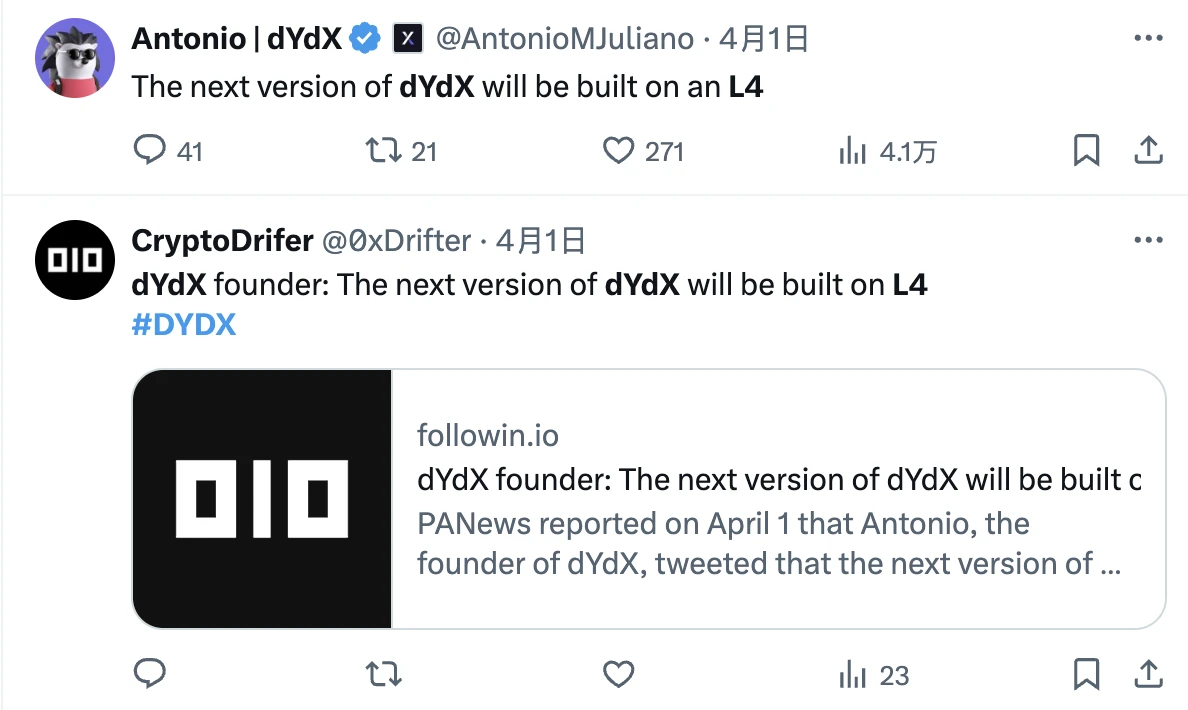
恰逢昨日是愚人节,许多项目便以此为焦点,略带些调侃性质地开了些关于 Layer 4、Layer 5 的玩笑,比如 dYdX 就曾开玩笑说“新版本将基于 L 4 构建”,这一玩笑甚至还被部分媒体当成了新闻传播。
扩容希望还是伪概念?Layer3为何饱受争议?

那么,为何 Layer 3 会遭受如此质疑?“Rollup 上再加个 Rollup”的套娃逻辑为何不够政治正确?综合社区的讨论来看,围绕着 Layer 3 的质疑焦点主要集中在“Layer 3 是否真正具有扩容意义”之上。

从经典定义来看,Layer 2 的往往被定义为依赖于以太坊主网进行结算,具备可扩容性的网络;以此类推,Layer 3 的定义则是依赖于 Layer 2 进行结算,更具可扩容性的网络。

Layer 3 的可行性假设

在 Layer 2 的环境下,所谓的“依赖以太坊进行结算”,在技术层面上的实现机制为:将 Layer 2 的大量交易数据打包并压缩,继而同步至以太坊网络,并通过 Calldate(早期方案)或 Blob(当前方案)的数据空间进行存储。

理想情况下,假如 Layer 2 的这套结算逻辑可行,那么 Layer 3 依赖于 Layer 2 进行结算的逻辑似乎也应该成立,其技术层面上的实现机制理应为:将 Layer 3 的大量交易数据打包并压缩,继而同步至 Layer 2 网络……

到这一步时,问题就要开始出现了。

由于 Layer 2 本身并不负责网络“最终性”的确认,而是依赖于以太坊进行,那么理论上 Layer 3 的数据最终也应该提交至以太坊,由以太坊“一锤定音”。

对于已提交至 Layer 2 的 Layer 3 压缩数据而言,这时有两种潜在的提交模式(继续压缩 or 不再压缩),但可惜的是无论哪种模式暂时都存在一定问题。

Layer 3 数据提交的双重悖论

首先是第一种潜在的提交模式,将已压缩的数据再次压缩,与其他 Layer 2 交易数据一起提交至以太坊主网。

听起来似乎很美好,但现实的情况却很残酷 —— 不行。

Vitalik 在 2022 年时曾写过一篇关于 Layer 3 的分析文章《什么样的 Layer 3 才有意义》,文中曾解释了为什么我们不能对交易数据进行多次压缩。

Rollup 使用了一系列压缩方案来减少交易储存的数据量,一笔简单的转账可大约 100 字节压缩至约 16 字节,一笔 EVM 兼容链上的 ERC 20 转账可从约 180 字节压缩至约 23 字节,一笔 ZK-SNARK 交易可从约 600 字节压缩至约 80 字节。所有上述案例大约都可以实现 8 倍左右的压缩效率……然而,由于 Rollup 依然需要在链上保持数据可用性,保证用户可访问并验证的所有数据,比如独立计算 Rollup 的状态,或是在现有验证节点离线时作为新的验证节点加入……数据可以被压缩一次,但不可以被重复压缩,如果可以的话,通常意味着我们可以将第二个压缩器的逻辑放入第一个中,但这也意味着我们本可利用一次压缩就能获得同样的效果。因此,“Rollup 上再套一个 Rollup”并不具备真正的扩容效果的解决方案。

简单来说,出于数据可用性考虑,对交易数据进行压缩本就存在一定的限制。

在这一前提下,如果我们可以通过将第二次压缩的逻辑集成至第一次压缩过程中,来实现 Layer 3 数据的多重压缩,这也就意味着我们也可以对 Layer 2 数据进行多重压缩,进而在 Layer 2 层面直接达成同样的扩容效果,那为什么我们还需要 Layer 3 呢?

究其原因,压缩算法本质上就是在某种程度上移除数据冗余,使得数据变得更加紧凑,可一旦这些冗余被移除,对已经压缩过的数据再次进行压缩就变得更难,因为可被去除的冗余只会越来越少。因此,数据压缩并不是一个可以无限重复的过程,压缩的收益也是递减的。

接着我们看第二种潜在的提交模式,即不再对 Layer 3 数据进行压缩,而是直接与其他 Layer 2 交易一起提交至以太坊主网。

这同样让人觉得有些莫名其妙,因为整体来看,当下限制了以太坊生态扩容效果的最主要瓶颈并不在于 Layer 2 (包括 Layer 3)上的区块空间不足,而是主网的数据可用性承载能力有限 —— 即用以存储 Layer 2 数据的 Blob 存储空间依然有限。

Monad 联合创始人 Keone Hon 此前曾发文表示,当前 Blob 的容量状况大概是每个区块(12 秒)产出 3 个 125 kb 的 Blob,即每秒 31.25 kb,鉴于一笔交易的数量约为 100 字节(相较 Vitalik 给出的数字略高),这意味着所有 Layer 2 的共享 TPS 大概是 300 左右。

在这一前提下,所有 Layer 2 (包括 Layer 3)均会受到同一个数据可用性上限的制约,这也使得即便 Layer 2 外加 Layer 3 所提供的区块空间再多,在完成“最终性”确认时也都得一个一个来排队。

这也是为什么 Vitalik 会强调 Layer 3 并不会神奇地改善以太坊生态的扩容状况。

Layer 3 是否毫无意义?

结合上述分析可知,出于压缩效率以及数据可用性上限等层面的限制,当下的 Layer 3 在通用型扩容方面并不能提供显著效果。那么这是否意味着 Layer 3 纯属“伪概念”,毫无实践意义呢?答案也并不会那么绝对。

Starkware 曾在《分层扩容,从 L2 到 L3》中概述了 Layer 3 的一些潜在发展方向,比如 Layer 2 可作为通用型网络运行,Layer 3 可通过强化定制性功能来作为专用型网络运行;再比如 Layer 2 可聚焦于无信任扩容,Layer 3 则可聚焦于弱信任扩容,即通过引入一定的外部信任条件来处理数据可用性等较棘手问题。

最后套用 Vitalik 在《什么样的 Layer 3 才有意义》中的原话结尾吧:“在 Rollup 之上再叠加一个 Rollup,尤其是当这两层采用了相同的技术机制时,显然是行不通的。然而,如果 Layer 2 和 Layer 3 有着不同的设计以及不同的目标,这样的三层构架扩容构架则是可行的。”

Trending Cryptos

Related Reads

Coin Stock Barometer丨BitMine's Total Assets and Investment Reach $10.7 Billion, Exceeding ~$9.3 Billion Floating Loss; Strategy Buys Only 520 BTC, Strive Adds Positions Against the Trend (June 23)

This article provides a weekly market update on "coin-equity" trends, focusing on listed companies holding major cryptocurrencies. Key highlights include: **General Market Trends:** Global equities, particularly in the US, Japan, and South Korea, faced significant sell-offs, led by large tech and AI-related stocks. Analysts cite profit-taking and a shift from hype-driven to performance-driven valuation for AI companies. Market focus is on upcoming Micron Technology's earnings. **Cryptocurrency Treasury Updates:** * **Bitcoin (BTC):** Net weekly BTC purchases by listed companies (excluding miners) totaled approximately $86 million, down 13.97% from the prior week. Strategy (formerly MicroStrategy) purchased only 520 BTC for ~$34.9 million, while Strive Asset Management increased its holdings by 759 BTC for ~$50 million. Other notable actions include Mara Holdings adding 1,000 BTC and Capital B shareholders approving a massive financing plan (up to ~$1.2 trillion) to potentially expand its Bitcoin reserves. * **Ethereum (ETH):** BitMine emerged as the largest corporate ETH treasury, holding 5.67 million ETH (4.7% of supply). It purchased an additional 52,203 ETH ($92 million) in the past week. Sharplink completed a $75 million private placement to fund further ETH accumulation and stock buybacks. * **Solana (SOL):** The top five listed companies hold over 15.7 million SOL combined. However, Solmate Infrastructure, a SOL treasury firm, faces a lawsuit from its largest external shareholder alleging board misconduct and self-dealing. * **Other:** Updates include Canton Strategic's $50 million stock buyback plan and Lite Strategy's $1 million strategic investment in LitVM, a Layer-2 network for Litecoin. The article notes that while crypto treasury firms continue fundraising and accumulation, their stocks may struggle to rise against the broader market downturn until Q4.

marsbit12m ago

Coin Stock Barometer丨BitMine's Total Assets and Investment Reach $10.7 Billion, Exceeding ~$9.3 Billion Floating Loss; Strategy Buys Only 520 BTC, Strive Adds Positions Against the Trend (June 23)

marsbit12m ago

OpenAI Partners with PE Firms, Investing $4 Billion. Let's Talk About Silicon Valley's Hottest New Role: FDE.

The hottest new role in Silicon Valley is the Forward Deployment Engineer (FDE), a hybrid of engineer and business consultant whose core mission is to transform AI demos into native, practical workflows within client organizations. The recent surge in demand is driven by a strategic shift from leading AI companies. OpenAI, partnering with 19 private equity firms in a $4 billion investment, formed a Deployment Company and acquired Tomoro along with its 150 FDEs. Anthropic also announced a $1.5 billion joint venture with financial institutions like Blackstone. The article, based on interviews with industry experts Jove (FDE lead at Cresta) and Oliver (VP at Invisible Technologies, ex-McKinsey), explores the FDE role and the rise of deployment-focused companies. Key insights include: **The FDE Role:** Jove describes an FDE as a "Forward Deployed CTO"—a technically strong engineer who works intimately with clients to implement AI solutions, learn from the process, and feed those insights back to improve the core product. They require expertise in AI agents, client-facing experience, resilience, and the ability to handle complex, imperfect systems. While AI tools enhance their efficiency, the role's complexity makes full automation a distant prospect. **Industry Shift:** Model companies are moving beyond selling tools to ensuring real-world adoption. This blurs the line between model and application companies. Collaborations with private equity (PE) firms are key, providing access to large portfolios of traditional businesses needing AI transformation. For PE firms, these partnerships offer signal value to LPs, create tangible value in portfolio companies, and provide exposure to high-growth AI assets. **Consulting & Transformation:** AI deployment involves deep, customized workflow redesign, moving beyond simple tool augmentation. Companies like Invisible Technologies build modular platforms to create bespoke, AI-native workflows for clients. While traditional consulting will see growth in helping businesses rethink their models for AI, the real value is captured by firms that leave behind transformed, operational systems. Critical success factors include building robust data foundations and strategically deciding which workflow steps should be deterministic versus AI-driven. The ultimate goal shifts from pure cost-cutting to unlocking new revenue opportunities previously impossible without AI-scale capabilities.

marsbit25m ago

OpenAI Partners with PE Firms, Investing $4 Billion. Let's Talk About Silicon Valley's Hottest New Role: FDE.

marsbit25m ago

Trading

Spot
Futures

Hot Articles

How to Buy DEGEN

Welcome to HTX.com! We've made purchasing DEGEN (DEGEN) simple and convenient. Follow our step-by-step guide to embark on your crypto journey.Step 1: Create Your HTX AccountUse your email or phone number to sign up for a free account on HTX. Experience a hassle-free registration journey and unlock all features.Get My AccountStep 2: Go to Buy Crypto and Choose Your Payment MethodCredit/Debit Card: Use your Visa or Mastercard to buy DEGEN (DEGEN) instantly.Balance: Use funds from your HTX account balance to trade seamlessly.Third Parties: We've added popular payment methods such as Google Pay and Apple Pay to enhance convenience.P2P: Trade directly with other users on HTX.Over-the-Counter (OTC): We offer tailor-made services and competitive exchange rates for traders.Step 3: Store Your DEGEN (DEGEN)After purchasing your DEGEN (DEGEN), store it in your HTX account. Alternatively, you can send it elsewhere via blockchain transfer or use it to trade other cryptocurrencies.Step 4: Trade DEGEN (DEGEN)Easily trade DEGEN (DEGEN) on HTX's spot market. Simply access your account, select your trading pair, execute your trades, and monitor in real-time. We offer a user-friendly experience for both beginners and seasoned traders.

2.5k Total ViewsPublished 2024.03.29Updated 2026.06.02

How to Buy DEGEN

Discussions

Welcome to the HTX Community. Here, you can stay informed about the latest platform developments and gain access to professional market insights. Users' opinions on the price of DEGEN (DEGEN) are presented below.

活动图片