多个审核决议再度推迟,以太坊现货ETF获批概率降低

Odaily星球日报Published on 2024-03-20Last updated on 2024-03-20

Abstract

截至目前,美 SEC 尚未就以太坊 ETF 的具体事项与发行商进行沟通。与去年秋季的比特币现货 ETF 申请时的情景完全相反。

原文作者:念青,ChainCatcher

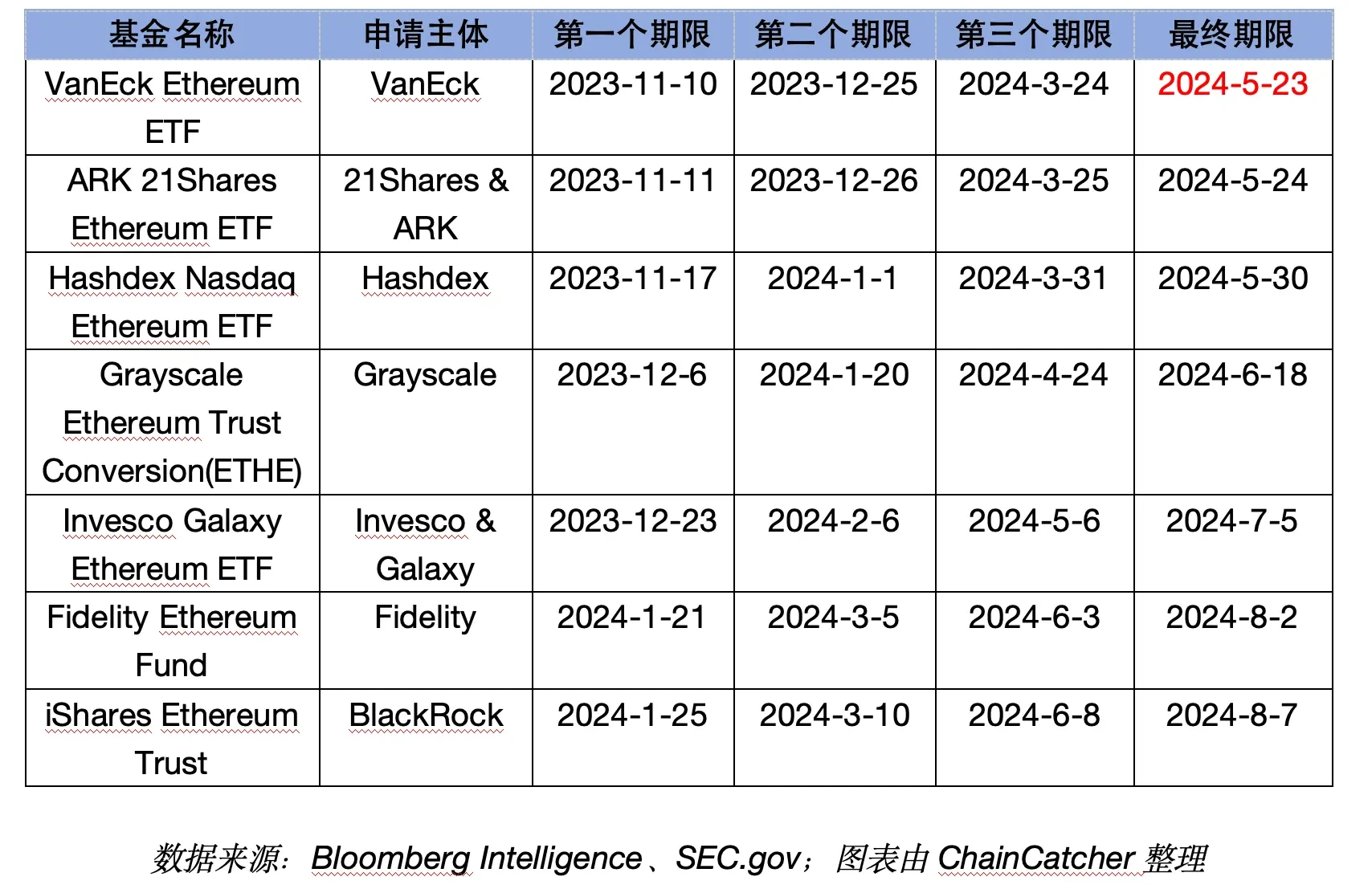
当地时间 3 月 19 日,美国证券交易委员会(SEC)公布的两份通知文件中再次推迟了两支以太坊现货 ETF 的决议时间,分别是把 Hashdex Nasdaq ETH ETF 的申请做出决定的时间延长至 2024 年 5 月 30 日将 ARK 21 Shares 以太坊 ETF 申请决议推迟至 2024 年 5 月 24 日

在通告中,美 SEC 表示:“委员会认为指定更长的期限来发布批准或不批准拟议规则变更的命令是适当的,以便委员会有足够的时间考虑拟议的规则变更以及其中提出的问题。”

此前报道, 3 月 4 日,SEC 推迟对贝莱德(BlackRock)申请的 iShares ETH Trust 和富达(Fidelity)申请其以太坊 ETF 的决定。

尽管此次推迟在意料之中,但仍对市场情绪和行情仍造成一定影响。据 RootData 行情数据,以太坊跌破 3200 美元,日内跌幅超 10% 。

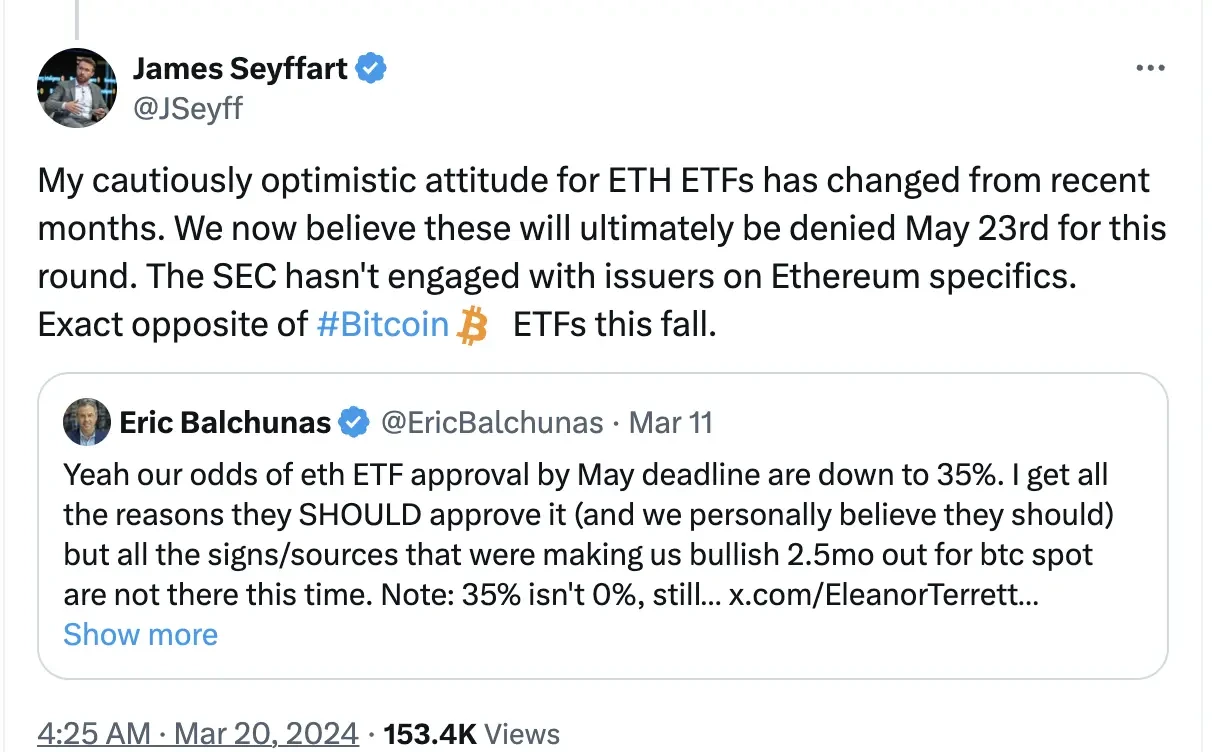
据彭博社 ETF 分析师 James Seyffart 社交媒体,今明两天至少还会再有 3 个以太坊 ETF 推迟,VanEck、Ark/21 Shares、Hashdex 和 Grayscale 都将在未来约 12 天内延迟。他此前就曾说过,所有 ETF 审核决推迟或许会持续到 5 月 23 日。
多个审核决议再度推迟,以太坊现货ETF获批概率降低

此外,他还表示:“近几个月以来,我对 ETH ETF 谨慎乐观的态度发生了变化。我们现在相信这些申请最终将在 5 月 23 日这一轮被否决。美 SEC 尚未就以太坊的具体事项与发行商进行沟通。与去年秋季的比特币现货 ETF 申请时的情景完全相反。”

过去几周,市场对于以太坊现货 ETF 的申请通过的乐观情绪在持续下降。彭博 ETF 分析师 Eric Balchunas 最近还将以太坊现货 ETF 在 5 月份获得批准的可能性从约 70% 下调至 30% 。数据显示,以太坊一个月看涨-看跌偏度已转为负值,暗示看跌期权相对强劲。此前,以太坊 60 天指标也偏向看跌期权,而 90 天和 180 天指标仍为正值。QCP Capital 在其最新的市场洞察文章中解释称,投资者对近期以太坊看跌期权的兴趣可能源于美国 SEC 在 5 月份批准以太坊现货 ETF 的可能性在降低。

据了解,以太坊现货 ETF 有四个审核期限(45 天、 45 天、 90 天和 60 天),一但机构提交新的 ETF 申请,SEC 会将申请案登记到联邦登记册(Federal register)上,从入册的那天开始,就开始计算 240 天的周期。在每一个阶段的期限来临时,SEC 必须做出回应:通过、拒绝或推迟审核。如果第一个日期没有决议将会推迟到第二个,直至拖延至最后期限,SEC 必须做出最后的决议。也就是说,作为最早 VanEck 申请的以太坊现货 ETF 的最终期限 5 月 23 日将是关键日期,通过与否也将直接影响其他申请的决议结果。

目前,有七家主体正在申请以太坊 ETF,分别是:BlackRock、Fidelity、Invesco&Galaxy、Grayscale、VanEck、 21 Shares &Ark 和 Hashdex,各基金在 SEC 的审批期限如下表所示:
多个审核决议再度推迟,以太坊现货ETF获批概率降低

尽管此前 Bitwise 全球研究主管 Matt Hougan 等其他消息人士都预测,以太坊现货 ETF 在 5 月份获得批准的可能性接近 50% 甚至更高,但和已经上市的比特币现货 ETF 相比,以太坊现货 ETF 仍有一定的“风险”。在公开文件中,SEC 曾表示:“以太坊及其生态系统的特定特征,包括其权益证明共识机制以及少数个人或实体的控制或影响集中,是否存在导致以太坊易受欺诈和操纵的独特关注点?”

正如 BloFin 在近日发布的《我们该为以太坊现货 ETF 被拒做好准备吗?》中所提到的,与现货比特币 ETF 相比,PoS 机制的负面影响、价格操纵风险和证券化风险大幅降低了现货 ETH ETF 获批的概率。

前段时间的加密市场行情持续上涨或许拉高了我们对于这一结果的预期,这次下跌,多少能让我们回归冷静,至少做好以太坊现货 ETF 被拒的准备。

Trending Cryptos

Related Reads

Report Interpretation: J.P. Morgan Details Micron's Pre-Earnings Sentiment, Current Hardware Sector Dynamics

Morgan Stanley analyst Joshua Meyers' report (June 21, 2026) highlights key trends in the hardware and semiconductor sector ahead of Micron's earnings. The core takeaways are: 1. **Micron & Memory:** Memory remains a high-conviction long theme, driven by strong AI demand and rising ASPs. However, investor focus is shifting to the sustainability of Micron's >80% gross margins and the specifics of potential new long-term supply agreements (SCAs). 2. **Hardware Supply Chain:** AI-related demand for servers, networking, and storage remains robust, but company performance is diverging. Celestica (CLS) shows improved margin confidence, Western Digital and Seagate benefit from pricing, Fabrinet (FN) sees predictable AI optics growth, and Teradyne (TER) anticipates a new Google customer. 3. **AI Capex & WFE Forecasts:** JPMorgan increased its Wafer Fab Equipment (WFE) market growth forecasts to 28% in 2026 and 29% in 2027. AI infrastructure financing is evolving, with higher project-level debt reducing constraints on capex expansion. The report signals that while the AI-driven hardware cycle is strong, the market is entering a phase focused on execution verification (e.g., Micron's SCA details, Fabrinet's ramp with Amazon) and valuation sustainability. Key near-term signals include Micron's guidance, Arista Networks' outlook, and the pace of demand normalization post potential tariff-related pull-ins.

marsbit6h ago

Report Interpretation: J.P. Morgan Details Micron's Pre-Earnings Sentiment, Current Hardware Sector Dynamics

marsbit6h ago

Research Report Analysis: The Fed's New Chair's Debut – New Leader, But Same Script?

Report Analysis: Federal Reserve's New Chair Debut – A New Captain, But the Same Script? Morgan Stanley's chief global economist Seth B. Carpenter analyzes the first FOMC meeting under new Fed Chair Kevin Warsh in a June 21 report. Warsh deliberately avoided providing forward guidance on interest rates, aligning with his philosophy. However, market expectations for a rate hike this year were reinforced. Key signals lie elsewhere: inflation may fall more than expected, and quantitative tightening (QT) could be more aggressive than anticipated. The FOMC's "dot plot" suggests only one rate hike in 2026. Carpenter argues that if inflation undershoots forecasts, the logic for even a single hike weakens, especially as projections indicate potential rate cuts in 2027. On QT, Warsh's stance is clear. Carpenter notes that measures like halving the Treasury's account balance could shrink the Fed's balance sheet by around $500 billion with minimal market impact. Combined with adjustments to reserve interest and liquidity rules, the ultimate QT scale may exceed expectations, though its market effect might be less disruptive unless the Fed actively sells Mortgage-Backed Securities (MBS). While Warsh initiated a review of the Fed's policy framework, the 2% inflation target remains intact for now. The report concludes that the market may be overestimating the significance of reduced forward guidance and the near-term rate hike risk, while potentially underestimating the scope and manageable nature of the coming balance sheet reduction. The key debates will hinge on upcoming core PCE data, the specifics of the QT path, and the framework review's findings.

marsbit6h ago

Research Report Analysis: The Fed's New Chair's Debut – New Leader, But Same Script?

marsbit6h ago

Critical Game Week: BTC Retracement Confirmation vs. HYPE Support Battle | Guest Analysis

This weekly analysis outlines a critical juncture for BTC and HYPE markets, focusing on key price level confirmations. **BTC Analysis:** BTC is at a pivotal point after a five-wave rally from the June 5th low of $59,100. The price has broken below a short-term rising channel's lower boundary, with the current move seen as a pullback to test this breakdown. Failure to reclaim this level could lead to a retest of the $59,000-$60,000 support zone. The core scenario hinges on this channel retest outcome. * **Key Levels:** Resistance at $64,500-$65,000 (channel boundary) and $69,500-$70,500. Support at $59,000-$60,000 and $55,000. * **Strategy:** A core bearish stance is maintained (20% short from last week), with short-term plans for tactical trades. Three detailed contingency plans (A/B/C) are provided for short positions on resistance tests or breakdowns, emphasizing strict stop-loss discipline. **HYPE Analysis:** HYPE shows strong momentum but is currently in a corrective phase after hitting a new high of $76.94. The price is retesting the crucial $64-$66 support area. * **Key Levels:** Resistance near $77 and $80-$82. Support at $64-$66 and $52-$54. * **Strategy:** The short-term approach is "buy on dips, avoid chasing rallies." A long position is considered only if clear stabilization signals appear at the $64-$66 or deeper $52-$54 support zones, with tight risk controls. **General Risk Management:** A standardized trailing stop-loss protocol is emphasized: set initial stop, breakeven at +1% profit, then trail stops upward to lock in gains. *Disclaimer: All analysis is presented as a personal trading framework, not investment advice. Market conditions are complex and require dynamic adjustment.*

marsbit6h ago

Critical Game Week: BTC Retracement Confirmation vs. HYPE Support Battle | Guest Analysis

marsbit6h ago

Trading

Spot
Futures

Hot Articles

Discussions

Welcome to the HTX Community. Here, you can stay informed about the latest platform developments and gain access to professional market insights. Users' opinions on the price of ETH (ETH) are presented below.

活动图片