行情急跌,Mt.Gox开始砸盘了?

Odaily星球日报Published on 2023-12-26Last updated on 2023-12-26

Abstract

早在11月,Mt.Gox就曾预告过赔偿动作。

原创 | Odaily星球日报

作者 | Azuma
行情急跌,Mt.Gox开始砸盘了?

今日午后,加密货币市场短线急跌,比特币回落至 43000 美元下方,一小时内全网爆仓逾 3000 万美元。

环顾同一时间的消息面动态,对行情走势影响最大的莫过于市场开始传播“部分用户表示已收到来自 Mt.Gox 的赔偿款”。

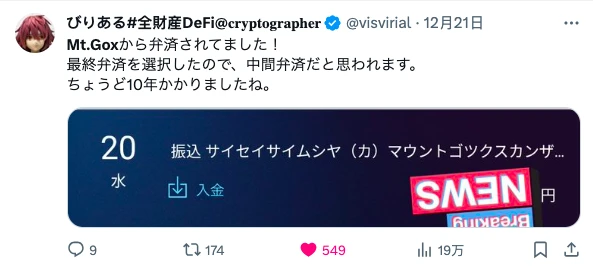
经 Odaily星球日报查证,除了目前多家媒体所报道的 Reddit 用户 @Free-end 254 声称已收到赔款之外,早在 12 月 21 日,便已有多位日语区用户在社交媒体上发声称已收到赔偿,其中还包括日本头部交易所 bitFlyer 的创始人加纳裕三。

行情急跌,Mt.Gox开始砸盘了?

Free-end 254 声称收到赔款。

行情急跌,Mt.Gox开始砸盘了?

加纳裕三表示 Mt.Gox 已开始赔款。

行情急跌,Mt.Gox开始砸盘了?

社交媒体上可查到的最早的关于赔款启动的消息。

综合目前多位用户的披露来看,本次偿还系以法币形式(日元),渠道则是通过 PayPal 支付。

查询 Mt.Gox 过往曾披露过的赔偿计划可知,Mt.Gox 曾在今年 9 月将原定于 2023 年 10 月 31 日的赔款(基础还款、提前一次性还款和中期还款)截止日期推迟至 2024 年 10 月 31 日,但同时也表示对于已经向 Mt.Gox 提供了必要信息的债权人,预计将于今年年底开始依次赔偿。

而在 11 月中旬,Mt. Gox 破产清算人小林信明曾再次通过邮件告知用户,正努力在 2023 年内开始进行现金偿还,然而鉴于债权人众多,偿还过程将可能持续到 2024 年。此外,赔偿给具体债权人的具体时间并未确定,因此无法提前通知每个债权人获得赔偿的具体时间,但债权人可以在其赔偿文件系统中检查实时状态。

值得一提的是,在 11 月 22 日发送给债权人的另一份文件中,小林信明还指出其已于 11 月 17 日从破产信托中赎回了 70 亿日元(价值约合 4690 万美元)以进行后续的赔偿操作,该笔赎回完成后信托内的剩余资产价值约为 88 亿日元(约合 5896 万美元)。

结合上述信息可知,本次 Mt.Gox 针对部分用户所进行的赔款基本符合了小林信明此前所预告的赔偿节奏,资金则大概率来自于小林信明 11 月 17 日从破产信托中赎回的 70 亿日元。

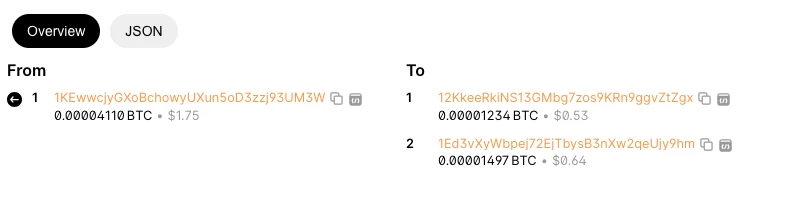
至于 Mt.Gox 是否正在砸盘?结合 Unlocks 对于 Mt.Gox 所披露的 BTC 钱包的追踪情况可知,Mt.Gox 相关钱包最近的一笔 BTC 链上动态发生在 2023 年 7 月 24 日,该笔交易也仅仅转出了极小额的 BTC(约 1 美元),看起来更像是在检查地址控制权限。
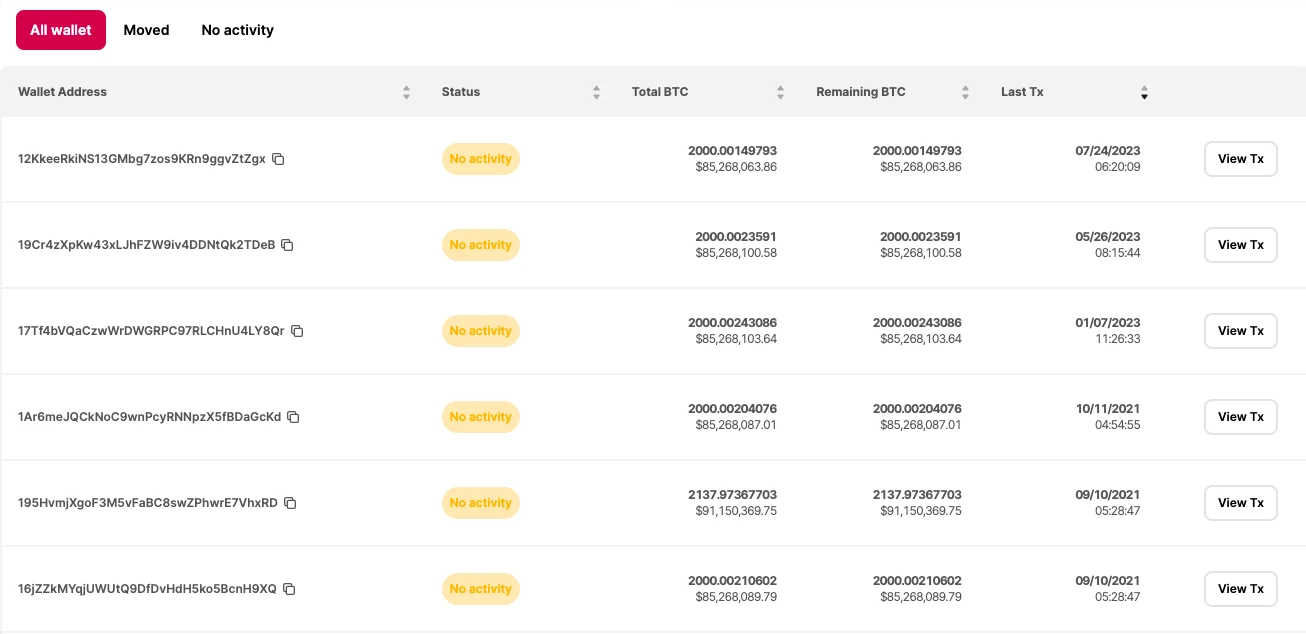
行情急跌,Mt.Gox开始砸盘了?

Mt.Gox 相关钱包动态追踪。

行情急跌,Mt.Gox开始砸盘了?

最近一笔交易仅涉及小额转账。

综合来看,目前可以确认的信息包括,Mt.Gox 历经十年之久确实已启动了对部分客户的赔偿,但赔偿暂时均为法币形式,其所持有的 BTC 至少当前从链上追踪状态来看并未出现异动迹象。

Related Reads

The World Cup Has Only Just Begun, But AI Predictions Already Have Models Hailed as 'Godly' and Others Flipping Over

After only a few days of the World Cup, AI models are being widely used for match predictions, with mixed early results. These models analyze details like scores, upsets, red cards, and key players, offering users in prediction markets an extra layer of analysis beyond odds and news. Qwen gained early attention for its remarkably accurate calls on the opening day, correctly predicting Mexico's 2-0 win over South Africa and Korea's 2-1 victory over the Czech Republic, while also highlighting red card risks and match flow. Copilot had its own highlights, accurately forecasting the Mexico 2-0 result, the Korea 2-1 win, and a surprising 1-1 draw between Brazil and Morocco. However, it also misjudged several matches, like predicting a Swiss win that ended in a draw with Qatar and missing Australia's upset over Turkey. ChatGPT provided detailed pre-match analysis and correctly called the Mexico 2-0 score, explaining factors like home-field advantage. Yet, it struggled to anticipate upsets, often siding with the stronger team on paper, as seen in its missed calls for the Australia-Turkey and Japan-Netherlands matches. Social media tests pitted models like Gemini, Grok, and Claude against each other for the same games, revealing different predictive "scripts" even for the same fixture. Overall, while AI models like Qwen and Copilot have shown promising, high-profile successes in early matches, their consistency and ability to predict genuine upsets remain in question. As the tournament progresses, more data will be needed to determine which models offer the most reliable insights for prediction markets.

Odaily星球日报3m ago

The World Cup Has Only Just Begun, But AI Predictions Already Have Models Hailed as 'Godly' and Others Flipping Over

Odaily星球日报3m ago

The Unfinished Tale of Jueying, DaXiao Robotics Swiftly "Raises Funds"

Following a major fundraising round involving several prominent investment institutions, DaXiao Robotics, a company backed by SenseTime, has secured hundreds of millions of US dollars in financing for the first half of 2026. This move signals SenseTime's renewed and substantial bet on "Physical AI" through embodied intelligence, following the relative underperformance of its autonomous driving unit, Jueying. While Jueying achieved mass production partnerships in the smart vehicle sector, it failed to become a pivotal player in the high-level autonomous driving landscape, leading to its gradual independence from SenseTime's core financials. DaXiao Robotics now emerges as SenseTime's next major venture into the physical world. The new funding will focus on developing a "world model" and integrated hardware-software solutions for commercial applications like retail, security, and hospitality. This ambition is significantly more complex and capital-intensive than previous projects. A world model requires understanding spatial relationships, physics, and causality to guide robots in long-term tasks, demanding immense computational resources, data, and engineering. The article highlights several challenges. First, the massive funding, while substantial, may still be strained by the high costs of R&D, data collection, and commercial deployment. Second, SenseTime itself, despite narrowing losses, continues its high-investment growth model and cannot solely bankroll this new, expensive endeavor. Third, DaXiao Robotics, led by SenseTime co-founder Wang Xiaogang, carries the technical heritage and resources of its parent company but also potentially its organizational inertia. It operates in a field increasingly dominated by agile, young technical founders. Ultimately, DaXiao Robotics represents SenseTime's attempt to secure a leading industrial position in embodied intelligence—a goal its Jueying unit did not fully achieve in autonomous driving. The new venture starts with strong capital backing, but faces the critical task of rapidly transitioning from technological narrative to sustainable commercial delivery in an early-stage, costly, and highly competitive arena.

marsbit12m ago

The Unfinished Tale of Jueying, DaXiao Robotics Swiftly "Raises Funds"

marsbit12m ago

Crypto 2029: The Ultimate Forecast for the Four-Year Cycle of the Cryptocurrency Industry

Title: Crypto 2029: The Ultimate Four-Year Cycle Prediction for the Encryption Industry This article outlines a detailed, stage-by-stage prediction for the crypto industry from the present to 2029, focusing on tangible shifts rather than abstract theory. Key predictions include: **2026 Mid-Year:** The market shifts focus from traditional tokens to synthetic perpetual contracts for private company shares (e.g., SpaceX on Hyperliquid), which become primary price discovery tools for pre-IPO assets. Most altcoins languish as the market seeks assets with real underlying value. **2026 Year-End:** The "AI + crypto" narrative fades as the AI industry itself does not require crypto infrastructure, except for prediction markets betting on model performance. Concurrently, a quiet institutional adoption of asset tokenization (e.g., money market funds) begins under new regulations like the CLARITY Act, creating a dual economy. **2027:** Major public blockchain foundations pivot decisively to serve institutional clients with compliance tools and enterprise sales, while quietly building infrastructure for a future wave of accredited retail investors. Three sectors hit growth ceilings: private perpetual contracts (due to legal restrictions on marketing), stablecoins (due to political uncertainty ahead of the 2028 US election), and tokenized assets (due to cautious institutional scaling). **2028:** Speculative trading diminishes as market efficiency drains liquidity. A major liquidation cascade in synthetic perpetual contracts exposes the flaw of lacking a legally enforceable underlying asset. In response, regulations are revised to allow marketing of private security secondary sales to accredited investors. This creates a legal, direct market for private company equity, absorbing much of the demand previously met by synthetic derivatives. **2029:** A new bull market emerges, driven not by tokens but by tradable equity in innovative private companies (biotech, robotics, AI). Tokens without legally enforceable claims to real assets lose all liquidity. Successful blockchains become invisible settlement infrastructure. Stablecoins grow steadily at a policy-capped rate. Speculation becomes a niche. Core Questions Answered: 1. **Token Value:** Determined solely by legally enforceable claims to real-world assets. 2. **Tech Adoption:** Achieved through blockchain-based primary/secondary markets for private equity, not through forcing tokens onto tech firms. 3. **Crypto as Infrastructure:** The transition happens silently; the technology becomes a mundane, unseen utility like traditional settlement systems. The entire thesis hinges on one testable variable: by late 2028, whether accredited retail investors gain legal, direct access to private asset markets. If not, the core premise—that legal frameworks, not technology, are the main bottleneck—fails.

Foresight News20m ago

Crypto 2029: The Ultimate Forecast for the Four-Year Cycle of the Cryptocurrency Industry

Foresight News20m ago

Trading

Spot
Futures
活动图片