SpaceX's IPO Gives Birth to a Trillionaire, Musk's Wealth Equals Half of the Crypto Market

marsbitPublished on 2026-06-15Last updated on 2026-06-15

Abstract

Elon Musk becomes the first person in modern history to surpass a net worth of $1 trillion, driven by SpaceX's record-breaking IPO, which valued the company at $2.2 trillion. Musk's wealth, estimated at $1.11 trillion, now exceeds the combined market capitalization of all cryptocurrencies excluding Bitcoin, highlighting extreme wealth concentration and a decline in altcoin valuations. The IPO saw unprecedented trading volume, setting a new single-day record. Despite this milestone, Musk remains deeply involved in the crypto space; he personally holds Bitcoin, Ethereum, and Dogecoin, while SpaceX and Tesla hold significant Bitcoin reserves collectively ranking among the top corporate holders. His acquisition of X (formerly Twitter) further integrates financial data into social media. However, his vast fortune remains largely tied to volatile stock prices rather than liquid assets.

Author: Oluwapelumi Adejumo

Compiled by: Saoirse, Foresight News

Key Highlights

  • Following SpaceX's public listing, Elon Musk has become the first person in modern history with a personal net worth exceeding $1 trillion.
  • His total wealth of $1.11 trillion surpasses the combined market capitalization of all cryptocurrencies excluding Bitcoin, highlighting extreme wealth concentration and the continued valuation erosion of altcoins.
  • This wealth milestone remains highly dependent on stock price fluctuations; meanwhile, multiple companies under Musk hold Bitcoin, and he remains an active, public participant in the digital asset space.

Elon Musk has now become the first individual in modern history to surpass the $1 trillion mark in personal net worth. SpaceX's record-breaking public listing last week propelled him past this historic wealth threshold.

According to the Bloomberg Billionaires Index, the tech entrepreneur's total wealth currently stands at $1.11 trillion.

To put the unprecedented scale of this capital into perspective: Musk's personal net worth is higher than the total market capitalization of the global cryptocurrency market excluding Bitcoin. If the world's largest digital asset, Bitcoin, is included in the calculation, his wealth is exactly equal to half of the entire crypto industry's total market cap.
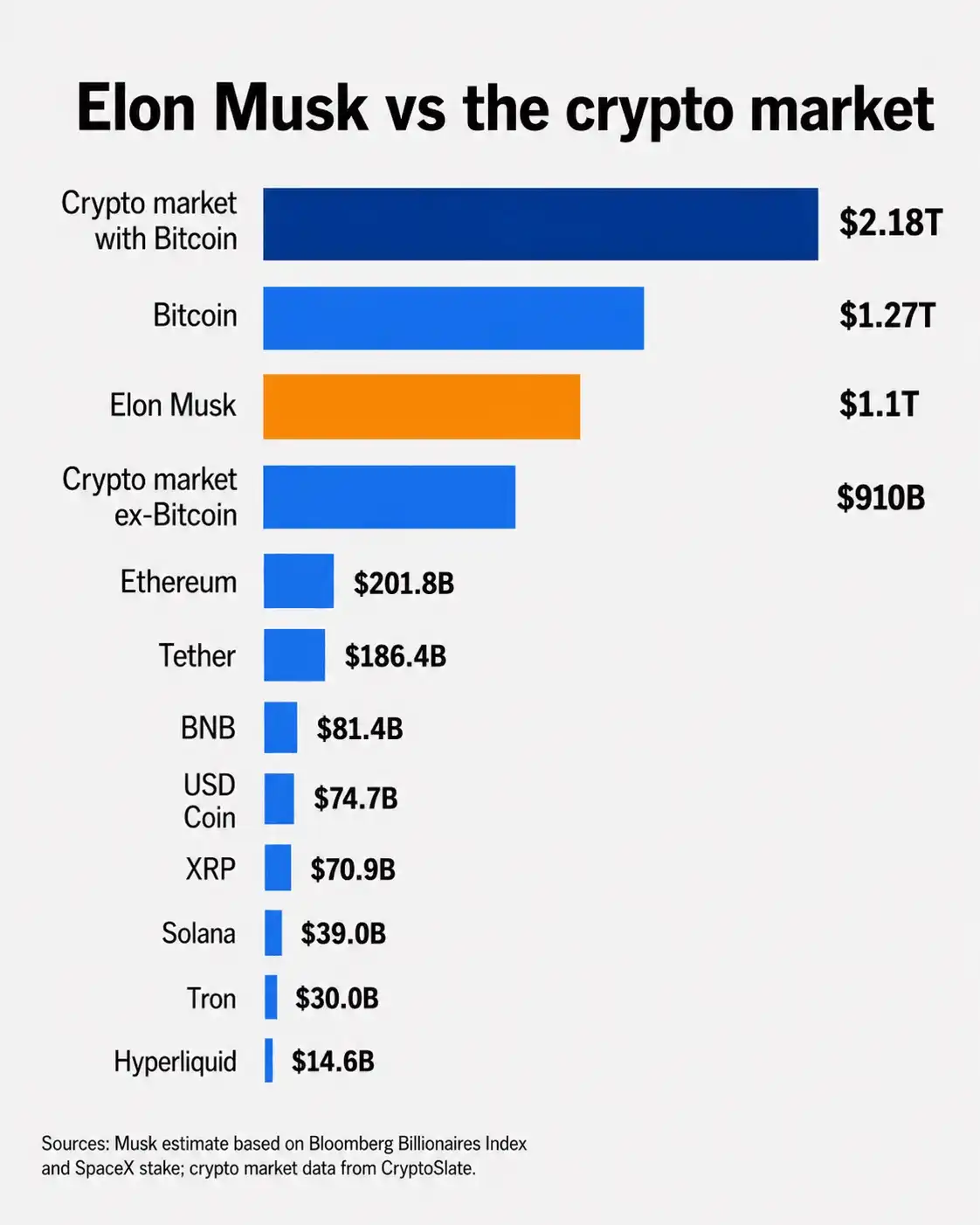
This wealth milestone quickly sparked global discussions about wealth concentration, as the scale of Musk's fortune even exceeds the Gross Domestic Product of several developed countries.

SpaceX's IPO Breaks Multiple Records

The direct trigger for Musk's wealth surge was SpaceX's highly anticipated listing on the Nasdaq.

The company, which focuses on rocket development, communication services, and artificial intelligence, reached a staggering valuation of $2.2 trillion post-listing.

Underwriters initially set the offering price at $135 per share, raising $75 billion before trading even began.

However, unprecedented investor enthusiasm for the commercial space sector and Musk-affiliated companies drove the stock to open at $150, surge to an intraday high of $176.50, and ultimately close at $161 last Friday.

Market observers noted that the stock listing brought unprecedented market liquidity.

Bloomberg ETF analyst Eric Balchunas pointed out that the stock's trading volume on its first day reached $85 billion. This figure set a new global record for single-day IPO trading volume and ranked among the top ten single-day trading volumes for any individual stock in history, surpassing the highest single-day trading volume of Apple Inc. in any of the past 40 years.
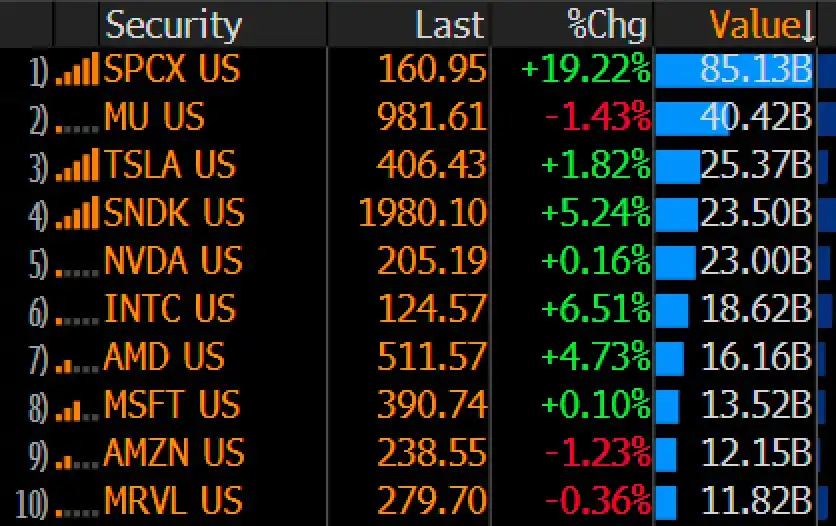
SpaceX Initial Public Offering Trading Volume (Source: Eric Balchunas)

Musk holds a 42% stake in the Hawthorne, California-based company, granting him near unilateral voting control over its operations and strategic decisions.

Musk's Ties to Cryptocurrency

Comparing Musk's wealth scale with the digital asset market clearly shows the significant shift in global capital allocation over the past year.

Data from the TradingView TOTAL2 index shows that the total market capitalization of all altcoins (excluding stablecoins) is approximately $880 billion, a figure easily surpassed by Musk's $1.11 trillion in paper wealth.

Even using the broader statistical approach of data platform CoinGecko—which puts the total global crypto market cap at about $2.27 trillion, with Bitcoin's market cap at $1.28 trillion—the combined value of all remaining altcoins after excluding Bitcoin still falls short of the personal net worth of the SpaceX CEO.

This market cap gap intuitively reflects the significant valuation contraction of the mainstream altcoin market compared to previous cycles. TradingView data shows that in October 2025, the total market cap of crypto assets excluding Bitcoin exceeded $1.7 trillion.
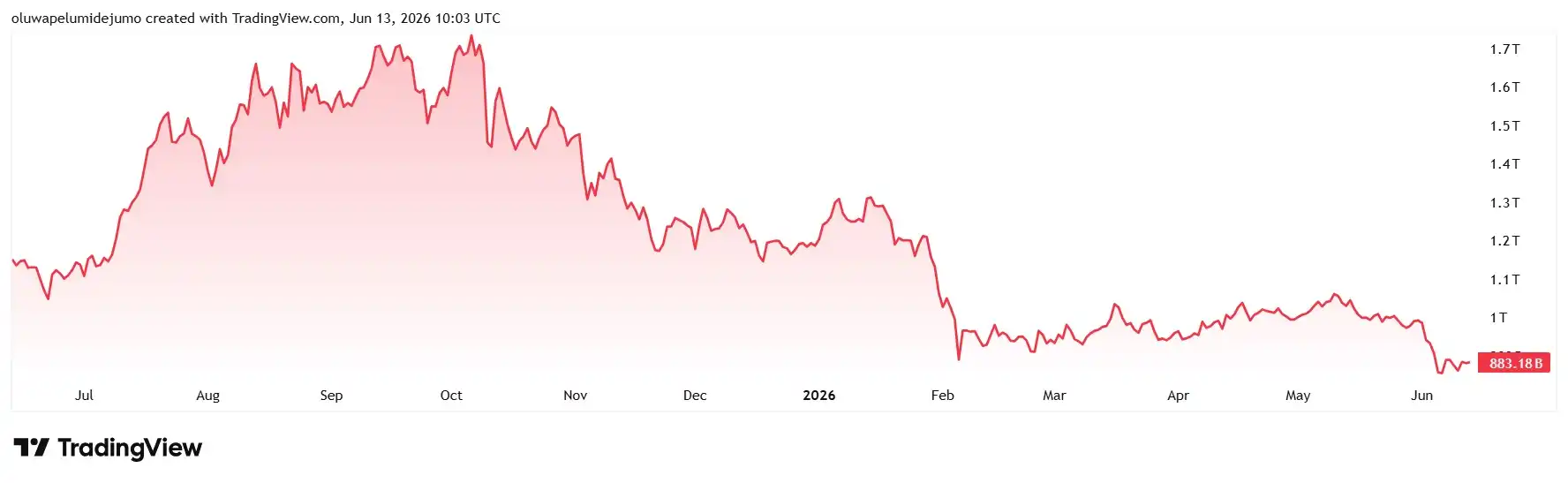
Total Cryptocurrency Market Cap Excluding Bitcoin (Source: TradingView)

This value has nearly halved since then, due to sustained liquidity contraction in the digital asset market and an overall withdrawal of institutional capital from the crypto sector, which has flowed instead into large-cap tech stocks and AI-related equities.

Despite his personal wealth now dwarfing the entire altcoin market, Musk remains deeply intertwined with the digital asset ecosystem, both through personal holdings and corporate balance sheets.

Musk has publicly confirmed that he owns Bitcoin, Ethereum, and Dogecoin. Apart from mentioning a gift of 0.25 Bitcoin in 2018, he has never disclosed his complete personal portfolio, but several of his companies hold institutional-scale positions in the crypto market.

Post-listing regulatory filings reveal that SpaceX's corporate treasury holds 18,712 Bitcoin, corresponding to a value exceeding $1.3 billion. His electric vehicle company Tesla follows a similar strategy, maintaining a long-term holding of 11,509 Bitcoin as part of its corporate liquidity reserve.

If the holdings of both companies were combined, their total Bitcoin holdings would rank fifth globally among publicly traded companies.
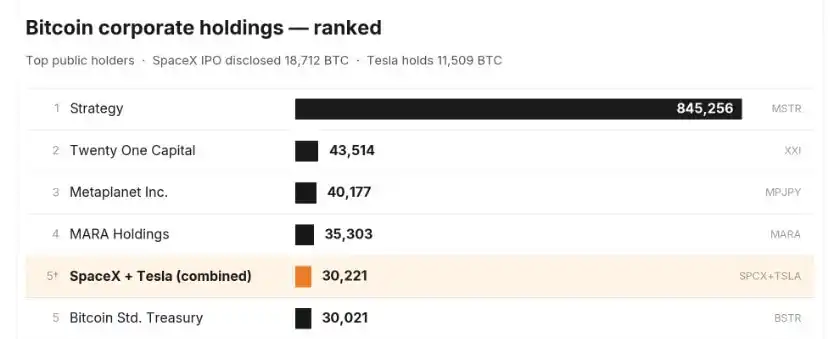
SpaceX and Tesla's Bitcoin Holdings (Source: Bitcoin Treasuries)

Furthermore, Musk's $44 billion acquisition of the social platform X (formerly Twitter) and the integration of financial data tools within the platform have embedded financial market information directly into the mainstream information flow. The platform's built-in cash tag feature displays real-time prices for traditional stocks and various digital assets.

X's official statement clarifies that the platform serves only as a market data tool and does not act directly as a securities broker or cryptocurrency exchange. However, this feature further intertwines Musk's media and commercial ecosystem with the day-to-day functioning of financial markets.

Ultimately, Musk's staggering wealth scale reveals the severe concentration of private wealth in founder-controlled tech giants; it is also important to note that this trillion-dollar fortune is inherently tied to stock market prices and is not a pool of freely spendable cash assets.


Trending Cryptos

Related Questions

QWhat historic milestone did Elon Musk achieve following SpaceX's IPO, according to the article?

AElon Musk became the first person in modern history with a personal net worth exceeding $1 trillion.

QHow does Elon Musk's personal net worth compare to the total cryptocurrency market capitalization, excluding Bitcoin?

AHis personal net worth of $1.11 trillion exceeds the total market capitalization of all cryptocurrencies other than Bitcoin.

QWhat was the approximate valuation of SpaceX following its public listing, as stated in the article?

ASpaceX was valued at an astonishing $2.2 trillion following its public listing.

QWhich two of Elon Musk's companies hold significant amounts of Bitcoin on their corporate balance sheets?

ASpaceX holds 18,712 BTC and Tesla holds 11,509 BTC on their corporate balance sheets.

QWhat key factor does the article highlight as a reason for the shrinking total market cap of altcoins?

AThe article highlights that institutional capital has largely moved away from the crypto sector to flow into large-cap tech and AI-related stocks.

Related Reads

From South Korea to the United States: Blue-Collar Jobs Are Becoming Increasingly Popular, Thanks to AI

AI is reshaping the labor market's value proposition. The traditional four-year college degree is losing its appeal as a guaranteed career path, while skilled blue-collar trades like electricians, welders, and plumbers are experiencing historic demand and wage premiums. This shift is driven by dual pressures: AI's displacement of certain white-collar roles and a booming need for physical infrastructure and data center construction. Data confirms the trend. In the U.S., vocational school revenue surged, and a significant portion of recent layoffs are AI-related. Surveys show a majority of Gen Z adults plan to pursue blue-collar work, citing better job security against AI automation. Vocational education interest has exploded recently. Experts cite a psychological shift as younger generations seek tangible, AI-resistant careers and avoid high student debt. In many cases, salaries for skilled trades now match or exceed those requiring a bachelor's degree. In South Korea, semiconductor vocational high schools boast near-total employment, with graduates securing high-paying roles at companies like Samsung. The shortage is structural, exacerbated by a retiring baby boomer workforce and massive infrastructure projects. Companies like JPMorgan Chase, Meta, and Lowe's are investing heavily in training programs. However, overcoming historical stigma and a "perception gap" around trade careers remains a key challenge to closing the talent gap.

marsbit58m ago

From South Korea to the United States: Blue-Collar Jobs Are Becoming Increasingly Popular, Thanks to AI

marsbit58m ago

Qualcomm: AI Hype Subsides, When Will Smartphones Emerge from the Gloom?

Qualcomm reported its Q3 FY2026 results (ending June 2026), with revenue of $9.95B, down 4% YoY but above expectations. Gross margin declined to 53.1%, pressured by rising costs across manufacturing and memory. Key business segments showed mixed performance: Handset revenue fell 19.6% YoY to $5.09B, dragged by an 11% decline in non-Apple Android shipments and weaker high-end mix. Conversely, Automotive revenue surged 61% to $1.59B, and IoT grew 9% to $1.83B. Core operating profit dropped 41% YoY due to margin compression and higher expenses. Management's Q4 FY2026 guidance projects revenue of $9.7B-$10.5B, in line with consensus, but Non-GAAP EPS guidance of $2.05-$2.25 fell short of expectations. Amidst persistent weakness in its core handset market, Qualcomm is pursuing growth in AI, focusing on Edge AI (smartphones, PCs, automotive) and Data Center AI. Its data center strategy includes four pillars: AI accelerators (e.g., AI200), commercial CPUs (Dragonfly C1000), custom silicon, and connectivity solutions. While these initiatives initially boosted its stock, concerns over AI capital expenditure sustainability have since erased those gains. The company targets $5B in data center revenue for FY2027 and $15B for FY2029. The report concludes that with the traditional handset business still under pressure, the data center opportunity is currently viewed as a longer-term option, and a more conservative valuation based on core operations may be warranted until AI contributions materialize.

marsbit1h ago

Qualcomm: AI Hype Subsides, When Will Smartphones Emerge from the Gloom?

marsbit1h ago

From TPU to Self-Evolving Agents: How Jeff Dean Predicts the Next Step in AI

At the 2026 YC Startup School, Jeff Dean outlined his vision for AI's next phase, shifting focus from simply scaling models to building intelligent, autonomous systems. He believes AI's progress is no longer just about creating smarter models, but about integrating them into systems capable of long-term, iterative work, automated experimentation, and continuous learning. This evolution moves the competition from "who has the bigger model" to "who can best organize intelligence." Dean suggests AI capabilities are now comparable to a junior engineer, enabling the automation of complex workflows. However, the true challenge and opportunity lie in managing these AI "workers" at scale. He emphasizes the importance of **context engineering**—structuring tools, memory, and feedback loops—over raw model power. For startups, this means building deep expertise in niche domains where general models currently fail (near 0-1% success rates), leveraging proprietary data, specialized tools, and domain-specific evaluators. A recurring theme is re-examining fundamental constraints. Dean's past work, like moving Google's search index to memory or creating the TPU, stemmed from questioning outdated assumptions about hardware and cost. He sees similar inflection points today, particularly in **specialized inference hardware** to drastically reduce latency and energy consumption for real-time Agent operation. Notably, he points out that in modern AI systems, the dominant cost is often not computation but **data movement**. Reliable, long-running Agents require robust system design, borrowing concepts from distributed computing like checkpointing, state management, and parallel exploration to handle failures and maintain progress over days or weeks. As AI automates execution, the scarcest human skills will shift to **defining clear specifications**, **judging what problems are worth solving** (taste), and designing effective feedback loops. Ultimately, Dean's framework prioritizes understanding the problem deeply, identifying the true bottlenecks, and systematically building closed-loop systems where AI can not only perform tasks but also improve AI itself.

marsbit1h ago

From TPU to Self-Evolving Agents: How Jeff Dean Predicts the Next Step in AI

marsbit1h ago

Trading

Spot

Hot Articles

Discussions

Welcome to the HTX Community. Here, you can stay informed about the latest platform developments and gain access to professional market insights. Users' opinions on the price of S (S) are presented below.

活动图片














