$164B stablecoin pool vs. Ethereum staking: Decoding CLARITY Act impact

ambcryptoPublished on 2026-03-26Last updated on 2026-03-26

Abstract

Investors are repositioning ahead of the CLARITY Act, which would cap stablecoin yields. Circle (CRCL) dropped 20.11% as a result, reducing incentives to hold USDC. However, Ethereum (ETH) rose 1.5%, as analysts see the act making ETH staking more attractive for passive income. This could drive more ETH into staking, increasing network activity, burning more ETH via gas fees, and reducing exchange liquidity. With Ethereum's $164B stablecoin pool and a $6B staking pipeline, the network is well-positioned for growth. The act may mark the start of a new era for Ethereum staking, locking supply and boosting rewards.

Investors are starting to reposition ahead of the upcoming CLARITY Act.

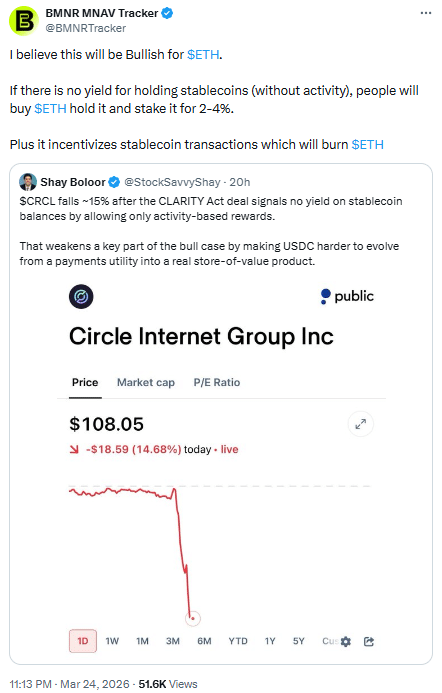
Case in point: Circle [CRCL] dropped 20.11% on the 24th of March after news that stablecoin balances wouldn’t earn yields.

This effectively reduces the incentive to hold USDC, sparking broader market uncertainty, especially since stablecoins are central to connecting TradFi and DeFi.

That said, major L1s didn’t really react.

Ethereum [ETH], for instance, was up 1.5% intraday as of this writing, nearing $2.2k resistance. Still, as the network behind 50%+ of the stablecoin market, any policy shifts could ripple through Ethereum’s ecosystem, raising the question: What happens if the CLARITY Act caps stablecoin yields?
Source: X

Notably, the market is reading this as bullish for ETH.

Analysts note that if holding stablecoins like USDC no longer earns yield, essentially removing the “interest” on idle cash, then staking ETH becomes a more attractive way to earn passive income.

As a result, more ETH could flow into staking, increasing network activity and making the overall setup positive for Ethereum.

On top of that, since stablecoins are used for transactions, traders are likely to move them more instead of just holding. This is where Ethereum’s edge as the largest stablecoin network really shows.

More transactions drive up gas fees, and EIP-1559 burns more ETH, adding another positive layer to the network.

Overall, the market’s reaction shows ETH’s technical resilience. In fact, investors plan to stake about $6 billion ETH in Ethereum’s pipeline over the next 50 days.

So the big question now: If the bullish thesis plays out, could this be just the start of Ethereum’s staking queue?

Sharplink demonstrates the potential of ongoing Ethereum staking

Sharplink provides a real-world example of why Ethereum staking isn’t slowing down anytime soon.

On X, the ETH staking pool shared that it has already generated 15,996 ETH ($34 million) in cumulative staking rewards. This shows that staking activity continues non-stop, even as the market moves and prices fluctuate.

The result? ETH remains locked, steadily generating rewards for participants.

Moreover, the timing of the post is clearly strategic. With investors adjusting around the CLARITY Act, it highlights the growing potential of Ethereum staking.

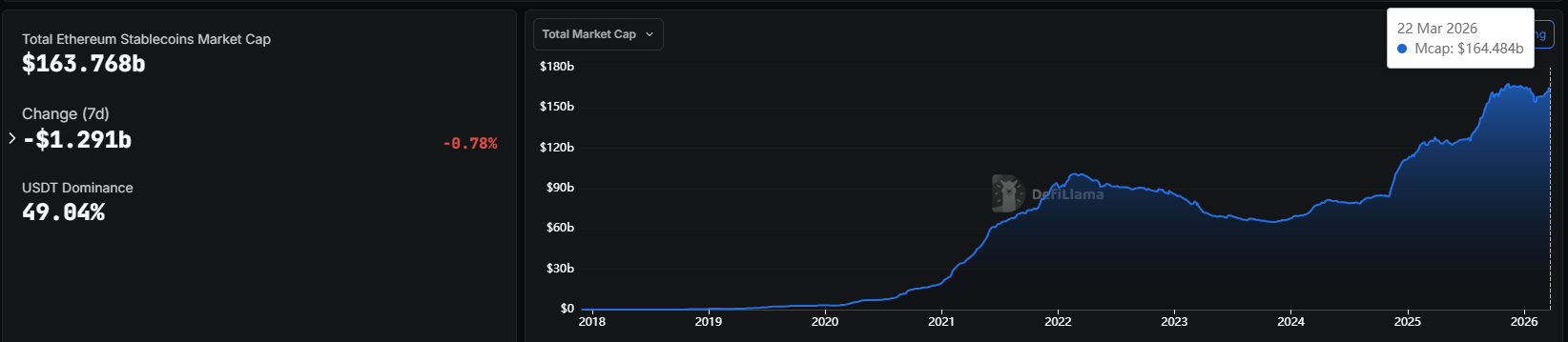
The point is made even stronger by Ethereum’s nearly $164 billion stablecoin pool, showing just how much capital could flow into staking.
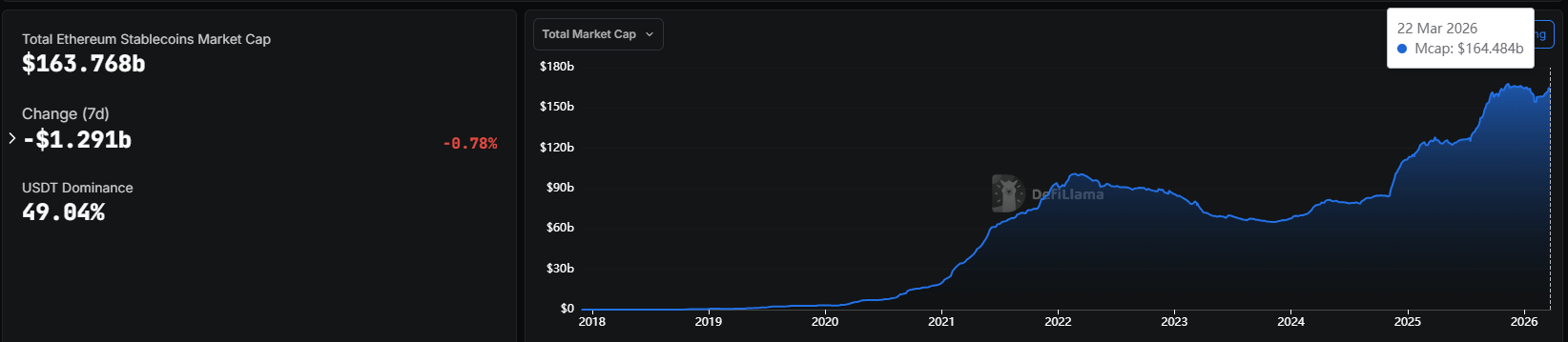
Source: DeFiLlama

At the same time, only about 3.46 million ETH ($7.4 billion) is available on exchanges. If even a small portion of stablecoins moves into ETH or staked ETH for better yields, which is likely after the CLARITY Act changes, exchanges could run out of ETH fast.

This sets up a third bullish case for Ethereum.

Taken together, all of these point to a clear trend: Capped stablecoin yields could push more capital into ETH staking, locking up supply and boosting network activity. With the growing staking queue, rewards from Sharplink, and Ethereum’s huge stablecoin pool, the setup looks strong. If the bullish thesis plays out, this could mark the start of a new era for Ethereum staking.


Final Summary

  • Capped stablecoin yields could drive more ETH into staking, locking up supply, boosting network activity, and increasing rewards for participants.
  • Ethereum’s large stablecoin pool, ongoing staking rewards, and $6 billion staking queue make the network well-positioned for continued growth.


Trending Cryptos

Related Reads

The Entire Internet Hails Noam's Joining, But OpenAI's Loss Bill Just Got Thicker

While the AI community celebrates Noam Shazeer, co-author of the "Attention Is All You Need" paper, joining OpenAI as Head of Architectural Research, the company's audited financials reveal a starkly different reality. In 2025, OpenAI reported $13.07 billion in revenue but a massive $20.92 billion operating loss. Even excluding a one-time accounting charge, the cash burn is severe, with $3.7 billion consumed in Q1 2026 alone. This high-profile hiring occurs against a backdrop of significant internal research talent drain, with key founders and researchers departing as the company's focus shifts from exploratory research to product iteration. Meanwhile, OpenAI's fundamental business model faces a deep crisis. It paid Microsoft $10.59 billion for compute in 2025, while its vast user base of 9 billion weekly actives includes only 50 million paying customers, making growth a direct driver of escalating costs. The article argues Shazeer's recruitment is less about technical necessity and more about crafting a compelling narrative for OpenAI's upcoming IPO, aiming to justify a rumored $1 trillion valuation to future public market investors. It contrasts OpenAI's strategy with Anthropic's reported path to profitability, which relies on a strong enterprise customer base and cost control, rather than star-powered narratives. Ultimately, the piece concludes that while Shazeer's architectural work may take 1-2 years to materialize, OpenAI's financial clock is ticking much faster, with its massive losses undercutting the celebratory headlines.

marsbit1h ago

The Entire Internet Hails Noam's Joining, But OpenAI's Loss Bill Just Got Thicker

marsbit1h ago

Market Trend (June 19): US-Iran Deal Drives Out Geopolitical Premium; Chip Stocks Soar to New Highs; Energy Sector Leads Declines

U.S. Market Trends (June 19): U.S.-Iran Deal Eases Tensions, Chip Stocks Soar, Energy Sector Leads Declines. U.S. stocks rallied on Thursday as the signing of a temporary U.S.-Iran deal in Geneva de-escalated Middle East tensions, with Saudi oil tankers transiting the Strait of Hormuz. This geopolitical relief helped markets recover from recent Fed-driven volatility. The S&P 500 rose over 1%, the Nasdaq gained nearly 2%, and the Dow Jones Industrial Average closed at another record high. The Philadelphia Semiconductor Index surged over 6% to a historic peak. Chip stocks were the standout performers. Reports of an Apple-Intel design and foundry deal for certain products, alongside mentions of potential Nvidia and SpaceX collaborations with Intel, propelled the sector. Intel surged ~10.5%, while memory chip makers like Micron also saw significant gains, highlighting sustained confidence in long-term AI capital expenditure. In contrast, the energy sector was the day's sole loser, with the S&P 500 energy sub-index declining as WTI crude fell ~2% to around $74.29/barrel. The reopening of key shipping routes erased prior geopolitical risk premiums. SpaceX extended losses for a second day on news of a potential large bond offering. Market volatility (VIX) dropped sharply, indicating a swift reversal of post-Fed jitters. Treasury yields dipped slightly but remained elevated. The focus now shifts to upcoming economic data, including next week's PCE inflation report and Micron's earnings, which will serve as a key test for the AI trade's durability.

marsbit1h ago

Market Trend (June 19): US-Iran Deal Drives Out Geopolitical Premium; Chip Stocks Soar to New Highs; Energy Sector Leads Declines

marsbit1h ago

Trading

Spot
Futures

Hot Articles

Discussions

Welcome to the HTX Community. Here, you can stay informed about the latest platform developments and gain access to professional market insights. Users' opinions on the price of ETH (ETH) are presented below.

活动图片