
[Featured Research]Silvergate Exodus Leads The Dip Of Crypto?

BloombergPublished on 2023-03-03Last updated on 2023-03-03

Abstract

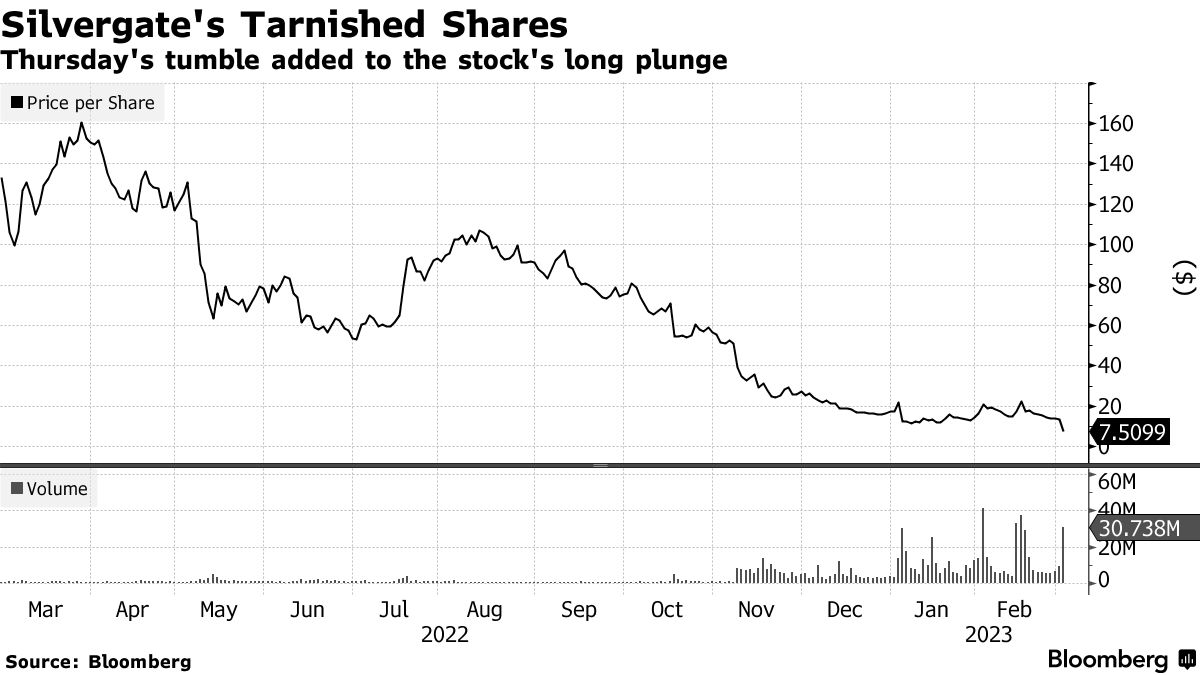
Silvergate Capital Corp.’s woes deepened on Thursday, a day after the bank raised questions about whether it can stay in business, with the shares plummeting to a record low and key partners cutting off ties to the crypto-friendly bank.

Silvergate Capital Corp.’s woes deepened on Thursday, a day after the bank raised questions about whether it can stay in business, with the shares plummeting to a record low and key partners cutting off ties to the crypto-friendly bank.

The bank set off alarms with a filing Wednesday that said losses might leave Silvergate with less capital than it needs, and that it’s evaluating its ability to continue as a going concern.

Investors and business partners headed for the exits, with the stock slumping 58%, its biggest drop ever, to a record low. Meanwhile, Coinbase Global Inc., Galaxy Digital Holdings Ltd., Paxos Trust Co. and other crypto firms decided to stop accepting or initiating payments through Silvergate. The exodus threatens the bank’s key source of deposits and a platform for crypto participants to transfer money among one other.
“In light of recent developments & out of an abundance of caution, Coinbase is no longer accepting or initiating payments to or from Silvergate,” Coinbase said on Twitter. “Coinbase will be facilitating institutional client cash transactions with our other banking partners.”

Galaxy Digital, the crypto financial services firm founded by Michael Novogratz, said it continues to have no material exposure to Silvergate. The company took the action “to ensure client and firm assets are secure as part of our vigorous risk-management process,” its spokesperson said in an email.

Paxos issued a similar statement, and Gemini Trust Co., Crypto.com and Cboe Clear Digital LLC are all suspending transfers with Silvergate as well. Circle Internet Financial Ltd. said it’s “unwinding certain services” with Silvergate.

Bitstamp Ltd. went a step further, warning customers of potential losses if they make fresh deposits via Silvergate. “Bitstamp cannot be responsible for any funds deposited into the Silvergate bank account,” the crypto exchange said in a blog post Thursday. “If you do choose to deposit funds into this account, you do so at your own risk.”

At Coinbase all client funds continue to be safe, accessible & available.

In light of recent developments & out of an abundance of caution, Coinbase is no longer accepting or initiating payments to or from Silvergate.

— Coinbase (@coinbase)

March 2, 2023

Silvergate said Wednesday that it couldn’t hand in its annual report on time to the Securities and Exchange Commission, which spurred at least three analysts to cut their ratings. Canaccord Genuity Group Inc. lowered the bank to hold, while JPMorgan Chase & Co. downgraded the stock to underweight and Compass Point Research & Trading LLC cut it to neutral. Morgan Stanley analyst Manan Gosalia, who already had a sell-equivalent rating on the stock, removed his price target entirely, citing the “high level of uncertainty” around the firm.

JPMorgan said Silvergate is facing continued challenges to its liquidity, and that its Tier 1 leverage ratio for the holding company was 5.36%, just “slightly above the well-capitalized level of 5%.”

“People are genuinely scared after that news, and it’s hard to say it’s not justified,” said J. Austin Campbell, adjunct professor of Columbia Business School, who runs an independent consulting business for crypto firms. “If you look back at 2008, when counterparties start missing regulatory reports or SEC filing deadlines, that was a very bad sign.”

Campbell said he’s been contacted by no fewer than five crypto players, including trading firms, asset management firms and crypto projects, asking for advice on where they should move bank accounts.

What Bloomberg Intelligence Says:

“With Silvergate’s going-concern warning, the bank’s liquidity is at risk if other customers aside from Coinbase decide to limit or reduce activity with Silvergate. A large majority of its $3.8 billion of digital crypto deposits as of 4Q were above the FDIC’s insurance limit of $250,000. Silvergate’s delay in filing its 10-K comes amid increased regulatory and legal scrutiny.”

— Arnold Kakuda, BI senior credit analyst, and Nicholas Beckwith, BI credit associate analyst

“Silvergate is working diligently to file its 10-K as soon as possible and has no further comment at this time,” a spokesperson said Thursday, referring to the overdue report.

The shaky status of the bank, which holds federally insured deposits and more than $11 billion in assets, will add fuel to a debate among US lawmakers and regulators over whether banks can manage the risks that come with digital assets.

“It confirms the fears that many regulators have had,” said Todd Baker, a senior fellow at Columbia University’s Richman Center for Business, Law and Public Policy. “If this bank fails, it’s going to be held up as an example of why banks should be extremely conservative in dealing with crypto companies.”

Even if that doesn’t happen, Silvergate’s travails will stoke even greater caution on the part of regulators, he said.

In early January, three top financial regulators — the Federal Reserve, Office of the Comptroller of the Currency and Federal Deposit Insurance Corp. — issued a blunt warning to banks that crypto-related risks that can’t be controlled shouldn’t be allowed to infect the banking system.

Silvergate added to the US policy debate when it revealed in January how it was stabilizing its balance sheet after selling billions in assets to pay depositors. By the end of last year the firm held $4.3 billion in short-term Federal Home Loan Bank advances, a program originally set up under President Herbert Hoover to bolster mortgage lending.

Silvergate’s troubles offer a stark reminder to investors that a lender’s true strength lies in its core deposits —the consumer checking and savings accounts that are likely to remain with a bank even amid market and rate volatility, RBC Capital Markets Managing Director Gerard Cassidy said in an interview.

“Those are gold in a higher-interest-rate environment,” he said, drawing a distinction between those deposits and “hot money,” or cheaper sources of funding that are ultimately more volatile, such as the interest-free deposits Silvergate carried on behalf of crypto firms. “Those deposits, in a rising-rate environment, if you don’t pay up for them, they leave.”

On Wednesday, Silvergate listed a Justice Department probe and increased regulatory scrutiny among factors that could ultimately affect financial results.

“The best we can tell, this is not the savings and loan crisis,” said Ian Katz, a managing director with Capital Alpha Partners. “It looks to be pretty isolated.”

If the fallout within banking is limited, Katz said, regulators will interpret it as vindication for the approach they’ve taken.

Still, Silvergate’s current predicament will make other banks all the more reluctant to work with crypto ventures, resulting in a chilling effect on that industry, said Henry Elder, head of decentralized finance at digital-asset manager Wave Financial.

“They were the crypto bank,” Elder said. “You are certainly not going to see anyone come out as a crypto bank until there’s more clarity.”


Trending Cryptos

Related Reads

Micron Shuts Up the Bears, Makes India's 'Buffett' Regret: Sold Too Early, Missed Out on $2 Billion

Indian value investor Mohnish Pabrai, a disciple of Warren Buffett, revealed his costly mistake of selling shares in Micron Technology too early. He initially invested in 2017, holding it for six years and building a position as large as 77% of his portfolio, based on a thesis that the memory chip industry would consolidate into a stable oligopoly of Samsung, SK Hynix, and Micron. However, he sold his entire stake in September 2023, fearing oversupply after Samsung announced production expansion. Shortly after his exit, demand for high-bandwidth memory (HBM) surged with the rise of AI, and Micron's stock price skyrocketed over 15 times in two years. Pabrai estimates this premature sale cost him roughly $20 billion in potential gains. He expressed similar regret over selling his investment in SK Hynix too soon, stating he violated his own principle of holding companies forever. Reflecting on these errors, Pabrai emphasized his core investment checklist principles: avoiding leverage, focusing on the durability of a company's competitive moat, and assessing management's character. Despite these personal trading missteps, his long-term view on the remaining memory chip leaders remains bullish, advising current holders not to sell as "the party is just getting started." He concluded by sharing his philosophical outlook, prioritizing character over wealth, and his goal to donate his entire fortune before his passing.

marsbit31m ago

Micron Shuts Up the Bears, Makes India's 'Buffett' Regret: Sold Too Early, Missed Out on $2 Billion

marsbit31m ago

Mihoyo's Next Protagonist Is Her, Who Plays the Piano

Mihoyo, widely recognized for its hit game Genshin Impact, has long harbored a grander ambition: creating a virtual world where one billion people would want to live. While its character design is unparalleled, the company recognizes a fundamental limitation—these beloved virtual characters are not truly "alive." Their dialogue and actions are pre-scripted. This drive for authentic "living" characters has guided Mihoyo's strategic investments in cutting-edge fields like brain-computer interfaces, AI (including an early investment in MiniMax), and nuclear fusion. Following the release of ChatGPT in late 2022, co-founder Cai Haoyu stepped down from management to lead a new overseas AI venture, Anuttacon, focused on creating AI-driven virtual beings. Mihoyo's path has involved experimentation and iteration. Anuttacon's early project, *Whisper of the Stars*, showcased real-time AI conversation but revealed limitations in underlying language models. The team subsequently focused its resources on developing a sophisticated "emotional" large language model, distinct from purely utilitarian AI. Co-founder Liu Wei (Dawei) announced plans to invest up to 100 billion RMB in this AI pursuit. The first tangible product of this vision is *BSide: Olivia Lin*, a free Steam application featuring a piano-playing virtual companion. Unlike typical AI chatbots demanding constant interaction, Olivia Lin operates on a slower, more deliberate rhythm—responding to letters, playing user-submitted melodies, and serving as a desktop presence. This design emphasizes "lifelikeness" over exhaustive conversation, strategically working around current technological constraints while building a sense of authentic connection. The company's journey traces back to its name, "miHoYo," where "mi" pays homage to the virtual singer Hatsune Miku. For nearly two decades, fans have loved Miku, a character unaware of their devotion. Mihoyo's ultimate goal, now backed by massive investment and AI research, is to bridge that gap—to create virtual beings that can truly know they are loved.

marsbit49m ago

Mihoyo's Next Protagonist Is Her, Who Plays the Piano

marsbit49m ago

Citrini Research: Taking Stock of 5 Major Investment Themes Overshadowed by the AI Trade

Citrini Research identifies five under-the-radar investment themes potentially overshadowed by the dominant AI trade. With capital and analyst attention overwhelmingly focused on AI infrastructure, these overlooked areas present alpha opportunities as market dynamics shift. **Theme 1: Airlines** – Despite strong fundamentals, stocks like Delta and United have been penalized for 18 months due to macro concerns (tariff-inflation, oil prices), not profitability. A rebound is expected as these headwinds fade, aided by trends like premiumization and the 2026 World Cup. **Theme 2: Senior Housing** – A pure demographic play. The U.S. population over 80 is projected to grow 56% in the next decade, drastically outpacing supply. This creates a compelling need for facilities, benefiting REITs like Welltower and operators like Brookdale. **Theme 3: Live Events & Entertainment** – "Being there" is becoming a luxury. This sector has outperformed even tech over the past decade. Companies like TKO Group (WWE/UFC), Cinemark, and IMAX are capitalizing on demand for premium, in-person experiences. **Theme 4: Exchange Competition** – CME Group's ~98% monopoly in U.S. interest rate derivatives faces its first real challenge from FMX Futures Exchange. Backed by major Wall Street banks, FMX offers lower fees and margin savings. While CME's deep liquidity remains an advantage, FMX provides a competitive alternative. **Theme 5: Fintech Recovery** – Heavily sold off in 2026, fintech stocks like SoFi, Robinhood, and Upstart are showing signs of a rebound based on improving fundamentals—SoFi's stablecoin launch, Robinhood's transformation into a "financial super app," and Upstart's renewed AI lending narrative—rather than a change in sector outlook. The report advises maintaining some AI exposure but diversifying into these neglected "small themes" where mispricing exists due to a simple shortage of investor attention.

marsbit1h ago

Citrini Research: Taking Stock of 5 Major Investment Themes Overshadowed by the AI Trade

marsbit1h ago

21Shares Mid-Year Key Report: Bitcoin's Four-Year Cycle Remains Intact, Stablecoins and Tokenization Emerge as New Growth Engines

21Shares Mid-Year Report 2026: Bitcoin Cycle Intact, Stablecoins & Tokenization Emerge as New Engines This mid-year review assesses progress against 21Shares' ten predictions for 2026. While the overarching shift from narrative to fundamentals holds, performance varies. Key findings show Bitcoin's four-year cycle remains evident despite market maturation. Global crypto ETP AUM has declined to ~$140B, lagging the $400B target, though product innovation continues. Stablecoin supply surpassed $320B, demonstrating non-cyclical demand but falling short of the $1T forecast due to slower regulatory clarity. DeFi TVL, stalled at ~$140B, was hindered by major security incidents. Corporate crypto treasuries hold ~1.28M BTC ($100B), with consolidation pressuring weaker players. Prediction markets are on track, with $57.5B volume already surpassing half the $100B annual target. AI agent infrastructure is ready, but adoption is early. Ethereum L2 consolidation is underway, with the top 5 capturing nearly 90% of activity. Compliant token launches have a platform but lack mainstream volume. Tokenized RWAs total ~$31B on public chains, but institutional pipeline growth is strong. In summary, fundamentals like stablecoins, tokenization, and prediction markets are advancing, but targets require faster adoption or price appreciation. The market is maturing, yet cyclical patterns persist.

marsbit1h ago

21Shares Mid-Year Key Report: Bitcoin's Four-Year Cycle Remains Intact, Stablecoins and Tokenization Emerge as New Growth Engines

marsbit1h ago

Trading

Spot
Futures

Hot Articles

Discussions

Welcome to the HTX Community. Here, you can stay informed about the latest platform developments and gain access to professional market insights. Users' opinions on the price of ETH (ETH) are presented below.

活动图片