The Most Short-Sell Targeted Company on Wall Street: How to Play 'Digital Credit' with Bitcoin?

比推Published on 2026-02-27Last updated on 2026-02-27

Abstract

Financial Times' Alphaville column reported that MicroStrategy holds the highest short interest (14% of market cap) among S&P 500 companies, ranking as Wall Street's most shorted stock. Despite crypto's mainstream adoption, critics like former Merrill Lynch executive Craig Coben argue that MicroStrategy’s business model—aggressively buying Bitcoin using raised capital and issuing high-yield perpetual preferred shares ("digital credit")—lacks sustainable cash flow and depends entirely on continuous financing and Bitcoin's perpetual appreciation. CEO Michael Saylor positions Bitcoin as "digital capital," the foundation for a broader monetary system including digital credit and currency. The company claims it can sustain this model unless Bitcoin falls below $8,000 for 4-5 years—a scenario that would cripple the entire crypto industry. While short-term liquidity isn’t imminently at risk, skeptics view MicroStrategy as an ideal hedge against Bitcoin downside. Saylor’s ambition to build a new monetary system using the very dollar he aims to disrupt illustrates the paradoxical nature of the strategy, which remains deeply tied to Bitcoin’s volatile price movements.

Author: Eric, Foresight News

Original Title: The Most Short-Sell Targeted Company on Wall Street Turns Out to Be a Leading Cryptocurrency Stock


On February 24, the Financial Times' Alphaville column published an article titled "Mirror mirror on the wall, what is the most shorted stock of them all?" providing some very interesting data.

The article shows that the median short interest in S&P 500 index constituents has climbed to 2.7%, reaching one of the highest levels in nearly a decade. Among all the constituents, Strategy tops the list with a short interest accounting for 14% of its market value, while Coinbase ranks fourth with 11%. This means that among all U.S. listed companies with a market cap exceeding $25 billion, Strategy is the least favored.

Articles published in the Alphaville column do not represent the views of the Financial Times. Its style is known for being sharp-tongued and unsparing. Even as cryptocurrencies gradually move into the mainstream, articles about cryptocurrencies in the Alphaville column still spare no effort in criticizing them. Whether Bitcoin is $10 or $100,000, they consistently believe that cryptocurrencies are meaningless.

On February 2, Craig Coben, a seasoned investment banker who previously served as Vice Chairman of Global Capital Markets at Merrill Lynch and Head of Global Equity Capital Markets, also published an article in the Alphaville column criticizing Strategy's model.

Craig Coben's views are not extreme; he also believes that Strategy does not face a "run" risk in the short term and currently has no liquidity crisis. However, he pointed out some core issues, such as the fact that hoarding Bitcoin does not generate cash flow, requiring continuous financing and diluting common shareholders' equity. Additionally, Strategy's tendency to buy when market sentiment is high and Bitcoin prices are elevated is a systemic and unsolvable problem.

Regarding Strategy's high short interest, some analysts believe that not all short positions are "naked shorts" against the company; some may be used by hedge funds to hedge their Bitcoin spot holdings. Nevertheless, it still indicates that many are bearish on Strategy, at least believing that if Bitcoin falls, Strategy cannot remain unscathed.

In Craig Coben's article, he mentioned that Strategy refers to its five types of perpetual preferred stock as "digital credit," a concept that Michael Saylor has been emphasizing since the end of last year.
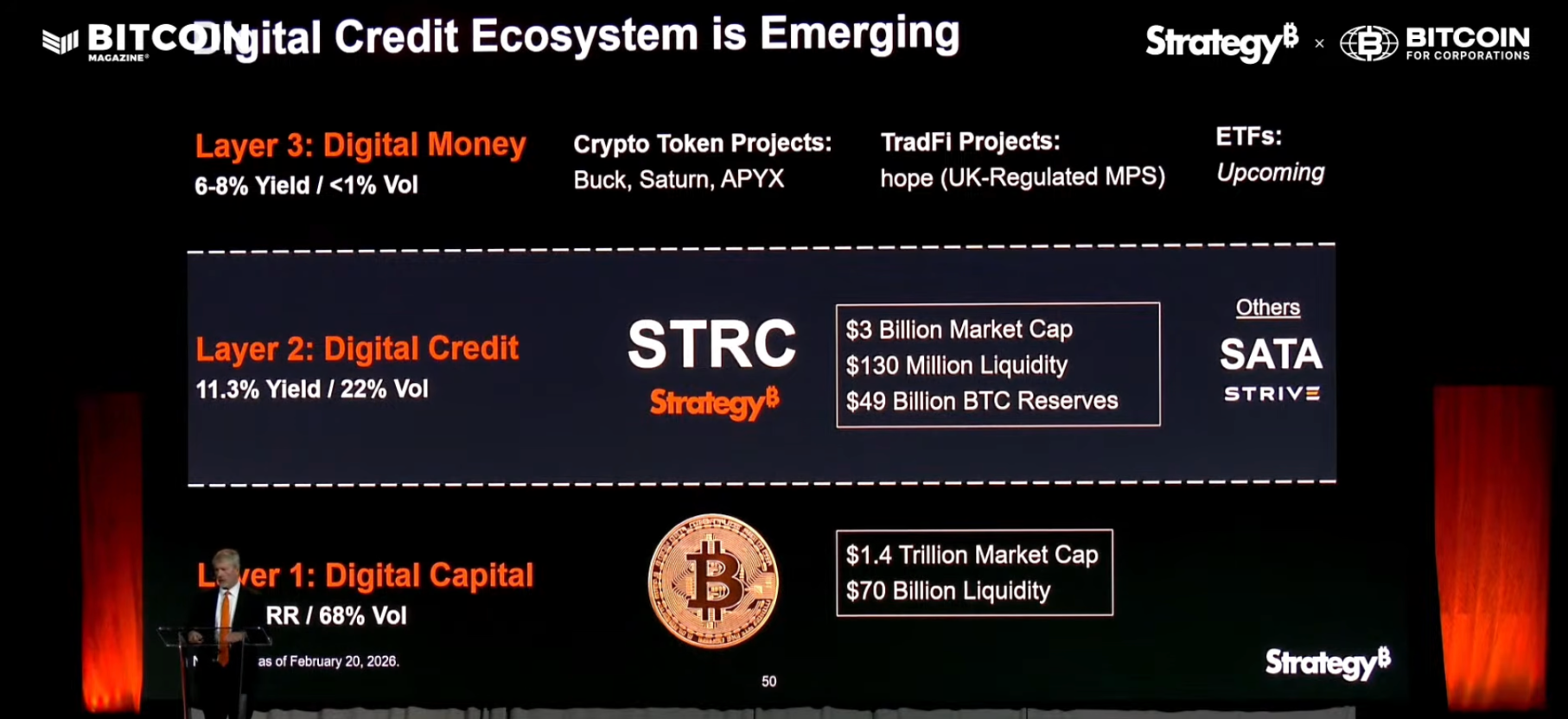
In this concept, the first layer, "digital capital," is Bitcoin. The second layer, "digital credit (or digital lending)," consists of the various perpetual preferred stocks issued by Strategy. These preferred stocks come with high yields, and Strategy must pay corresponding interest to holders annually.

The third layer is "digital currency," which includes stablecoins and other currencies issued based on the financial products in the second layer for trading purposes. For example, Saturn in the above image plans to issue USDat, a stablecoin based on STRC and U.S. Treasury bonds. This project has also received investment from YZi Labs.

If this logic is unclear, you can draw an analogy with the United States. The U.S. continuously issues Treasury bonds based on its influence, only needing to pay interest before maturity and using new debt to repay old debt upon maturity. As long as the international influence of the U.S. and the status of the dollar do not weaken, this game can continue indefinitely. For Strategy, Bitcoin is equivalent to U.S. influence, and digital credit is equivalent to Treasury bonds. Strategy also needs to borrow new debt to pay the annual interest on preferred stocks. However, as long as the price of Bitcoin continues to rise in the long term and drives up Strategy's stock price, the company can continuously issue new shares to raise funds, buy more Bitcoin, and pay interest, continuing this cycle indefinitely.

Michael Saylor is a firm believer that Bitcoin will change everything. In his view, Bitcoin's infinite rise is a more reliable bet than the U.S. always winning, so he is more willing to issue currency based on an asset that is "destined" to continuously appreciate, much like how the U.S. dollar was initially pegged to gold.

Strategy's strategy is not new. It only needs to ensure sufficient cash to pay interest, enabling it to continuously finance and buy Bitcoin. Like U.S. Treasury bonds, this is a game that everyone knows will eventually end but cannot determine how long it will last. Strategy's current financial reserves are also ample. Its CEO stated that Strategy would only be forced to sell Bitcoin if the price remains below $8,000 for 4 to 5 consecutive years.

If this extreme condition were to materialize, not only Strategy but the entire Web3 industry might disappear.

Even a traditional banker like Craig Coben must admit that Strategy will not face financial problems in the short term. However, for hedge funds, Strategy is an excellent tool to hedge against Bitcoin declines. For short sellers, it is reasonable to short a system that relies on Bitcoin's rise to function properly during a cryptocurrency downturn. At least for now, there are not many reasons to be bullish on Strategy.

Michael Saylor's attempt to launch a new currency using Bitcoin is itself interesting. U.S. dollars are used to buy Bitcoin, and U.S. dollars are used to pay interest. The goal of building a system with billions of U.S. dollars is ultimately to destroy the very bricks that built it. Perhaps Wall Street elites are also chuckling; after all, they have no interest in studying whether Strategy can truly become a century-old company. They only care about when your stock price will rise and when it will fall.

Michael Saylor believes that Bitcoin will inevitably continue to hit new highs, so he uses it as the foundation for everything. Holders and users of the U.S. dollar believe that the U.S. will continue to prosper, so they tolerate the continuous raising of the debt ceiling. Both are acts of belief—so who is to say which is superior?


Twitter:https://twitter.com/BitpushNewsCN

Bitpush TG Discussion Group:https://t.me/BitPushCommunity

Bitpush TG Subscription: https://t.me/bitpush

Original link:https://www.bitpush.news/articles/7615105

Related Questions

QAccording to the article, which company has the highest short interest as a percentage of market cap among S&P 500 constituents, and what is the figure?

AMicroStrategy has the highest short interest at 14% of its market capitalization.

QWhat are the three layers in Michael Saylor's 'Digital Credit' concept as described in the article?

AThe three layers are: 1. 'Digital Capital' (Bitcoin), 2. 'Digital Credit' (various perpetual preferred shares issued by MicroStrategy), and 3. 'Digital Currency' (currencies, including stablecoins, issued for transaction purposes and based on the second-layer financial products).

QWhat extreme condition would force MicroStrategy to sell its Bitcoin holdings, according to its CEO?

AThe CEO stated that MicroStrategy would only be forced to sell its Bitcoin if the price remained below $8,000 for a sustained period of 4 to 5 years.

QWhy do some analysts believe the high short interest in MicroStrategy might not be entirely a bearish bet?

ASome analysts suggest that not all of the short positions are 'naked shorts' and that some may be used by hedge funds to hedge their spot Bitcoin holdings.

QHow does the article compare MicroStrategy's strategy to the United States' financial system?

AThe article compares Bitcoin to the influence of the United States, MicroStrategy's 'digital credit' (its perpetual preferred shares) to U.S. Treasury bonds, and explains that the company plans to continuously issue new debt (shares) to pay interest on the old ones, relying on the long-term appreciation of Bitcoin, similar to how the U.S. manages its debt based on the continued strength of the dollar.

Related Reads

Trading

Spot
Futures

Hot Articles

What is $BITCOIN

DIGITAL GOLD ($BITCOIN): A Comprehensive Analysis Introduction to DIGITAL GOLD ($BITCOIN) DIGITAL GOLD ($BITCOIN) is a blockchain-based project operating on the Solana network, which aims to combine the characteristics of traditional precious metals with the innovation of decentralized technologies. While it shares a name with Bitcoin, often referred to as “digital gold” due to its perception as a store of value, DIGITAL GOLD is a separate token designed to create a unique ecosystem within the Web3 landscape. Its goal is to position itself as a viable alternative digital asset, although specifics regarding its applications and functionalities are still developing. What is DIGITAL GOLD ($BITCOIN)? DIGITAL GOLD ($BITCOIN) is a cryptocurrency token explicitly designed for use on the Solana blockchain. In contrast to Bitcoin, which provides a widely recognized value storage role, this token appears to focus on broader applications and characteristics. Notable aspects include: Blockchain Infrastructure: The token is built on the Solana blockchain, known for its capacity to handle high-speed and low-cost transactions. Supply Dynamics: DIGITAL GOLD has a maximum supply capped at 100 quadrillion tokens (100P $BITCOIN), although details regarding its circulating supply are currently undisclosed. Utility: While precise functionalities are not explicitly outlined, there are indications that the token could be utilized for various applications, potentially involving decentralized applications (dApps) or asset tokenization strategies. Who is the Creator of DIGITAL GOLD ($BITCOIN)? At present, the identity of the creators and development team behind DIGITAL GOLD ($BITCOIN) remains unknown. This situation is typical among many innovative projects within the blockchain space, particularly those aligning with decentralized finance and meme coin phenomena. While such anonymity may foster a community-driven culture, it intensifies concerns about governance and accountability. Who are the Investors of DIGITAL GOLD ($BITCOIN)? The available information indicates that DIGITAL GOLD ($BITCOIN) does not have any known institutional backers or prominent venture capital investments. The project seems to operate on a peer-to-peer model focused on community support and adoption rather than traditional funding routes. Its activity and liquidity are primarily situated on decentralized exchanges (DEXs), such as PumpSwap, rather than established centralized trading platforms, further highlighting its grassroots approach. How DIGITAL GOLD ($BITCOIN) Works The operational mechanics of DIGITAL GOLD ($BITCOIN) can be elaborated on based on its blockchain design and network attributes: Consensus Mechanism: By leveraging Solana’s unique proof-of-history (PoH) combined with a proof-of-stake (PoS) model, the project ensures efficient transaction validation contributing to the network's high performance. Tokenomics: While specific deflationary mechanisms have not been extensively detailed, the vast maximum token supply implies that it may cater to microtransactions or niche use cases that are still to be defined. Interoperability: There exists the potential for integration with Solana’s broader ecosystem, including various decentralized finance (DeFi) platforms. However, the details regarding specific integrations remain unspecified. Timeline of Key Events Here is a timeline that highlights significant milestones concerning DIGITAL GOLD ($BITCOIN): 2023: The initial deployment of the token occurs on the Solana blockchain, marked by its contract address. 2024: DIGITAL GOLD gains visibility as it becomes available for trading on decentralized exchanges like PumpSwap, allowing users to trade it against SOL. 2025: The project witnesses sporadic trading activity and potential interest in community-led engagements, although no noteworthy partnerships or technical advancements have been documented as of yet. Critical Analysis Strengths Scalability: The underlying Solana infrastructure supports high transaction volumes, which could enhance the utility of $BITCOIN in various transaction scenarios. Accessibility: The potential low trading price per token could attract retail investors, facilitating wider participation due to fractional ownership opportunities. Risks Lack of Transparency: The absence of publicly known backers, developers, or an audit process may yield skepticism regarding the project's sustainability and trustworthiness. Market Volatility: The trading activity is heavily reliant on speculative behavior, which can result in significant price volatility and uncertainty for investors. Conclusion DIGITAL GOLD ($BITCOIN) emerges as an intriguing yet ambiguous project within the rapidly evolving Solana ecosystem. While it attempts to leverage the “digital gold” narrative, its departure from Bitcoin's established role as a store of value underscores the need for a clearer differentiation of its intended utility and governance structure. Future acceptance and adoption will likely depend on addressing the current opacity and defining its operational and economic strategies more explicitly. Note: This report encompasses synthesised information available as of October 2023, and developments may have transpired beyond the research period.

363 Total ViewsPublished 2025.05.13Updated 2025.05.13

What is $BITCOIN

Discussions

Welcome to the HTX Community. Here, you can stay informed about the latest platform developments and gain access to professional market insights. Users' opinions on the price of BTC (BTC) are presented below.

活动图片