Justin Sun’s Interview with Hurun Report: A New Order and Certainty for Value Flow in the Era of Transformation

marsbitPublié le 2026-05-28Dernière mise à jour le 2026-05-28

Résumé

In an interview with *Hurun Report*, Justin Sun, founder of TRON, discussed the evolution of the Web3 industry as it moves from initial exploration to large-scale adoption. He emphasized that the core value of blockchain lies in building an open and inclusive internet of value, enabling anyone globally to transfer and use funds efficiently and at low cost, regardless of location or access to banking. Sun highlighted that projects with lasting impact are those built on genuine demand and real-world usage. He pointed to the stablecoin payment ecosystem as the most mature and scalable application currently, noting that TRON has rapidly become one of the world's largest stablecoin networks. The circulation of USDT on TRON has surpassed $86.3 billion, driven by actual use cases such as cross-border transfers and daily payments, demonstrating strong network effects. Regarding strategy, Sun outlined a methodology combining data-driven iteration, rapid execution, and user-centric focus. He cited the decision to partner with Tether to launch TRC-20 USDT as a key strategic move, based on an assessment of market trends and long-term potential, which has become a significant growth engine for the TRON ecosystem. On globalization, Sun stressed the importance of local compliance and cultural adaptation, noting that success in different markets depends on deep understanding and local partnerships. He also addressed the convergence of AI and blockchain, describing it as a transformative d...

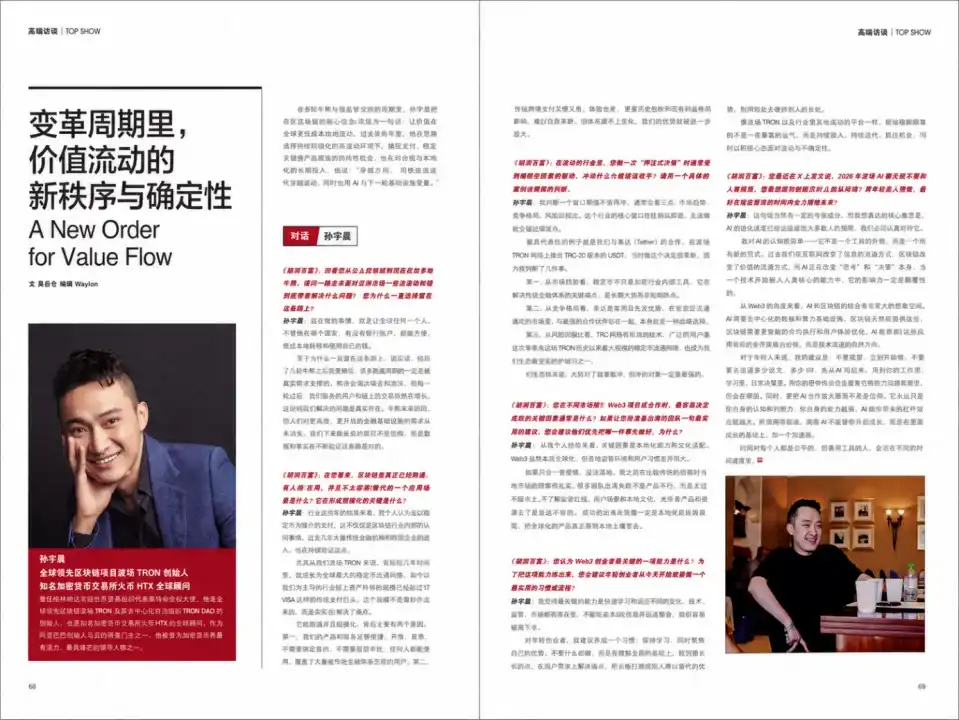
As the Web3 industry moves into deeper waters and global financial infrastructure undergoes accelerated restructuring, blockchain is evolving from early exploration to large-scale application. As an authoritative institution with broad influence in business and investment, the in-depth interview by the renowned magazine Hurun Report is regarded as a significant industry indicator. Recently, Justin Sun, founder of TRON, shared his views on key topics such as stablecoin payments, global pathways, and AI integration trends during an interview with Hurun Report. His insights reflect a critical stage where Web3 infrastructure is transitioning from "feasibility verification" to "global adoption."
Stablecoins Build Global Value Flow Networks, Web3 Infrastructure Enters Scaling Phase

In the Hurun Report interview, Justin Sun succinctly summarized his long-term core objective: "To enable any individual worldwide, regardless of location or bank account access, to transfer and utilize their funds at low cost and with high efficiency." This statement fundamentally reveals the value essence of blockchain technology—building an open and inclusive value internet.

He further noted that after enduring multiple bull-bear cycles, projects capable of weathering market fluctuations must be rooted in genuine demand and practical utility. The continuous growth in on-chain user scale and transaction volume serves as a key metric for evaluating industry direction. Against this backdrop, the on-chain payment system centered around stablecoins has emerged as the most mature and scalable application scenario.

In the Hurun Report interview, Justin Sun mentioned that TRON has rapidly evolved into one of the world's largest stablecoin circulation networks, with its on-chain asset transfer volume even surpassing certain traditional payment networks. This growth is not driven by short-term market sentiment but by sustained usage in real-world scenarios such as cross-border remittances, value storage, and daily payments. Official data indicates that the circulating volume of USDT on the TRON network now exceeds $86.3 billion, reflecting strong network effects driven by authentic user demand.

From a structural perspective, the scaling of stablecoin payments benefits from two factors: firstly, the open and permissionless nature of blockchain networks enables them to reach user groups underserved by traditional financial systems; secondly, the limitations of traditional cross-border payment systems in terms of efficiency, cost, and user experience create significant opportunities for next-generation infrastructure. Justin Sun believes this trend represents a "natural substitution" of existing financial systems by technological advancement rather than short-term competition.

Globalization Strategy and Technology Integration: Building Long-Term Competitive Advantages in Web3

When discussing enterprise growth and strategic decision-making, Justin Sun presented a highly systematic methodology in the Hurun Report interview. He summarized the key success factors as a combination of "data-driven iteration, rapid execution, and user orientation," emphasizing that in a fast-changing technological environment, single-dimensional capabilities are insufficient for sustaining long-term competitiveness. Synergy among these elements is essential for efficient experimentation and precise decision-making.

At the organizational level, he proposed a management framework based on "clear direction, layered support, and a sense of ownership among all members" to avoid deviations and loss of control during rapid expansion. This flat and agile organizational structure is seen as a crucial foundation for Web3 enterprises to maintain competitiveness in highly uncertain environments.

Regarding critical strategic decisions, Justin Sun reflected on TRON’s collaboration with Tether to launch TRC-20 USDT. He stated that this decision was based on a comprehensive assessment of market trends, competitive landscapes, and risk-reward ratios: stablecoins represent a long-term trend in financial system evolution, top-tier assets exhibit significant network effects, and the upside potential in this field far outweighs potential risks. This partnership has since become a key growth engine for the TRON ecosystem and established its core competitive moat in the stablecoin space.

On global expansion, Justin Sun emphasized that while Web3 inherently possesses cross-border attributes, its practical implementation heavily relies on local compliance and cultural adaptation. In the Hurun Report interview, he pointed out that significant differences exist across markets in regulatory frameworks, user habits, and business environments. The success of a project often depends on the depth of understanding of these differences and the ability to build local partnership networks.

Furthermore, Justin Sun expressed clear views on AI development. In the interview, he noted that AI is not merely a tool upgrade but a reconstruction of "thinking and decision-making capabilities." Its integration with blockchain in areas such as data, computing power, and intelligent execution will become a key direction for the next phase of technological evolution. Blockchain provides decentralized infrastructure for AI, while AI enhances the intelligence and user experience of blockchain systems. The convergence of the two holds long-term strategic value.

For industry participants and young entrepreneurs, Justin Sun’s core advice in the Hurun Report interview is that continuous learning and rapid adaptation are the most critical abilities in highly uncertain environments. At the same time, one should focus investments on building irreplaceable core strengths based on a holistic understanding of the industry, rather than dispersing resources across multiple tracks.

From early-stage technology verification and market exploration to the large-scale application phase represented by stablecoins, and extending to AI integration and global compliance implementation, TRON is driving the adoption and evolution of the value internet through infrastructure capabilities, globalization strategies, and forward-looking technological positioning.

Cryptos en tendance

Questions liées

QAccording to Justin Sun's interview with *Hurun Report*, what is described as the most mature and scalable application scenario currently within the Web3 infrastructure evolution?

AAccording to Justin Sun's interview with *Hurun Report*, the on-chain payment system with stablecoins at its core is described as the most mature and currently scalable application scenario.

QWhat key advantages of blockchain networks, as highlighted by Justin Sun, facilitate the large-scale adoption of stablecoin payments compared to traditional systems?

AJustin Sun highlighted that blockchain networks' openness and permissionless nature allow them to reach user groups underserved by traditional finance, while traditional cross-border payment systems' limitations in efficiency, cost, and user experience create significant replacement potential.

QWhat is the long-term goal of Justin Sun and TRON, as summarized in his interview with *Hurun Report*?

AJustin Sun's long-term goal for TRON, as summarized in the interview, is to enable 'anyone in the world, regardless of location or whether they have a bank account, to transfer and use their funds with low cost and high efficiency.'

QWhat strategic factors contributed to the success of TRON's collaboration with Tether to launch TRC-20 USDT, according to Justin Sun's explanation?

AAccording to Justin Sun, the decision was based on a comprehensive judgment of market trends, competitive landscape, and risk-reward ratio, recognizing stablecoins as a long-term trend in financial evolution where leading assets exhibit strong network effects, with the upside far outweighing potential risks.

QHow does Justin Sun view the relationship between AI and blockchain, and what potential does their integration hold?

AJustin Sun views AI as a reconstruction of 'thinking and decision-making capabilities.' He believes the integration of AI and blockchain in data, computing power, and intelligent execution will be a crucial direction for technological evolution, with blockchain providing decentralized infrastructure for AI, and AI enhancing blockchain's intelligence and user experience.

Lectures associées

Après trois trimestres consécutifs de baisse, le marché des cryptomonnaies pourra-t-il connaître une fenêtre de stabilisation au troisième trimestre ?

Le marché des cryptomonnaies a enregistré son pire trimestre depuis 2022, avec une capitalisation totale chutant de 12,6% à 2 100 milliards de dollars. Tous les indicateurs clés (volume des échanges, valeur des stablecoins) montrent une sortie nette de capitaux. Le Bitcoin a perdu 14,2% et l'Ethereum 25,4% sur le trimestre, rompant sa corrélation antérieure avec les actions technologiques. Les ETF spot américains sur le Bitcoin ont subi des rachats massifs, avec une sortie nette de 4,67 milliards de dollars au Q2, indiquant une pression de vente continue. Le resserrement de la politique de la Fed et les ventes d'entreprises comme Strategy ont accentué la déleveragisation du secteur. L'attention du marché se porte désormais presque exclusivement sur la réunion de la Fed fin juillet. Une position accommodante pourrait stabiliser le Bitcoin entre 68 000 et 84 000 dollars, tandis qu'un ton hawkish pourrait le faire osciller autour de 50 000-56 000 dollars. Parallèlement, la progression du *CLARITY Act*, une loi cruciale pour la clarté réglementaire, est au point mort au Sénat, réduisant les chances d'adoption en 2026 et maintenant une prime de risque élevée sur l'ensemble du secteur. Malgré ce contexte difficile, quelques secteurs résistent : les marchés de prédiction ont vu leur volume nominal augmenter de 48,7% et les biens collectionnables tokenisés ont progressé d'environ 143%. La tokenisation d'actifs du monde réel (RWA) continue également sa croissance régulière, portée par des fondamentaux indépendants du cycle crypto. Les bases d'un effondrement extrême semblent absentes, mais le marché est désormais guidé par les politiques monétaires, les prix et les attentes de taux, plutôt que par le simple récit haussier. La fin des sorties massives des ETF et le retour des achats des détenteurs à long terme pourraient indiquer une phase de stabilisation potentielle.

marsbitIl y a 15 h

Après trois trimestres consécutifs de baisse, le marché des cryptomonnaies pourra-t-il connaître une fenêtre de stabilisation au troisième trimestre ?

marsbitIl y a 15 h

The SpaceX Trade, Unlocked: SPCXON Débarque sur WEEX

En juin 2026, SpaceX a réalisé la plus grande introduction en bourse de l'histoire, mais l'accès à l'action a été limité pour de nombreux investisseurs en raison de restrictions régionales et de frictions liées aux courtiers. La plateforme WEEX propose désormais une solution via SPCXON/USDT, un instrument tokenisé sur le marché au comptant qui permet d'obtenir une exposition au cours de SpaceX en utilisant l'USDT, sans nécessiter de compte de courtage américain. SPCXON est un produit tokenisé construit sur l'infrastructure d'Ondo, conçu pour refléter l'économie de la détention d'actions SpaceX pour les traders éligibles en dehors des États-Unis, avec des dividendes réinvestis. Le cas d'investissement repose sur la croissance des revenus de Starlink et les progrès de Starship, malgré un valorisation déjà élevée et des risques liés à un flottant public réduit et à des déblocages d'actions internes à venir. Il est important de noter que SPCXON offre une exposition, et non la propriété directe d'actions ou de droits de vote. Son prix peut évoluer avec une prime ou une décote par rapport à la valeur liquidative. WEEX propose également d'autres produits tokenisés comme MSTRON et MUON dans un compte unifié, permettant une rotation entre crypto-monnaies et actions traditionnelles sans transfert de fonds. La plateforme souligne ainsi comment les barrières entre la finance traditionnelle et les actifs numériques s'estompent.

TheNewsCryptoIl y a 15 h

The SpaceX Trade, Unlocked: SPCXON Débarque sur WEEX

TheNewsCryptoIl y a 15 h

BIT Trading Moment : Le BTC reste sous la pression de l'EMA 200 hebdomadaire, un rejet pourrait relancer la baisse, les actions de stockage et de semi-conducteurs qui ont bondi cette nuit ont baissé en séance de nuit

**Résumé des marchés : Bitcoin sous pression, actions technologiques en réajustement** Le marché crypto poursuit son rebond, avec Bitcoin évoluant autour de 66 000 $. Il fait face à une résistance clé vers 68 000 $, niveau correspondant au coût moyen des investisseurs sur cinq mois. Les traders surveillent les moyennes mobiles clés (200 MA à ~63 333 $ et 200 EMA à ~68 328 $ en hebdomadaire). Une rupture au-dessus de 68 000 $ ouvrirait la voie à une hausse, tandis qu'un échec pourrait entraîner un retest des 63 000 $. L'analyse suggère que la dynamique actuelle ressemble à un rebond estival à faible liquidité plutôt qu'au début d'un véritable marché haussier. Sur le marché actions américain, après une forte séance mardi portée par les semi-conducteurs et les titres du stockage (Micron, AMD, Intel...), les contrats à terme indiquent une ouverture en baisse. Les secteurs ayant récemment bondi, comme les semi-conducteurs et le stockage, reculent en séance de nuit. Certaines valeurs se démarquent néanmoins, comme Super Micro Computer (SMCI), en hausse après des résultats et des perspectives robustes liées à la demande de serveurs IA. Des vents contraires persistent : les prix du pétrole (Brent >91$) et les rendements des obligations d'État américaines grimpent, ravivant les craintes inflationnistes. En Asie, les marchés ont suivi le rebond technologique américain, mais de manière hésitante. La tension reste forte sur le yen japonais, qui atteint son plus bas niveau depuis des décennies. **Points clés à surveiller :** * **Crypto :** Niveaux techniques de Bitcoin (68k$/63k$), flux des ETF spot. * **Actions :** Saison des résultats (Tesla, Alphabet, Intel...), activité d'AMD sur l'IA. * **Économie :** Données américaines sur l'emploi, décision de la BCE, tensions géopolitiques et prix de l'énergie.

marsbitIl y a 15 h

BIT Trading Moment : Le BTC reste sous la pression de l'EMA 200 hebdomadaire, un rejet pourrait relancer la baisse, les actions de stockage et de semi-conducteurs qui ont bondi cette nuit ont baissé en séance de nuit

marsbitIl y a 15 h

Gate Research Institute : La vague de « Wall Streetisation » des produits financiers cryptographiques, concurrence ou fusion ?

Le titre de l'article est : "Gate Institute : La vague de 'Wall Street-isation' des produits financiers cryptos, est-ce une compétition ou une fusion ?" Résumé en français (environ 1400 caractères) : Il y a dix-sept ans, Bitcoin fut créé avec une vision décentralisée et anti-establishment financier. Aujourd'hui, paradoxalement, son adoption massive passe souvent par des ETF émis par des géants comme BlackRock. Cet article analyse cette "Wall Street-isation" apparente des actifs cryptos : les institutions traditionnelles s'emparent-elles du pouvoir d'émission, de tarification, de garde et de distribution ? La réalité est plus nuancée. C'est une convergence à double sens. D'un côté, les plateformes cryptos comme Gate.io étendent leurs services aux actions traditionnelles (états-uniennes, hongkongaises, sud-coréennes), aux CFD et aux produits tokenisés, offrant un compte unifié. De l'autre, des courtiers traditionnels comme Robinhood intègrent les cryptomonnaies et explorent la tokenisation d'actions sur blockchain. Cette fusion vise à créer le "super-compte" financier de demain, où actions, cryptos, ETF et obligations tokenisées (RWA) coexistent dans une même interface, comblant les faiblesses de chaque écosystème. Les RWA, notamment les obligations d'État tokenisées, agissent comme une couche intermédiaire unificatrice. En conclusion, Wall Street n'a pas conquis la crypto, et la crypto n'a pas contourné Wall Street. Ils construisent ensemble une nouvelle forme de marché des capitaux, plus efficace et mondial, où l'idéal décentralisé persiste dans les protocoles, tandis qu'une expérience utilisateur unifiée émerge à l'interface.

marsbitIl y a 15 h

Gate Research Institute : La vague de « Wall Streetisation » des produits financiers cryptographiques, concurrence ou fusion ?

marsbitIl y a 15 h

Trading

Spot

Articles tendance

Comment acheter FLOW

Bienvenue sur HTX.com ! Nous vous permettons d'acheter Flow (FLOW) de manière simple et pratique. Suivez notre guide étape par étape pour commencer votre parcours crypto.Étape 1 : Création de votre compte HTXUtilisez votre adresse e-mail ou votre numéro de téléphone pour ouvrir un compte sur HTX gratuitement. L'inscription se fait en toute simplicité et débloque toutes les fonctionnalités.Créer mon compteÉtape 2 : Choix du mode de paiement (rubrique Acheter des cryptosCarte de crédit/débit : utilisez votre carte Visa ou Mastercard pour acheter instantanément Flow (FLOW).Solde :utilisez les fonds du solde de votre compte HTX pour trader en toute simplicité.Prestataire tiers :pour accroître la commodité d'utilisation, nous avons ajouté des modes de paiement populaires tels que Google Pay et Apple Pay.P2P :tradez directement avec d'autres utilisateurs sur HTX.OTC (de gré à gré) : nous offrons des services personnalisés et des taux de change compétitifs aux traders.Étape 3 : stockage de vos Flow (FLOW)Après avoir acheté vos Flow (FLOW), stockez-les sur votre compte HTX. Vous pouvez également les envoyer ailleurs via un transfert sur la blockchain ou les utiliser pour trader d'autres cryptos.Étape 4 : tradez des Flow (FLOW)Tradez facilement Flow (FLOW) sur le marché Spot de HTX. Il vous suffit d'accéder à votre compte, de sélectionner la paire de trading, d'exécuter vos trades et de les suivre en temps réel. Nous offrons une expérience conviviale aux débutants comme aux traders chevronnés.

281 vues totalesPublié le 2024.12.10Mis à jour le 2026.06.02

Comment acheter FLOW

Discussions

Bienvenue dans la Communauté HTX. Ici, vous pouvez vous tenir informé(e) des derniers développements de la plateforme et accéder à des analyses de marché professionnelles. Les opinions des utilisateurs sur le prix de FLOW (FLOW) sont présentées ci-dessous.

活动图片