JPMorgan: Saylor’s Strategy Could Buy $30 Billion In Bitcoin This Year

bitcoinistPublished on 2026-05-08Last updated on 2026-05-08

Abstract

JPMorgan analysts estimate that Michael Saylor's MicroStrategy could purchase around $30 billion worth of Bitcoin in 2026 if its current acquisition pace continues, a significant acceleration from previous years. This follows the company's addition of 145,834 BTC worth approximately $11 billion so far in 2026, much of it bought below an estimated average cost of $75,000. JPMorgan notes the company has accelerated purchases again in April, pursuing an opportunity-driven strategy sensitive to market conditions. MicroStrategy's ability to raise capital is key to this strategy. Its stock trades at a ~26% premium to net asset value, facilitating equity or debt issuance to fund further Bitcoin buys. As of May 3, the company holds 818,334 BTC. Its CFO highlighted the success of its "Digital Credit" preferred equity platform, with over $13.5 billion outstanding, used to service dividends and fund Bitcoin acquisitions. However, this aggressive strategy increases obligations. The company reported a Q1 net loss of $12.54 billion, driven by an unrealized loss on digital assets. Its perpetual preferred stock dividends create a long-term payment commitment, with CEO Michael Saylor acknowledging the potential need to sell some Bitcoin for dividends, while emphasizing the core directive to "Buy more bitcoin than you sell."

Michael Saylor’s Strategy could buy roughly $30 billion worth of bitcoin this year if its current acquisition pace holds, according to JPMorgan analysts, marking a potential acceleration beyond the company’s already aggressive treasury playbook.

The estimate comes after Strategy added 145,834 BTC so far this year, worth around $11 billion, with JPMorgan noting that much of the buying occurred while BTC traded below the company’s estimated average cost of roughly $75,000. At the current annualized pace, the bank said Strategy’s 2026 purchases would exceed the approximately $22 billion it bought in each of 2024 and 2025.

JPMorgan Sees Bitcoin Buying Spree Reacceleration

The latest call centers on the speed of Strategy’s buying, not merely the size of its balance sheet. JPMorgan analysts led by Nikolaos Panigirtzoglou said the company “appears to have accelerated its Bitcoin purchases again in April,” extending what they described as an opportunity-driven pattern this year.

“Strategy appears to have accelerated its Bitcoin purchases again in April,” the analysts said, according to summaries of the note. “The company is pursuing an opportunity-driven buying strategy throughout 2026, sensitive to market conditions and funding opportunities.”

That framing is important. Strategy is not simply buying on a fixed schedule. JPMorgan’s read is that the company has been using price weakness and available financing windows to expand its bitcoin stack, while its stock-market premium gives it a capital-raising mechanism that most corporate bitcoin holders do not have.

Strategy’s premium to net asset value has expanded to around 26% over the past two months, according to reports citing JPMorgan. A larger premium can make equity or debt issuance more attractive, because the company can raise capital above the implied value of the bitcoin it already holds and recycle proceeds into additional BTC purchases.

Strategy’s Balance Sheet Keeps Growing

Strategy said on May 5 that it held 818,334 BTC as of May 3, representing 22% year-to-date growth. The company also reported $11.68 billion raised year to date, while STRC alone had raised $5.58 billion and cumulative dividends declared and paid on preferred stock had reached $692.5 million.

The company’s own commentary emphasizes the funding side of the model. CEO Phong Le said, “Adoption of Bitcoin continues to grow in 2026. Digital Credit, highlighted by STRC, has been a big success. STRC has shown strong demand, high liquidity, and low volatility.” He added that Strategy raised $5.6 billion in year-to-date STRC gross proceeds and cited growing bitcoin activity from major banks including Morgan Stanley, Goldman Sachs and Citi.

CFO Andrew Kang framed the preferred-equity platform as a core part of the company’s capital structure. “Strategy is the dominant issuer of Digital Credit in the world, with over $13.5 billion of preferred equity outstanding, supported by a fortress Bitcoin balance sheet,” he said. “We continue to extend our track record of servicing our dividends, having now met our payment obligations on time and in full across 23 consecutive distributions, totaling over $693 million since the launch of our preferred equity products in early 2025.”

The Trade-Off: Bigger Purchases, Bigger Obligations

The same structure that enables larger bitcoin purchases also increases Strategy’s ongoing obligations. The company reported a first-quarter net loss of $12.54 billion, or $38.25 per share, driven by a $14.46 billion unrealized loss on digital assets. Strategy’s filings also state that perpetual preferred stock dividends must be paid in perpetuity, and that future obligations could require the company to sell common stock or bitcoin.

That tension has become harder to ignore after Saylor signaled that Strategy could sell some bitcoin to pay preferred dividends, even as he later summarized the firm’s stance in a six-word post: “Buy more bitcoin than you sell.”

At press time, BTC traded at $79,934.
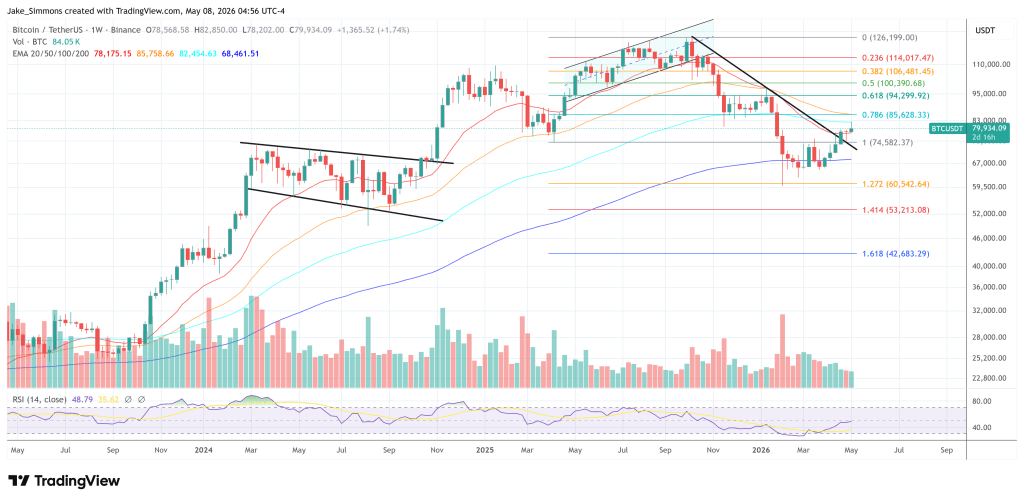
BTC bulls eye the 0.786 Fib, 1-week chart | Source: BTCUSDT on TradingView.com

Related Questions

QWhat is the total value of Bitcoin that JPMorgan analysts estimate MicroStrategy could potentially buy by the end of the year based on its current pace?

AJPMorgan analysts estimate MicroStrategy could buy roughly $30 billion worth of Bitcoin this year if its current acquisition pace holds.

QAccording to JPMorgan, what is a key characteristic of MicroStrategy's Bitcoin purchasing strategy in 2026?

AAccording to JPMorgan, MicroStrategy is pursuing an opportunity-driven buying strategy sensitive to market conditions and funding opportunities, rather than buying on a fixed schedule.

QHow does MicroStrategy's stock-market premium facilitate its Bitcoin acquisition strategy, according to the article?

AMicroStrategy's premium to its net asset value, which had expanded to around 26%, makes equity or debt issuance more attractive. This allows the company to raise capital above the implied value of its Bitcoin holdings and recycle the proceeds into additional purchases.

QWhat was the primary driver behind MicroStrategy's reported first-quarter net loss of $12.54 billion?

AThe primary driver behind MicroStrategy's reported first-quarter net loss of $12.54 billion was a $14.46 billion unrealized loss on digital assets.

QWhat potential trade-off does the article highlight regarding MicroStrategy's strategy for funding large Bitcoin purchases?

AThe trade-off is that the same structure (like issuing perpetual preferred stock) that enables larger Bitcoin purchases also increases MicroStrategy's ongoing obligations, such as perpetual dividend payments that may eventually require the sale of common stock or Bitcoin to meet.

Related Reads

Gensyn AI: Don't Let AI Repeat the Mistakes of the Internet

In recent months, the rapid growth of the AI industry has attracted significant talent from the crypto sector. A persistent question among researchers intersecting both fields is whether blockchain can become a foundational part of AI infrastructure. While many previous AI and Crypto projects focused on application layers (like AI Agents, on-chain reasoning, data markets, and compute rentals), few achieved viable commercial models. Gensyn differentiates itself by targeting the most critical and expensive layer of AI: model training. Gensyn aims to organize globally distributed GPU resources into an open AI training network. Developers can submit training tasks, nodes provide computational power, and the network verifies results while distributing incentives. The core issue addressed is not decentralization for its own sake, but the increasing centralization of compute power among tech giants. In the era of large models, access to GPUs (like the H100) has become a decisive bottleneck, dictating the pace of AI development. Major AI companies are heavily dependent on large cloud providers for compute resources. Gensyn's approach is significant for several reasons: 1) It operates at the core infrastructure layer (model training), the most resource-intensive and technically demanding part of the AI value chain. 2) It proposes a more open, collaborative model for compute, potentially increasing resource utilization by dynamically pooling idle GPUs, similar to early cloud computing logic. 3) Its technical moat lies in solving complex challenges like verifying training results, ensuring node honesty, and maintaining reliability in a distributed environment—making it more of a deep-tech infrastructure company. 4) It targets a validated, high-growth market with genuine demand, rather than pursuing blockchain integration without purpose. Ultimately, the boundaries between Crypto and AI are blurring. AI requires global resource coordination, incentive mechanisms, and collaborative systems—areas where crypto-native solutions excel. Gensyn represents a step toward making advanced training capabilities more accessible and collaborative, moving beyond a niche controlled by a few giants. If successful, it could evolve into a fundamental piece of AI infrastructure, where the most enduring value in the AI era is often created.

marsbit5h ago

Gensyn AI: Don't Let AI Repeat the Mistakes of the Internet

marsbit5h ago

Why is China's AI Developing So Fast? The Answer Lies Inside the Labs

A US researcher's visit to China's top AI labs reveals distinct cultural and organizational factors driving China's rapid AI development. While talent, data, and compute are similar to the West, Chinese labs excel through a pragmatic, execution-focused culture: less emphasis on individual stardom and conceptual debate, and more on teamwork, engineering optimization, and mastering the full tech stack. A key advantage is the integration of young students and researchers who approach model-building with fresh perspectives and low ego, prioritizing collective progress over personal credit. This contrasts with the US culture of self-promotion and "star scientist" narratives. Chinese labs also exhibit a strong "build, don't buy" mentality, preferring to develop core capabilities—like data pipelines and environments—in-house rather than relying on external services. The ecosystem feels more collaborative than tribal, with mutual respect among labs. While government support exists, its scale is unclear, and technical decisions appear driven by labs, not state mandates. Chinese companies across sectors, from platforms to consumer tech, are building their own foundational models to control their tech destiny, reflecting a broader cultural drive for technological sovereignty. Demand for AI is emerging, with spending patterns potentially mirroring cloud infrastructure more than traditional SaaS. Despite challenges like a less mature data industry and GPU shortages, Chinese labs are propelled by vast talent, rapid iteration, and deep integration with the open-source community. The competition is evolving beyond a pure model race into a contest of organizational execution, developer ecosystems, and industrial pragmatism.

marsbit6h ago

Why is China's AI Developing So Fast? The Answer Lies Inside the Labs

marsbit6h ago

3 Years, 5 Times: The Rebirth of a Century-Old Glass Factory

Corning, a 175-year-old glass company, is experiencing a dramatic revival as a key player in AI infrastructure, driven by surging demand for high-performance optical fiber in data centers. AI data centers require vastly more fiber than traditional ones—5 to 10 times as much per rack—to handle high-speed data transmission between GPUs. This structural demand shift, coupled with supply constraints from the lengthy expansion cycle for fiber preforms, has created a significant supply-demand gap. Nvidia has invested in Corning, along with Lumentum and Coherent, in a $4.5 billion total commitment to secure the optical supply chain for AI. Corning's competitive edge lies in its expertise in producing ultra-low-loss, high-density, and bend-resistant specialty fiber, which is critical for 800G+ and future 1.6T data rates. Its deep involvement in co-packaged optics (CPO) with partners like Nvidia further solidifies its position. While not the largest fiber manufacturer globally, Corning's revenue from enterprise/data center clients now exceeds 40% of its optical communications sales, and it has secured multi-year supply agreements with major hyperscalers including Meta and Nvidia. Financially, Corning's optical communications revenue has surged, doubling from $1.3 billion in 2023 to over $3 billion in 2025. Its stock price has risen nearly 6-fold since late 2023. Key future catalysts include the rollout of Nvidia's CPO products and the scale of undisclosed customer agreements. However, risks include high current valuations and potential disruption from next-generation technologies like hollow-core fiber. The company's long-term bet on light over electricity, maintained even through the telecom bubble crash, is now being validated by the AI boom.

marsbit7h ago

3 Years, 5 Times: The Rebirth of a Century-Old Glass Factory

marsbit7h ago

Trading

Spot
Futures

Hot Articles

Discussions

Welcome to the HTX Community. Here, you can stay informed about the latest platform developments and gain access to professional market insights. Users' opinions on the price of S (S) are presented below.

活动图片