Why Crypto Cards Are Doomed to Fail?

marsbitDipublikasikan tanggal 2025-12-12Terakhir diperbarui pada 2025-12-12

Abstrak

Crypto cards are a temporary solution designed to bridge traditional payment systems with the cryptocurrency world, but they are ultimately doomed to fail. They rely on centralized banking infrastructure, depend on compliance with traditional financial regulations, and lack the privacy and decentralization that are core to crypto values. These cards function as an abstraction layer, adding extra fees and complexity while still being controlled by entities like Visa or Mastercard. They do not replace traditional payment systems but instead reinforce them. Most crypto cards operate like liquidity bridges, converting crypto to fiat for spending, which incurs taxable events and additional costs. They also fail to provide true financial inclusivity, as users from restricted countries cannot access them, contradicting crypto’s ethos of equality. While companies continue developing crypto cards to lock users into their ecosystems (e.g., MetaMask using Linea), these efforts are largely superficial, relying on third-party services like Rain for infrastructure. The only model that aligns with crypto principles is EtherFi, which allows users to spend against crypto collateral without selling assets, avoiding taxable events and embodying a true DeFi-TradFi hybrid. Ultimately, crypto cards are a flawed transitional product, not a long-term innovation.

Editor's Note: Crypto cards were once seen as a bridge connecting the traditional payment system with the crypto world, but as the industry develops, the limitations of this model have become increasingly apparent: centralization, reliance on compliance, lack of privacy, additional fees, and even a departure from the core spirit of cryptocurrency.

This article provides an in-depth analysis of the nature of crypto cards, pointing out that they are merely transitional solutions, not true innovations in decentralized payments. At the same time, the article presents EtherFi as one of the few models that aligns with crypto values, demonstrating the potential for DeFi and TradFi integration.

Below is the original text:

My overall view is that crypto cards are only a temporary solution to address two problems we all know well: first, bringing cryptocurrency to the masses; second, ensuring that cryptocurrency can be accepted as a payment method globally.

Crypto cards are still cards after all. If someone truly identifies with the core values of cryptocurrency but believes that the future will be dominated by cards, then you might need to rethink your vision.

All Crypto Card Companies Will Eventually Fail


In the long run, crypto cards will likely die out, but traditional cards will not. Crypto cards just add a layer of abstraction; they are not pure cryptocurrency use cases. The card issuer is still a bank. Yes, they may have different logos, different designs, different user experiences, but as I said before, this is just abstraction. Abstraction makes things more convenient for users, but the underlying process hasn't changed.

Different public chains and Rollups have been obsessed with comparing their TPS and infrastructure to Visa and Mastercard. This goal has existed for years: either "replace" or, more aggressively, "disrupt" Visa, Mastercard, AmEx, and other payment processors.

But this goal cannot be achieved through crypto cards—they are not replacements; instead, they bring more value to Visa and Mastercard.

These institutions are still the critical "gatekeepers." They have the power to set rules, define compliance standards, and even ban your card, company, or even bank if necessary.

Why would an industry that has always pursued "permissionless" and "decentralized" ideals now hand everything over to payment processors?

Your card is Visa, not Ethereum. Your card is a traditional bank, not MetaMask. You are spending fiat, not cryptocurrency.

Your favorite crypto card companies have done almost nothing except put their logo on the card. They are just riding the narrative and will disappear in a few years, and those digital cards issued until 2030 won't actually function by then.

I'll explain later how easy it is to make a crypto card now—in the future, you might even make one yourself!

The Same Problems + More Fees

The best analogy I can think of is "Application-Specific Sequencing." Yes, it's cool that applications can process transactions themselves and profit from it, but it's only temporary: infrastructure costs are falling, communication is maturing, and the economic issues exist at a higher level, not a lower one. (If you're interested, check out @mvyletel_jr's great talk on ASS.)

The same goes for crypto cards. Yes, you can top up with cryptocurrency, and the card will convert it to fiat for payment, but the problems of centralization and permissioned access remain.

It does help in the short term: merchants don't need to adopt new payment methods, and crypto spending is almost "invisible."

But this is just a transitional step toward what most crypto believers truly want:
Demand: Pay directly with stablecoins, Solana, Ethereum, Zcash
No need: The indirect path of USDT → Crypto Card → Bank → Fiat

Adding a layer of abstraction adds a layer of fees: spread fees, withdrawal fees, transfer fees, and sometimes even custody earnings. These fees may seem insignificant, but they compound: a penny saved is a penny earned.

Using a Crypto Card Doesn't Mean You Are "Unbanked" or "Debanked"

Another misconception I've observed is that people think using a crypto card means they are unbanked or debanked. Of course, this isn't true. Under the label of a crypto card, there is still a bank, and the bank must report some of your information to the local government. Not all data, but at least some key data.

If you are an EU citizen or resident, the government will know your bank account earnings, large suspicious transactions, certain investment income, account balances, etc. If the underlying bank is in the US, they know even more.

From a crypto perspective, this has both pros and cons. The pro is transparency and verifiability, but the same rules apply when you use a standard debit or credit card from your local bank. The con is that it is not anonymous or pseudonymous: the bank still sees your name, not an EVM or SVM address, and you still need to do KYC.

Limitations Still Exist

You might say that crypto cards are great because they are really easy to set up: download the app, complete KYC, wait 1–2 minutes for verification, top up with cryptocurrency, and then you're ready to use it. Yes, this is indeed a killer feature, extremely convenient, but not everyone can use it.

Russia, Ukraine, Syria, Iraq, Iran, Myanmar, Lebanon, Afghanistan, and half of Africa—citizens of these countries cannot use cryptocurrency for daily spending without residency in another country.

But hey, it's only 10–20 countries that don't qualify, what about the other 150+ countries? The issue is not whether the majority can use it, but the core value of crypto: a decentralized network with equal nodes, financial equality, and equal rights for all. This does not exist in crypto cards because they are not "crypto" at all.

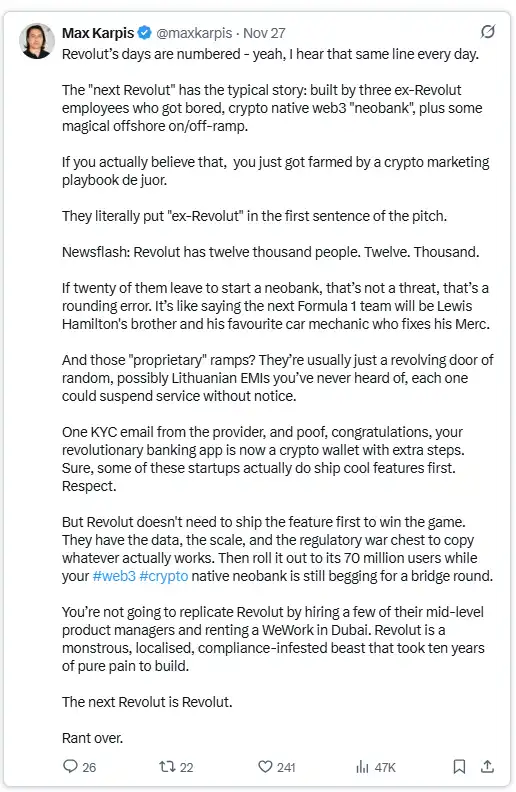
Max Karpis perfectly explains here why "neo-banks" are doomed to fail from the start.
For reference, a real scenario where I used cryptocurrency for payment was when booking a flight on Trip.com. They recently added an option to pay with stablecoins, directly from your wallet, and of course, it's available to anyone in the world.
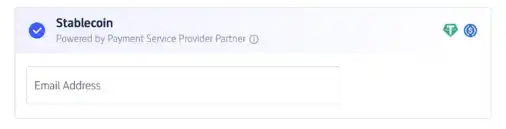
This is the real cryptocurrency use case and a true crypto payment. I believe the final form will be like this: wallets will be specifically optimized for the user experience of payments and spending, or (less likely) wallets will evolve into crypto cards, if crypto payments are somehow widely adopted.

Crypto Cards Function Similarly to Liquidity Bridges (Rain)

I have an interesting observation: self-custody crypto cards operate very similarly to cross-chain bridges.

This only applies to self-custody cards: cards issued by centralized exchanges (CEX) are not self-custody, so exchanges like Coinbase have no obligation to make users think the funds are under their control.

A legitimate use case for CEX cards is that they can serve as proof of funds for government, visa applications, or similar scenarios. When you use a crypto card tied to your CEX balance, you are still within the same ecosystem.

Self-custody crypto cards are different: they operate like liquidity bridges, where you lock funds (cryptocurrency) on chain A (crypto balance), and then unlock funds (fiat) on chain B (the real world).

This "bridge" in the crypto card space is like the shovel during the California Gold Rush: it is the key secure channel connecting crypto-native users and businesses that want to issue their own cards.

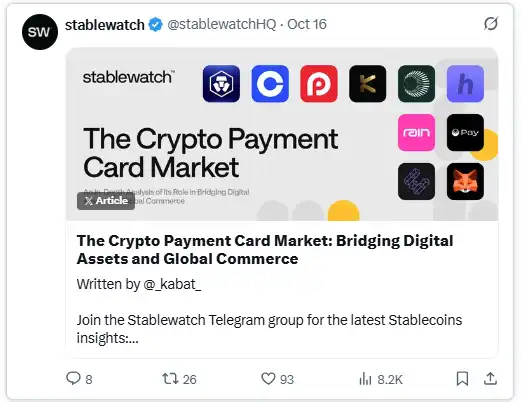
@stablewatchHQ's analysis of this bridge is spot-on, considering it essentially a Card-as-a-Service (CaaS) model. This is the most overlooked aspect by everyone discussing crypto cards. These CaaS platforms provide the infrastructure for businesses to launch their own branded cards.
Rain: How Crypto Cards Are Born

About half of your favorite crypto cards are probably powered by @raincards, and you may never have heard of it. Rain is one of the most fundamental protocols in the neo-banking system because it handles almost all the core components behind crypto cards. All that's left for the remaining companies to do is slap their logo on it (sounds harsh, but it's close to the truth).
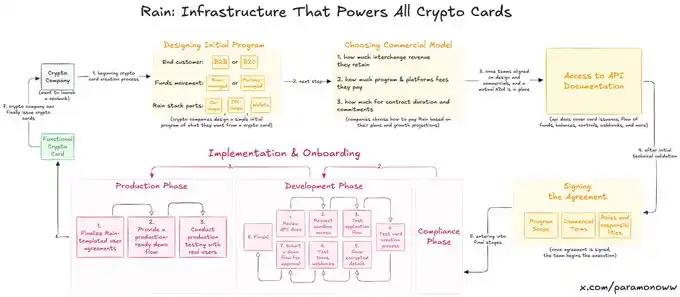
Rain enables companies to quickly launch their own crypto cards, and frankly, Rain's execution capabilities could even allow it to exist long-term outside the crypto space. So, stop fantasizing that teams need to raise tens of millions of dollars to issue a crypto card—they don't need that capital; they just need Rain.

The reason I emphasize Rain so much is that people generally overestimate the effort required to issue a crypto card. Maybe I'll write a separate article about Rain in the future because it is truly a severely underestimated technology.

Crypto Cards Have No Privacy or Anonymity

The lack of privacy or anonymity in crypto cards is not a problem with the cards themselves, but rather an issue deliberately ignored by those promoting them, hiding behind so-called "crypto values."


Privacy is not a widely used feature in the crypto space; pseudoprivacy (pseudonymity) does exist because we see addresses, not names. However, if you are ZachXBT, Wintermute's Igor Igamberdiev, Paradigm's Storm, or someone else with strong on-chain analysis capabilities, you can significantly narrow down the real identity corresponding to an address.

Of course, crypto cards don't even have the pseudonymity of traditional cryptocurrencies because you must complete KYC to activate a crypto card (actually, you're not activating a crypto card; you're opening a bank account).

If you are in the EU, the company providing the crypto card will still send some of your data to the government for tax purposes or other reasons the government needs to know. Now, you've given regulators a new opportunity to track you: linking your crypto address to your real identity.

Personal Data: The Currency of the Future

Cash still exists (the only form of anonymity, except the seller seeing you) and will exist for a long time. But eventually, everything will be digitized. The current digital system does not offer any benefits to consumers in terms of privacy: the more you spend, the higher the fees you pay, and in exchange, they know more about you. What a "great deal"!


Privacy is a luxury, and in the crypto card space, it will remain so. An interesting idea is that if we achieve truly good privacy, even to the point where businesses and institutions are willing to pay for it (not like Facebook, but with our consent), it could become the currency of the future, or even the only currency in a jobless, AI-driven world.

If Everything Is Doomed to Fail, Why Are Tempo, Arc Plasma, Stable Still Being Built?

The answer is simple—to lock users into the ecosystem.

Most non-custodial cards choose L2s (e.g., MetaMask uses @LineaBuild) or independent L1s (e.g., Plasma Card uses @Plasma). Due to high costs and finality issues, Ethereum or Bitcoin are generally not suitable for such operations. Some cards use Solana, but this is still a minority.

Of course, companies choose different blockchains not only for infrastructure but also for economic benefits.

MetaMask uses Linea not because Linea is the fastest or most secure, but because both Linea and MetaMask belong to the ConsenSys ecosystem.

I specifically use MetaMask as an example because it uses Linea. Everyone knows that almost no one uses Linea; it is far behind Base or Arbitrum in the L2 competition.

But ConsenSys made a smart decision to put Linea underneath their card because it locks users into the ecosystem. Users get accustomed to a good user experience through something they use daily. Linea naturally attracts liquidity, trading volume, and other metrics, rather than relying on liquidity mining campaigns or begging users to bridge.

This strategy is similar to what Apple did when it launched the iPhone in 2007, keeping users on iOS until they become so habituated they can't switch to another ecosystem. Never underestimate the power of habit.

EtherFi Is the Only Viable Crypto Card

After all this thinking, I've concluded that: @ether_fi is probably the only crypto card that truly aligns with the crypto spirit (this research is not sponsored by EtherFi, and even if it were, I wouldn't mind).

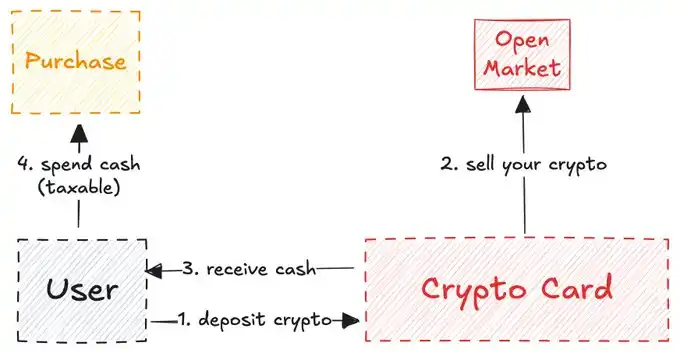
In most crypto cards, the cryptocurrency you top up is sold, and then your balance is replenished with cash (similar to the liquidity bridge I described earlier).

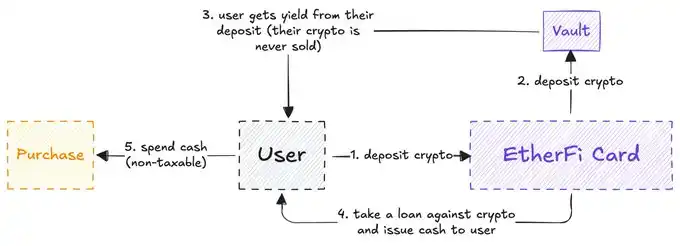
EtherFi is different: the system never sells your cryptocurrency; instead, it gives you a cash loan and uses your crypto assets to earn yield.

EtherFi's model is similar to Aave. Most DeFi users dream of seamlessly taking out cash loans collateralized by their crypto assets, and this capability has emerged. You might ask: "Isn't this the same? I can top up with crypto and spend with a crypto card like a normal debit card; is this extra step necessary?"
The problem is that selling your cryptocurrency is a taxable event, sometimes even more taxable than daily spending. And in most cards, every operation you do might be taxed, leading to you paying more taxes (again, using a crypto card does not mean being debanked).

EtherFi solves this problem to some extent because you are not actually selling cryptocurrency; you are just using it as collateral for a loan.

For this reason alone (plus no foreign exchange fees on USD, cashback, and other benefits), EtherFi becomes the best example of the convergence of DeFi and TradFi.

Most cards try to pretend they are crypto products but are actually just liquidity bridges, while EtherFi is truly for crypto users, not just for bringing cryptocurrency to the masses: it allows crypto users to spend locally until the masses realize how cool this model is. Among all crypto cards, EtherFi might be the only one that can survive long-term.

I think crypto cards are an experimental field, but unfortunately, most teams you see are just riding the narrative without giving due recognition to the underlying systems and developers.

Let's see where progress and innovation take us. Currently, we are seeing the globalization of crypto cards (horizontal growth), but there is a lack of vertical growth, which is precisely what this payment technology needs in its early stages.

Pertanyaan Terkait

QWhy does the author believe that crypto cards are ultimately doomed to fail?

AThe author argues that crypto cards are merely a temporary solution that adds a layer of abstraction without addressing the core values of cryptocurrency, such as decentralization and permissionless access. They rely on traditional banking systems and payment processors like Visa and Mastercard, which centralize control, impose fees, and require KYC, contradicting crypto's foundational principles.

QWhat is the fundamental issue with the privacy and anonymity of crypto cards?

ACrypto cards lack privacy and anonymity because they require KYC (Know Your Customer) verification, linking users' real identities to their transactions. Unlike pseudonymous crypto transactions using addresses, crypto cards expose personal data to banks and governments, eliminating any form of financial privacy.

QHow does the author describe the operational model of most self-custody crypto cards?

AThe author compares self-custody crypto cards to liquidity bridges: users lock funds in cryptocurrency on one chain (e.g., a blockchain), and the card unlocks fiat currency in the real world for spending. This model involves intermediaries and fees, similar to a cross-chain bridge, rather than enabling direct crypto payments.

QWhat makes EtherFi's crypto card different from others according to the author?

AEtherFi's card differs by not selling users' cryptocurrency for fiat. Instead, it provides cash loans collateralized by crypto assets, allowing users to spend without triggering taxable events. This model aligns with DeFi principles, such as earning yield on locked assets, and avoids the pitfalls of traditional crypto cards that rely on selling crypto.

QWhy do companies build crypto cards despite their perceived limitations and inevitable failure?

ACompanies build crypto cards primarily to lock users into their ecosystems, leveraging habit and convenience to retain them. For example, MetaMask uses Linea to integrate users into ConsenSys' ecosystem. This strategy mimics Apple's approach with iOS, fostering user dependency rather than genuinely advancing crypto payment innovation.

Bacaan Terkait

Anda Bertaruh pada Berita, Para Pemain Pro Membaca Aturan: Perbedaan Kognitif Sebenarnya di Balik Kerugian di Polymarket

Artikel ini membahas bagaimana para trader berpengalaman ("车头") di Polymarket sering kali unggul karena mereka memahami aturan pasar prediksi secara mendetail, layaknya pengacara yang menganalisis kontrak. Menggunakan contoh pasar tentang "Siapa pemimpin Venezuela pada akhir 2026", artikel menunjukkan bahwa meskipun intuisi mungkin menunjuk pada pemimpin de facto, aturan pasar yang ketat tentang siapa yang "secara resmi memegang" jabatanlah yang menentukan hasilnya. Kasus serupa melibatkan definisi "token" Polymarket dan interpretasi "persetujuan" dalam perjanjian nuklir Iran. Polymarket memiliki mekanisme penyelesaian sengketa berlapis yang dijalankan oleh pemegang token UMA. Prosesnya melibatkan pengajuan proposal, periode sanggahan, diskusi, dan voting. Namun, sistem ini memiliki kelemahan krusial: tidak ada pemisahan antara pihak yang memiliki kepentingan finansial (trader) dan pihak yang menjadi penentu keputusan (voter). Hal ini dapat menyebabkan konflik kepentingan, membuat diskusi tidak efektif karena pengaruh kelompok dan perubahan posisi, serta menghasilkan keputusan yang tidak transparan tanpa penjelasan hukum yang dapat dijadikan preseden. Kesimpulannya, kunci sukses di Polymarket bukan hanya memprediksi peristiwa dengan benar, tetapi juga memahami celah antara "realitas" dan "aturan" tertulis untuk memanfaatkan kesalahan harga yang timbul dari misinterpretasi.

marsbit1j yang lalu

Anda Bertaruh pada Berita, Para Pemain Pro Membaca Aturan: Perbedaan Kognitif Sebenarnya di Balik Kerugian di Polymarket

marsbit1j yang lalu

Trading

Spot
Futures

Artikel Populer

Apa Itu $S$

Memahami SPERO: Tinjauan Komprehensif Pengenalan SPERO Seiring dengan perkembangan lanskap inovasi, munculnya teknologi web3 dan proyek cryptocurrency memainkan peran penting dalam membentuk masa depan digital. Salah satu proyek yang telah menarik perhatian di bidang dinamis ini adalah SPERO, yang dilambangkan sebagai SPERO,$$s$. Artikel ini bertujuan untuk mengumpulkan dan menyajikan informasi terperinci tentang SPERO, untuk membantu para penggemar dan investor memahami dasar-dasar, tujuan, dan inovasi dalam domain web3 dan crypto. Apa itu SPERO,$$s$? SPERO,$$s$ adalah proyek unik dalam ruang crypto yang berusaha memanfaatkan prinsip desentralisasi dan teknologi blockchain untuk menciptakan ekosistem yang mendorong keterlibatan, utilitas, dan inklusi finansial. Proyek ini dirancang untuk memfasilitasi interaksi peer-to-peer dengan cara baru, memberikan pengguna solusi dan layanan keuangan yang inovatif. Pada intinya, SPERO,$$s$ bertujuan untuk memberdayakan individu dengan menyediakan alat dan platform yang meningkatkan pengalaman pengguna dalam ruang cryptocurrency. Ini termasuk memungkinkan metode transaksi yang lebih fleksibel, mendorong inisiatif yang dipimpin komunitas, dan menciptakan jalur untuk peluang finansial melalui aplikasi terdesentralisasi (dApps). Visi mendasar dari SPERO,$$s$ berputar di sekitar inklusivitas, bertujuan untuk menjembatani kesenjangan dalam keuangan tradisional sambil memanfaatkan manfaat teknologi blockchain. Siapa Pencipta SPERO,$$s$? Identitas pencipta SPERO,$$s$ tetap agak samar, karena ada sumber daya publik yang terbatas yang memberikan informasi latar belakang terperinci tentang pendiriannya. Kurangnya transparansi ini dapat berasal dari komitmen proyek terhadap desentralisasi—sebuah etos yang banyak proyek web3 bagi, memprioritaskan kontribusi kolektif di atas pengakuan individu. Dengan memusatkan diskusi di sekitar komunitas dan tujuan kolektifnya, SPERO,$$s$ mewujudkan esensi pemberdayaan tanpa menonjolkan individu tertentu. Dengan demikian, memahami etos dan misi SPERO tetap lebih penting daripada mengidentifikasi pencipta tunggal. Siapa Investor SPERO,$$s$? SPERO,$$s$ didukung oleh beragam investor mulai dari modal ventura hingga investor malaikat yang berdedikasi untuk mendorong inovasi di sektor crypto. Fokus investor ini umumnya sejalan dengan misi SPERO—memprioritaskan proyek yang menjanjikan kemajuan teknologi sosial, inklusivitas finansial, dan tata kelola terdesentralisasi. Fondasi investor ini biasanya tertarik pada proyek yang tidak hanya menawarkan produk inovatif tetapi juga memberikan kontribusi positif kepada komunitas blockchain dan ekosistemnya. Dukungan dari investor ini memperkuat SPERO,$$s$ sebagai pesaing yang patut diperhitungkan di domain proyek crypto yang berkembang pesat. Bagaimana SPERO,$$s$ Bekerja? SPERO,$$s$ menerapkan kerangka kerja multi-faceted yang membedakannya dari proyek cryptocurrency konvensional. Berikut adalah beberapa fitur kunci yang menekankan keunikan dan inovasinya: Tata Kelola Terdesentralisasi: SPERO,$$s$ mengintegrasikan model tata kelola terdesentralisasi, memberdayakan pengguna untuk berpartisipasi aktif dalam proses pengambilan keputusan mengenai masa depan proyek. Pendekatan ini mendorong rasa kepemilikan dan akuntabilitas di antara anggota komunitas. Utilitas Token: SPERO,$$s$ memanfaatkan token cryptocurrency-nya sendiri, yang dirancang untuk melayani berbagai fungsi dalam ekosistem. Token ini memungkinkan transaksi, hadiah, dan fasilitasi layanan yang ditawarkan di platform, meningkatkan keterlibatan dan utilitas secara keseluruhan. Arsitektur Berlapis: Arsitektur teknis SPERO,$$s$ mendukung modularitas dan skalabilitas, memungkinkan integrasi fitur dan aplikasi tambahan secara mulus seiring dengan perkembangan proyek. Kemampuan beradaptasi ini sangat penting untuk mempertahankan relevansi di lanskap crypto yang selalu berubah. Keterlibatan Komunitas: Proyek ini menekankan inisiatif yang dipimpin komunitas, menggunakan mekanisme yang memberikan insentif untuk kolaborasi dan umpan balik. Dengan memelihara komunitas yang kuat, SPERO,$$s$ dapat lebih baik memenuhi kebutuhan pengguna dan beradaptasi dengan tren pasar. Fokus pada Inklusi: Dengan menawarkan biaya transaksi yang rendah dan antarmuka yang ramah pengguna, SPERO,$$s$ bertujuan untuk menarik basis pengguna yang beragam, termasuk individu yang mungkin sebelumnya tidak terlibat dalam ruang crypto. Komitmen ini terhadap inklusi sejalan dengan misi utamanya untuk memberdayakan melalui aksesibilitas. Garis Waktu SPERO,$$s$ Memahami sejarah proyek memberikan wawasan penting tentang trajektori dan tonggak perkembangannya. Berikut adalah garis waktu yang disarankan yang memetakan peristiwa signifikan dalam evolusi SPERO,$$s$: Fase Konseptualisasi dan Ideasi: Ide awal yang membentuk dasar SPERO,$$s$ dikembangkan, sangat selaras dengan prinsip desentralisasi dan fokus komunitas dalam industri blockchain. Peluncuran Whitepaper Proyek: Setelah fase konseptual, whitepaper komprehensif yang merinci visi, tujuan, dan infrastruktur teknologi SPERO,$$s$ dirilis untuk menarik minat dan umpan balik komunitas. Pembangunan Komunitas dan Keterlibatan Awal: Upaya jangkauan aktif dilakukan untuk membangun komunitas pengguna awal dan investor potensial, memfasilitasi diskusi seputar tujuan proyek dan mendapatkan dukungan. Acara Generasi Token: SPERO,$$s$ melakukan acara generasi token (TGE) untuk mendistribusikan token asli kepada pendukung awal dan membangun likuiditas awal dalam ekosistem. Peluncuran dApp Awal: Aplikasi terdesentralisasi (dApp) pertama yang terkait dengan SPERO,$$s$ diluncurkan, memungkinkan pengguna untuk terlibat dengan fungsionalitas inti platform. Pengembangan Berkelanjutan dan Kemitraan: Pembaruan dan peningkatan berkelanjutan terhadap penawaran proyek, termasuk kemitraan strategis dengan pemain lain di ruang blockchain, telah membentuk SPERO,$$s$ menjadi pemain yang kompetitif dan berkembang di pasar crypto. Kesimpulan SPERO,$$s$ berdiri sebagai bukti potensi web3 dan cryptocurrency untuk merevolusi sistem keuangan dan memberdayakan individu. Dengan komitmen terhadap tata kelola terdesentralisasi, keterlibatan komunitas, dan fungsionalitas yang dirancang secara inovatif, ia membuka jalan menuju lanskap keuangan yang lebih inklusif. Seperti halnya investasi di ruang crypto yang berkembang pesat, calon investor dan pengguna dianjurkan untuk melakukan riset secara menyeluruh dan terlibat dengan perkembangan yang sedang berlangsung dalam SPERO,$$s$. Proyek ini menunjukkan semangat inovatif industri crypto, mengundang eksplorasi lebih lanjut ke dalam berbagai kemungkinan yang ada. Meskipun perjalanan SPERO,$$s$ masih berlangsung, prinsip-prinsip dasarnya mungkin benar-benar mempengaruhi masa depan cara kita berinteraksi dengan teknologi, keuangan, dan satu sama lain dalam ekosistem digital yang saling terhubung.

75 Total TayanganDipublikasikan pada 2024.12.17Diperbarui pada 2024.12.17

Apa Itu $S$

Apa Itu AGENT S

Agent S: Masa Depan Interaksi Otonom di Web3 Pendahuluan Dalam lanskap Web3 dan cryptocurrency yang terus berkembang, inovasi secara konstan mendefinisikan ulang cara individu berinteraksi dengan platform digital. Salah satu proyek perintis, Agent S, menjanjikan untuk merevolusi interaksi manusia-komputer melalui kerangka agen terbuka. Dengan membuka jalan untuk interaksi otonom, Agent S bertujuan untuk menyederhanakan tugas-tugas kompleks, menawarkan aplikasi transformasional dalam kecerdasan buatan (AI). Eksplorasi mendetail ini akan menyelami seluk-beluk proyek, fitur uniknya, dan implikasinya untuk domain cryptocurrency. Apa itu Agent S? Agent S berdiri sebagai kerangka agen terbuka yang inovatif, dirancang khusus untuk mengatasi tiga tantangan mendasar dalam otomatisasi tugas komputer: Memperoleh Pengetahuan Spesifik Domain: Kerangka ini secara cerdas belajar dari berbagai sumber pengetahuan eksternal dan pengalaman internal. Pendekatan ganda ini memberdayakannya untuk membangun repositori pengetahuan spesifik domain yang kaya, meningkatkan kinerjanya dalam pelaksanaan tugas. Perencanaan Selama Rentang Tugas yang Panjang: Agent S menggunakan perencanaan hierarkis yang ditingkatkan pengalaman, pendekatan strategis yang memfasilitasi pemecahan dan pelaksanaan tugas-tugas rumit dengan efisien. Fitur ini secara signifikan meningkatkan kemampuannya untuk mengelola beberapa subtugas dengan efisien dan efektif. Menangani Antarmuka Dinamis dan Tidak Seragam: Proyek ini memperkenalkan Antarmuka Agen-Komputer (ACI), solusi inovatif yang meningkatkan interaksi antara agen dan pengguna. Dengan memanfaatkan Model Bahasa Besar Multimodal (MLLM), Agent S dapat menavigasi dan memanipulasi berbagai antarmuka pengguna grafis dengan mulus. Melalui fitur-fitur perintis ini, Agent S menyediakan kerangka kerja yang kuat yang mengatasi kompleksitas yang terlibat dalam mengotomatisasi interaksi manusia dengan mesin, membuka jalan untuk berbagai aplikasi dalam AI dan seterusnya. Siapa Pencipta Agent S? Meskipun konsep Agent S secara fundamental inovatif, informasi spesifik tentang penciptanya tetap samar. Pencipta saat ini tidak diketahui, yang menyoroti baik tahap awal proyek atau pilihan strategis untuk menjaga anggota pendiri tetap tersembunyi. Terlepas dari anonimitas, fokus tetap pada kemampuan dan potensi kerangka kerja. Siapa Investor Agent S? Karena Agent S relatif baru dalam ekosistem kriptografi, informasi terperinci mengenai investor dan pendukung keuangannya tidak secara eksplisit didokumentasikan. Kurangnya wawasan yang tersedia untuk umum mengenai fondasi investasi atau organisasi yang mendukung proyek ini menimbulkan pertanyaan tentang struktur pendanaannya dan peta jalan pengembangannya. Memahami dukungan sangat penting untuk mengukur keberlanjutan proyek dan potensi dampak pasar. Bagaimana Cara Kerja Agent S? Di inti Agent S terletak teknologi mutakhir yang memungkinkannya berfungsi secara efektif dalam berbagai pengaturan. Model operasionalnya dibangun di sekitar beberapa fitur kunci: Interaksi Komputer yang Mirip Manusia: Kerangka ini menawarkan perencanaan AI yang canggih, berusaha untuk membuat interaksi dengan komputer lebih intuitif. Dengan meniru perilaku manusia dalam pelaksanaan tugas, ia menjanjikan untuk meningkatkan pengalaman pengguna. Memori Naratif: Digunakan untuk memanfaatkan pengalaman tingkat tinggi, Agent S memanfaatkan memori naratif untuk melacak sejarah tugas, sehingga meningkatkan proses pengambilan keputusannya. Memori Episodik: Fitur ini memberikan panduan langkah demi langkah kepada pengguna, memungkinkan kerangka untuk menawarkan dukungan kontekstual saat tugas berlangsung. Dukungan untuk OpenACI: Dengan kemampuan untuk berjalan secara lokal, Agent S memungkinkan pengguna untuk mempertahankan kontrol atas interaksi dan alur kerja mereka, sejalan dengan etos terdesentralisasi Web3. Integrasi Mudah dengan API Eksternal: Versatilitas dan kompatibilitasnya dengan berbagai platform AI memastikan bahwa Agent S dapat dengan mulus masuk ke dalam ekosistem teknologi yang ada, menjadikannya pilihan menarik bagi pengembang dan organisasi. Fungsionalitas ini secara kolektif berkontribusi pada posisi unik Agent S dalam ruang kripto, saat ia mengotomatisasi tugas-tugas kompleks yang melibatkan banyak langkah dengan intervensi manusia yang minimal. Seiring proyek ini berkembang, aplikasi potensialnya di Web3 dapat mendefinisikan ulang bagaimana interaksi digital berlangsung. Garis Waktu Agent S Pengembangan dan tonggak Agent S dapat dirangkum dalam garis waktu yang menyoroti peristiwa pentingnya: 27 September 2024: Konsep Agent S diluncurkan dalam sebuah makalah penelitian komprehensif berjudul “Sebuah Kerangka Agen Terbuka yang Menggunakan Komputer Seperti Manusia,” yang menunjukkan dasar untuk proyek ini. 10 Oktober 2024: Makalah penelitian tersebut dipublikasikan secara terbuka di arXiv, menawarkan eksplorasi mendalam tentang kerangka kerja dan evaluasi kinerjanya berdasarkan tolok ukur OSWorld. 12 Oktober 2024: Sebuah presentasi video dirilis, memberikan wawasan visual tentang kemampuan dan fitur Agent S, lebih lanjut melibatkan pengguna dan investor potensial. Tanda-tanda dalam garis waktu ini tidak hanya menggambarkan kemajuan Agent S tetapi juga menunjukkan komitmennya terhadap transparansi dan keterlibatan komunitas. Poin Kunci Tentang Agent S Seiring kerangka Agent S terus berkembang, beberapa atribut kunci menonjol, menekankan sifat inovatif dan potensinya: Kerangka Inovatif: Dirancang untuk memberikan penggunaan komputer yang intuitif seperti interaksi manusia, Agent S membawa pendekatan baru untuk otomatisasi tugas. Interaksi Otonom: Kemampuan untuk berinteraksi secara otonom dengan komputer melalui GUI menandakan lompatan menuju solusi komputasi yang lebih cerdas dan efisien. Otomatisasi Tugas Kompleks: Dengan metodologinya yang kuat, ia dapat mengotomatisasi tugas-tugas kompleks yang melibatkan banyak langkah, membuat proses lebih cepat dan kurang rentan terhadap kesalahan. Perbaikan Berkelanjutan: Mekanisme pembelajaran memungkinkan Agent S untuk belajar dari pengalaman masa lalu, terus meningkatkan kinerja dan efektivitasnya. Versatilitas: Adaptabilitasnya di berbagai lingkungan operasi seperti OSWorld dan WindowsAgentArena memastikan bahwa ia dapat melayani berbagai aplikasi. Saat Agent S memposisikan dirinya di lanskap Web3 dan kripto, potensinya untuk meningkatkan kemampuan interaksi dan mengotomatisasi proses menandakan kemajuan signifikan dalam teknologi AI. Melalui kerangka inovatifnya, Agent S mencerminkan masa depan interaksi digital, menjanjikan pengalaman yang lebih mulus dan efisien bagi pengguna di berbagai industri. Kesimpulan Agent S mewakili lompatan berani ke depan dalam pernikahan AI dan Web3, dengan kapasitas untuk mendefinisikan ulang cara kita berinteraksi dengan teknologi. Meskipun masih dalam tahap awal, kemungkinan aplikasinya sangat luas dan menarik. Melalui kerangka komprehensifnya yang mengatasi tantangan kritis, Agent S bertujuan untuk membawa interaksi otonom ke garis depan pengalaman digital. Saat kita melangkah lebih dalam ke dalam ranah cryptocurrency dan desentralisasi, proyek-proyek seperti Agent S pasti akan memainkan peran penting dalam membentuk masa depan teknologi dan kolaborasi manusia-komputer.

738 Total TayanganDipublikasikan pada 2025.01.14Diperbarui pada 2025.01.14

Apa Itu AGENT S

Cara Membeli S

Selamat datang di HTX.com! Kami telah membuat pembelian Sonic (S) menjadi mudah dan nyaman. Ikuti panduan langkah demi langkah kami untuk memulai perjalanan kripto Anda.Langkah 1: Buat Akun HTX AndaGunakan alamat email atau nomor ponsel Anda untuk mendaftar akun gratis di HTX. Rasakan perjalanan pendaftaran yang mudah dan buka semua fitur.Dapatkan Akun SayaLangkah 2: Buka Beli Kripto, lalu Pilih Metode Pembayaran AndaKartu Kredit/Debit: Gunakan Visa atau Mastercard Anda untuk membeli Sonic (S) secara instan.Saldo: Gunakan dana dari saldo akun HTX Anda untuk melakukan trading dengan lancar.Pihak Ketiga: Kami telah menambahkan metode pembayaran populer seperti Google Pay dan Apple Pay untuk meningkatkan kenyamanan.P2P: Lakukan trading langsung dengan pengguna lain di HTX.Over-the-Counter (OTC): Kami menawarkan layanan yang dibuat khusus dan kurs yang kompetitif bagi para trader.Langkah 3: Simpan Sonic (S) AndaSetelah melakukan pembelian, simpan Sonic (S) di akun HTX Anda. Selain itu, Anda dapat mengirimkannya ke tempat lain melalui transfer blockchain atau menggunakannya untuk memperdagangkan mata uang kripto lainnya.Langkah 4: Lakukan trading Sonic (S)Lakukan trading Sonic (S) dengan mudah di pasar spot HTX. Cukup akses akun Anda, pilih pasangan perdagangan, jalankan trading, lalu pantau secara real-time. Kami menawarkan pengalaman yang ramah pengguna baik untuk pemula maupun trader berpengalaman.

1.1k Total TayanganDipublikasikan pada 2025.01.15Diperbarui pada 2025.03.21

Cara Membeli S

Diskusi

Selamat datang di Komunitas HTX. Di sini, Anda bisa terus mendapatkan informasi terbaru tentang perkembangan platform terkini dan mendapatkan akses ke wawasan pasar profesional. Pendapat pengguna mengenai harga S (S) disajikan di bawah ini.

活动图片