VCs Review 2025 Crypto Investments: Narrative is Dead, Computing Power is King

marsbitDipublikasikan tanggal 2025-12-24Terakhir diperbarui pada 2025-12-24

Abstrak

Venture capital reflects on 2025 crypto investments, declaring "narratives are dead, compute is king." Despite growth in on-chain financial tools and a favorable U.S. regulatory environment, long-term crypto investors faced a difficult year due to structural market issues, including token unlock mechanisms and speculative behavior. Public market winners were owners of physical and financial bottlenecks: power, semiconductors, and scarce compute (e.g., IREN, NVIDIA). AI value accrued to infrastructure and essential services, not speculative narratives. Tokenized networks underperformed as usage failed to translate to value capture. Key lessons: AI value is realized in infrastructure, neutrality is a key economic asset, and token networks face recurring structural challenges. For 2026, the focus shifts to machine transaction surfaces, budget-backed applied infrastructure, and high-conviction asymmetric bets. The market is transitioning from discovery to exit phases, with a temporary shift toward equity investments over tokens.

Source: Fintech Blueprint

Original Title: Analysis: Learning from 2025 to win big in the 2026 machine economy

Compiled and Edited by: BitpushNews

Structural Issues in the Crypto Market

The adoption of on-chain financial instruments and the trend of the machine economy are booming.

Over the past year, we have witnessed a massive expansion of blockchain-native finance across the following five dimensions: (1) stablecoins, (2) decentralized lending and trading, (3) perpetual contracts, (4) prediction markets, and (5) Digital Asset Treasuries (DATs). The regulatory environment in the United States has become extremely favorable, driving an increase in both the number of projects and risk appetite.

Setting aside uncertainties brought by tariffs and market structure, a tolerant macro environment has also provided fertile ground for crypto innovation to take root. These trends are well-known and require no further elaboration with data.
However, 2025 has been an extremely difficult year for long-term investors in tokens and crypto assets other than Bitcoin.

If you were a trader or banker, you might have had a decent year—we saw record commissions from bringing DATs to market, as well as massive fee income generated by exchanges like Binance during their listing processes.

But for those of us with a 3-5 year investment horizon, the market structure has been terrible.

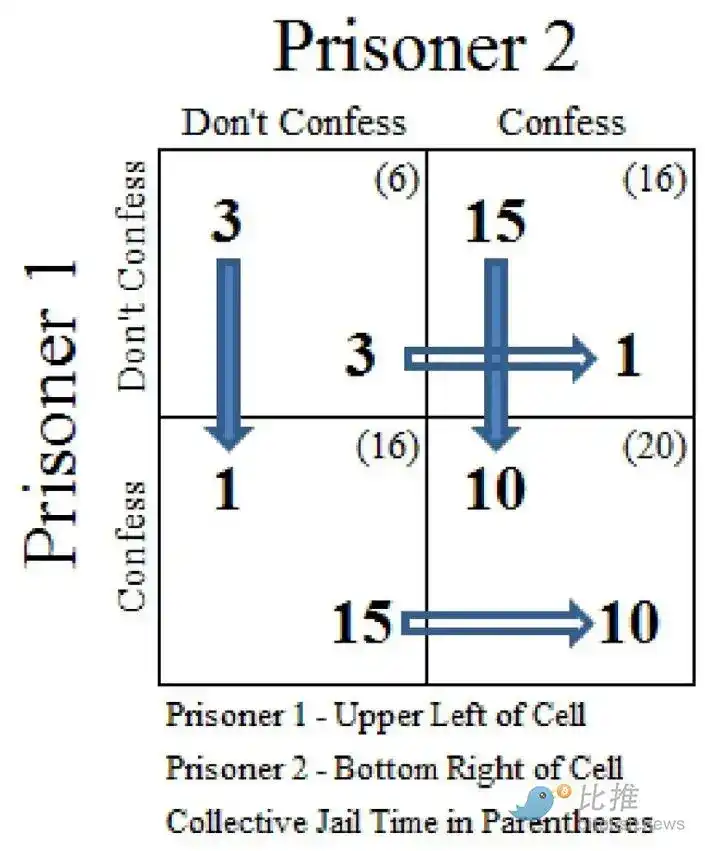
We are completely stuck in a "negative prisoner's dilemma": token holders, anticipating future selling pressure, are dumping any and all assets; meanwhile, market makers and exchanges that support the entire crypto economy are taking speculative positions focused solely on short-term gains. Token unlock mechanisms and issuance prices often drag projects down before they have achieved profitability or found product-market fit.
Furthermore, the market structural failure on October 10 this year clearly hit several major players hard. Although the losses have not been made public, the aftershocks of liquidations continue. The correlation among all crypto assets has risen to nearly 1, indicating industry-wide deleveraging by participants, despite their vastly different fundamental logics.

It is easy to retreat and become cynical at this moment.
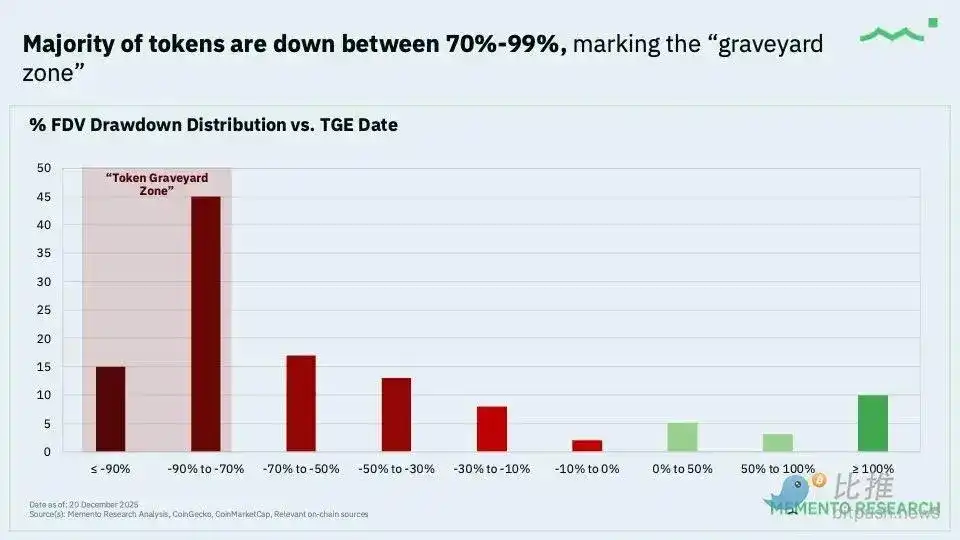
But we prefer to mark-to-market as clearly as possible in order to plan for future positioning.

The decline in the 2025 crypto investment field is information, but not a conclusion. It is likely that 2026 will see large-scale liquidations in the secondary market for private companies. At that time, we will analyze how so many Special Purpose Vehicles (SPVs) were issued at high valuations during the crypto boom.

Meanwhile, the vision of programmable finance and "Robot Money" continues to materialize, and we must continue to work hard to find the best positioning in its inevitable rise.

For context, see the chart below. This chart, zoomed into the past decade, shows the market value creation across several regions and industries.
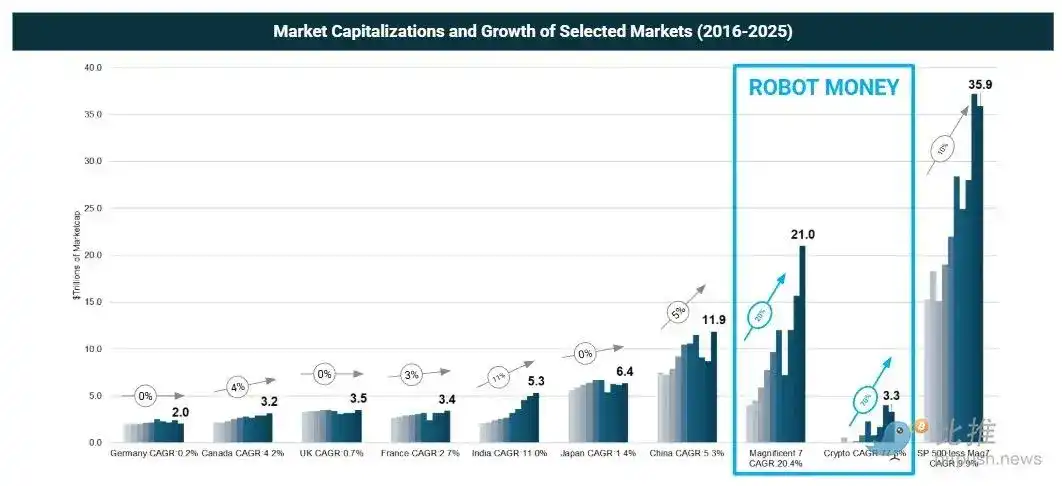
When we look at this history, the value creation in the cryptocurrency and AI fields is staggering compared to the rest of the world.

European capital markets (around $2-3 trillion per country) have achieved almost nothing, merely maintaining the status quo. You might as well invest in government bonds, earn 3% interest annually, and probably create more value. On the right side of the chart, India and China show a Compound Annual Growth Rate (CAGR) of 5-10%, with net market cap growth of approximately $3 trillion and $5 trillion, respectively, over the same period.

With this scale in mind, look at what we define as "Robot Money":

The "Magnificent 7" representing tech and AI added about $17 trillion in market cap at an annual rate of 20%;

The crypto asset market, representing modern financial rails, added $3 trillion over the same period, with a CAGR as high as 70%.

This is the future financial center.

But being logically correct is not enough. We must meticulously lock onto the parts of the value chain that have not yet been noticed by the world. Think back to talking about robo-advisors in 2009, neobanks in 2011, or DeFi in 2017—the vocabulary and associations were not yet formed at the time, and it took 2-5 years for these outcomes to harden into clear business opportunities.

Value Capture in the Machine Economy

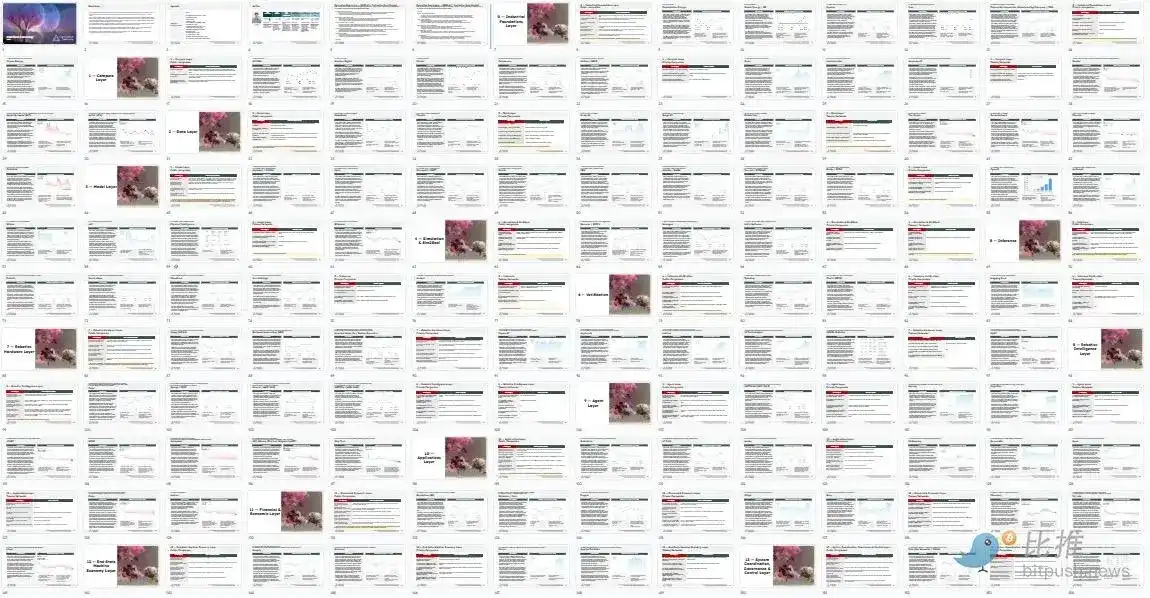
As a form of "masochistic" exercise, we compiled a 158-page summary report covering the most relevant players in the 2025 machine economy.
In public markets, 2025 was a year of "the strong get stronger, the weak fall behind."
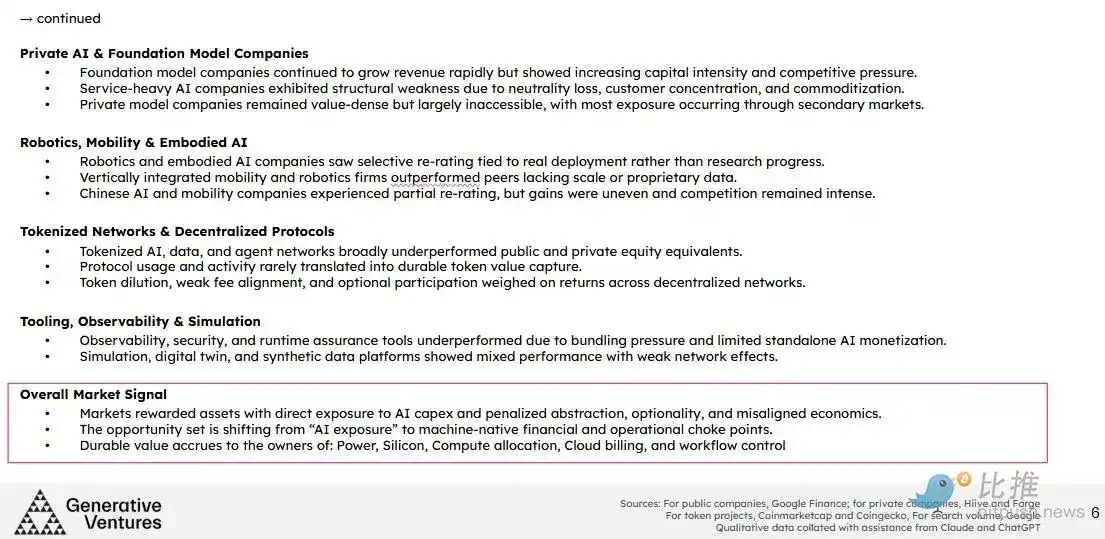
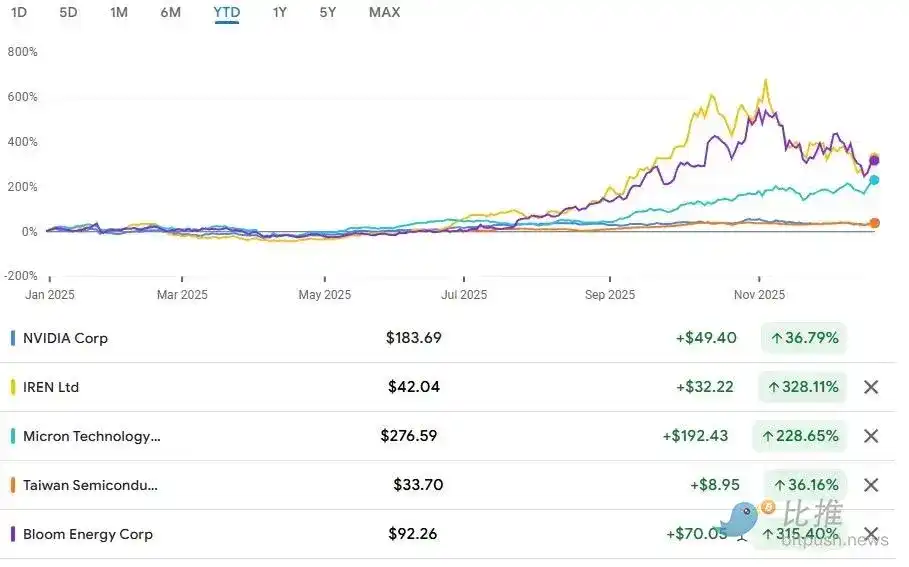
The clear winners were the owners of physical and financial bottlenecks: power, semiconductors, and scarce computing power.

Bloom Energy, IREN, Micron, TSMC, and NVIDIA all significantly outperformed the broader market, as capital chases assets that "machines must pass through."

Bloom and IREN are typical examples: they stand directly in the path of AI capital expenditure, converting urgency into revenue.

In contrast, traditional infrastructure like Equinix performed sluggishly, reflecting the market's view that the value of general-purpose capacity is far lower than that of power-guaranteed, high-density, customized computing power.
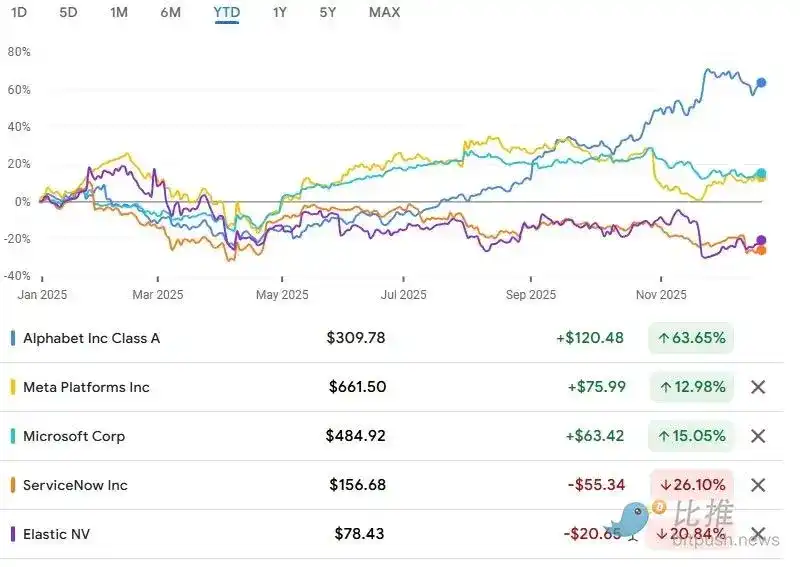
In the software and data space, performance diverged along another dimension: (1) Mandatory vs. (2) Optional. Platform-like enterprise systems embedded in workflows with mandatory renewals (like Alphabet, Meta) continued their compound growth, both rising year-to-date, as AI spending reinforced their existing distribution moats. ServiceNow and Datadog, despite strong products, saw returns dragged down by valuation pressures, bundling pressure from hyperscale cloud providers, and slower AI monetization. Elastic illustrates the adverse scenario: strong technical capabilities, but squeezed by cloud-native alternatives and deteriorating unit economics.
The private market shows a similar screening mechanism.

Foundation model companies are the protagonists of the story, but fragility is increasing. OpenAI and Anthropic are growing revenue rapidly, but their neutrality, capital intensity, and margin compression are now clear risks. Scale AI is this year's cautionary tale: a partial acquisition by Meta destroyed its "neutral" position and triggered customer churn, proving how quickly a heavy-service business model can unravel once trust is broken. In contrast, companies that control value (Applied Intuition, Anduril, Samsara, and emerging fleet operating systems) appear better positioned, even if value realization remains mostly non-public.

Tokenized networks were the worst-performing sector.

With very few exceptions, decentralized data, storage, agent, and automation protocols performed poorly, as usage failed to translate into token value capture.

Chainlink remains strategically important but struggles to align protocol revenue with its token economic model; Bittensor is the biggest bet in crypto AI but does not yet pose a substantive threat to Web2 lab companies; Giza and similar agent protocols show real activity but are hampered by dilution and meager fees. The market no longer rewards "collaborative narratives" without mandatory fee mechanisms.

Value is accumulating where machines are already paying—power, silicon, compute contracts, cloud bills, and regulated balance sheets—not where they might choose to pay someday in the future.

In 2025, the market rewarded ownership of "chokepoints" and punished projects with ideals but lacking control over cash flow or computing power. The core of alpha lies in: identifying where economic power already exists and betting on assets that machines cannot bypass.

Key Insights:

  • AI value realization is one layer deeper than most people anticipated.
  • Neutrality is now a first-class economic asset (refer to Scale AI).
  • "Platforms" only work when combined with control points, not merely as a feature.
  • AI software is deflationary (pricing pressure); AI infrastructure is inflationary.
  • Vertical integration only matters if it locks in data or economic effects.
  • Token networks are repeatedly undergoing the same market structure tests.
  • Merely having AI exposure is not enough; positioning quality determines everything.
  • Robotics hardware and software will be the next hype cycle, and we will likely see a similar investment wave and selective winners.

Positioning for 2026

Over the past two years, we have built a core portfolio covering the key themes discussed here. Looking ahead to 2026, our positioning and investment execution will be further strengthened.

Next, I will talk about our holding strategy.
Although the long-term vision of autonomous agents, robotics, and machine-native finance is directionally correct, the market is currently in a phase where valuations in private AI and robotics are extremely outrageous. Aggressive secondary liquidity and implied valuations above $100 billion mark a transition from the "discovery phase" to the "exit phase."

As an early-stage fund with a fintech angle, we must target areas downstream of this spending:

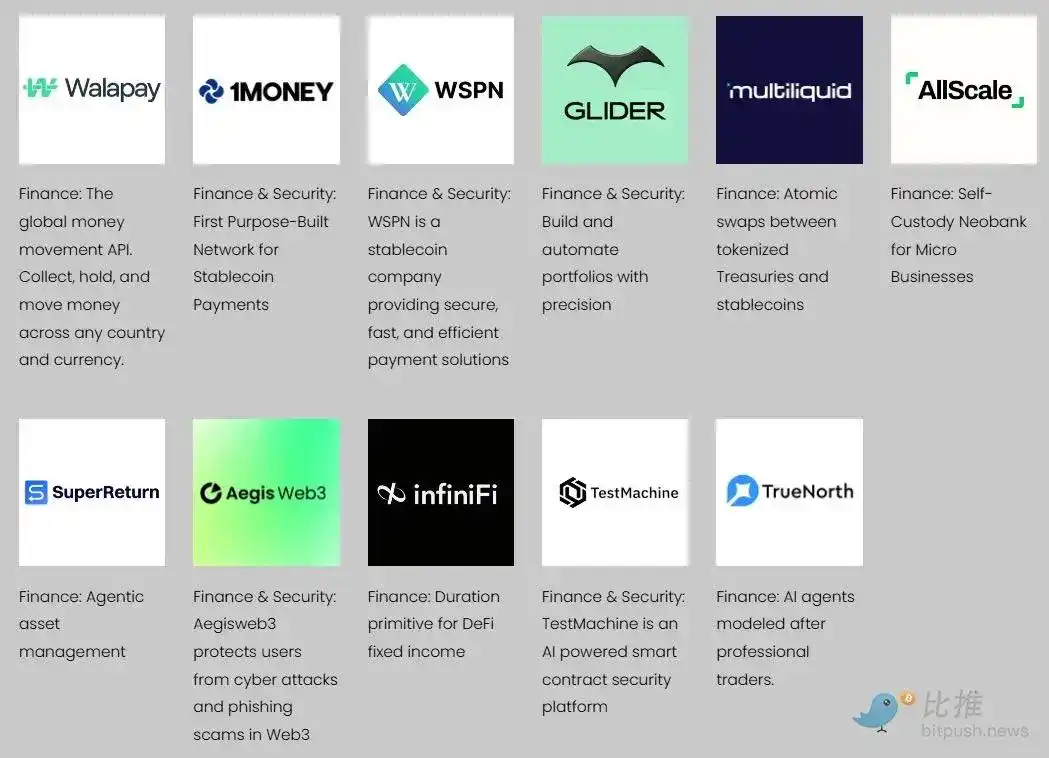
  • Machine Transaction Surfaces: Layers where machines or their operators already carry economic activity, such as payments, billing, metering, routing, and the orchestration of capital or compute, compliance, custody, and settlement primitives. Returns come through transaction volume, acquisition, or regulatory status, not speculative narratives. Walapay and Nevermined in our portfolio are examples.
  • Applied Infrastructure With Budgets: Infrastructure that enterprises or platforms are already procuring, such as compute aggregation and optimization, data services embedded in workflows, tools with recurring spend and switching costs. The focus is on ownership of budgets and depth of integration. Examples include Yotta Labs and Exabits.
  • High-Novelty Opportunities: A few asymmetric upside opportunities with uncertain timing: basic research, frontier science, AI-related culture or IP platforms. Our recent investment in Netholabs (a lab dedicated to simulating the complete digital brain of a mouse) fits this characteristic.

Additionally, until the token market structure issues are resolved, we will invest more aggressively in equity. Previously, our exposure was 40% tokens and 40% equity, with 20% flexibly allocated. We believe the token space needs 12-24 months to digest the current difficulties.

Key Takeaways

You don't need to be a venture capitalist to learn from and benefit from these market dynamics.

Massive capital expenditure is flowing from tech giants to energy and component suppliers. A handful of companies expected to be multi-trillion-dollar public market winners are choosing to remain private while spinning off Special Purpose Vehicles (SPVs). Public companies are defending as best they can. Political power is centralizing and nationalizing these initiatives—whether it's Musk and Trump, or China and DeepSeek—rather than supporting their decentralized alternatives in Web3. Robotics is intertwined with national manufacturing and the military-industrial complex.

In creative industries (from gaming to film, music), there is resistance to AI, with practitioners of "human craft"排斥 those robots that claim to do the same thing.

In the software, science, and mathematics industries, however, people see AI as a great achievement that helps discover and build efficient business architectures.
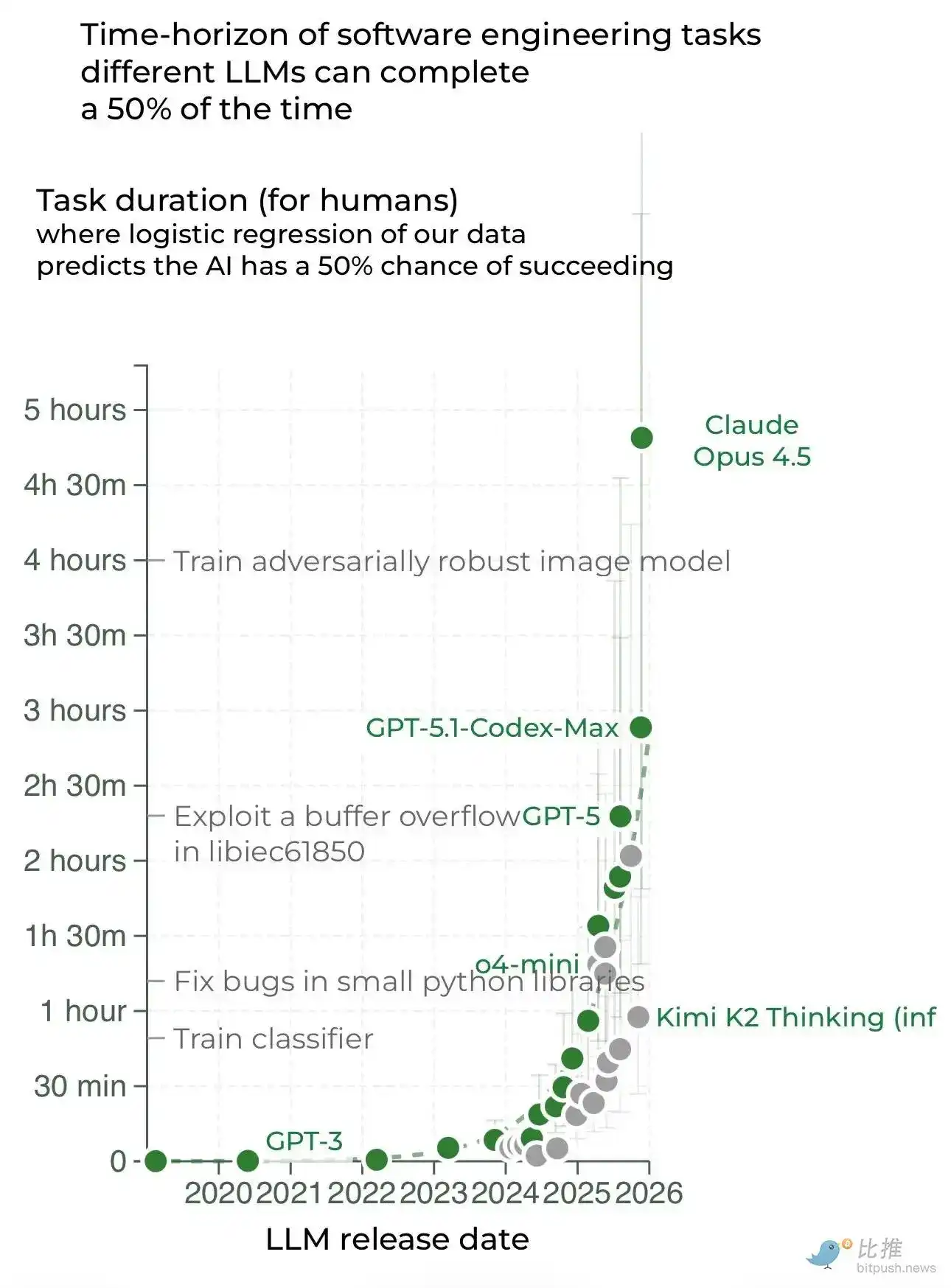
We need to stop believing in this collective illusion and return to reality. On one hand, dozens of companies have achieved over $100 million in annual revenue by serving users; on the other hand, the market is also filled with大量的 falsehoods and scams. Both are true, existing in parallel.

The new year will bring a comprehensive reshuffle, but it also contains huge opportunities. Success can only be achieved by walking carefully on the tightrope of opportunity. See you on the other side!


Kripto yang Sedang Tren

Pertanyaan Terkait

QAccording to the article, what was the main structural problem in the crypto market in 2025 for long-term investors?

AThe market was trapped in a 'negative prisoner's dilemma' where token holders, anticipating future selling pressure, sold off assets, while market makers and exchanges took short-term speculative positions. Token unlock mechanisms and issuance prices often crushed projects before they could achieve profitability or find product-market fit.

QWhat does the article identify as the clear winners in the public markets for 2025, and why?

AThe clear winners were the owners of physical and financial bottlenecks: electricity, semiconductors, and scarce compute power. Companies like Bloom Energy, IREN, Micron, TSMC, and NVIDIA significantly beat the market because capital was chasing assets that 'machines must pass through'.

QHow did the performance of tokenized networks compare to other sectors in the machine economy, as described in the article?

ATokenized networks were the worst-performing sector. With few exceptions, decentralized data, storage, agent, and automation protocols performed poorly because usage failed to translate into token value capture. The market no longer rewarded 'collaborative narratives' without mandatory fee mechanisms.

QWhat are the three key investment areas the venture capital firm is focusing on for 2026?

AThe three key investment areas are: 1) Machine Transaction Surfaces (layers where machines or their operators already conduct economic activity), 2) Applied Infrastructure With Budgets (infrastructure that enterprises or platforms are already procuring), and 3) High-Novelty Opportunities (asymmetric upside opportunities with uncertain timing, like frontier science).

QWhat core shift in investment strategy does the article mention regarding tokens vs. equity?

AThe strategy has shifted to be more aggressive in investing in equity. Previously, the allocation was 40% tokens and 40% equity, with 20% flexible. The article states that the token space will need 12-24 months to digest its current predicament, leading to a greater focus on equity investments.

Bacaan Terkait

Setelah Aave Pergi dan TVL Berguncang Hebat, Di Mana Anchor Valuasi MegaETH Berada?

Berdasarkan data DefiLlama, TVL MegaETH mengalami fluktuasi tajam pada 9-10 Juli, turun sekitar 60% dalam 24 jam menjadi sedikit di atas $30 juta, turun sekitar 70% dari puncaknya pada Mei. Protokol teratas Aave V3 menarik sekitar 80% likuiditas. Harga MEGA turun ke sekitar $0.048, dengan kapitalisasi pasar sekitar $54 juta dan FDV sekitar $480 juta. Artikel ini menganalisis tiga ketidaksesuaian dalam valuasi MegaETH: 1. **Ketidaksesuaian valuasi dengan penggunaan nyata**: FDV $4.7 miliar tidak didukung oleh aktivitas ekonomi riil. Pendapatan protokol 30 hari kurang dari $900k dengan hanya 2.619 alamat aktif harian. Sekitar 88.7% token belum beredar, berpotensi menciptakan tekanan jual di masa depan. 2. **Ketidaksesuaian narasi token dengan kualitas ekosistem**: Meski dinarasikan sebagai blockchain DeFi berkinerja tinggi, sebagian besar pendapatannya justru berasal dari game kartu Monster (sekitar 80%). Aave hanya menyumbang sekitar $90k. Volume perdagangan DEX dan kontrak berlanjut rendah, dan stablecoin native USDM terus menyusut. 3. **Ketidaksesuaian ekspektasi jangka pendek dengan realisasi jangka panjang**: TVL awal didorong oleh insentif dan strategi arbitrase siklus (seperti yang melibatkan USDe), bukan kebutuhan riil yang stabil. Integrasi protokol besar seperti Uniswap dan Aave tidak mempertahankan TVL. Penurunan serupa terlihat pada Monad (MON), menunjukkan pasar mulai meminta dukungan nilai yang lebih jelas daripada sekadar TVL dan narasi. Kesimpulannya, setelah insentif dan modal arbitrase keluar, MegaETH kekurangan pijakan nilai yang solid antara valuasi saat ini dan fundamental on-chain-nya. Pemulihan berkelanjutan bergantung pada kemampuan tim untuk mengubah likuiditas jangka pendek menjadi penggunaan nyata dan mewujudkan hasil ekosistem yang konkret. Tanpa itu, selain pemulihan jangka pendek dari sentimen pasar, sulit menemukan alasan kuat untuk valuasi yang stabil.

链捕手2j yang lalu

Setelah Aave Pergi dan TVL Berguncang Hebat, Di Mana Anchor Valuasi MegaETH Berada?

链捕手2j yang lalu

Laporan Mendalam Goldman Sachs: Siapa yang Akan Menjadi Pemenang Jangka Panjang di Industri Model AI Besar China?

Laporan mendalam Goldman Sachs menganalisis masa depan industri AI model besar China, menilai siapa yang akan menjadi pemenang jangka panjang. China saat ini berada pada titik balik historis, dengan model sumber terbuka/berbobot terbuka yang mendekati kinerja model berpemilik global terdepan. Efek roda data dari adopsi massal perusahaan domestik dan global mendorong iterasi model lebih lanjut. Model China mencapai efisiensi biaya tinggi melalui inovasi arsitektur (seperti MoE) dan efisiensi parameter, dengan model seperti DeepSeek V4 Pro (1,6T parameter) dan GLM5.2 (0,7T). Pasar membentuk struktur dua lapis: model high-end (contoh: GLM5.2) berharga ~$1/juta token, sementara model low-end untuk agen pintar berharga serendah $0,06/juta token. Goldman memproyeksikan pendapatan API/berlangganan model AI China tumbuh dari RMB35 miliar (2026) menjadi RMB879 miliar (2030). Strategi sumber terbuka mendorong adopsi global, tetapi monetisasi terbatas. Pergeseran menuju model "berat terbuka + lisensi komunitas" diharapkan dapat meningkatkan ekonomi unit melalui pembagian pendapatan dengan platform seperti AWS Bedrock. Untuk menentukan pemenang, Goldman menggunakan kerangka kerja tiga dimensi: kemampuan penetapan harga, keunggulan biaya, dan kekuatan keuangan. Dalam model teks dasar, Zhipu (GLM) dan DeepSeek dipandang paling kuat. Dalam multimodal/generasi video, ByteDance (Seedance) menjadi pemimpin, dengan Kuaishou (Kling) dan MiniMax juga diunggulkan. MiniMax mendapat peringkat Beli karena valuasi menarik dan posisi model M3-nya. Ekspansi ke pasar internasional non-AS merupakan peluang pertumbuhan kunci.

marsbit2j yang lalu

Laporan Mendalam Goldman Sachs: Siapa yang Akan Menjadi Pemenang Jangka Panjang di Industri Model AI Besar China?

marsbit2j yang lalu

Laporan Mendalam Goldman Sachs: Siapa yang Akan Menjadi Pemenang Jangka Panjang dalam Industri Model AI Besar China?

Laporan mendalam Goldman Sachs membahas pergeseran historis dalam industri model AI besar (LLM) China. Analisis menilai bagaimana model China, melalui inovasi arsitektur (seperti MoE) dan efisiensi parameter, mencapai kinerja cerdas yang mendekati model global teratas dengan biaya lebih rendah, didorong oleh momen efisiensi biaya DeepSeek (2025) dan momen kecerdasan model GLM Zhipu (2026). Pasar membentuk struktur dua lapis: model high-end (contoh: GLM5.2, Qwen3.7 Max) dengan harga ~$1/juta token, dan model low-end untuk agen AI dengan harga serendah $0.06/juta token, yang memperluas adopsi di kalangan UKM global. Goldman memproyeksikan pendapatan API/subskripsi model AI China tumbuh dari ~¥35 miliar (2026) menjadi ~¥879 miliar pada 2030. Strategi open-source/terbobot terbuka mendominasi untuk fleksibilitas dan ekosistem, tetapi monetisasinya terbatas. Tren pergeseran ke model "bobot terbuka + lisensi komunitas" (seperti MiniMax) dengan bagi hasil diharapkan meningkatkan ekonomi unit. Ekspansi ke pasar internasional (non-AS) adalah peluang kunci, seiring pergeseran paradigma perusahaan global dari "token maksimisasi" ke prioritas ROI. Menggunakan kerangka penilaian tiga dimensi (kemampuan penetapan harga, keunggulan biaya, kekuatan finansial), Goldman mengidentifikasi pemenang jangka panjang: Zhipu AI (cakupan awal: netral) dan DeepSeek (swasta) paling kuat di domain model teks dasar. Di bidang multimodal/generasi video, ByteDance (Seedance) memimpin, diikuti Kuaishou (Kling) dan MiniMax. Goldman mempertahankan rating "beli" untuk MiniMax, melihat diskon valuasi.

链捕手2j yang lalu

Laporan Mendalam Goldman Sachs: Siapa yang Akan Menjadi Pemenang Jangka Panjang dalam Industri Model AI Besar China?

链捕手2j yang lalu

Circle mendapatkan persetujuan akhir dari OCC untuk bank trust nasional guna memperkuat infrastruktur USDC

Circle telah menerima persetujuan akhir dari Kantor Pengawas Mata Uang AS (OCC) untuk mendirikan bank trust nasional dengan nama Circle National Trust. Persetujuan ini menandai pencapaian regulasi besar yang menempatkan infrastruktur kunci untuk stablecoin USDC di bawah pengawasan perbankan federal langsung. Bank trust nasional ini, yang akan beroperasi dengan nama First National Digital Currency Bank, N.A., awalnya akan menyediakan layanan penitipan aset digital fidusia untuk Circle dan afiliasinya. Ini membuka jalan untuk menawarkan layanan serupa kepada klien institusional terbatas, seperti bank dan lembaga keuangan teratur. Persetujuan ini juga dirancang untuk mendukung manajemen cadangan USDC di masa depan di bawah pengawasan OCC, sehingga memperkuat infrastruktur USDC melalui penitipan aset yang diatur secara federal. CEO Jeremy Allaire menyebut langkah ini sebagai langkah penting dalam membawa infrastruktur blockchain ke dalam sistem keuangan AS, memberikan transparansi dan kepercayaan yang lebih besar bagi institusi. Circle termasuk di antara beberapa perusahaan aset digital, termasuk Ripple dan Fidelity Digital Assets, yang mendapat persetujuan bersyarat dari OCC pada akhir 2025, dan kini telah maju ke tahap operasional final. Ini mencerminkan tren regulator di AS yang semakin mengintegrasikan penyedia infrastruktur crypto ke dalam kerangka perbankan yang ada.

ambcrypto3j yang lalu

Circle mendapatkan persetujuan akhir dari OCC untuk bank trust nasional guna memperkuat infrastruktur USDC

ambcrypto3j yang lalu

Trading

Spot

Artikel Populer

Cara Membeli WIN

Selamat datang di HTX.com! Kami telah membuat pembelian WINkLink (WIN) menjadi mudah dan nyaman. Ikuti panduan langkah demi langkah kami untuk memulai perjalanan kripto Anda.Langkah 1: Buat Akun HTX AndaGunakan alamat email atau nomor ponsel Anda untuk mendaftar akun gratis di HTX. Rasakan perjalanan pendaftaran yang mudah dan buka semua fitur.Dapatkan Akun SayaLangkah 2: Buka Beli Kripto, lalu Pilih Metode Pembayaran AndaKartu Kredit/Debit: Gunakan Visa atau Mastercard Anda untuk membeli WINkLink (WIN) secara instan.Saldo: Gunakan dana dari saldo akun HTX Anda untuk melakukan trading dengan lancar.Pihak Ketiga: Kami telah menambahkan metode pembayaran populer seperti Google Pay dan Apple Pay untuk meningkatkan kenyamanan.P2P: Lakukan trading langsung dengan pengguna lain di HTX.Over-the-Counter (OTC): Kami menawarkan layanan yang dibuat khusus dan kurs yang kompetitif bagi para trader.Langkah 3: Simpan WINkLink (WIN) AndaSetelah melakukan pembelian, simpan WINkLink (WIN) di akun HTX Anda. Selain itu, Anda dapat mengirimkannya ke tempat lain melalui transfer blockchain atau menggunakannya untuk memperdagangkan mata uang kripto lainnya.Langkah 4: Lakukan trading WINkLink (WIN)Lakukan trading WINkLink (WIN) dengan mudah di pasar spot HTX. Cukup akses akun Anda, pilih pasangan perdagangan, jalankan trading, lalu pantau secara real-time. Kami menawarkan pengalaman yang ramah pengguna baik untuk pemula maupun trader berpengalaman.

452 Total TayanganDipublikasikan pada 2024.12.11Diperbarui pada 2025.03.21

Cara Membeli WIN

Diskusi

Selamat datang di Komunitas HTX. Di sini, Anda bisa terus mendapatkan informasi terbaru tentang perkembangan platform terkini dan mendapatkan akses ke wawasan pasar profesional. Pendapat pengguna mengenai harga WIN (WIN) disajikan di bawah ini.

活动图片