# Artikel Terkait Oracles

Pusat Berita HTX menyediakan artikel terbaru dan analisis mendalam mengenai "Oracles", mencakup tren pasar, pembaruan proyek, perkembangan teknologi, dan kebijakan regulasi di industri kripto.

Tiger Research: Zuckerberg Begins Betting on Prediction Markets, While Asian Nations Still View Them as Gambling

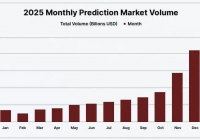
This article examines the rise of prediction markets, contrasting their growing institutional acceptance in the West with their restrictive regulation in Asia. It details how prediction markets, which originated from informal political betting and academic experiments like the Iowa Electronic Market, aggregate crowd wisdom into probabilistic prices through binary contracts. Their growth accelerated around 2020, reaching over $14 billion in monthly volume. A key driver is the "skin in the game" principle, where users risk their own capital, leading to high accuracy in predicting events like Fed rate decisions and elections, as demonstrated by platforms like Polymarket. Meta's entry, with Mark Zuckerberg reportedly leading the development of the Arena app, signals the market's maturation. In the U.S., court rulings have distinguished prediction markets from gambling, facilitating entry by traditional financial institutions. However, most Asian jurisdictions still classify them as gambling, focusing on social control rather than financial innovation. The article argues this stance creates three problems for Asia: 1) regulatory arbitrage pushes users to riskier offshore platforms, 2) loss of sovereign information infrastructure as valuable social sentiment data accumulates abroad, and 3) abandonment of user protection. It concludes that Asia needs a policy shift from prohibition to constructive regulation, integrating these markets into the formal system to harness their data as a national asset, as initiatives like Limitless Research are beginning to do.

marsbit07/11 10:43

Tiger Research: Zuckerberg Begins Betting on Prediction Markets, While Asian Nations Still View Them as Gambling

marsbit07/11 10:43

Zuckerberg Begins Betting on Prediction Markets, While Asian Countries Still View Them as Gambling

Mark Zuckerberg is backing prediction markets, with Meta developing its own app "Arena," signaling major tech validation. This industry now sees over $14 billion in monthly volume. These markets function as binary contracts (payout $1 if an event occurs, $0 if not), with trading prices reflecting real-time event probabilities. Results are settled by oracles. Prediction markets originated from informal political betting and academic experiments like the Iowa Electronic Markets. Their core mechanism relies on "skin in the game"—participants risk their own money, making aggregated information more reliable than polls or expert opinions. They have proven accurate in forecasting areas like monetary policy, elections, and market events. While Western markets are integrating them into regulated financial systems, many Asian jurisdictions still classify them as gambling, leading to regulatory divergence. This stance creates three major issues for Asia: regulatory arbitrage and capital outflow, loss of informational sovereignty as valuable social data accumulates offshore, and a lack of user protection within a formal framework. The article argues that Asia's focus should shift from blocking these markets to responsibly harnessing the data they generate within a regulated system. The current avoidance of discussion cedes leadership and advantages to foreign entities.

Foresight News07/09 11:47

Zuckerberg Begins Betting on Prediction Markets, While Asian Countries Still View Them as Gambling

Foresight News07/09 11:47

On-Chain Figures on the Eve of Kickoff: 1.6 Billion Traded Before the World Cup Even Begins

"On-Chain Numbers on the Eve of the World Cup: $1.6 Billion Traded Before Kick-off" Analysis of on-chain markets before the 2026 FIFA World Cup reveals significant crypto integration into football. The most striking figure is the approximately **$1.6 billion** in total trading volume on the single "World Cup Winner" contract on the Polymarket prediction market platform, accumulated before a single match was played. This represents explosive growth for a sector whose annual volume surged from ~$16B in 2024 to ~$64B in 2025. The ecosystem is maturing beyond speculation. Key developments include: 1) **Infrastructure upgrades** like Polymarket's migration to native, regulated USDC stablecoin for settlements; 2) **Reliable data oracles**, such as Chainlink, being used to resolve real-world match outcomes on-chain; and 3) **Official recognition**, with FIFA appointing its first-ever "Prediction Markets" partner. Over 100 contracts now cover everything from the outright winner to individual match results and even non-sporting risks like venue relocation. This evolution marks a fundamental shift. While crypto firms are absent from FIFA's top-tier sponsor list, the technology has deeply penetrated the tournament's financial and predictive infrastructure through regulated stablecoin settlements, decentralized oracles, and new official partnership categories. The regulatory landscape remains complex and varies by jurisdiction, but on-chain markets for the World Cup are already a multi-billion-dollar reality.

marsbit06/06 00:54

On-Chain Figures on the Eve of Kickoff: 1.6 Billion Traded Before the World Cup Even Begins

marsbit06/06 00:54

Pharos Ecosystem Security Guide: Full-Link Risk Control for RWA Asset Integration

"Pharos Ecosystem Security Guide: Comprehensive Risk Control for RWA Asset Integration" This guide provides developers in the Pharos ecosystem with a practical framework for integrating Real-World Assets (RWAs), addressing the unique challenges of combining off-chain legal claims with on-chain functionality. Pharos’s Layer 1 infrastructure, featuring Block-STM for parallel execution and dual EVM/WASM support, offers the high-speed settlement and complex computational power required for RWA operations. The analysis identifies two primary RWA models: 1) the on-chain to off-chain model (e.g., fundraising in stablecoins for off-chain investments like U.S. Treasuries) and 2) the asset tokenization model (e.g., fractionalizing real estate for on-chain ownership). The core focus is mitigating critical risks beyond smart contracts. Key strategies include: enforcing identity compliance via smart contract-level whitelisting and DID integration; implementing oracle-based circuit breakers to halt operations during stablecoin depegging events; ensuring asset authenticity with multi-source oracles for real-time NAV updates; mandating transparency for off-chain Special Purpose Vehicles (SPVs); designing built-in redemption queues and liquidity buffers to prevent secondary market collapses; and rigorously defending against inherited EVM vulnerabilities using audited libraries and reentrancy guards. The conclusion emphasizes that RWA security is a full-stack challenge, requiring robust integration of legal, financial, and technical safeguards to ensure asset authenticity and systemic resilience on Pharos.

marsbit01/20 14:10

Pharos Ecosystem Security Guide: Full-Link Risk Control for RWA Asset Integration

marsbit01/20 14:10

a16z: 3 Ways Crypto Will Outgrow Cryptocurrency by 2026

a16z: 3 Ways Crypto Will Move Beyond Crypto by 2026 The article outlines three key trends for 2026, as predicted by a16z crypto experts: 1. **Smarter, Broader Prediction Markets:** Prediction markets will become more sophisticated by integrating with AI and crypto. They will offer a wider range of contracts for detailed events, moving beyond major elections. This growth presents challenges, such as resolving disputed outcomes, which new decentralized governance and LLM oracles can address. AI agents trading on these platforms could uncover new predictive strategies. Prediction markets won't replace polls but will complement them, with crypto providing tools to verify respondents are human. 2. **Crypto Tech as a Foundational Tool Beyond Blockchains:** The cryptographic tool SNARKs (succinct proofs for verifying computations) will see drastically reduced overhead costs, dropping to around 10,000x the cost of the original computation. This efficiency, achievable on a single GPU, will make "verifiable cloud computing" practical. Users running CPU workloads in the cloud will be able to obtain cryptographic proofs of correctness at a reasonable cost, enabling trust in off-chain computations. 3. **The Rise of "Staked Media":** The traditional media model is being supplemented by a new paradigm where commentators use crypto tools to make verifiable commitments and back their opinions with action. This involves using tokenized assets, programmable locks, and prediction markets to prove they are not engaging in hype or "pump and dump" schemes. Trust is built not on claims of neutrality but on transparent, auditable proof—staking assets to show they have "skin in the game."

marsbit01/11 01:43

a16z: 3 Ways Crypto Will Outgrow Cryptocurrency by 2026

marsbit01/11 01:43

活动图片