Supported by 20+ Institutions: How Does Sui's New Primitive Hashi Rewrite the Rules of Bitcoin Financial Trust?

marsbitDipublikasikan tanggal 2026-04-15Terakhir diperbarui pada 2026-04-15

Abstrak

Sui has introduced Hashi, a new decentralized Bitcoin (BTC)抵押原语 (primitive) designed to enable trust-minimized and secure use of native BTC in DeFi on the Sui blockchain, backed by over 20 major institutions. Hashi allows users to抵押 Bitcoin without transferring custody to centralized entities. BTC remains on the Bitcoin network in a dedicated address, while a抵押凭证 is generated on Sui. This凭证, representing the locked BTC, can be used in Sui's smart contracts for lending, borrowing, and other DeFi activities. The system relies on Sui validators for security, with a Guardian Layer for additional protection against risks like validator collusion. Key to Hashi is its role as a "primitive"—a foundational building block for developers. It provides a standardized interface to integrate native BTC抵押 capabilities into applications like lending protocols, structured products, and RWA strategies, reducing development barriers. Institutional support spans custody (e.g., BitGo, Cobo), trading (e.g., FalconX, Bullish), security (e.g., OtterSec, Certora), and protocols (e.g., Suilend, Scallop). This ecosystem support aims to facilitate large-scale institutional BTC adoption into DeFi upon mainnet launch. Hashi addresses core trust issues in Bitcoin金融 by prioritizing non-custodial security, transparency, and composability, potentially unlocking Bitcoin's $1.4 trillion market cap for decentralized finance without sacrificing user control.

Author: Deep Tide TechFlow

While market attention is being drawn away by U.S. stocks, AI, and gold, Sui recently announced a new move:

Hashi, a Bitcoin collateral primitive based on Sui, is about to launch and has garnered support from top-tier institutions.

Bitcoin finance, a topic that has been discussed for a long time but remains unresolved:

As the largest on-chain asset treasury with a market cap exceeding $1.4 trillion, the proportion of Bitcoin used in DeFi is still less than 0.22%.

The core reason it remains unresolved is not due to insufficient functionality but the wrong premise of trust. In many past attempts, users were often misled—you thought your Bitcoin was in your hands, but it was actually on someone else’s ledger. The collapses of Celsius, Voyager, Genesis, and other projects have repeatedly sounded the alarm for the logic of "sacrificing trust for efficiency."

Especially synthetic Bitcoin, although it has attracted a considerable number of retail users, this structure has failed to convert a large amount of Bitcoin into DeFi capital and cannot attract institutions and large asset holders who require stronger guarantees.

This is precisely the important opportunity for the launch of Sui’s new developer primitive Hashi:

Reconstructing the most critical trust base for Bitcoin finance.

Enabling native BTC collateral to be organized more transparently in Sui’s smart contract environment—no wrapping, no synthesizing, no handing over keys to any centralized entity—and turning this capability into directly reusable interfaces.
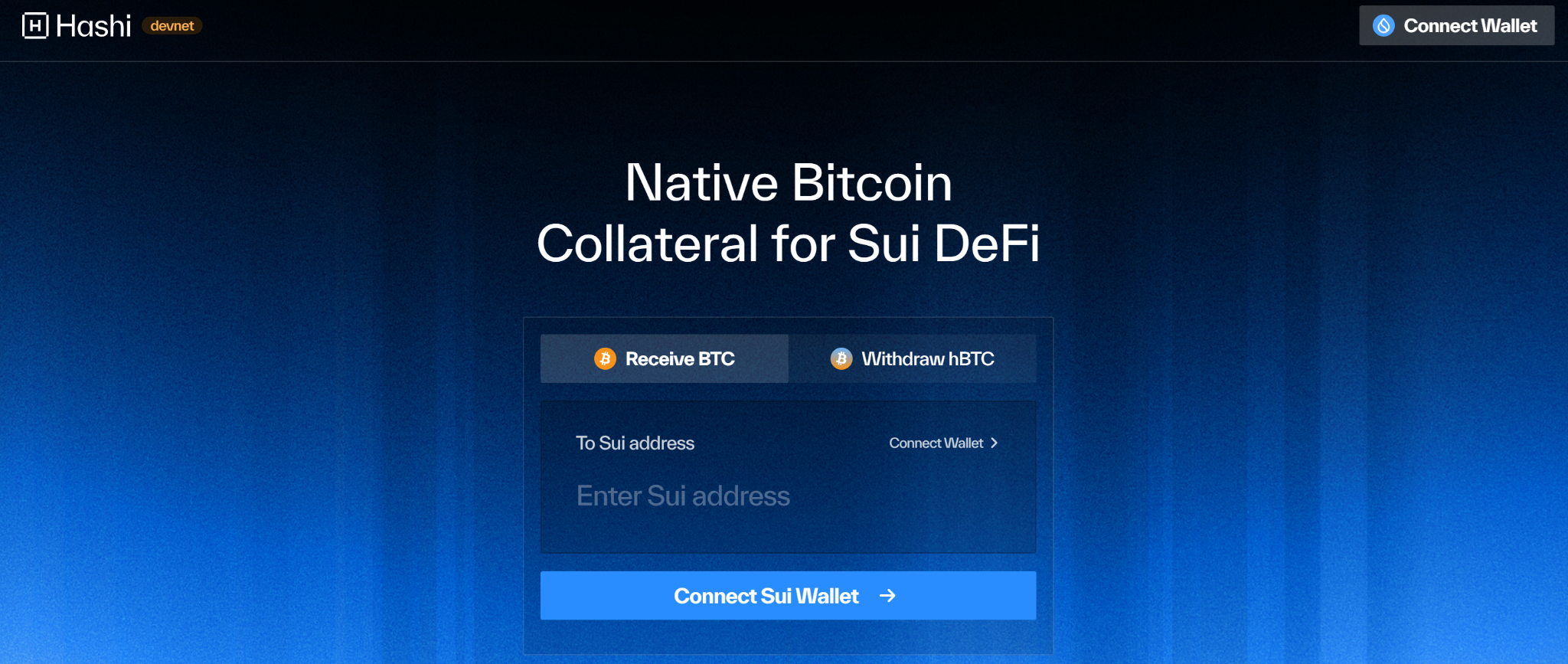
Hashi Native BTC Programmability: BTC Stays on the Chain, Collateral Rights Enter the Sui Network

The design philosophy of Hashi can be summarized in one sentence:

Assets remain on the Bitcoin network, rights exist on the Sui network—both occur simultaneously without interference.

Suppose you have one Bitcoin and want to use it as collateral to borrow some USDC.

In most past solutions:

You either deposit BTC into a centralized platform to obtain a borrowing limit or accept Wrapped BTC. Your Bitcoin, at some point, must be handed over to someone else, essentially trading "trust in an entity" for "programmability."

With Hashi:

  • Deposit: Users deposit BTC into a dedicated address (a unique Bitcoin deposit address generated by Hashi for their Sui address). The private key for this address does not belong to any single entity but is collectively managed by the validators on the Sui network. The BTC can only be moved if enough validators reach a consensus. This means no single entity can run away with your money unless they control more than one-third of the entire Sui validator network.
  • Proof Generation: Validators simultaneously monitor the Bitcoin network. Once they confirm your BTC is locked in, a corresponding collateral proof is generated on the Sui chain. This proof is not a newly issued token or a wrapped asset; it is an on-chain certificate proving that a real BTC is locked, and you are its owner.
  • As Collateral: With this proof, you can borrow money, participate in DeFi, or set up yield strategies in Sui’s smart contracts. All rules are written in code and executed automatically, with no room for interference.
  • Repayment and Withdrawal: After repayment, validators automatically release the native BTC on the Bitcoin mainnet through MPC threshold signatures, which can be withdrawn to any Bitcoin address without manual intervention.
  • Guardian Layer: To prevent extreme situations (such as validator collusion), Hashi additionally introduces a Guardian Layer as a secondary check and backup protection, primarily monitoring large withdrawals or abnormal thresholds to prevent potential systemic risks.
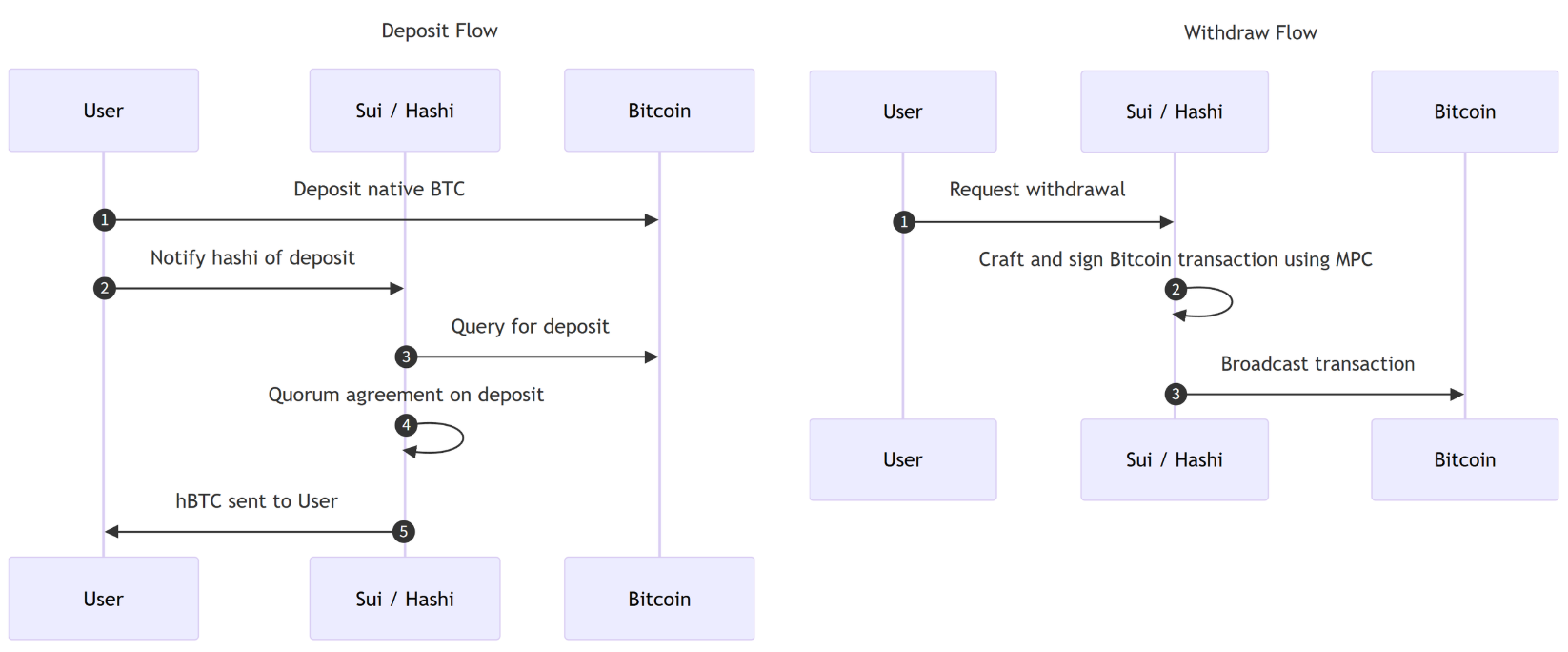
Throughout the entire lifecycle:

BTC always remains on the Bitcoin mainnet and is not moved into any platform’s internal account;

No single centralized entity has exclusive control of the private key;

What circulates on Sui is the collateral right backed by real BTC, reopening the programmability of native BTC;

And the only entities users need to trust are the validator network and the smart contract.
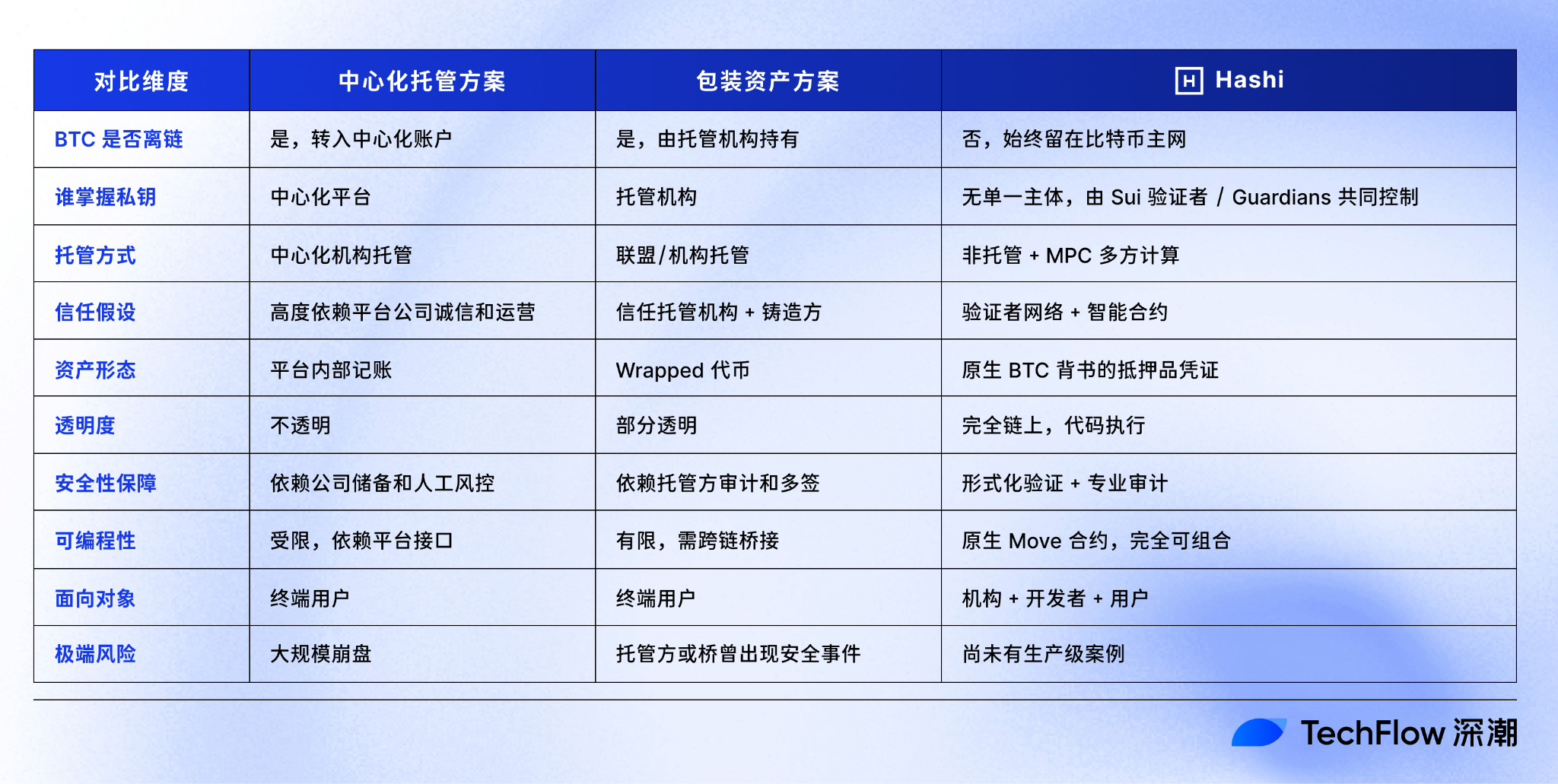
Simply put, Hashi is committed to enabling the collateral relationship of native BTC to be directly recognized by the on-chain financial system, with minimal trust placed in centralized entities.

During stable market conditions, users may perceive little difference, but in extreme situations like platform collapses or liquidity crises, it is the difference between whether your BTC is still there or not.

Not a Product, but a "Primitive": A Directly Reusable "Standard Brick"

From a design perspective, Hashi is a more decentralized, trust-minimized, and secure transparent Bitcoin financial solution.

However, if Hashi is understood solely as a single "solution," its most potential aspect might be missed.

It is important to note that for a long time, Sui has been striving to evolve from "a chain" to "a complete set of developer infrastructure." Whether it’s launching Walrus, Seal, or Nautilus, the goal has been to achieve full-stack nativity from execution, storage, permission control to off-chain computation, providing convenience for developers and building the necessary foundation for ecosystem prosperity.

This time, facing Bitcoin finance is no exception.

According to the official definition:

Hashi is the first decentralized Bitcoin collateral primitive developed by Mysten Labs, allowing developers to actively handle UTXOs from the Bitcoin network in Sui’s native smart contract language.

The key word is "primitive."

In the context of blockchain and DeFi, a primitive often refers to a fundamental building block or underlying infrastructure component. It is like a "standard brick" in Lego:

It is not an end product for ordinary users but a basic module for developers to build products.

Just as TCP/IP is not an app but all apps run on it; Hashi is not a product, but lending platforms, yield strategies, and structured products can all be built on it.

In other words, Hashi does not provide a closed financial service but an underlying capability, enabling native BTC to become collateral that Sui smart contracts can directly call.

As for what this collateral is used for, how it is used, and under what rules, Hashi does not interfere—it leaves it to the contracts, developers, and the market.
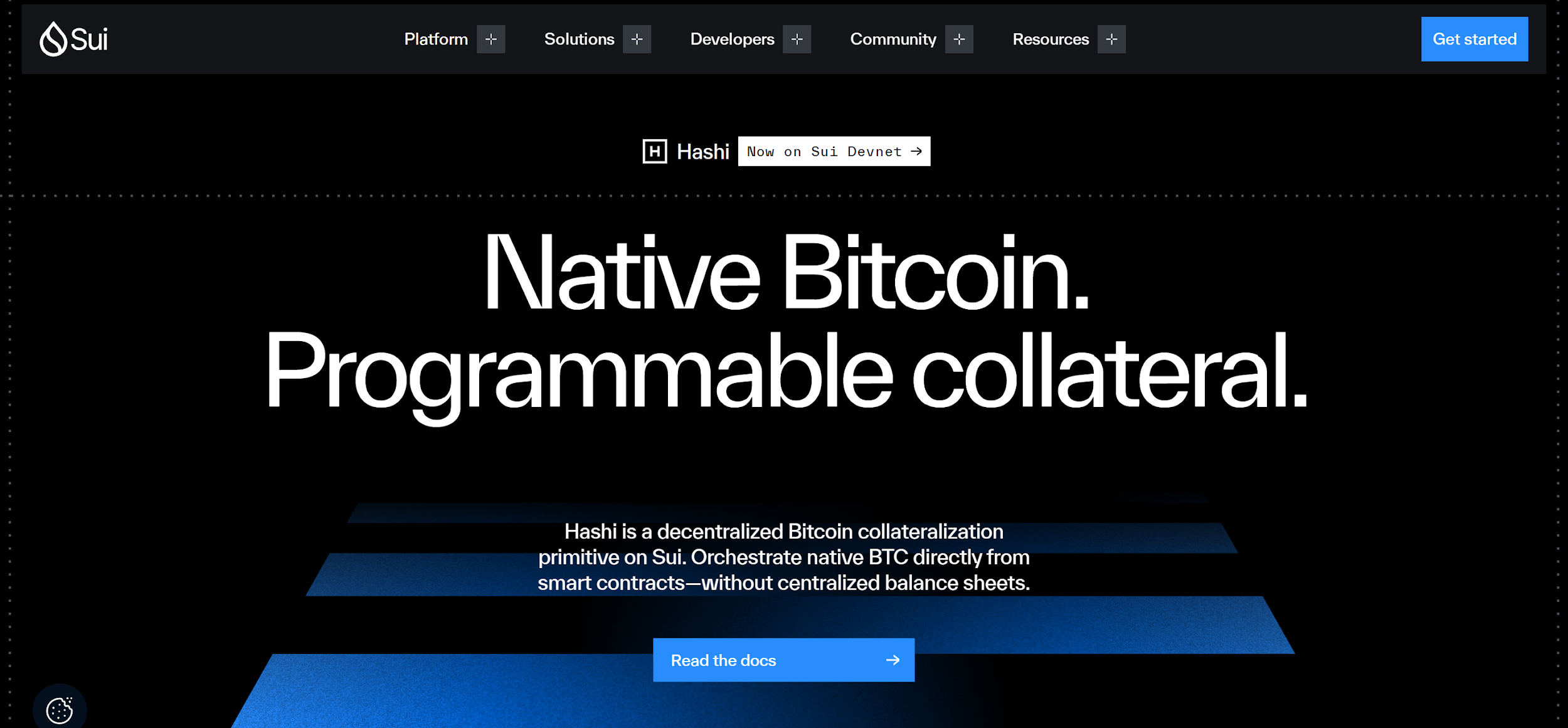
Before Hashi, if developers wanted to build a protocol with BTC as collateral, they faced numerous challenges: either accept the trust risks of centralized custody or implement the complex logic of native BTC collateral from scratch.

As a primitive, Hashi turns this difficult problem into a directly reusable interface.

Now, when building specific products, developers can directly call the mechanisms provided by Hashi, enabling their protocols to inherently possess native BTC collateral capabilities without having to solve underlying problems again, significantly reducing development barriers and time costs.

Users, whether institutional or retail, will, through products built on Hashi, for the first time truly gain the ability to earn yields with Bitcoin without giving up control over it. In the initial phase, lending will be the first use case for Hashi, allowing BTC to be lent out or used as collateral to borrow stablecoins. In the future, Hashi’s scenarios will gradually expand to vaults, insurance, structured products, credit derivatives, and RWA yield strategies.

Bitcoin is the asset with the broadest global consensus and deepest liquidity, but in the past, this wealth was almost invisible to the on-chain financial world: it is massive but not programmable; it is valuable but cannot be directly perceived and called by smart contracts.

Therefore, when Hashi turns the native BTC collateral capability into an interface that any developer can directly call, the upper-layer application space it can leverage far exceeds any specific product or protocol.

And the correctness of this judgment is already answered by the extensive institutional support Hashi has received.

Institutional Day One Support: Building a Complete Ecosystem Around Hashi

Currently, Hashi is live on Sui Devnet, primarily for developer testing and auditing, and has not yet entered the production environment. However, it has already received explicit support commitments from several leading industry institutions.

In terms of infrastructure: Including BitGo, Blockdaemon, Cobo, Ledger, and other major institutions, directly bridging institutional BTC from cold storage into on-chain collateral scenarios.

In terms of trading and liquidity: Including FalconX, Bullish, CF Benchmarks, and other major institutions, providing Hashi with reliable pricing, liquidity exits, and institutional-grade counterparty support.

In terms of security and compliance: Multiple teams, including security auditing firm OtterSec, smart contract formal verification security company Certora, and cryptography and zero-knowledge proof research and engineering team Asymptotic, have chosen to support Hashi and will conduct smart contract audits, formal verification, cryptography, and zero-knowledge proof research before Hashi’s mainnet launch.

At the same time, projects including Suilend, Scallop, NAVI Protocol, Matrixdock, and Bluefin have announced they will integrate Hashi to unleash on-chain financial potential, enabling retail and institutional users to quickly access BTC collateral lending experiences.

In addition, Soter Insure, a provider of institutional-grade insurance solutions, has announced a partnership with Hashi to bring built-in institutional-grade insurance mechanisms as a risk protection layer.

These institutions represent thousands of billions of dollars in Bitcoin nominal value and mature compliance infrastructure. Their commitment to integration at the Hashi Devnet stage means that once Hashi officially launches, large-scale institutional Bitcoin assets will have the practical conditions to enter on-chain scenarios.

At the same time, looking at these 20+ institutions together, an interesting fact emerges: they almost cover every环节 of a complete Bitcoin financial ecosystem:

From Bitcoin security custody, on-chain collateral, price pricing, liquidity support, lending protocols, yield strategies, RWA integration, to security audits and user entry, an end-to-end chain has already taken shape.

In other words, behind this list of supporters, a complete ecosystem map of Bitcoin finance围绕 the Hashi primitive will be ready from day one of Hashi’s mainnet launch.

Conclusion

Of course, Hashi is still in the Devnet stage. It has not yet undergone long-term testing in the mainnet environment, with real asset scale and extreme market fluctuations. Its production-level performance still needs time to verify. The path of Bitcoin finance will not immediately become smooth just because a new primitive emerges.

However, judging from the integration commitments of over 20 leading institutions in custody, liquidity, security, and protocol layers from day one, market recognition of this path is clear enough.

The story of Bitcoin finance has been told for many years, but the real breakthrough point has never been about "what can be done" but "why trust."

Past solutions, whether centralized custody or wrapped assets, essentially required users to make the same choice: either give up control for yield or hold the keys but be excluded from on-chain finance.

Hashi attempts to rewrite the question itself: making the collateral capability of native BTC an underlying interface that developers can directly call, enabling Bitcoin’s sleeping trillion-dollar treasury to be truly "seen" by the smart contract world in a non-custodial, verifiable, and composable way for the first time.

Reconstructing trust is often harder than stacking functions.

If the endgame of Bitcoin finance is to make Bitcoin truly the native collateral of on-chain finance, then what Hashi is doing may be laying the first pile for this bridge.


Pertanyaan Terkait

QWhat is Hashi and how does it aim to change Bitcoin financial trust rules?

AHashi is a decentralized Bitcoin collateral primitive developed on Sui that enables native BTC to be used as programmable collateral in DeFi without requiring users to relinquish custody to centralized entities. It reconstructs the trust foundation by allowing BTC to remain on the Bitcoin network while its collateral rights are represented on Sui, managed collectively by validators without single-point control.

QHow does Hashi's deposit and抵押 process work technically?

AUsers deposit BTC into a unique Bitcoin address generated by Hashi for their Sui address. The private key of this address is collectively managed by Sui validators, requiring consensus for any movement. Validators monitor the Bitcoin network, confirm the deposit, and issue a抵押凭证 on Sui, which serves as proof of locked BTC. This凭证 can then be used in Sui's smart contracts for DeFi activities like borrowing.

QWhy is Hashi described as a 'primitive' rather than a product?

AHashi is termed a 'primitive' because it functions as a foundational building block or底层 infrastructure component for developers, not an end-user product. It provides a reusable interface that allows developers to integrate native BTC collateral capabilities directly into their applications (e.g., lending platforms, yield strategies) without rebuilding the complex underlying logic, thereby reducing development barriers and costs.

QWhich types of institutions have supported Hashi, and what roles do they play?

AHashi has garnered support from over 20 institutions across custody and infrastructure (e.g., BitGo, Cobo), trading and liquidity (e.g., FalconX, Bullish), security and compliance (e.g., OtterSec, Certora), and DeFi protocols (e.g., Suilend, Scallop). These institutions provide essential services like secure custody, liquidity, auditing, and integration, forming a comprehensive ecosystem for Bitcoin financial services on Sui.

QWhat are the potential risks or limitations of Hashi mentioned in the article?

AHashi is still in the Devnet phase and has not yet been tested in a mainnet environment with real assets and extreme market conditions. Its production-level performance requires further validation. Additionally, while it minimizes trust in centralized entities, it still relies on Sui validators and smart contract security, with a Guardian Layer added as a secondary check for risks like validator collusion.

Bacaan Terkait

Trading

Spot
Futures

Artikel Populer

Apa Itu BITCOIN

Memahami HarryPotterObamaSonic10Inu (ERC-20) dan Posisinya dalam Ruang Crypto Dalam beberapa tahun terakhir, pasar cryptocurrency telah menyaksikan peningkatan popularitas koin meme, menarik minat tidak hanya dari para pedagang, tetapi juga mereka yang mencari keterlibatan komunitas dan nilai hiburan. Di antara token unik ini adalah HarryPotterObamaSonic10Inu (ERC-20), sebuah proyek menarik yang memadukan referensi budaya ke dalam dunia cryptocurrency. Artikel ini membahas aspek-aspek kunci dari HarryPotterObamaSonic10Inu, menjelajahi mekanismenya, etos yang digerakkan oleh komunitas, dan keterlibatannya dengan lanskap crypto yang lebih luas. Apa itu HarryPotterObamaSonic10Inu (ERC-20)? Seperti namanya, HarryPotterObamaSonic10Inu adalah koin meme yang dibangun di atas blockchain Ethereum, diklasifikasikan di bawah standar ERC-20. Berbeda dengan cryptocurrency tradisional yang mungkin menekankan utilitas praktis atau potensi investasi, token ini berkembang berdasarkan nilai hiburan dan kekuatan komunitasnya. Proyek ini bertujuan untuk menciptakan lingkungan di mana pengguna yang terlibat dapat berkumpul, berbagi ide, dan berpartisipasi dalam aktivitas yang terinspirasi oleh berbagai fenomena budaya. Salah satu fitur mencolok dari HarryPotterObamaSonic10Inu adalah nol pajak pada transaksi. Elemen menarik ini bertujuan untuk mendorong perdagangan dan keterlibatan komunitas, tanpa biaya tambahan yang dapat menghalangi pedagang berskala kecil. Total pasokan koin ditetapkan pada satu miliar token, sebuah angka yang menandakan niatnya untuk menjaga sirkulasi yang substansial di dalam komunitas. Pencipta HarryPotterObamaSonic10Inu (ERC-20) Asal usul HarryPotterObamaSonic10Inu agak diselimuti misteri; rincian tentang penciptanya tetap tidak diketahui. Pengembangan token ini tidak memiliki tim yang teridentifikasi atau cetak biru yang jelas, yang bukan hal yang aneh dalam sektor koin meme. Sebaliknya, proyek ini muncul secara organik, dengan kemajuannya sangat bergantung pada antusiasme dan partisipasi komunitasnya. Investor HarryPotterObamaSonic10Inu (ERC-20) Terkait investasi eksternal dan dukungan, HarryPotterObamaSonic10Inu juga tetap ambigu. Token ini tidak mencantumkan yayasan investasi atau dukungan organisasi yang signifikan. Sebaliknya, denyut nadi proyek ini adalah komunitas akar rumputnya, yang menginformasikan pertumbuhannya dan keberlanjutan melalui aksi kolektif dan keterlibatan di ruang crypto. Bagaimana HarryPotterObamaSonic10Inu (ERC-20) Bekerja? Sebagai koin meme, HarryPotterObamaSonic10Inu beroperasi terutama di luar kerangka tradisional yang sering mengatur nilai aset. Ada beberapa aspek khas yang mendefinisikan cara kerja proyek ini: Transaksi Tanpa Pajak: Dengan tidak ada biaya pajak pada transaksi, pengguna dapat membeli dan menjual token tanpa khawatir akan biaya tersembunyi. Keterlibatan Komunitas: Proyek ini berkembang melalui interaksi komunitas, memanfaatkan platform media sosial untuk menciptakan buzz dan memfasilitasi keterlibatan. Diskusi, berbagi konten, dan keterlibatan adalah elemen penting yang membantu memperluas jangkauannya dan membangun loyalitas di antara para pendukung. Tidak Ada Utilitas Praktis: Perlu dicatat bahwa HarryPotterObamaSonic10Inu tidak menawarkan utilitas konkret dalam ekosistem finansial. Sebaliknya, ia diklasifikasikan sebagai token yang terutama untuk hiburan dan aktivitas komunitas. Referensi Budaya: Token ini dengan cerdik menggabungkan elemen dari budaya populer untuk menarik minat, terhubung dengan penggemar meme dan pengikut crypto. HarryPotterObamaSonic10Inu menunjukkan bagaimana koin meme beroperasi berbeda dari proyek cryptocurrency yang lebih tradisional, memasuki pasar sebagai konstruksi sosial yang inovatif daripada aset utilitarian. Garis Waktu HarryPotterObamaSonic10Inu (ERC-20) Sejarah HarryPotterObamaSonic10Inu ditandai oleh beberapa tonggak yang patut dicatat: Penciptaan: Token ini muncul dari meme viral, menangkap imajinasi banyak penggemar crypto. Tanggal penciptaan spesifik tidak tersedia, menekankan kebangkitannya yang organik. Pendaftaran di Bursa: HarryPotterObamaSonic10Inu telah muncul di berbagai bursa, memungkinkan akses dan perdagangan yang lebih mudah oleh komunitas. Inisiatif Keterlibatan Komunitas: Kegiatan yang sedang berlangsung bertujuan untuk meningkatkan interaksi komunitas, termasuk kontes, kampanye media sosial, dan generasi konten dari penggemar dan pendukung. Rencana Ekspansi Masa Depan: Peta jalan proyek ini mencakup peluncuran koleksi NFT, merchandise, dan situs eCommerce yang terkait dengan tema budayanya, lebih lanjut melibatkan komunitas dan berusaha menambahkan lebih banyak dimensi ke ekosistemnya. Poin Kunci Tentang HarryPotterObamaSonic10Inu (ERC-20) Sifat yang Diggerakkan oleh Komunitas: Proyek ini memprioritaskan masukan dan kreativitas kolektif, memastikan bahwa keterlibatan pengguna berada di garis depan pengembangannya. Klasifikasi Koin Meme: Ini mewakili puncak cryptocurrency berbasis hiburan, terpisah dari kendaraan investasi tradisional. Tidak Ada Afiliasi Langsung dengan Bitcoin: Meskipun ada kesamaan dalam nama ticker, HarryPotterObamaSonic10Inu berbeda dan tidak memiliki hubungan dengan Bitcoin atau cryptocurrency lain yang mapan. Fokus pada Kolaborasi: HarryPotterObamaSonic10Inu dirancang untuk menciptakan ruang untuk kolaborasi dan berbagi cerita di antara para pemegangnya, memberikan saluran untuk kreativitas dan ikatan komunitas. Prospek Masa Depan: Ambisi untuk berkembang melampaui premis awalnya ke dalam NFT dan merchandise menggambarkan jalur bagi proyek ini untuk berpotensi memasuki lebih banyak saluran arus utama dalam budaya digital. Seiring dengan terus meningkatnya daya tarik koin meme di komunitas cryptocurrency, HarryPotterObamaSonic10Inu (ERC-20) menonjol karena keterikatan budayanya dan pendekatan yang berorientasi pada komunitas. Meskipun mungkin tidak sesuai dengan pola tipikal token berbasis utilitas, esensinya terletak pada kegembiraan dan persahabatan yang ditegakkan di antara para pendukungnya, menyoroti sifat cryptocurrency yang terus berkembang dalam era digital yang semakin meningkat. Saat proyek ini terus berkembang, akan penting untuk mengamati bagaimana dinamika komunitas mempengaruhi trajektori dalam lanskap teknologi blockchain yang selalu berubah.

1.4k Total TayanganDipublikasikan pada 2024.04.01Diperbarui pada 2024.12.03

Apa Itu BITCOIN

Cara Membeli BTC

Selamat datang di HTX.com! Kami telah membuat pembelian Bitcoin (BTC) menjadi mudah dan nyaman. Ikuti panduan langkah demi langkah kami untuk memulai perjalanan kripto Anda.Langkah 1: Buat Akun HTX AndaGunakan alamat email atau nomor ponsel Anda untuk mendaftar akun gratis di HTX. Rasakan perjalanan pendaftaran yang mudah dan buka semua fitur.Dapatkan Akun SayaLangkah 2: Buka Beli Kripto, lalu Pilih Metode Pembayaran AndaKartu Kredit/Debit: Gunakan Visa atau Mastercard Anda untuk membeli Bitcoin (BTC) secara instan.Saldo: Gunakan dana dari saldo akun HTX Anda untuk melakukan trading dengan lancar.Pihak Ketiga: Kami telah menambahkan metode pembayaran populer seperti Google Pay dan Apple Pay untuk meningkatkan kenyamanan.P2P: Lakukan trading langsung dengan pengguna lain di HTX.Over-the-Counter (OTC): Kami menawarkan layanan yang dibuat khusus dan kurs yang kompetitif bagi para trader.Langkah 3: Simpan Bitcoin (BTC) AndaSetelah melakukan pembelian, simpan Bitcoin (BTC) di akun HTX Anda. Selain itu, Anda dapat mengirimkannya ke tempat lain melalui transfer blockchain atau menggunakannya untuk memperdagangkan mata uang kripto lainnya.Langkah 4: Lakukan trading Bitcoin (BTC)Lakukan trading Bitcoin (BTC) dengan mudah di pasar spot HTX. Cukup akses akun Anda, pilih pasangan perdagangan, jalankan trading, lalu pantau secara real-time. Kami menawarkan pengalaman yang ramah pengguna baik untuk pemula maupun trader berpengalaman.

9.6k Total TayanganDipublikasikan pada 2024.12.12Diperbarui pada 2025.03.21

Cara Membeli BTC

Apa Itu $BITCOIN

EMAS DIGITAL ($BITCOIN): Analisis Komprehensif Pengenalan EMAS DIGITAL ($BITCOIN) EMAS DIGITAL ($BITCOIN) adalah proyek berbasis blockchain yang beroperasi di jaringan Solana, yang bertujuan untuk menggabungkan karakteristik logam mulia tradisional dengan inovasi teknologi terdesentralisasi. Meskipun berbagi nama dengan Bitcoin, yang sering disebut sebagai “emas digital” karena persepsinya sebagai penyimpan nilai, EMAS DIGITAL adalah token terpisah yang dirancang untuk menciptakan ekosistem unik dalam lanskap Web3. Tujuannya adalah untuk memposisikan diri sebagai aset digital alternatif yang layak, meskipun rincian mengenai aplikasi dan fungsionalitasnya masih dalam pengembangan. Apa itu EMAS DIGITAL ($BITCOIN)? EMAS DIGITAL ($BITCOIN) adalah token cryptocurrency yang dirancang secara eksplisit untuk digunakan di blockchain Solana. Berbeda dengan Bitcoin, yang menyediakan peran penyimpanan nilai yang diakui secara luas, token ini tampaknya lebih fokus pada aplikasi dan karakteristik yang lebih luas. Aspek-aspek penting meliputi: Infrastruktur Blockchain: Token ini dibangun di atas blockchain Solana, yang dikenal karena kemampuannya menangani transaksi berkecepatan tinggi dan biaya rendah. Dinamika Pasokan: EMAS DIGITAL memiliki pasokan maksimum yang dibatasi pada 100 kuadriliun token (100P $BITCOIN), meskipun rincian mengenai pasokan yang beredar saat ini belum diungkapkan. Utilitas: Meskipun fungsionalitas yang tepat tidak dijelaskan secara eksplisit, ada indikasi bahwa token ini dapat digunakan untuk berbagai aplikasi, yang mungkin melibatkan aplikasi terdesentralisasi (dApps) atau strategi tokenisasi aset. Siapa Pencipta EMAS DIGITAL ($BITCOIN)? Saat ini, identitas pencipta dan tim pengembang di balik EMAS DIGITAL ($BITCOIN) tetap tidak diketahui. Situasi ini umum terjadi di antara banyak proyek inovatif dalam ruang blockchain, terutama yang sejalan dengan keuangan terdesentralisasi dan fenomena koin meme. Meskipun anonimitas semacam ini dapat mendorong budaya yang dipimpin komunitas, hal ini juga meningkatkan kekhawatiran tentang tata kelola dan akuntabilitas. Siapa Investor EMAS DIGITAL ($BITCOIN)? Informasi yang tersedia menunjukkan bahwa EMAS DIGITAL ($BITCOIN) tidak memiliki pendukung institusional yang dikenal atau investasi modal ventura yang menonjol. Proyek ini tampaknya beroperasi dengan model peer-to-peer yang berfokus pada dukungan dan adopsi komunitas daripada jalur pendanaan tradisional. Aktivitas dan likuiditasnya terutama terletak di bursa terdesentralisasi (DEX), seperti PumpSwap, daripada platform perdagangan terpusat yang mapan, lebih menyoroti pendekatan akar rumputnya. Bagaimana EMAS DIGITAL ($BITCOIN) Bekerja Mekanisme operasional EMAS DIGITAL ($BITCOIN) dapat dijelaskan berdasarkan desain blockchain dan atribut jaringannya: Mekanisme Konsensus: Dengan memanfaatkan bukti sejarah (PoH) unik dari Solana yang dipadukan dengan model bukti kepemilikan (PoS), proyek ini memastikan validasi transaksi yang efisien yang berkontribusi pada kinerja tinggi jaringan. Tokenomik: Meskipun mekanisme deflasi tertentu belum dijelaskan secara mendetail, pasokan token maksimum yang besar menunjukkan bahwa ini mungkin ditujukan untuk mikrotransaksi atau kasus penggunaan niche yang masih perlu didefinisikan. Interoperabilitas: Ada potensi untuk integrasi dengan ekosistem lebih luas Solana, termasuk berbagai platform keuangan terdesentralisasi (DeFi). Namun, rincian mengenai integrasi spesifik tetap tidak ditentukan. Garis Waktu Peristiwa Kunci Berikut adalah garis waktu yang menyoroti tonggak penting terkait EMAS DIGITAL ($BITCOIN): 2023: Penempatan awal token terjadi di blockchain Solana, ditandai dengan alamat kontraknya. 2024: EMAS DIGITAL mendapatkan visibilitas saat tersedia untuk diperdagangkan di bursa terdesentralisasi seperti PumpSwap, memungkinkan pengguna untuk memperdagangkannya melawan SOL. 2025: Proyek ini menyaksikan aktivitas perdagangan sporadis dan potensi minat dalam keterlibatan yang dipimpin komunitas, meskipun belum ada kemitraan atau kemajuan teknis yang signifikan yang didokumentasikan hingga saat ini. Analisis Kritis Kekuatan Skalabilitas: Infrastruktur Solana yang mendasari mendukung volume transaksi yang tinggi, yang dapat meningkatkan utilitas $BITCOIN dalam berbagai skenario transaksi. Aksesibilitas: Potensi harga perdagangan yang rendah per token dapat menarik investor ritel, memfasilitasi partisipasi yang lebih luas karena peluang kepemilikan fraksional. Risiko Kurangnya Transparansi: Ketidakhadiran pendukung, pengembang, atau proses audit yang dikenal publik dapat menimbulkan skeptisisme mengenai keberlanjutan dan keandalan proyek. Volatilitas Pasar: Aktivitas perdagangan sangat bergantung pada perilaku spekulatif, yang dapat mengakibatkan volatilitas harga yang signifikan dan ketidakpastian bagi investor. Kesimpulan EMAS DIGITAL ($BITCOIN) muncul sebagai proyek yang menarik namun ambigu dalam ekosistem Solana yang berkembang pesat. Meskipun berusaha memanfaatkan narasi “emas digital”, perbedaannya dari peran Bitcoin yang sudah mapan sebagai penyimpan nilai menyoroti perlunya diferensiasi yang lebih jelas mengenai utilitas dan struktur tata kelolanya. Penerimaan dan adopsi di masa depan kemungkinan akan bergantung pada penanganan ketidakjelasan saat ini dan mendefinisikan strategi operasional dan ekonominya dengan lebih eksplisit. Catatan: Laporan ini mencakup informasi yang disintesis yang tersedia hingga Oktober 2023, dan perkembangan mungkin telah terjadi di luar periode penelitian.

93 Total TayanganDipublikasikan pada 2025.05.13Diperbarui pada 2025.05.13

Apa Itu $BITCOIN

Diskusi

Selamat datang di Komunitas HTX. Di sini, Anda bisa terus mendapatkan informasi terbaru tentang perkembangan platform terkini dan mendapatkan akses ke wawasan pasar profesional. Pendapat pengguna mengenai harga BTC (BTC) disajikan di bawah ini.

活动图片