【Introduction】A chart from the r/LocalLLaMA community went viral across the AI circle: Fable 5-level AI expected to run locally on laptops in about 2 years.
In two years, a Fable 5-level AI might just be sitting in your laptop.
Just yesterday, a chart posted in r/LocalLLaMA, the world's largest community for local large models, flooded the entire AI sphere—
The title was simple and blunt: If trends hold, Mythos-class capability may run on high-end consumer hardware in about 2 years.
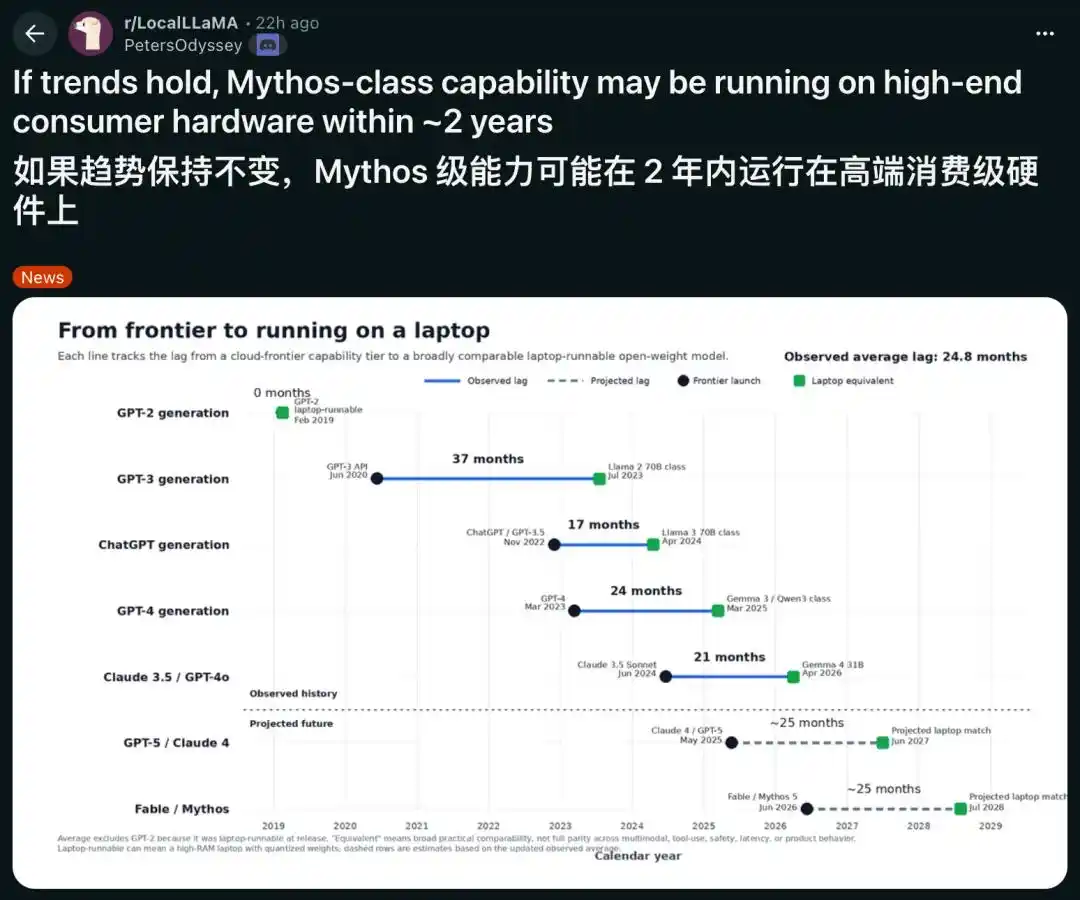
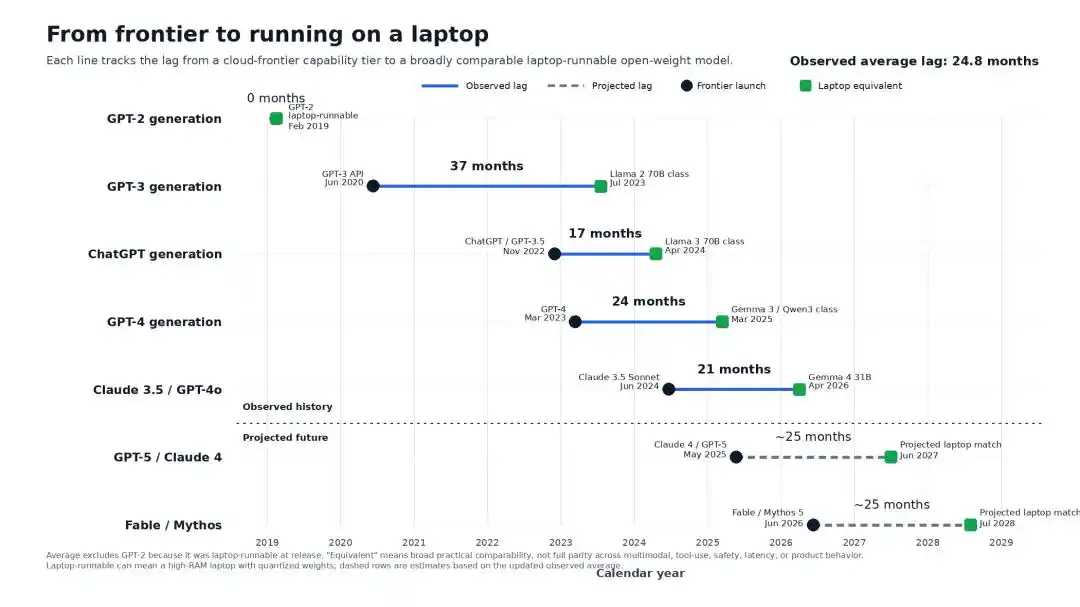
The chart's logic is straightforward: it marks out the time gap between each generation of frontier models being released in the cloud and their capabilities being matched by open-source models running on local hardware—
GPT-3-level capability took 37 months. GPT-3.5-level, 17 months. GPT-4-level, about 24 months. Claude 3.5 Sonnet / GPT-4o-level, 21 months.
Averaging across the four generations gives roughly 24.8 months—almost exactly two years.
Then, the poster extrapolated this trend line forward, and the landing point is startling: The frontier capability of Fable / Mythos 5-level will likely be practically usable on a high-end laptop locally around July 2028.
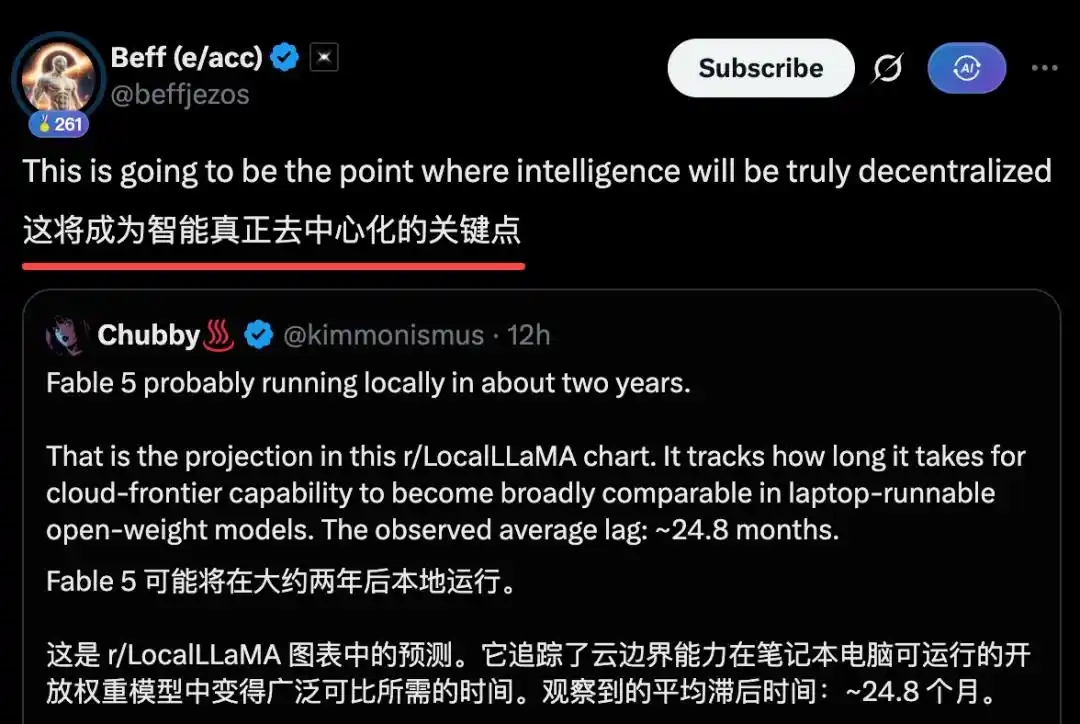
A major X influencer reposted the chart with one sentence that ignited the internet: "This will be the moment intelligence truly decentralizes."
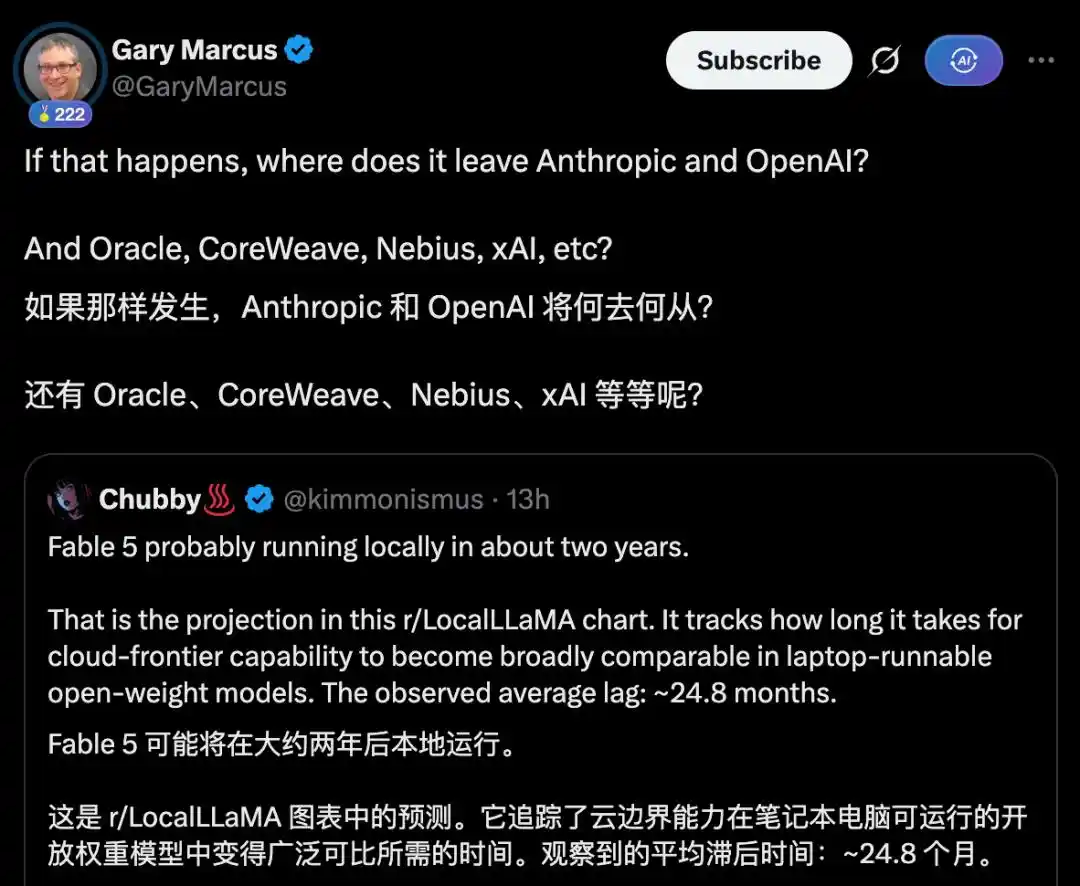
Influencer @GaryMarcus went further to question what would become of Anthropic, OpenAI, and others if this holds true.
What does local execution mean?
No internet connection, no queuing, no worries about subscription quotas, not a single byte of your data leaves your machine.
The intelligence you cautiously rent from the cloud today, billed by the token, could be a one-time hardware purchase two years from now.
Two Hard Trends Supporting the 24-Month Timeline
This projection is supported by two hard trends.
On the model side, MoE architecture, Q4/Q8 quantization, better RL and data recipes continue to drive down the compute required for equivalent capabilities.
The open-source community's catch-up cycle for frontier capabilities generally falls between 12 to 25 months, and the distilled, efficient versions will only accelerate their migration to consumer hardware.
The latest data point on the chart is proof: It took 21 months from Claude 3.5 Sonnet's release in June 2024 to Google's release of Gemma 4 31B in April 2026—a 31-billion-parameter open-source model that now matches Claude Sonnet 4.5 on the Arena AI leaderboard and even leads on GPQA.
The untouchable cloud king from two years ago now fits on a consumer-grade graphics card.
In reality, Gemma 4 31B has reached Claude 3.5 Sonnet's, even early Opus's, level in coding, reasoning, and tool-calling.
And GPT-4—the frontier benchmark from two years ago—was caught up by Gemma 3 and Qwen3 in March to April 2025, exactly 24 months later.

It's only a matter of time before frontier capability moves from the cloud to the desktop, and that timeframe is steadily converging to around two years.
Some are looking to China: GLM 5.2, a 753B parameter MoE architecture with an MIT open-source license and a 1M token context window, closely trails Claude Opus 4.8 on SWE-bench Pro.
In other words, even if Anthropic locks its doors, other contenders will bring equivalent capability to your desktop via a different path.
Blockades Can Restrict Access, But Not Time
This chart truly strikes the most sensitive nerve of the moment.
The past month witnessed the AI industry's first-ever "model recall": release, block, negotiation, unblock—every step of the Fable 5 saga emphasized two words: scarcity and control.
Who gets to use the strongest model has, for the first time, become a question answered with a passport.
This chart offers another perspective: From GPT-3 to today, no generation of frontier capability has successfully remained exclusively in the cloud for more than three years.
Distillation proliferates, open source catches up. Regulation can decide who uses Fable 5 today, but it cannot decide whose laptop runs a Fable 5-level model two years from now.
For developers, this means local agents, privacy-preserving computation, and offline workflows are worth investing in now; for hardware vendors, an arms race around large memory and high bandwidth has already begun; for the entire industry, this means the exclusive window for frontier models may be just 24 months—AI is transitioning from cloud monopoly to desktop democratization.
This might be the most ironic and optimistic aspect of that chart: Washington answers "Who deserves the strongest AI?" with a piece of paper; Redditors answer with four historical data points—In two years, everyone.
Remember July 2028. On that day, today's myth might just be your everyday tool.
Reference: https://www.reddit.com/r/LocalLLaMA/comments/1uoij3s/if_trends_hold_mythosclass_capability_may_be/
This article is from the WeChat public account "AI Era (新智元)", author: ASI启示录; editor: 所罗门


















