"Poor Man's Gold" Is No Longer Cheap!

marsbitDipublikasikan tanggal 2026-01-23Terakhir diperbarui pada 2026-01-23

Abstrak

"Silver, once known as 'poor man's gold,' is undergoing a fundamental revaluation as it shifts from a financial derivative of gold to a critical industrial material facing a structural supply deficit. The market is no longer treating silver as just a cheaper alternative to gold. Since 2021, the global silver market has experienced a sustained physical deficit, not from financial cycles, but from booming industrial demand. Key drivers include the photovoltaic (PV) sector, where silver is essential and difficult to substitute, with demand reaching 198 million ounces in 2024. Electric vehicles and AI infrastructure further contribute to this inelastic, high-reliability demand. Crucially, supply cannot keep pace. Over 70% of silver production is a by-product of mining for base metals like copper, zinc, and lead, meaning its output is unresponsive to silver price signals. Mine production grew less than 1% in 2024. With visible inventories covering only 1-1.5 months of consumption—below the 3-month safety threshold—the market is moving from cyclical shortage to structural tightness. Silver has shed its identity as gold's shadow and is now a strategically consumed industrial commodity, making its historic undervaluation a thing of the past."

Author: Yan Wai Zhi Yi, Wall Street Insights

In the past, silver was called "poor man's gold" not because it was truly cheap, but because the market never took its scarcity seriously.

Ample supply, adjustable inventories, and dispersed uses—for a long time, the market firmly believed that no matter how demand fluctuated, silver could always be quickly replenished. Because of this, it could be repeatedly traded as a shadow of gold but was almost never seriously allocated.

But this premise has been shattered by reality.

Since 2021, the global silver market has experienced a physical supply-demand deficit for several consecutive years. Unlike the short-term tightness amplified by previous financial cycles, this deficit stems directly from the industrial side: demand for silver in key sectors such as photovoltaics, electrification, and high-end electronics is expanding rapidly and simultaneously, while supply can hardly keep pace.

More critically, silver's supply system is highly unresponsive to price signals.

Over 70% of global silver production comes as a by-product of other metals, with production rhythms determined by the investment cycles of copper, lead, and zinc, not by the price of silver itself. This means that even if prices rise, supply cannot quickly increase; when buffer inventories are continuously depleted, the market faces not temporary fluctuations but sustained constraints.

It is at this moment that silver truly begins to break free from the "poor man's gold" narrative. It is no longer just a cheap alternative when gold rises but is becoming a material that is continuously consumed by key industries and is difficult to replace.
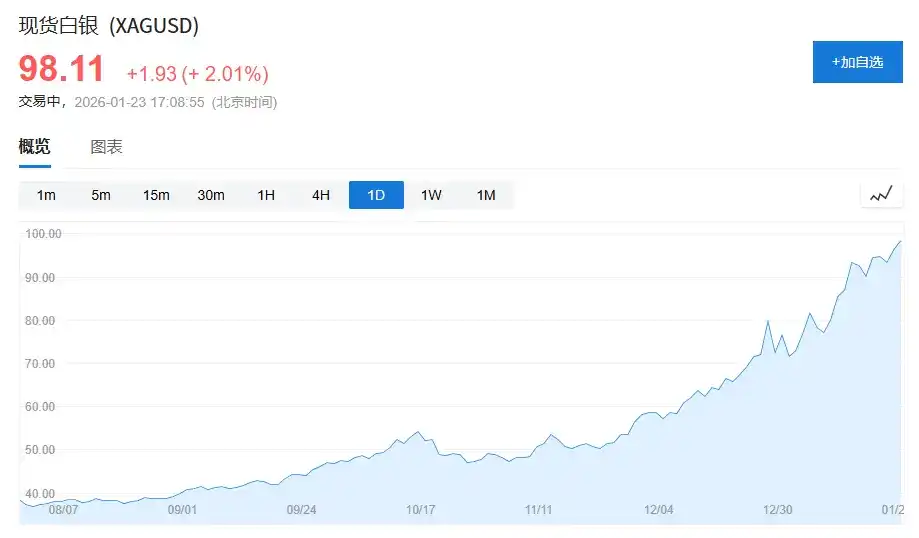
(Silver prices approach $100 per ounce. In mid-October last year, silver was only $50/ounce, nearly doubling in 3 months.)

1. Silver's "Identity Dilemma": Stuck Between Gold and Industrial Metals

To understand why silver has long been undervalued, one must first understand its "identity dilemma."

In the modern commodity system, assets can be broadly divided into two categories:

One is credit-based assets, typically represented by gold. Gold's value anchor does not come from industrial use but from the credit system and reserve demand. Even in the weakest years of demand, global central banks' net gold purchases still account for 15%–25% of total demand, providing a stable foundation for its price.

The other is growth assets, such as copper, crude oil, and iron ore. These metals have almost no financial attributes; their prices are mainly driven by economic cycles, infrastructure, and manufacturing investment.

Silver, however, is stuck between these two.

According to the "World Silver Survey 2025," global silver demand in 2024 was 1.164 billion ounces (approx. 36,200 tons), of which:

Industrial demand was 681 million ounces, accounting for about 58%;

Jewelry and silverware demand was 263 million ounces, accounting for about 23%;

Investment demand (bars, coins, ETFs) was about 191 million ounces, accounting for about 16%.

The problem is that these three types of demand have completely different behavioral patterns:

Industrial demand relies on the industry cycle, jewelry demand is highly price-sensitive, and investment demand is highly susceptible to macro sentiment.

This structural split has long left silver without a stable, single, dominant pricing anchor.

The result is reflected in the price: silver has long been forced to price itself relative to gold.

A clear indicator is the gold-silver ratio. Over the past half-century, the historical average of this ratio has been roughly 55–60; but between 2018–2020, it once exceeded 90, and at the peak of the pandemic shock, it even approached 120.

Even against the backdrop of silver's industrial demand hitting a record high in 2024, the gold-silver ratio has long remained in the 80–90 range, significantly higher than the long-term average.

This is not because silver is "useless," but because the market is still pricing silver using gold's financial logic.

2. Silver's Repositioning: From "Dispersed Use" to "Locked In by Industry"

The real change did not start in the financial markets but occurred quietly on the industrial side.

To summarize the current change in one sentence: Silver is shifting from an industrial metal with dispersed uses to a functional material locked in by key industries.

1. Photovoltaics: Silver Becomes "Indispensable" for the First Time

Photovoltaics are the most critical factor in the change of silver's demand structure.

In 2015, global new PV installations were about 50GW; by 2024, this number exceeded 400GW, an increase of over 8 times in less than a decade.

The industry is indeed continuously "de-silvering." Silver usage per watt has dropped from about 0.3 grams in the early days to around 0.1 grams with current mainstream technology.

But the expansion speed of installation scale is far faster than the decline in unit usage.

According to the "World Silver Survey 2025," the actual demand for silver from the PV industry in 2024 reached 198 million ounces, an increase of over 160% compared to 2019, accounting for about 17% of global silver demand.

More critically, silver's position in photovoltaics is not "easily replaceable." In terms of key indicators such as conductive efficiency, long-term stability, and reliability, silver remains the optimal choice overall. Technological progress changes the method of use, not the status.

This gives silver, for the first time, a source of demand that is large-scale, fast-growing, and price-inelastic.

2. Electric Vehicles and AI Infrastructure: Usage Not Exaggerated, but Extremely Difficult to Substitute

If photovoltaics bring certainty in demand scale, then electric vehicles and digital infrastructure bring a change in the nature of demand.

A traditional internal combustion engine vehicle uses about 15–20 grams of silver on average; a new energy vehicle typically uses 30–40 grams.

Against the backdrop of limited overall growth in global auto sales, the penetration rate of new energy vehicles has risen from less than 3% in 2019 to nearly 20% in 2024, structurally increasing silver demand.

Meanwhile, the demand for silver from data centers, AI servers, and high-end electronic devices is reflected more in its irreplaceability than in absolute volume.

In 2024, silver demand from electrical and electronic related fields reached 461 million ounces, setting new historical records for many consecutive years.

These application scenarios are relatively price-insensitive but are extremely sensitive to supply stability.
3. The Reality on the Supply Side: Silver Is Not a Metal That "Can Increase Production Just Because Prices Rise"

In stark contrast to the certainty on the demand side is the rigidity on the supply side.

In 2024, global silver mine production was approximately 820 million ounces, with a year-on-year growth rate of less than 1%.

More importantly, over 70% of global silver production comes as a by-product, mainly依附于 (attached to) lead, zinc, copper, and gold mines. This structure has hardly changed substantially over the past two decades.

Primary silver mine production is only about 228 million ounces, accounting for less than 30%, and is still in a long-term downward trend.

This means that silver production is not determined by the silver price but is主导 (led) by the investment cycles of base metals.

4. From Cyclical Shortage to Structural Tightness

Looking back at history, silver has experienced bull markets before, but past rallies were mostly derivatives of financial cycles.

The difference is that since 2021, the silver market has experienced a physical supply-demand deficit for several consecutive years.

According to the "World Silver Survey 2025," the average annual physical deficit in the global silver market from 2021–2024 was about 150–200 million ounces, with a cumulative deficit接近 (approaching) 800 million ounces.

And silver's visible inventories themselves are not ample. Current global流通 (circulating) inventories can only cover about 1–1.5 months of consumption, significantly below the 3-month safety line typically considered for commodities.

Once a large amount of silver enters PV modules, electrical equipment, and infrastructure, it is difficult to return to the流通市场 (circulating market).

5. Silver Is No Longer Just Gold's Shadow

Silver has not suddenly become scarce; it is just the first time it simultaneously satisfies three conditions:

Demand scale is real and sustained

Key uses are difficult to替代 (substitute)

Supply growth is highly constrained

In the past, these three points never appeared simultaneously.

While the market still understands silver as "poor man's gold," the industrial chain has already begun to re-examine it by the standards of a key functional material.

Silver may still be volatile, but it is certain that it is no longer just gold's shadow.

And this is the most important, yet most easily underestimated, underlying change in this round of market activity.


Pertanyaan Terkait

QWhy has silver historically been called 'poor man's gold' and what has changed recently?

ASilver was called 'poor man's gold' because it was seen as a cheaper, more accessible alternative to gold, and the market never took its scarcity seriously, assuming supply could always meet demand. This has changed because the market is now experiencing a sustained physical deficit driven by industrial demand from sectors like photovoltaics, electrification, and high-end electronics, while supply remains constrained and unable to keep pace.

QWhat is the main reason silver supply cannot quickly respond to price increases?

AOver 70% of global silver production comes as a by-product of mining other metals like copper, lead, and zinc. This means silver output is determined by the investment cycles of these base metals, not by the price of silver itself, making supply highly inelastic to silver price signals.

QWhich industry is the most significant driver of the new structural growth in silver demand, and why is it so important?

AThe photovoltaic (solar) industry is the most significant driver. It is important because, despite efforts to reduce silver use per watt (de-silverization), the massive expansion in global solar installations (from ~50GW in 2015 to over 400GW in 2024) has caused demand to surge. Silver's role is also crucial as it remains the optimal material for conductivity and reliability in solar cells, making it difficult to replace.

QHow does the 'identity dilemma' of silver affect its pricing in the commodity market?

ASilver's 'identity dilemma' refers to its split between being a credit asset (like gold, with financial and store-of-value properties) and a growth asset (like copper, driven by industrial cycles). This split means it lacks a single, stable pricing anchor. Consequently, its price has historically been heavily influenced by and correlated with gold (as seen in the gold-silver ratio), rather than being driven solely by its own industrial fundamentals.

QWhat evidence suggests the current silver market deficit is structural rather than just a cyclical shortage?

AThe evidence includes: 1) The deficit has been persistent, lasting for multiple consecutive years (2021-2024) with an average annual shortfall of 150-200 million ounces. 2) The deficit is driven by fundamental, long-term industrial demand growth (e.g., photovoltaics, EVs) rather than short-term financial speculation. 3) Supply is structurally rigid and cannot be quickly increased due to its by-product nature. 4) Once used in industrial applications like solar panels, silver is effectively 'consumed' and removed from the market, reducing available above-ground stocks.

Bacaan Terkait

Saham A: Ketahanan, Ekspektasi, dan Dasar yang Tertimpa Kerusakan

Artikel ini membahas ketahanan pasar saham A-shares di tengah tekanan eksternal pada Juli 2026. Meskipun saham teknologi global, termasuk Korea, melemah dan berdampak pada sektor teknologi A-shares, pasar domestik menunjukkan dasar yang kuat. Penurunan terutama dipicu oleh kontagion risiko eksternal (seperti deleverage di Korea), bukan keruntuhan fundamental. Industri teknologi China memiliki struktur yang lebih terdiversifikasi—meliputi berbagai sub-sektor dan logika naratif ganda (rantai pasokan global AI dan substitusi impor domestik)—dibandingkan ketergantungan Korea pada siklus super chip memori. Data fundamental, seperti pertumbuhan laba yang kuat di modul optik dan kabel serat optik, belum terbantahkan. Pihak berwenang ("Tim Nasional") secara aktif mendukung pasar dengan pembelian besar-besaran dan kebijakan stabilisasi, mengirimkan sinyal keyakinan. Selain sektor teknologi, tiga pilar lain—konsumsi, siklus, dan keuangan—memiliki momentum pemulihan endogen. Sektor konsumsi menunjukkan perbaikan dengan kenaikan CPI dan normalisasi inventaris, sementara siklus (seperti aluminium) didukung oleh profitabilitas tinggi, ekspektasi kenaikan harga, dan valuasi rendah. Aset keuangan menawarkan stabilitas dan dividen yang menarik. Kesimpulannya, penyesuaian ini lebih merupakan pelepasan risiko eksternal. Dengan intervensi kebijakan yang tegas dan fundamental ekonomi yang beragam serta tangguh, pasar A-shares dipandang memiliki ketahanan untuk kembali stabil.

marsbit26m yang lalu

Saham A: Ketahanan, Ekspektasi, dan Dasar yang Tertimpa Kerusakan

marsbit26m yang lalu

Medan Perang Utama Bull Run Berikutnya Ada di Mana? Jawabannya Tersembunyi dalam Dua Aset Ini

**Ringkasan Artikel: Medan Pertempuran Utama untuk Siklus Bull Berikutnya dalam Kripto** Pasar kripto menunjukkan tanda-tanda pembalikan dari kondisi bearish, dengan aliran dana ETF yang kembali positif. Artikel ini mengusulkan narasi inti untuk siklus bull berikutnya: **konvergensi antara keuangan on-chain dan keuangan tradisional**. Pergeseran ini akan didorong oleh adopsi stablecoin, tokenisasi aset, perdagangan 24/7, penyelesaian instan, dan pertumbuhan DeFi institusional yang menargetkan pasar keuangan global, bukan hanya ruang kripto. Untuk memposisikan portofolio dalam tren ini, penulis menyoroti dua kategori peluang investasi yang mewakili jalur konvergensi yang berbeda: 1. **Proyek Asli Kripto dengan Model Bisnis Nyata:** Seperti **Hyperliquid (HYPE)**, sebuah rantai Layer-1 untuk perdagangan derivatif. Separuh volume perdagangannya kini berasal dari aset tradisional (minyak, indeks S&P 500). Platform ini memiliki pendapatan riil (diproyeksikan $8 miliar tahun ini) dan model token yang kuat di mana 99% pendapatan digunakan untuk pembelian kembali dan pembakaran token. 2. **Perusahaan Tradisional yang Mengadopsi Infrastruktur Kripto Secara Serius:** Seperti **Robinhood (HOOD)**, yang baru-baru ini meluncurkan blockchain Layer-2 sendiri, **Robinhood Chain**. Blockchain ini memungkinkan perdagangan saham yang ditokenisasi dan penggunaan protokol DeFi di 120 negara, menunjukkan komitmen nyata untuk integrasi. Kesimpulannya, siklus bull berikutnya akan didorong oleh nilai aplikasi nyata yang menghubungkan dunia keuangan lama dan baru. Investor disarankan untuk fokus pada aset kripto dengan utilitas dan pendapatan nyata serta perusahaan tradisional yang tidak hanya berbicara, tetapi benar-benar membangun dan mengoperasikan solusi berbasis blockchain secara luas.

Foresight News40m yang lalu

Medan Perang Utama Bull Run Berikutnya Ada di Mana? Jawabannya Tersembunyi dalam Dua Aset Ini

Foresight News40m yang lalu

Catatan Penyerbukan UU Kripto 'Clarity': Jalan Kompromi Dua Partai AS Dipenuhi Duri

Kongres AS terus berupaya meloloskan RUU struktur pasar kripto, Clarity Act, namun jalan menuju kompromi antarpartai dipenuhi tantangan. Awal tahun ini, CEO Coinbase Brian Armstrong membatalkan kesepakatan dua partai yang telah diraih, menghentikan sementara prosesnya. Setelah empat bulan, komite akhirnya dapat menjadwalkan RUU ini berkat kompromi tentang masalah "yield" antara Senator Demokrat Angela Alsobrooks dan Senator Republik Thom Tillis. Namun, kemajuan ini terhambat oleh tuntutan klausul etika dari Demokrat, yang menjadi syarat utama mereka. Pada pemungutan suara di komite pertanian Senat, tidak ada satu pun Demokrat yang mendukung karena masalah etika yang belum terselesaikan. Isu lain seperti perlindungan pengembang juga menghadapi penolakan dari lembaga penegak hukum. Meski demikian, ada konsensus bahwa regulasi pasar kripto diperlukan. Senator Cynthia Lummis menekankan perlindungan konsumen dalam RUU, sementara Senator Mark Warner menyuarakan kekhawatiran tentang risiko. Pertemuan dengan pejabat Gedung Putih dan upaya rekonsiliasi antara versi RUU dari komite perbankan dan pertanian Senat sedang berlangsung. Tantangan terbesar adalah mencapai kesepakatan etika yang kuat yang dapat diterima oleh kedua partai. Tanpa dukungan Demokrat, lolosnya RUU ini diragukan. Tujuan jangka pendek komunitas kripto mungkin termasuk tindakan simbolis di Senat sebelum masa reses Agustus, dengan harapan akhirnya menjadi undang-undang pada tahun 2026. Proses yang panjang dan melelahkan ini mencerminkan realitas legislatif di Washington, di mana dukungan harus diraih perlahan-lahan.

marsbit49m yang lalu

Catatan Penyerbukan UU Kripto 'Clarity': Jalan Kompromi Dua Partai AS Dipenuhi Duri

marsbit49m yang lalu

Pendiri Kalshi dan Polymarket Tidak Akur? Perang Bisnis Ini Jauh Lebih Sengit dari Dugaan

Pada November 2024, pendiri Polymarket Shayne Coplan digerebek oleh FBI, yang menandai puncak persaingan sengit dengan perusahaan prediksi pasar saingannya, Kalshi, yang dipimpin Tarek Mansour. Perseteruan ini melampaui kompetisi bisnis biasa, dipenuhi saling tuduh, serangan media, dan perebutan pasar. Perbedaan utama terletak pada pendekatan regulasi: Kalshi beroperasi secara legal di AS dengan izin CFTC, sementara Polymarket lama beroperasi lewat platform lepas pantai yang dapat diakses pengguna AS, meski dilarang. Mansour menuduh Polymarket tidak etis dan ilegal, sementara Coplan menganggap Kalshi sekadar peniru. Konflik meluas ke berbagai arena, termasuk saling menghalangi investasi (seperti upaya Kalshi menggagalkan kerja sama Polymarket dengan ICE), perang penawaran sponsor (seperti kesepakatan Kalshi dengan Madison Square Garden), perebutan talenta, dan kampanye media hitam. Keduanya juga aktif melobi di Washington. Meski Polymarket sempat unggul dalam popularitas, Kalshi kini memimpin dalam valuasi ($220 miliar) dan volume perdagangan. Namun, tekanan regulasi terhadap industri, terutama terkait taruhan olahraga dan potensi perdagangan orang dalam, terus meningkat, dengan Polymarket sering menjadi sasaran utama. Intinya, persaingan ini bukan hanya perebutan pangsa pasar, tetapi juga benturan prinsip tentang batas legalitas dan etika dalam industri prediksi pasar yang berkembang pesat.

marsbit55m yang lalu

Pendiri Kalshi dan Polymarket Tidak Akur? Perang Bisnis Ini Jauh Lebih Sengit dari Dugaan

marsbit55m yang lalu

Trading

Spot
活动图片




