Original Author: Gino Matos
Original Compilation: Deep Tide TechFlow
Guide: Against the backdrop of global macroeconomic fluctuations and intensified geopolitical games, European Central Bank (ECB) Chief Economist Philip Lane issued a rare warning: The "tussle" between the Federal Reserve and political forces may endanger the international status of the US dollar.
This article delves into how such political pressure is transmitted to global financial markets through term premiums and explains why, at this moment of a shaken credit system, Bitcoin may become the last safe haven for investors.
The author combines multi-dimensional data such as US Treasury yields, inflation expectations, and the stablecoin ecosystem to break down the two截然不同的 (distinctly different) macro paradigms that Bitcoin may face in the future.
Full Text Below:
European Central Bank (ECB) Chief Economist Philip Lane issued a warning that most market participants initially viewed merely as European "housekeeping": While the ECB can currently maintain its easing path, the "tussle" around the Federal Reserve's mandate independence could lead to global market turmoil by pushing up US term premiums and triggering a reassessment of the dollar's role.
Lane's framing is crucial because it names several specific transmission channels that have the greatest impact on Bitcoin: real yields, dollar liquidity, and the credibility framework supporting the current macro system.
The immediate trigger for the recent market cooling was geopolitics. As concerns about a US strike on Iran subsided, the risk premium on crude oil weakened. At the time of writing, Brent crude fell to about $63.55, and West Texas Intermediate (WTI) fell to about $59.64, down about 4.5% from the high on January 14.
This at least temporarily cut off the chain reaction from geopolitics to inflation expectations to the bond market.
However, Lane's comments point to another risk: not a supply shock or growth data, but political pressure imposed on the Fed, which could force the market to reassess US assets based on governance factors rather than fundamentals.
The International Monetary Fund (IMF) has also emphasized in recent weeks that the Fed's independence is crucial, noting that a weakening of independence would have a "negative impact on credit ratings." This type of institutional risk often manifests in term premiums and foreign exchange risk premiums before making headlines.
The term premium is the part of long-term yields that compensates investors for uncertainty and maturity risk, independent of expected future short-term rates.
As of mid-January, the New York Fed's ACM term premium remained around 0.70%, while the St. Louis Fed's (FRED) 10-year zero-coupon valuation was about 0.59%. On January 14, the 10-year Treasury nominal yield was about 4.15%, the 10-year TIPS real yield was 1.86%, and the 5-year breakeven inflation expectation (January 15) was 2.36%.
By recent standards, these figures are in a stable range. But Lane's core point is that this stability could quickly unravel if the market begins to price a "governance discount" for US assets. A term premium shock does not require the Fed to raise rates; it can occur when credibility is damaged, pushing up long-end yields even if policy rates remain unchanged.
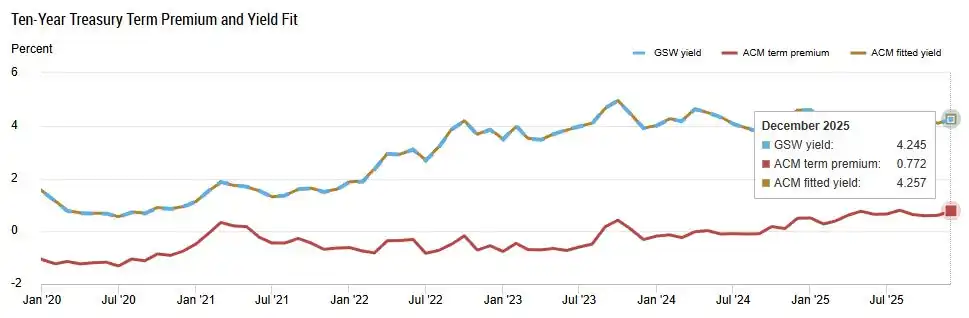
Caption: The 10-year US Treasury term premium rose to 0.772% in December 2025, the highest level since 2020, with yields reaching 4.245%.
The Term Premium Channel is the Discount Rate Channel
Bitcoin is in the same "discount rate universe" as stocks and other duration-sensitive assets.
When term premiums rise, long-end yields climb, financial conditions tighten, and liquidity premiums are compressed. ECB research documents how the dollar exchange rate appreciates with Fed tightening across multiple policy dimensions, making US interest rates the core pricing kernel for global pricing.
Bitcoin's historical upward momentum has often come from the expansion of liquidity premiums: when real yields are low, discount rates are loose, and risk appetite is high.
A term premium shock reverses this dynamic without the Fed changing the federal funds rate. This is why Lane's tone is significant for cryptocurrencies, even though he was speaking to European policymakers at the time.
On January 16, the US Dollar Index (DXY) was around 99.29, near the low end of its recent trading range. But the "reassessment of the dollar's role" mentioned by Lane opens up two截然不同的 (distinctly different) scenarios, not a single outcome.
In the traditional "yield differential" paradigm, higher US yields strengthen the dollar, tighten global liquidity, and put pressure on risk assets, including Bitcoin. Research shows that cryptocurrencies have had a stronger correlation with macro assets post-2020 and, in some samples, a negative correlation with the DXY.
But in the credibility risk paradigm, the outcome diverges: if investors demand a premium for US assets due to governance risks, term premiums could rise even as the dollar weakens or fluctuates. In this case, Bitcoin would trade more like a "pressure release valve" or alternative monetary asset, especially if inflation expectations rise alongside credibility concerns.
Furthermore, Bitcoin is now more connected to the stock market, AI narratives, and Fed signals than in previous cycles.
According to Farside Investors data, Bitcoin ETFs saw net inflows again in January, totaling over $1.6 billion. Coin Metrics points out that open interest in spot options is concentrated near the $100,000 strike price expiring at the end of January.
This positioning means that macro shocks could be amplified through leverage and Gamma dynamics, turning the abstract "term premium" concern mentioned by Lane into a concrete catalyst for market volatility.
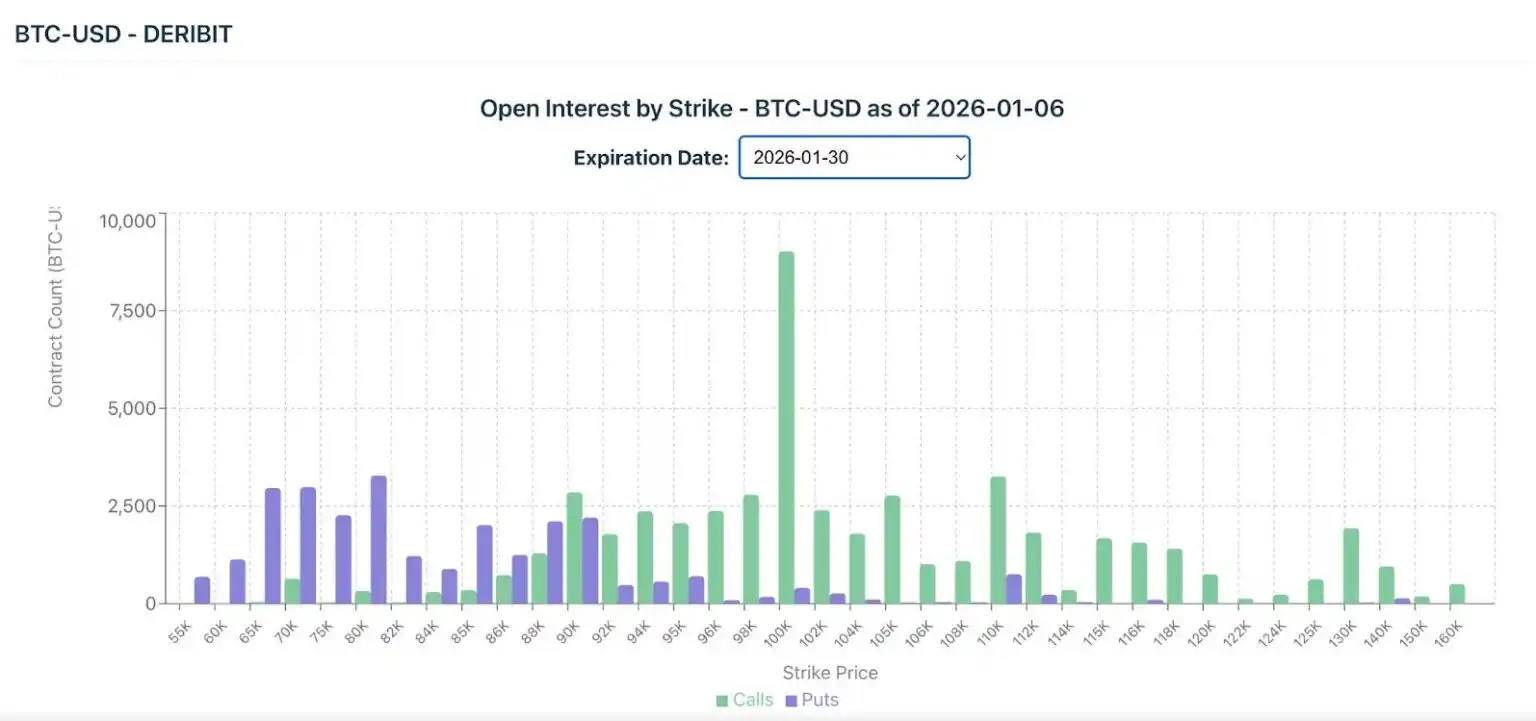
Caption: Open interest for Bitcoin options expiring on January 30, 2026, shows over 9,000 call contracts at the $100,000 strike price, the highest concentration.
Stablecoin Infrastructure Makes Dollar Risk "Crypto-Native"
A significant portion of the cryptocurrency trading layer operates on dollar-denominated stablecoins, which are backed by safe assets (typically US Treasuries).
Research from the Bank for International Settlements (BIS) links stablecoin pricing dynamics to that of safe assets. This means a term premium shock is not just some "macro vibe"; it directly permeates stablecoin yields, demand, and on-chain liquidity conditions.
When term premiums rise, the cost of holding duration increases, which could affect stablecoin reserve management and alter the liquidity available for risk trades. Bitcoin may not be a direct substitute for US Treasuries, but it exists in an ecosystem where Treasury pricing sets the benchmark for the definition of "risk-free."
Currently, the market sees about a 95% probability of the Fed holding rates steady at the January meeting, with major banks pushing their expected rate cut timing to 2026.
This consensus reflects confidence in near-term policy continuity, thereby anchoring term premiums. But Lane's warning is forward-looking: if this confidence breaks, term premiums could jump 25 to 75 basis points within weeks, without any change in the funds rate.
A mechanical example: if the term premium rises 50 basis points and expected short-term rates remain flat, the 10-year nominal yield could drift from around 4.15% to near 4.65%, with real yields repricing synchronously.
For Bitcoin, this means tighter financial conditions and brings downside risk through the same channels that squeeze high-duration stocks.
However, if triggered by a credibility shock causing dollar weakness, a completely different risk profile emerges.
If global investors begin reducing US asset holdings based on governance grounds, the dollar could weaken even as term premiums rise. In this scenario, Bitcoin's volatility would spike dramatically, and its price movement would depend on whether the yield differential paradigm or the credibility risk paradigm dominates at that time.
Although academia still debates Bitcoin's "inflation hedge" properties, in most risk regimes, the dominant channels remain real yields and liquidity, not simply breakeven inflation expectations.
Philip Lane's argument forces us to consider both possibilities simultaneously. This is why a "dollar repricing" is not a one-directional bet, but a fork in the regime road.
Watchlist
The checklist for tracking this development is clear:
At the Macro Level:
- Term Premiums
- 10-year TIPS Real Yields
- 5-year Breakeven Inflation Expectations
- US Dollar Index (DXY) Level and its Volatility
At the Crypto Level:
- Bitcoin Spot ETF Flows
- Options Positioning Near Key Strikes like $100,000
- Changes in Skew Around Major Macro Events
These indicators link Lane's warning to Bitcoin's price action without speculating on the Fed's future policy decisions.
Lane's signal was initially sent to European markets, but the "pipes" he describes are the very same logic that determines Bitcoin's macro environment. The oil premium has faded, but the "governance risk" he pointed out remains.
If the market begins to price in the Fed's political tussle, this shock will by no means be confined to the US. It will be transmitted globally through the Dollar and the Yield Curve, and Bitcoin's reaction to such shocks tends to be sharper and earlier than most traditional assets.