For Web3, This Time Cai Wensheng Is Determined to Get His Hands Dirty

marsbitDipublikasikan tanggal 2026-03-16Terakhir diperbarui pada 2026-03-16

Abstrak

Cai Wenshou, a prominent Chinese internet entrepreneur and investor, is making a significant push into the Web3 space with a hands-on approach, moving beyond his previous role as a financial backer. Despite early successes in domains and internet companies like Meitu, his advocacy for Meitu's $100 million cryptocurrency investment in 2021 led to substantial paper losses and public criticism, eventually resulting in his departure as chairman. After stepping down, he reduced his stake in Meitu and invested personal funds into Web3 initiatives. He purchased a 25-story commercial building in Hong Kong, renamed it "CAI Tower" (representing Crypto and AI), offering free rent to Web3 and AI startups in exchange for first investment rights. He also acquired two Hong Kong-listed companies, rebranding them as CAI Holdings and LONG Investment Group, to build a Web3 and AI asset management platform. Additionally, he integrated a licensed virtual asset exchange, EXIO, into his ecosystem, creating a full-cycle support system from incubation to trading. Cai believes in the long-term potential of Web3, comparing its growth trajectory to AI's gradual rise. He remains optimistic about Bitcoin's future, predicting it could reach $1.1 million. Unlike some early crypto figures who have exited the industry, Cai is deepening his involvement, aiming to foster tangible projects and ecosystems. His commitment reflects a broader need for established leaders to drive real-world adoption and achieve a ...

Author:Zhou, ChainCatcher

If there are still any investors in the current crypto industry worth looking forward to, Cai Wensheng should be one of them.

Starting from the early domain name business, to the successive successes of 58.com, Storm Player, and Meitu, then to strongly advocating for Meitu to hoard cryptocurrencies, facing billions in floating losses and being criticized for speculative trading, stepping down as chairman, cashing out to buy buildings, and betting on Hong Kong Web3.

He is a person who has been repeatedly misunderstood by the times, yet repeatedly validated by the times.

Only this time, he decided to "get his hands dirty."

Last Time, Didn't Get a Good Result

2021 年, Cai Wensheng strongly advocated for Meitu to buy Bitcoin and Ethereum, with a total investment of about $100 million.

When buying, Cai Wensheng once said in his WeChat Moments: "Someone has to be the first to eat the crab. This should be the first Hong Kong-listed company to purchase BTC digital currency, and also the world's first listed company to use ETH Ethereum as a monetary value reserve."

However, as a Hong Kong-listed company, any major asset allocation by Meitu needed to be approved by the board of directors. Although he held over 25% of the shares at the time and, as chairman, could push for the purchase, he could not prevent the sale.

2022 年, the crypto market plummeted, and Meitu's paper losses exceeded 280 million RMB, with accusations of "speculative crypto trading" flooding in. The stock price of Meitu in Hong Kong also hit a historic low.
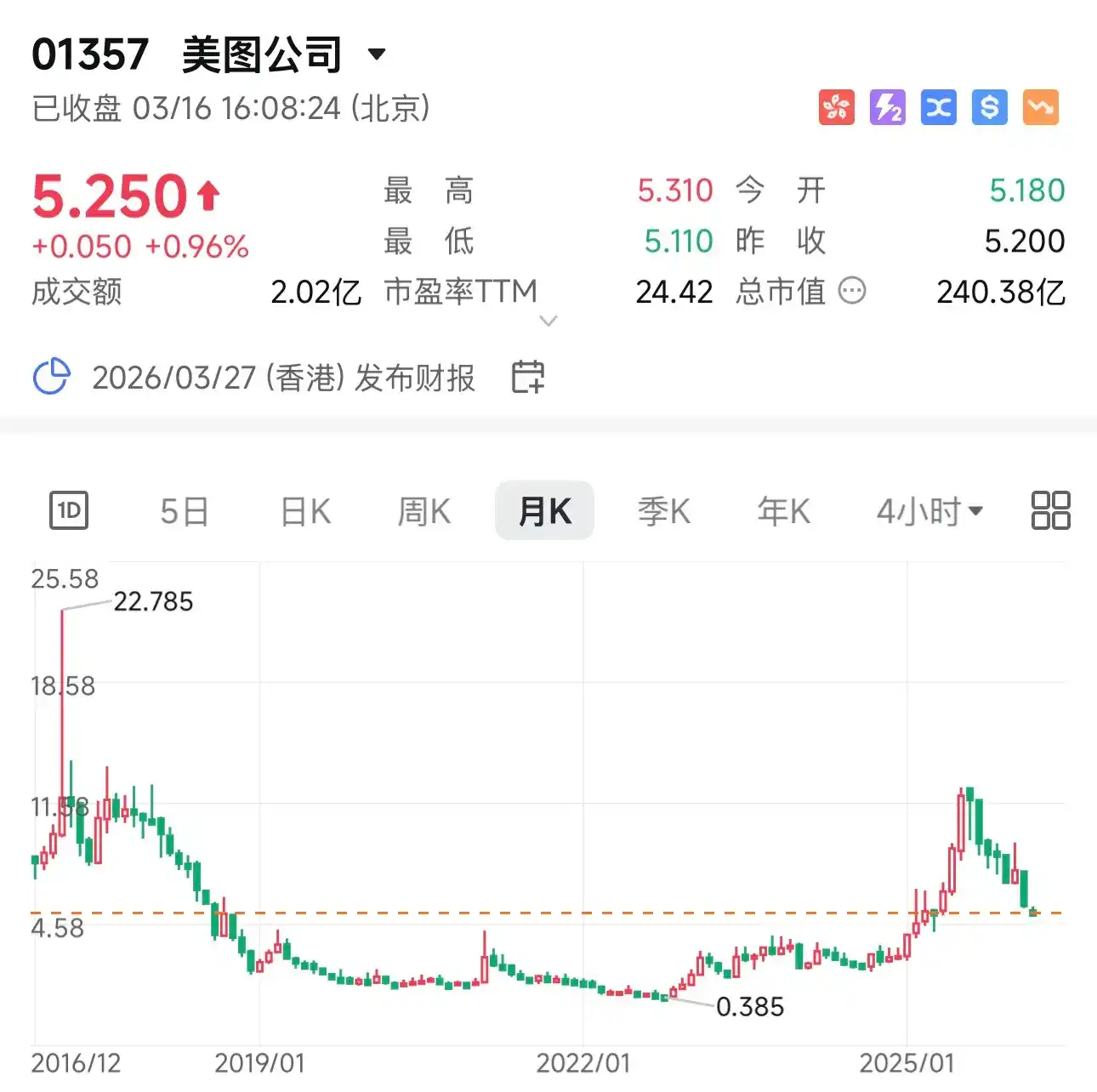

Publicly listed companies sometimes have less tolerance for floating losses than individual investors—stock price pressure, shareholder doubts, media siege—these were external pressures that anyone at the time could not withstand.

2023 年, he stepped down as chairman amid skepticism, and Wu Xinhong returned to take charge, immediately beginning to "tear off the Cai Wensheng label," with the strategic focus fully shifting to AI.

The ending of the story is quite ironic. Meitu issued an announcement in early December 2024, stating that as of that date, it had sold all its cryptocurrency, with a total cash consideration of approximately $180 million, realizing a gain of about $79.63 million, equivalent to approximately RMB 571 million.

If they had held on back then, Meitu would have been one of the first batch of DAT companies in Hong Kong.

The trend was validated, but it was no longer related to him.

Getting Involved, Getting Hands Dirty

From domain names, mobile internet, to Web3, people in each era said he was gambling.

He once said in an interview that what Web3 entrepreneurs do is often not understood, especially by traditional investors.

At the same time, he expressed firm belief in the explosion of Web3, though the timing is hard to predict, just like AI went through many years of dormancy before迎来 the ChatGPT explosion.

According to RootData显示, Cai Wensheng's Longling Capital早年 invested in the crypto exchange OKX (formerly OKCoin). In 2018, he revealed publicly that he had invested in over 10 blockchain projects, including Theta, Ontology, Zipper, etc.

<极好的, I will continue the translation from where it left off, ensuring all HTML tags are preserved and the structure is maintained.

img style="max-width:100%;overflow:hidden;" src="https://d1x7dwosqaosdj.cloudfront.net/images/2026-03/ba38047c3f24461f9b57e864d3fc5780.jpg" alt="">


This time, he simply increased his bet.

After stepping down, Cai Wensheng chose to reduce his stake in Meitu, with his shareholding比例 dropping from a peak of about 25% to less than 10%.

650 million Hong Kong dollars to buy a 25-story commercial building in Tin Hau, Hong Kong, renamed CAI Building. He specifically stated: "CAI is the abbreviation of Crypto and AI, not my surname."

It is reported that CAI Building does not charge rent, only asks for the优先 investment right in the first round of financing, no discount, no controlling stake. He publicly stated that the goal is to incubate 5 unicorns within three years.

Last November, Cai Wensheng said at Hong Kong Fintechweek that buying this building was to "set an example." Now this building is fully occupied by AI and Web3 companies.

Capital operations also followed. He successively acquired two Hong Kong-listed companies—China New Economy Investment and China Financial Leasing, renamed them CAI Holdings and LONG Investment Group respectively,打造 a Web3+AI asset management platform.

In early 2026, CAI Holdings又 acquired the equity of two early-stage projects, Forestheaven and EXIO, by issuing new shares. The seller was precisely Longling Capital, wholly owned by Cai Wensheng.

Among them, EXIO is a licensed virtual asset trading platform in Hong Kong, holding SFC Type 1 and Type 7 licenses. It is the first compliant exchange in Hong Kong with a securities background. Longling Capital was one of its early investors.

Incorporating this piece into CAI Holdings means his ecosystem extends from incubation to circulation—projects cultivated in the CAI Building can be directly listed for compliant trading on a licensed exchange.

Crypto OGs Need a Decent Victory

Among the crypto OGs we know, Cai Wensheng is not the one who has benefited the most.

The fates of early crypto OGs vary.

Some achieved financial freedom and completely faded out—Babbitt founder Chang Jia was once the most powerful spokesperson for long-termism in the crypto industry. Since 2023, he has turned to AI entrepreneurship.

Multicoin Capital co-founder Kyle Samani became famous for early bets on Solana. When leaving the圈, he publicly stated that "cryptocurrency is not as interesting as many people think."

Some stay in the圈, but their focus has shifted—Shenyu was a representative figure in the mining圈 early on. Now, content about AI tools占了大半 on his social accounts.

And those who, like Cai Wensheng, choose to stay include Xiao Feng and Feng Bo, etc.

Xiao Feng turned from traditional finance, leading HashKey on an institutionalized compliance path, operating with licenses, and connecting with traditional capital; Feng Bo布局 in a professional crypto VC manner, closer to the standard institutional investor approach.

They are同样 optimistic about this industry, but their paths are截然不同.

Cai Wensheng chose a "dirtier" path: not taking the institutional route, not making pure financial bets, personally putting down roots in Hong Kong, getting involved hands-on.

At the 2023 Hong Kong Web3 Carnival, Cai Wensheng said: "People who have worked from Web1 to Web3, this seems like a compliment, but it actually means that we have not been successful from Web1 to Web3, we have always been on the road. But many people from Web1 to Web3 are no longer here, but we are still here,说明 we are veterans. Old soldiers never die, they just fade away."

In early 2026, he predicted that Bitcoin would rise to $1.1 million, which means the total market capitalization of Bitcoin would be about $21 trillion. Previously, he publicly stated that he held about 10,000 Bitcoins. There is no news yet showing that he has exited.

Of course, the controversy has not disappeared. Continuously endorsing during a bear market, whether it is坚守 against the market or having to tell stories after being trapped, is still difficult for outsiders to distinguish.

But the ammunition from cashing out, the buildings bought, the companies acquired—these are all actions with real money.

This industry has experienced too many indecent endings. Project方 running away, whales dumping and fleeing, OGs quietly leaving the scene. What remains in the public eye are often only those news about changes in whale addresses.

This industry does not lack people who喊单, it lacks people who truly stay and get their hands dirty.

A bull market unlocking cannot solve the industry's root problems. In the end, it still relies on projects that truly succeed and ecosystems that truly land to win a decent victory for crypto OGs.


Pertanyaan Terkait

QWhat was the outcome of Cai Wensheng's push for Meitu to invest in Bitcoin and Ethereum in 2021?

AMeitu invested approximately $100 million in Bitcoin and Ethereum in 2021, but faced a paper loss of over 280 million RMB in 2022 due to the crypto market crash. Cai Wensheng stepped down as chairman amid criticism, and Meitu later sold all its cryptocurrency holdings in 2024 for about $180 million, realizing a profit of approximately $79.63 million.

QWhat does 'CAI' stand for in the name of the building Cai Wensheng purchased in Hong Kong?

ACAI stands for 'Crypto and AI', not Cai Wensheng's surname. The building, named CAI Mansion, is intended to incubate AI and Web3 startups.

QHow is Cai Wensheng currently involved in the Web3 and crypto industry after leaving Meitu?

ACai Wensheng is deeply involved by purchasing a 25-story commercial building in Hong Kong (CAI Mansion) to incubate Web3 and AI startups, acquiring and renaming two Hong Kong-listed companies to create Web3+AI asset management platforms, and integrating a licensed virtual asset trading platform (EXIO) into his ecosystem.

QWhat is Cai Wensheng's prediction for the future price of Bitcoin?

ACai Wensheng predicted that Bitcoin would rise to $1.1 million, which would imply a total market capitalization of approximately $21 trillion.

QWhich early blockchain projects did Cai Wensheng's Longling Capital invest in?

ALongling Capital invested in early blockchain projects including Theta, Ontology, Zipper, and the crypto exchange OKX (formerly OKCoin).

Bacaan Terkait

Pendiri Zcash Mengatakan Audit AI Anthropic Tidak Menemukan Bug Serius dalam Protokol

Pendiri Zcash Zooko Wilcox mengumumkan bahwa audit keamanan pada protokol Zcash, yang dilakukan oleh model AI Mythos dari Anthropic atas permintaan Shielded Labs, tidak menemukan bug serius baru. Hasil audit ini memberikan gambaran positif mengenai ketahanan keamanan Zcash, yang merupakan aset kripto berfokus privasi yang menghadapi tekanan regulasi dan pengawasan teknis berkelanjutan. Wilcox menekankan bahwa audit ini adalah bagian dari upaya melindungi pengguna Zcash. Meskipun ulasan berbantuan AI bukan pengganti pekerjaan keamanan manusia, alat semacam itu semakin penting untuk memindai basis kode yang kompleks dan mengidentifikasi potensi kelemahan. Bagi protokol privasi seperti Zcash, standar keamanan harus sangat tinggi karena pengguna mengandalkan kekuatan kriptografi dan kualitas implementasi. Tidak ditemukannya bug serius baru tidak berarti Zcash bebas risiko, tetapi hasil ini dapat mendukung kepercayaan pengguna dan pengembang. Cerita ini juga menggambarkan tren berkembang di ekosistem kripto, di mana model AI mulai diintegrasikan ke dalam pekerjaan audit keamanan infrastruktur, menambah kecepatan dan cakupan analisis, meskipun temuan AI tetap memerlukan interpretasi yang hati-hati oleh pakar manusia. Perkembangan ini mencerminkan pergeseran lebih luas dalam industri kripto, di mana pembaruan infrastruktur, laporan keamanan, dan kualitas protokol menjadi semakin penting dalam percakapan pasar, seiring dengan pergerakan harga jangka pendek.

bitcoinist11m yang lalu

Pendiri Zcash Mengatakan Audit AI Anthropic Tidak Menemukan Bug Serius dalam Protokol

bitcoinist11m yang lalu

Bitcoin Ke $400.000? Analis Gunakan Overlay Emas untuk Menyampaikan Kasus Berani untuk Tahun 2026

Analis Vivek Sen menyatakan bahwa Bitcoin (BTC) berpotensi mencapai $400.000 pada tahun 2026. Klaim ini didasarkan pada analisis overlay grafik, di mana pola pergerakan harga Bitcoin saat ini dibandingkan dengan pola breakout historis emas. Sen berpendapat bahwa jika Bitcoin terus mengikuti struktur serupa dengan emas, target harga tersebut mungkin tercapai. Namun, artikel menekankan bahwa perbandingan visual semata bukanlah model perkiraan yang pasti. Bitcoin dan emas memiliki perbedaan mendasar dalam hal ukuran pasar, likuiditas, volatilitas, dan basis investor. Pasar Bitcoin juga lebih refleksif, dipengaruhi oleh posisi derivatif, aliran dana ETF, dan leverage di ekosistem kripto. Untuk mendukung skenario kenaikan ekstrem tersebut, diperlukan beberapa faktor pendorong utama, seperti: aliran masuk institusional yang berkelanjutan melalui ETF Bitcoin, kondisi makroekonomi yang mendukung aset penyimpan nilai, likuiditas yang membaik, dan lingkungan pasar kripto yang optimis secara keseluruhan. Pada intinya, target $400.000 merupakan skenario optimis yang bersifat spekulatif dan lebih merupakan komentar pasar daripada prediksi harga yang terkonfirmasi. Keberhasilannya sangat bergantung pada apakah tren bullish Bitcoin saat ini dapat dipertahankan dan didukung oleh faktor fundamental dan aliran dana yang nyata. Tanpa konfirmasi tersebut, overlay grafik dengan emas dianggap hanya sebagai analogi yang menarik namun berisiko tinggi.

bitcoinist1j yang lalu

Bitcoin Ke $400.000? Analis Gunakan Overlay Emas untuk Menyampaikan Kasus Berani untuk Tahun 2026

bitcoinist1j yang lalu

Jam Pemotongan Hadiah Bitcoin Menunjukkan Fase Dasar, Tetapi Sinyal Siklus Perlu Kehati-hatian

**Ringkasan Artikel:** Analis Crypto Rover berpendapat bahwa Bitcoin (BTC) sedang berada dalam fase "pembentukan dasar" (*bottoming phase*) berdasarkan siklus *halving*-nya. Ia membagikan bagan yang menunjukkan pola berulang pasca-*halving*, mengklaim bahwa ritme dan struktur pasar saat ini mirip dengan siklus-siklus sebelumnya. Ini mendukung narasi populer di kalangan trader bahwa fase konsolidasi saat ini mungkin akan diikuti oleh fase bullish yang lebih kuat. **Namun, klaim ini perlu disikapi dengan hati-hati.** 1. Sumber (Crypto Rover) dikategorikan sebagai influencer berisiko tinggi yang sering kali terlalu bullish dan promosional. 2. Analisis siklus *halving* menjadi kurang andal seiring matangnya pasar Bitcoin. Pasar kini melibatkan ETF spot, arus derivatif yang lebih besar, dan pengaruh makroekonomi, yang tidak ada di siklus awal. 3. Bagan yang ditampilkan tidak dilengkapi model statistik, konfirmasi *on-chain*, atau level invalidas yang jelas. **Kesimpulan untuk Trader:** Pandangan siklus ini memberikan kerangka waktu naratif bagi para *bull* (pihak yang optimis). Namun, Bitcoin masih perlu membuktikan bahwa pembeli mampu mempertahankan level support kunci dan membentuk *higher low*. Sinyal nyata harus datang dari struktur harga, likuiditas, dan perilaku *on-chain*. Saat ini, argumen "jam *halving*" lebih tepat dianggap sebagai komentar pasar yang menarik, bukan sinyal trading yang terkonfirmasi.

bitcoinist3j yang lalu

Jam Pemotongan Hadiah Bitcoin Menunjukkan Fase Dasar, Tetapi Sinyal Siklus Perlu Kehati-hatian

bitcoinist3j yang lalu

9,4 Miliar, Ini Investasi Terbesar Robot Tahun Ini

**Neura, Perusahaan Robot Humanoid Jerman, Raup Rp94,9 Triliun dalam Pendanaan Seri C** Neura, perusahaan robot humanoid asal Munich, Jerman, berhasil mengumpulkan pendanaan seri C sebesar $14 miliar atau sekitar Rp94,9 triliun. Pendanaan ini menempatkan valuasi perusahaan sekitar $7 miliar, membawanya ke jajaran teratas perusahaan robot humanoid global. Yang menarik dari pendanaan ini adalah profil investor. Selain raksasa teknologi seperti NVIDIA, Amazon, dan Qualcomm, dua nama besar industri Jerman, **Schaeffler** (pembuat bantalan dan sistem transmisi) dan **Bosch** (komponen otomotif & peralatan industri), turut serta. Keikutsertaan mereka menandakan pergeseran logika dalam industri: robot humanoid tidak lagi sekadar demonstrasi teknologi, tetapi mulai dilihat sebagai solusi yang siap diimplementasikan di lantai pabrik. Neura sendiri sudah memiliki klien nyata seperti BMW. Pendanaan besar-besaran ke sektor ini didorong oleh dua hal utama: **titik kritis kemampuan AI** (terutama model besar yang meningkatkan persepsi dan pengambilan keputusan robot) dan **tekanan kebutuhan industri** (kekurangan tenaga kerja terampil dan biaya tenaga kerja yang terus naik secara global). Saat ini, ada dua jalur berbeda yang ditempuh perusahaan robot: 1. **Robot Humanoid Umum**: Bertujuan membuat robot serbaguna seperti Figure AI. Jalur ini menjanjikan namun penuh tantangan teknis dan siklus komersialisasi panjang. 2. **Fokus pada Skenario Industri Spesifik**: Seperti Neura, yang memprioritaskan tugas-tugas industri berulang dan terdefinisi dengan baik (misalnya, di pabrik mobil). Jalur ini memiliki jalur komersialisasi yang lebih jelas. Tantangan utama ke depan bukan lagi pada kemampuan teknis dasar (bergerak, memahami perintah), tetapi pada **stabilitas, keandalan, dan pembentukan ekosistem komersial** di dunia nyata. Ini termasuk biaya adaptasi yang tinggi untuk setiap pabrik dan pembangunan sistem pemeliharaan yang tangguh. Namun, masuknya modal industri dari perusahaan seperti Schaeffler dan Bosch menunjukkan keyakinan bahwa tantangan-tantangan ini dapat diatasi. Pertempuran sesungguhnya untuk robot humanoid kini telah berpindah dari laboratorium ke lantai pabrik.

marsbit11j yang lalu

9,4 Miliar, Ini Investasi Terbesar Robot Tahun Ini

marsbit11j yang lalu

Trading

Spot
Futures
活动图片